Recognition: no theorem link
KM3-230213A and potential astrophysical sources
Pith reviewed 2026-05-11 01:49 UTC · model grok-4.3
The pith
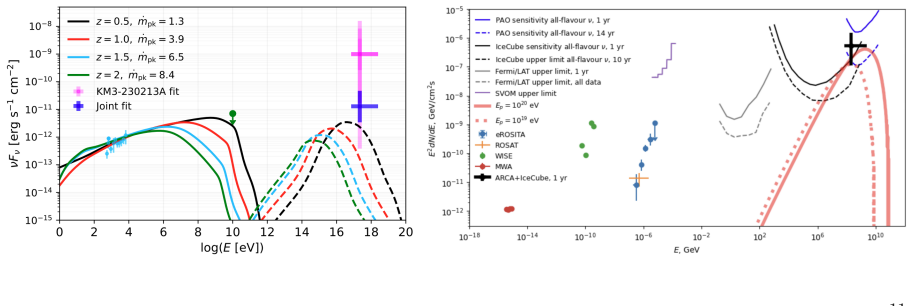
The KM3-230213A neutrino is the first astrophysical event observed above 100 PeV, standing in tension with limits from IceCube and the Pierre Auger Observatory.
A machine-rendered reading of the paper's core claim, the machinery that carries it, and where it could break.
Core claim
The detection of KM3-230213A marks the first observation of an astrophysical neutrino with energy above 100 PeV. This opens a new window on the ultra-high energy universe but conflicts with existing limits set by IceCube and the Pierre Auger Observatories. The paper discusses possible scenarios for the origin of the event and presents recent work that uses the inferred diffuse ultra-high energy neutrino flux to constrain features of potential source populations.
What carries the argument
The KM3-230213A event together with the diffuse ultra-high energy neutrino flux it implies, which together act as a new constraint on the population of sources capable of accelerating particles to extreme energies.
If this is right
- New source classes or acceleration mechanisms beyond those currently modeled will be needed if the event energy is confirmed.
- The observed tension with IceCube and Auger limits implies either a statistical fluctuation, a different source population, or the need to revise current flux models.
- The diffuse flux measurement can already be combined with other data to tighten limits on the density and luminosity of ultra-high energy neutrino sources.
- Additional events above 100 PeV will be required to distinguish among the proposed origin scenarios.
Where Pith is reading between the lines
- A harder spectrum at the highest energies than previously assumed may be required to accommodate this single high-energy detection.
- Targeted multi-messenger searches for gamma-ray or cosmic-ray counterparts to KM3-230213A could identify the specific source.
- Improved energy reconstruction in neutrino telescopes will be essential to confirm the energies of future candidate events.
Load-bearing premise
The event KM3-230213A is a genuine astrophysical neutrino rather than a background fluctuation or reconstruction artifact, and the inferred diffuse flux accurately represents the underlying source population.
What would settle it
An independent reanalysis of the KM3-230213A data that concludes the event is consistent with background or a misreconstructed lower-energy interaction would falsify the central claim.
Figures

read the original abstract
The recent detection of the ultra-high energy neutrino KM3-230213A by KM3NeT/ARCA marks the first observation of an astrophysical neutrino with energy above 100 PeV, opening a new window to the ultra-high energy Universe. In this contribution, the current global ultra-high energy neutrino landscape in light of this event is reviewed, including tension of this observation with existing limits set by the IceCube and the Pierre Auger Observatories. Different scenarios are discussed to explain its origin. Recent efforts to constrain features of potential source populations using the inferred diffuse ultra-high energy neutrino flux are also presented.
Editorial analysis
A structured set of objections, weighed in public.
Referee Report
Summary. The manuscript reviews the recent detection of the ultra-high energy neutrino KM3-230213A by KM3NeT/ARCA, presented as the first astrophysical neutrino above 100 PeV. It surveys the global UHE neutrino landscape, highlights tensions with IceCube and Pierre Auger Observatory limits, explores possible astrophysical origins for the event, and discusses efforts to constrain features of source populations using the inferred diffuse flux.
Significance. If the single-event flux inference holds and the event is representative, the work usefully synthesizes multi-experiment data and identifies tensions that could guide future UHE neutrino searches. The timely review of source scenarios adds context for the community, but the overall significance is limited by the absence of quantitative details on how a single event translates into population-level constraints.
major comments (1)
- Abstract: The claim that the detection enables constraints on source population features via the inferred diffuse flux is load-bearing for the paper's discussion section, yet the abstract (and by extension the manuscript) supplies no explicit formula, exposure calculation, assumed spectral index, effective area above 100 PeV, or systematic error budget for the flux estimate. This leaves the representativeness assumption untested and weakens the subsequent tension and population analyses.
minor comments (2)
- The manuscript would benefit from a short methods subsection or appendix that reproduces the flux inference step-by-step (including Poisson statistics and detector response) so readers can assess robustness without external references.
- Clarify the exact energy threshold and reconstruction uncertainty for KM3-230213A when comparing to IceCube and Auger limits to avoid ambiguity in the tension discussion.
Simulated Author's Rebuttal
We thank the referee for their constructive feedback and recommendation for major revision. We address the single major comment below and have revised the manuscript to incorporate additional quantitative details supporting the flux inference and population analyses.
read point-by-point responses
-
Referee: Abstract: The claim that the detection enables constraints on source population features via the inferred diffuse flux is load-bearing for the paper's discussion section, yet the abstract (and by extension the manuscript) supplies no explicit formula, exposure calculation, assumed spectral index, effective area above 100 PeV, or systematic error budget for the flux estimate. This leaves the representativeness assumption untested and weakens the subsequent tension and population analyses.
Authors: We agree that the current manuscript, as a concise review contribution, does not explicitly reproduce the technical details of the single-event flux inference (which are referenced to the primary KM3NeT discovery paper). To strengthen the load-bearing claim and better support the tension and population discussions, we will add a new paragraph in the revised main text that outlines the key elements of the flux estimate. This will include the assumed spectral index, a summary of the relevant exposure and effective area above 100 PeV, and a brief accounting of systematic uncertainties. The abstract will also be updated to more accurately preview these additions. These changes will make the representativeness assumption more transparent without altering the paper's overall scope or length. revision: yes
Circularity Check
No circularity: observational report with no derivation chain
full rationale
The manuscript reports the KM3-230213A detection, reviews the UHE neutrino landscape, notes tensions with IceCube/Auger limits, and discusses source scenarios using the stated inferred flux. No equations, fitted parameters, predictions, or self-citations are presented that reduce by construction to the paper's own inputs. The flux inference is asserted without an explicit formula or self-referential definition inside the text, and external benchmarks are invoked independently. This is self-contained observational reporting with no load-bearing circular steps.
Axiom & Free-Parameter Ledger
Reference graph
Works this paper leans on
-
[1]
M. G. Aartsenet al.,Science361, 6398 (2018)
work page 2018
- [2]
- [3]
- [4]
- [5]
- [6]
-
[7]
Adrianiet al., accepted for publication in JCAP,arXiv:2502.08387(2025)
O. Adrianiet al., accepted for publication in JCAP,arXiv:2502.08387(2025)
-
[8]
O. Adrianiet al., submitted to Astronomical Journal,arXiv:2502.08484(2025)
-
[9]
G. F. de Clairfontaine, M. Perucho and J. M. Mart´ ı,Monthly Notices of the Royal Astronomical Society544, 4, 4217-4225 (2025)
work page 2025
-
[10]
P. Kivokurtseva and S. Troitsky,preprint arXiv:2509.10352(2025)
- [11]
-
[12]
A. Neronov, F. Oikonomou and D. Semikoz,preprint arXiv:2502.12986(2025)
- [13]
-
[14]
Cermenatiet al.,preprint arXiv:2507.11993(2025)
A. Cermenatiet al.,preprint arXiv:2507.11993(2025)
- [15]
- [16]
-
[17]
M. Mukhopadhyay and S. S. Kimura,preprint arXiv:2601.22266(2026)
- [18]
-
[19]
Adrianiet al., accepted for publication in Astronomy and Astrophysics, arXiv:2509.14895(2025)
O. Adrianiet al., accepted for publication in Astronomy and Astrophysics, arXiv:2509.14895(2025)
discussion (0)
Sign in with ORCID, Apple, or X to comment. Anyone can read and Pith papers without signing in.