Recognition: 2 theorem links
· Lean TheoremRoot bounds of vertical systems using tropical geometry
Pith reviewed 2026-05-11 01:58 UTC · model grok-4.3
The pith
The generic number of complex zeros of an augmented vertically parametrized system equals the tropical intersection number of a tropical linear space and a classical linear space.
A machine-rendered reading of the paper's core claim, the machinery that carries it, and where it could break.
Core claim
We prove that the generic number of complex zeros of an augmented vertically parametrized system is the tropical intersection number of a tropical linear space and a classical linear space. In the special case when the matroid of the tropical linear space is cotransversal, we express this number as a mixed volume. We also obtain bounds on the maximal number of positive zeros, which is often the significant number in applications, from the number of intersections between positive tropicalizations, and when the positive zeros have toric structure we provide upper bounds that are simpler and in some cases smaller than the generic root count.
What carries the argument
The tropical intersection number between the tropical linear space induced by the vertical parametrization (with its matroid) and the classical linear space coming from the linear augmentation.
If this is right
- Exact generic complex root counts for systems describing optimization critical points and chemical reaction network steady states.
- Mixed volume formulas for the root count whenever the matroid is cotransversal.
- Lower bounds on the number of positive real solutions obtained from intersections of positive tropicalizations.
- Simpler upper bounds on positive solutions when those solutions have toric structure, sometimes tighter than the generic count.
- Practical algorithms, implemented in Julia, that compute these root bounds for applications.
Where Pith is reading between the lines
- The same tropical intersection technique could be tested on non-vertical parametrizations to see whether similar exact counts emerge.
- For large chemical networks the positive-root bounds may allow faster stability checks than full complex root enumeration.
- Additional matroid properties beyond cotransversality might yield further explicit formulas for the intersection number.
- Direct comparison of the tropical count against mixed-volume software on random vertical instances would confirm numerical agreement in low dimensions.
Load-bearing premise
The vertically parametrized system is generic and the linear augmentation preserves the tropical linear space structure that encodes the root count.
What would settle it
For a concrete generic augmented vertical system, compute the actual number of complex solutions by Gröbner basis or numerical homotopy continuation and check whether it equals the tropical intersection number; any mismatch disproves the claim.
Figures


read the original abstract
Sparse polynomial systems with vertical coefficient dependencies arise naturally when describing the critical points of optimization problems and, when augmented with linear forms, the steady states of chemical reaction networks. Moreover, any polynomial system is the specialization of such a parametrized system. We prove that the generic number of complex zeros of an augmented vertically parametrized system is the tropical intersection number of a tropical linear space and a classical linear space. In the special case when the matroid of the tropical linear space is cotransversal, we express this number as a mixed volume. We also obtain bounds on the maximal number of positive zeros, which is often the significant number in applications. We derive lower bounds from the number of intersections between positive tropicalizations, and when the positive zeros have toric structure, we provide upper bounds that are simpler and in some cases smaller than the generic root count. The resulting algorithms are implemented in Julia.
Editorial analysis
A structured set of objections, weighed in public.
Referee Report
Summary. The manuscript proves that the generic number of complex zeros of an augmented vertically parametrized polynomial system equals the tropical intersection number of a tropical linear space and a classical linear space. For cotransversal matroids this count reduces to a mixed volume. The paper also derives lower bounds on positive real zeros from positive tropical intersections and upper bounds when the positive zeros admit toric structure, and supplies a Julia implementation of the algorithms.
Significance. If the proof is correct, the result supplies a direct tropical-geometric formula for root counts in vertically parametrized systems that arise in optimization and chemical reaction networks, together with a practical reduction to mixed volume in a natural special case. The positive-root bounds address a quantity of direct applied interest, and the open Julia code supports reproducibility and computational use.
minor comments (3)
- [Theorem 3.1] The genericity hypotheses on the vertical coefficients and the augmentation forms are stated in the main theorem but would benefit from an explicit checklist or a short table summarizing which parameters must be generic for the equality to hold.
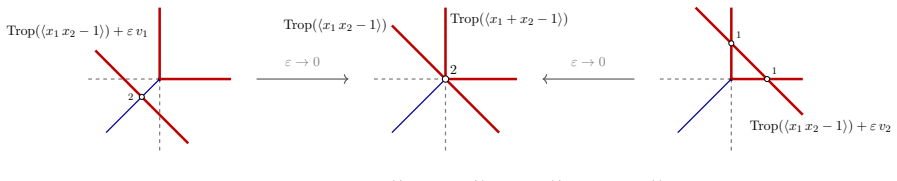
- [Figure 2] Figure 2 (tropical linear space example) would be clearer if the classical linear space were drawn in the same ambient space with the intersection points labeled.
- [§4.2] The proof of the mixed-volume reduction in the cotransversal case invokes a standard matroid identity; a one-sentence pointer to the precise reference or lemma number would help readers trace the step.
Simulated Author's Rebuttal
We thank the referee for their positive summary of the manuscript, the assessment of its significance for applications in optimization and chemical reaction networks, and the recommendation of minor revision. No major comments were raised in the report.
Circularity Check
No significant circularity; central equality follows from established tropical intersection theory
full rationale
The paper proves that the generic number of complex zeros of an augmented vertically parametrized system equals the tropical intersection number of a tropical linear space and a classical linear space, with a reduction to mixed volume in the cotransversal matroid case. This derivation relies on standard results in tropical geometry and matroid theory rather than any self-definitional loop, fitted parameter renamed as prediction, or load-bearing self-citation chain. No equation or step reduces the claimed count to its own inputs by construction; the result is presented as a theorem proved from prior independent foundations, with algorithms implemented separately in Julia. The structure is self-contained against external algebraic and tropical benchmarks.
Axiom & Free-Parameter Ledger
axioms (2)
- standard math Tropical intersection theory for linear spaces and their matroids
- standard math Cotransversal matroids admit a mixed-volume expression for their intersection numbers
Lean theorems connected to this paper
-
IndisputableMonolith/Foundation/AlexanderDuality.leanalexander_duality_circle_linking unclearWe prove that the generic number of complex zeros of an augmented vertically parametrized system is the tropical intersection number of a tropical linear space and a classical linear space.
Reference graph
Works this paper leans on
-
[1]
[AGS20] X. Allamigeon, S. Gaubert, and M. Skomra. Tropical spectrahedra.Discrete Comput. Geom.63.3 (2020). [AKW06] F. Ardila, C. Klivans, and L. Williams. The positive Bergman complex of an oriented matroid. Eur. J. Comb.27.4 (2006). [Ale13] D. Alessandrini. Logarithmic limit sets of real semi-algebraic sets.Adv. Geom.13.1 (2013). [Ard07] F. Ardila. Trans...
work page 2020
-
[2]
[BBPMZ24] V. Borovik, P. Breiding, J. del Pino, M. Micha lek, and O. Zilberberg. Khovanskii bases for semimixed systems of polynomial equations—approximating stationary nonlinear Newtonian dynamics.J. Math. Pures Appl. (9)182 (2024). [BCS22] L. Brustenga i Moncus´ ı, G. Craciun, and M.-S. Sorea. Disguised toric dynamical systems.J. Pure Appl. Algebra226.8...
work page 2024
-
[3]
Preprint:arXiv:2208.04590v2. [BJS+07] T. Bogart, A. N. Jensen, D. Speyer, B. Sturmfels, and R. R. Thomas. Computing tropical varieties. Journal of Symbolic Computation42.1-2 (2007). [BKM11] J. E. Bonin, J. P. S. Kung, and A. de Mier. Characterizations of transversal and fundamental transversal matroids.Electron. J. Comb.18.1 (2011). [BLMM17] L. Bossinger,...
-
[4]
[BRT23] P. Breiding, K. Rose, and S. Timme. Certifying zeros of polynomial systems using interval arithmetic.ACM Trans. Math. Softw.49.1 (2023). [BSW22] P. Breiding, F. Sottile, and J. Woodcock. Euclidean distance degree and mixed volume.Found. Comput. Math.22.6 (2022). [CDSS09] G. Craciun, A. Dickenstein, A. Shiu, and B. Sturmfels. Toric dynamical system...
work page 2023
- [5]
-
[6]
Polymake: a framework for analyzing convex polytopes
Preprint:arXiv:2512.07373. [FH25] E. Feliu and O. Henriksson. Toric invariance of vertically parametrized systems (2025). Preprint: arXiv:2411.15134v3. [FHC14] D. Flockerzi, K. Holstein, and C. Conradi. N-site phosphorylation systems with 2N-1 steady states.Bull. Math. Biol.76.8 (2014). [FHP25] E. Feliu, O. Henriksson, and B. Pascual-Escudero. Generic con...
-
[7]
28 [GRPD19] M. Giaroli, R. Rischter, M. P´ erez Mill´ an, and A. Dickenstein. Parameter regions that give rise to 2[n/2] +1 positive steady states in the n-site phosphorylation system.Math. Biosci. Eng.16.6 (2019). [GRZ22] P. G¨ orlach, Y. Ren, and L. Zhang. Computing zero-dimensional tropical varieties via projections. Comput. Complexity31.1 (2022). [HHR...
work page 2019
-
[8]
Tropical computations inpolymake
Preprint:arXiv:2409.13288. [HJ17] S. Hampe and M. Joswig. “Tropical computations inpolymake”.Algorithmic and experimental methods in algebra, geometry, and number theory. Cham: Springer,
-
[9]
Generic root counts of tropically transverse systems: an invitation to tropical geometry inOSCAR
[HJ72] F. Horn and R. Jackson. General mass action kinetics.Arch. Rational. Mech. Anal.47 (1972). [HJS19] S. Hampe, M. Joswig, and B. Schr¨ oter. Algorithms for tight spans and tropical linear spaces.J. Symbolic Comput.91 (2019). [HR25a] P. A. Helminck and Y. Ren. Generic root counts and flatness in tropical geometry.J. Lond. Math. Soc. (2)111.5 (2025). [...
work page 1972
-
[10]
[HS95] B. Huber and B. Sturmfels. A polyhedral method for solving sparse polynomial systems.Math. Comput.64.212 (1995). [Jen16] A. N. Jensen.Tropical Homotopy Continuation
work page 1995
- [11]
-
[12]
Preprint:arXiv:2308.07765v2. [Lom+23] T. E. Loman, Y. Ma, V. Ilin, S. Gowda, N. Korsbo, N. Yewale, C. Rackauckas, and S. A. Isaacson. Catalyst: Fast and flexible modeling of reaction networks.PLoS Comput. Biol.19.10 (2023). [LY19] A. Leykin and J. Yu. Beyond polyhedral homotopies.Journal of Symbolic Computation91 (2019). MEGA 2017, Effective Methods in Al...
-
[13]
[MFRCSD15] S. M¨ uller, E. Feliu, G. Regensburger, C. Conradi, A. Shiu, and A. Dickenstein. Sign conditions for injectivity of generalized polynomial maps with applications to chemical reaction networks and real algebraic geometry.Found. Comput. Math.16.1 (2015). [MS15] D. Maclagan and B. Sturmfels.Introduction to tropical geometry. Vol
work page 2015
-
[14]
[OP13] B. Osserman and S. Payne. Lifting tropical intersections.Doc. Math.18 (2013). [Oxl06] J. G. Oxley.Matroid Theory. Oxford Graduate Texts in Mathematics. Oxford University Press, Inc.,
work page 2013
-
[15]
[PDSC12] M. P´ erez Mill´ an, A. Dickenstein, A. Shiu, and C. Conradi. Chemical reaction systems with toric steady states.Bull. Math. Biol.74 (2012). [Rin13] F. Rinc´ on. Computing tropical linear spaces.J. Symb. Comput.51 (2013). [RT26] K. Rose and M. L. Telek. Computing positive tropical varieties and lower bounds on the number of positive roots.J. Symb...
work page 2012
-
[16]
[WS08] L. Wang and E. D. Sontag. On the number of steady states in a multiple futile cycle.J. Math. Biol.57 (2008). 29 Authors’ addresses: Elisenda Feliu, University of Copenhagenefeliu@math.ku.dk Paul Alexander Helminck, IMPAN Warsawphelminck@impan.pl Oskar Henriksson, CSBD and MPI-CBG Dresdenoskar.henriksson@mpi-cbg.de Yue Ren, Durham Universityyue.ren2...
work page 2008
discussion (0)
Sign in with ORCID, Apple, or X to comment. Anyone can read and Pith papers without signing in.