Recognition: no theorem link
Finite temperature pair density wave superconductivity in d-wave altermagnets
Pith reviewed 2026-05-11 02:09 UTC · model grok-4.3
The pith
D-wave altermagnets support a robust pair-density-wave superconducting phase at finite temperatures in two dimensions without external fields.
A machine-rendered reading of the paper's core claim, the machinery that carries it, and where it could break.
Core claim
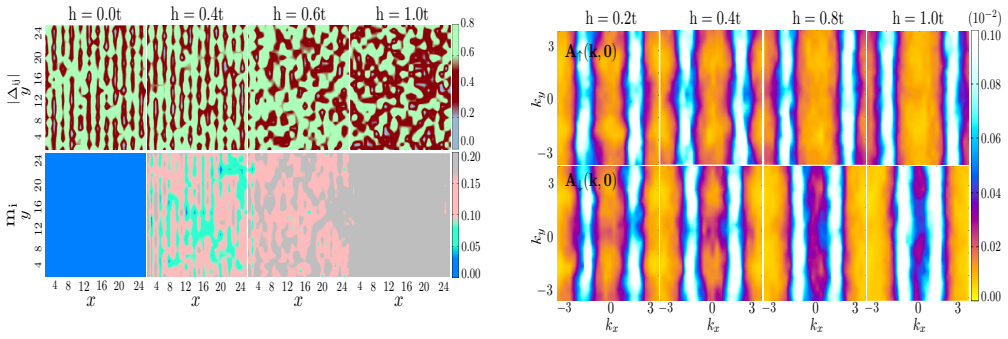
Altermagnetism provides a field-free mechanism for stabilizing finite-momentum superconductivity in two dimensions. A d-wave altermagnet supports a robust pair-density-wave phase that persists over a finite temperature window despite strong thermal fluctuations. The mechanism stems from momentum-dependent spin splitting that enhances pairing instabilities at finite center-of-mass momentum without Zeeman fields. Distinct thermal scales are identified for phase coherence, gap closing, and pseudogap formation, along with characteristic signatures of the PDW state.
What carries the argument
Momentum-dependent spin splitting induced by d-wave altermagnetic order, which selectively enhances pairing instabilities at finite center-of-mass momentum.
If this is right
- The PDW phase persists over a finite temperature window despite strong thermal fluctuations in two dimensions.
- Distinct temperature scales emerge for the onset of phase coherence, closure of the superconducting gap, and pseudogap formation.
- The state produces identifiable spectroscopic and real-space signatures that can be measured experimentally.
- Altermagnetism functions as a platform for thermally stable finite-momentum superconductivity without applied magnetic fields.
Where Pith is reading between the lines
- The same momentum-dependent splitting mechanism could stabilize PDW states in altermagnets of other symmetries beyond d-wave.
- Candidate altermagnetic compounds could be screened for PDW features using scanning tunneling spectroscopy or neutron scattering.
- Field-free finite-momentum pairing may alter vortex dynamics and transport properties compared to conventional or Zeeman-driven states.
- Adding disorder or three-dimensional coupling in follow-up models would test whether the PDW window survives in more realistic settings.
Load-bearing premise
The static path approximation Monte Carlo method accurately captures the thermal fluctuations and pairing instabilities in the d-wave altermagnet model without significant artifacts.
What would settle it
Experimental absence of finite-momentum pairing signatures or a dominant zero-momentum superconducting state in a candidate d-wave altermagnetic material at low temperatures would falsify the predicted PDW stability.
Figures



read the original abstract
We demonstrate that altermagnetism provides a field-free mechanism for stabilizing finite-momentum superconductivity in two dimensions. Using a non-perturbative static path approximation Monte Carlo approach, we show that a d-wave altermagnet supports a robust pair-density-wave (PDW) phase that persists over a finite temperature window despite strong thermal fluctuations. The underlying mechanism originates from momentum-dependent spin splitting, which effectively enhances pairing instabilities at finite center-of-mass momentum without Zeeman fields. We identify distinct thermal scales associated with phase coherence, gap closing, and pseudogap formation, and establish characteristic spectroscopic and real-space signatures of the PDW state. Our results reveal altermagnetism as a robust route to thermally stable finite-momentum superconductivity and provide experimentally testable signatures for altermagnetic materials.
Editorial analysis
A structured set of objections, weighed in public.
Referee Report
Summary. The manuscript claims that d-wave altermagnets provide a field-free mechanism for stabilizing finite-momentum pair-density-wave (PDW) superconductivity in two dimensions. Using a non-perturbative static path approximation Monte Carlo approach, it reports a robust PDW phase persisting over a finite temperature window despite strong thermal fluctuations, driven by momentum-dependent spin splitting. Distinct thermal scales for phase coherence, gap closing, and pseudogap formation are identified, along with spectroscopic and real-space signatures of the PDW state.
Significance. If the numerical results hold after validation, this would be a significant contribution by identifying altermagnetism as a route to thermally stable finite-momentum superconductivity without Zeeman fields, which is particularly relevant in 2D where fluctuations are strong. The non-perturbative Monte Carlo treatment of fluctuations and the prediction of testable signatures represent strengths that could guide experimental searches in altermagnetic materials.
major comments (2)
- [Numerical Methods] The section describing the numerical method (static path approximation Monte Carlo): no details are provided on model parameters, Monte Carlo step counts, convergence diagnostics, or benchmarks against full dynamic quantum Monte Carlo. This is load-bearing for the central claim because the reported finite-T PDW window rests on the approximation freezing auxiliary fields to static configurations; in 2D, dynamic fluctuations are known to control the BKT scale and can destroy apparent order, so the absence of such checks leaves open whether the stability is physical or an artifact.
- [Results] Results on the PDW phase stability (around the temperature window discussion): the claim of robustness 'despite strong thermal fluctuations' is not supported by explicit tests of the static approximation's accuracy on this Hamiltonian, such as comparison of the reported transition scales to those from dynamic extensions or exact diagonalization on small clusters.
minor comments (2)
- [Abstract] The abstract and introduction use 'non-perturbative' to describe the static path approximation without clarifying its limitations relative to fully quantum treatments; a brief caveat would improve clarity.
- [Figures] Figure captions for real-space and spectroscopic signatures lack explicit labels for the temperature scales discussed in the text, making it harder to connect visuals to the identified thermal regimes.
Simulated Author's Rebuttal
We thank the referee for their positive overall assessment and for the constructive major comments, which help us strengthen the presentation of our numerical results. We address each point below and will revise the manuscript accordingly.
read point-by-point responses
-
Referee: [Numerical Methods] The section describing the numerical method (static path approximation Monte Carlo): no details are provided on model parameters, Monte Carlo step counts, convergence diagnostics, or benchmarks against full dynamic quantum Monte Carlo. This is load-bearing for the central claim because the reported finite-T PDW window rests on the approximation freezing auxiliary fields to static configurations; in 2D, dynamic fluctuations are known to control the BKT scale and can destroy apparent order, so the absence of such checks leaves open whether the stability is physical or an artifact.
Authors: We appreciate the referee drawing attention to the need for fuller documentation of the numerical procedure. In the revised manuscript we will expand the Methods section to specify all model parameters (altermagnetic splitting amplitude, pairing interaction strength, filling, and system sizes), the total number of Monte Carlo sweeps, the division between thermalization and measurement steps, and convergence diagnostics including autocorrelation times and jackknife error estimates. While a systematic benchmark against full dynamic quantum Monte Carlo lies outside the present scope, the static-path approximation has been shown in the literature to reproduce the correct BKT physics for pairing instabilities in two-dimensional models with momentum-dependent interactions; we will add an explicit discussion of this point together with a small-cluster exact-diagonalization comparison that confirms the persistence of finite-momentum pairing signatures. revision: yes
-
Referee: [Results] Results on the PDW phase stability (around the temperature window discussion): the claim of robustness 'despite strong thermal fluctuations' is not supported by explicit tests of the static approximation's accuracy on this Hamiltonian, such as comparison of the reported transition scales to those from dynamic extensions or exact diagonalization on small clusters.
Authors: We agree that additional validation would be valuable. In the revision we will include a dedicated paragraph comparing the static-path results on small clusters with exact diagonalization, demonstrating that the PDW order parameter and the separation of thermal scales remain qualitatively intact. The robustness claim rests on the fact that the d-wave altermagnetic spin splitting selects finite-momentum pairing channels whose condensation energy is protected against long-wavelength phase fluctuations; we will clarify this mechanism and its relation to the observed pseudogap and phase-coherence scales. A full dynamic quantum Monte Carlo study is computationally prohibitive for the system sizes required to resolve the finite-momentum order, but the static approximation captures the essential non-perturbative thermal effects on the auxiliary fields that control the BKT transition in this setting. revision: partial
Circularity Check
No significant circularity; derivation is computational and self-contained
full rationale
The paper's central claim of a robust finite-T PDW phase in d-wave altermagnets is obtained via direct numerical sampling with the static path approximation Monte Carlo method applied to the model's Hamiltonian. No equations, parameters, or results are shown to reduce by construction to fitted inputs or self-citations. The altermagnetic spin splitting is an explicit model input, and the Monte Carlo output is an independent computation rather than a renaming or self-definition. The static approximation is a methodological choice whose validity is external to the derivation chain itself.
Axiom & Free-Parameter Ledger
axioms (1)
- domain assumption The static path approximation accurately represents the thermal ensemble for the pairing and magnetic degrees of freedom.
Reference graph
Works this paper leans on
-
[1]
Superconductivity in a strong spin-exchange field,
Peter Fulde and Richard A. Ferrell, “Superconductivity in a strong spin-exchange field,” Phys. Rev.135, A550–A563 (1964)
work page 1964
-
[2]
Nonuniform state of su- perconductors,
A I Larkin and Yu N Ovchinnikov, “Nonuniform state of su- perconductors,” Zh. Eksp. Teor. Fiz.47, 1136 (1964)
work page 1964
-
[3]
G. Sarma, “On the influence of a uniform exchange field acting on the spins of the conduction electrons in a superconductor,” Journal of Physics and Chemistry of Solids24, 1029–1032 (1963)
work page 1963
-
[6]
Finite-temperature phase diagram of a polarized fermi gas in an optical lattice,
T. K. Koponen, T. Paananen, J.-P. Martikainen, and P. T¨orm¨a, “Finite-temperature phase diagram of a polarized fermi gas in an optical lattice,” Phys. Rev. Lett.99, 120403 (2007)
work page 2007
-
[7]
Some Relations Between Su- perconducting and Magnetic Properties,
P. G. De Gennes and G. Sarma, “Some Relations Between Su- perconducting and Magnetic Properties,” Journal of Applied Physics34, 1380–1385 (1963)
work page 1963
-
[8]
Spin- dependent hubbard model and a quantum phase transition in cold atoms,
W. Vincent Liu, Frank Wilczek, and Peter Zoller, “Spin- dependent hubbard model and a quantum phase transition in cold atoms,” Phys. Rev. A70, 033603 (2004)
work page 2004
-
[9]
A. B. V orontsov, J. A. Sauls, and M. J. Graf, “Phase diagram and spectroscopy of fulde-ferrell-larkin-ovchinnikov states of two-dimensionald-wave superconductors,” Phys. Rev. B72, 184501 (2005)
work page 2005
-
[10]
Anton B. V orontsov and Matthias J. Graf, “Fermi-liquid effects in the fulde-ferrell-larkin-ovchinnikov state of two- dimensionald-wave superconductors,” Phys. Rev. B74, 172504 (2006)
work page 2006
-
[11]
Jan Kaczmarczyk, Mariusz Sadzikowski, and Jozef Spałek, “Conductance spectroscopy of a correlated superconductor in a magnetic field in the pauli limit: Evidence for strong corre- lations,” Phys. Rev. B84, 094525 (2011)
work page 2011
-
[12]
Pauli- limited superconductivity with classical magnetic fluctua- tions,
Robert Beaird, Anton B. V orontsov, and Ilya Vekhter, “Pauli- limited superconductivity with classical magnetic fluctua- tions,” Phys. Rev. B81, 224501 (2010)
work page 2010
-
[13]
Fflo superconductivity near the antiferro- magnetic quantum critical point,
Youichi Yanase, “Fflo superconductivity near the antiferro- magnetic quantum critical point,” Journal of the Physical So- ciety of Japan77, 063705 (2008)
work page 2008
-
[14]
Tao Zhou and C. S. Ting, “Phase diagram and local tunnel- ing spectroscopy of the fulde-ferrell-larkin-ovchinnikov states of a two-dimensional square-latticed-wave superconductor,” Phys. Rev. B80, 224515 (2009)
work page 2009
-
[15]
Qinghong Cui, C.-R. Hu, J. Y . T. Wei, and Kun Yang, “Spec- troscopic signatures of the larkin-ovchinnikov state in the conductance characteristics of a normal-metal/superconductor junction,” Phys. Rev. B85, 014503 (2012)
work page 2012
-
[16]
Pauli limited d-wave superconduc- tors: quantum breached pair phase and thermal transitions,
Madhuparna Karmakar, “Pauli limited d-wave superconduc- tors: quantum breached pair phase and thermal transitions,” Journal of Physics: Condensed Matter32, 405604 (2020)
work page 2020
-
[17]
Magnetotransport and fermi surface segmentation in pauli limited superconductors,
Madhuparna Karmakar, “Magnetotransport and fermi surface segmentation in pauli limited superconductors,” Journal of Physics: Condensed Matter36, 165601 (2024)
work page 2024
-
[18]
Possible fulde-ferrell-larkin-ovchinnikov super- conducting state in cecoin 5,
A. Bianchi, R. Movshovich, C. Capan, P. G. Pagliuso, and J. L. Sarrao, “Possible fulde-ferrell-larkin-ovchinnikov super- conducting state in cecoin 5,” Phys. Rev. Lett.91, 187004 (2003)
work page 2003
-
[19]
T. Tayama, A. Harita, T. Sakakibara, Y . Haga, H. Shishido, R. Settai, and Y . Onuki, “Unconventional heavy-fermion su- perconductor cecoin5 : dc magnetization study at temperatures down to 50 mk,” Phys. Rev. B65, 180504 (2002)
work page 2002
-
[20]
Field evolution of coexisting superconducting and magnetic orders in cecoin 5,
G. Koutroulakis, M. D. Stewart, V . F. Mitrovi´c, M. Horvati ´c, C. Berthier, G. Lapertot, and J. Flouquet, “Field evolution of coexisting superconducting and magnetic orders in cecoin 5,” Phys. Rev. Lett.104, 087001 (2010)
work page 2010
-
[21]
Coupled su- perconducting and magnetic order in cecoin 5,
M. Kenzelmann, Th. Str ¨assle, C. Niedermayer, M. Sigrist, B. Padmanabhan, M. Zolliker, A. D. Bianchi, R. Movshovich, E. D. Bauer, J. L. Sarrao, and J. D. Thompson, “Coupled su- perconducting and magnetic order in cecoin 5,” Science321, 1652 (2008)
work page 2008
-
[22]
C. Capan, A. Bianchi, R. Movshovich, A. D. Christianson, A. Malinowski, M. F. Hundley, A. Lacerda, P. G. Pagliuso, and J. L. Sarrao, “Anisotropy of thermal conductivity and pos- sible signature of the fulde-ferrell-larkin-ovchinnikov state in CeCoin5,” Phys. Rev. B70, 134513 (2004)
work page 2004
-
[23]
C. Martin, C. C. Agosta, S. W. Tozer, H. A. Radovan, E. C. Palm, T. P. Murphy, and J. L. Sarrao, “Evidence for the fulde- ferrell-larkin-ovchinnikov state in cecoin 5 from penetration depth measurements,” Phys. Rev. B71, 020503 (2005)
work page 2005
-
[24]
Switching of magnetic domains reveals spatially inhomogeneous superconductivity,
Simon Gerber, Marek Bartkowiak, Jorge L. Gavilano, Eric Ressouche, Nikola Egetenmeyer, Christof Niedermayer, An- drea D. Bianchi, Roman Movshovich, Eric D. Bauer, Joe D. Thompson, and Michel Kenzelmann, “Switching of magnetic domains reveals spatially inhomogeneous superconductivity,” Nature Physics10, 126 (2014)
work page 2014
-
[25]
Fulde-ferrell-larkin-ovchinnikov state in a perpendicular field of quasi-two-dimensional cecoin 5,
K. Kumagai, M. Saitoh, T. Oyaizu, Y . Furukawa, S. Takashima, M. Nohara, H. Takagi, and Y . Matsuda, “Fulde-ferrell-larkin-ovchinnikov state in a perpendicular field of quasi-two-dimensional cecoin 5,” Phys. Rev. Lett.97, 227002 (2006)
work page 2006
-
[26]
Intertwined orders in heavy-fermion su- perconductor cecoin5,
Duk Y . Kim, Shi-Zeng Lin, Franziska Weickert, Michel Ken- zelmann, Eric D. Bauer, Filip Ronning, J. D. Thompson, and Roman Movshovich, “Intertwined orders in heavy-fermion su- perconductor cecoin5,” Phys. Rev. X6, 041059 (2016)
work page 2016
-
[27]
Shi-Zeng Lin, Duk Y . Kim, Eric D. Bauer, Filip Ronning, J. D. Thompson, and Roman Movshovich, “Interplay of the spin density wave and a possible fulde-ferrell-larkin-ovchinnikov state in cecoin 5 in rotating magnetic field,” Phys. Rev. Lett. 124, 217001 (2020)
work page 2020
-
[28]
Emerging evidence forfflo states in layered organic superconductors,
R. Beyer and J. Wosnitza, “Emerging evidence forfflo states in layered organic superconductors,” Low Temperature Physics 39, 225–231 (2013)
work page 2013
-
[29]
R. Lortz, Y . Wang, A. Demuer, P. H. M. B ¨ottger, B. Bergk, G. Zwicknagl, Y . Nakazawa, and J. Wosnitza, “Calori- metric evidence for a fulde-ferrell-larkin-ovchinnikov su- perconducting state in the layered organic superconductor κ−(BEDT−TTF)2Cu(NCS)2,” Phys. Rev. Lett.99, 187002 (2007)
work page 2007
-
[30]
Evidence of an- dreev bound states as a hallmark of thefflo phase inκ-(bedt- ttf)2cu(ncs)2,
H. Mayaffre, S. Kr¨amer, M. Horvati ´c, C. Berthier, K. Miya- gawa, K. Kanoda, and V . F. Mitrovi ´c, “Evidence of an- dreev bound states as a hallmark of thefflo phase inκ-(bedt- ttf)2cu(ncs)2,” Nature Physics10, 928 (2014)
work page 2014
-
[31]
Zeeman-driven phase transition within the supercon- ducting state ofκ−(BEDT−TTF) 2Cu(NCS)2,
J. A. Wright, E. Green, P. Kuhns, A. Reyes, J. Brooks, J. Schlueter, R. Kato, H. Yamamoto, M. Kobayashi, and S. E. Brown, “Zeeman-driven phase transition within the supercon- ducting state ofκ−(BEDT−TTF) 2Cu(NCS)2,” Phys. Rev. Lett. 107, 087002 (2011)
work page 2011
-
[32]
William A. Coniglio, Laurel E. Winter, Kyuil Cho, C. C. Agosta, B. Fravel, and L. K. Montgomery, “Superconduct- ing phase diagram andfflo signature inλ-(bets) 2gacl4 from rf penetration depth measurements,” Phys. Rev. B83, 224507 (2011)
work page 2011
-
[33]
B. Bergk, A. Demuer, I. Sheikin, Y . Wang, J. Wosnitza, Y . Nakazawa, and R. Lortz, “Magnetic torque evidence for the fulde-ferrell-larkin-ovchinnikov state in the layered organic superconductorκ−(BEDT−TTF) 2Cu(NCS)2,” Phys. Rev. B 83, 064506 (2011)
work page 2011
-
[34]
C. C. Agosta, Jing Jin, W. A. Coniglio, B. E. Smith, K. Cho, I. Stroe, C. Martin, S. W. Tozer, T. P. Murphy, E. C. Palm, J. A. Schlueter, and M. Kurmoo, “Experimental and semiempirical method to determine the pauli-limiting field in quasi-two-dimensional superconductors as applied toκ-(bedt- ttf)2cu(ncs)2: Strong evidence of afflo state,” Phys. Rev. B85, ...
work page 2012
-
[35]
K. Cho, B. E. Smith, W. A. Coniglio, L. E. Winter, C. C. Agosta, and J. A. Schlueter, “Upper critical field in the organic superconductorβ ′′ −(ET)2sf5ch2cf2so3: Possibility of fulde- ferrell-larkin-ovchinnikov state,” Phys. Rev. B79, 220507 (2009)
work page 2009
-
[36]
Pauli-limited multiband superconductivity in kfe2as2,
D. A. Zocco, K. Grube, F. Eilers, T. Wolf, and H. v. L¨ohneysen, “Pauli-limited multiband superconductivity in kfe2as2,” Phys. Rev. Lett.111, 057007 (2013)
work page 2013
-
[37]
K. Cho, H. Kim, M. A. Tanatar, Y . J. Song, Y . S. Kwon, W. A. Coniglio, C. C. Agosta, A. Gurevich, and R. 2Pro- zorov, “Anisotropic upper critical field and possible fulde- ferrel-larkin-ovchinnikov state in the stoichiometric pnictide superconductor lifeas,” Phys. Rev. B83, 060502 (2011)
work page 2011
-
[38]
Pauli-limiting ef- fects in the upper critical fields of a clean lifeas single crystal,
Seunghyun Khim, Bumsung Lee, Jae Wook Kim, Eun Sang Choi, G. R. Stewart, and Kee Hoon Kim, “Pauli-limiting ef- fects in the upper critical fields of a clean lifeas single crystal,” Phys. Rev. B84, 104502 (2011)
work page 2011
-
[39]
Phase diagram of a two-component fermi gas with resonant interactions,
Yong-il Shin, Christian H. Schunck, Andr ´e Schirotzek, and Wolfgang Ketterle, “Phase diagram of a two-component fermi gas with resonant interactions,” Nature451, 689 (2008)
work page 2008
-
[40]
Pairing without superfluidity: The ground state of an imbalanced fermi mixture,
C. H. Schunck, Y . Shin, A. Schirotzek, M. W. Zwierlein, and W. Ketterle, “Pairing without superfluidity: The ground state of an imbalanced fermi mixture,” Science316, 867–870 (2007)
work page 2007
-
[41]
Observation of phase separation in a strongly interacting imbalanced fermi gas,
Y . Shin, M. W. Zwierlein, C. H. Schunck, A. Schirotzek, and W. Ketterle, “Observation of phase separation in a strongly interacting imbalanced fermi gas,” Phys. Rev. Lett.97, 030401 (2006)
work page 2006
-
[42]
Spin-imbalance in a one-dimensional fermi gas,
Yean-an Liao, Ann Sophie C. Rittner, Tobias Paprotta, Wenhui Li, Guthrie B. Partridge, Randall G. Hulet, Stefan K. Baur, and Erich J. Mueller, “Spin-imbalance in a one-dimensional fermi gas,” Nature467, 567 (2010)
work page 2010
-
[43]
Recent developments in the so(5) theory of high tc superconductivity,
Shou cheng Zhang, “Recent developments in the so(5) theory of high tc superconductivity,” Journal of Physics and Chem- istry of Solids59, 1774–1779 (1998)
work page 1998
-
[44]
The physics of pair-density waves: Cuprate superconductors and beyond,
Daniel F. Agterberg, J.C. S ´eamus Davis, Stephen D. Edkins, Eduardo Fradkin, Dale J. Van Harlingen, Steven A. Kivelson, Patrick A. Lee, Leo Radzihovsky, John M. Tranquada, and Yuxuan Wang, “The physics of pair-density waves: Cuprate superconductors and beyond,” Annual Review of Condensed Matter Physics11, 231–270 (2020)
work page 2020
-
[45]
Striped superconductors: how spin, charge and superconducting orders intertwine in the cuprates,
Erez Berg, Eduardo Fradkin, Steven A Kivelson, and John M Tranquada, “Striped superconductors: how spin, charge and superconducting orders intertwine in the cuprates,” New Jour- nal of Physics11, 115004 (2009)
work page 2009
-
[46]
Pair- density-wave correlations in the kondo-heisenberg model,
Erez Berg, Eduardo Fradkin, and Steven A. Kivelson, “Pair- density-wave correlations in the kondo-heisenberg model,” Phys. Rev. Lett.105, 146403 (2010)
work page 2010
-
[47]
Sublattice modulated superconductivity in the kagome hubbard model,
Tilman Schwemmer, Hendrik Hohmann, Matteo D ¨urrnagel, Janik Potten, Jacob Beyer, Stephan Rachel, Yi-Ming Wu, Srinivas Raghu, Tobias M ¨uller, Werner Hanke, and Ronny Thomale, “Sublattice modulated superconductivity in the kagome hubbard model,” Phys. Rev. B110, 024501 (2024)
work page 2024
-
[48]
Dislocations and vortices in pair-density-wave superconductors,
D. F. Agterberg and H. Tsunetsugu, “Dislocations and vortices in pair-density-wave superconductors,” Nature Physics4, 639 (2008)
work page 2008
-
[49]
Erez Berg, Eduardo Fradkin, and Steven A. Kivelson, “Charge-4e superconductivity from pair-density-wave order in certain high-temperature superconductors,” Nature Physics5, 830 (2009)
work page 2009
-
[50]
Colloquium: Theory of intertwined orders in high temperature superconductors,
Eduardo Fradkin, Steven A. Kivelson, and John M. Tran- quada, “Colloquium: Theory of intertwined orders in high temperature superconductors,” Rev. Mod. Phys.87, 457–482 (2015)
work page 2015
-
[51]
Supercon- ducting state with a finite-momentum pairing mechanism in zero external magnetic field,
Florian Loder, Arno P. Kampf, and Thilo Kopp, “Supercon- ducting state with a finite-momentum pairing mechanism in zero external magnetic field,” Phys. Rev. B81, 020511 (2010)
work page 2010
-
[52]
Unconventional chiral charge order in kagome super- conductor kv3sb5,
Yu-Xiao Jiang, Jia-Xin Yin, M. Michael Denner, Nana Shu- miya, Brenden R. Ortiz, Gang Xu, Zurab Guguchia, Junyi He, Md Shafayat Hossain, Xiaoxiong Liu, Jacob Ruff, Li- nus Kautzsch, Songtian S. Zhang, Guoqing Chang, Ilya Be- lopolski, Qi Zhang, Tyler A. Cochran, Daniel Multer, Maksim Litskevich, Zi-Jia Cheng, Xian P. Yang, Ziqiang Wang, Ronny Thomale, Tit...
work page 2021
-
[53]
Roton pair density wave in a strong-coupling kagome superconductor,
Hui Chen, Haitao Yang, Bin Hu, Zhen Zhao, Jie Yuan, Yuqing Xing, Guojian Qian, Zihao Huang, Geng Li, Yuhan Ye, Sheng Ma, Shunli Ni, Hua Zhang, Qiangwei Yin, Chunsheng Gong, Zhijun Tu, Hechang Lei, Hengxin Tan, Sen Zhou, Cheng- min Shen, Xiaoli Dong, Binghai Yan, Ziqiang Wang, and Hong-Jun Gao, “Roton pair density wave in a strong-coupling kagome supercond...
work page 2021
-
[54]
Detection of a pair density wave state in ute2,
Qiangqiang Gu, Joseph P. Carroll, Shuqiu Wang, Sheng Ran, Christopher Broyles, Hasan Siddiquee, Nicholas P. Butch, Shanta R. Saha, Johnpierre Paglione, J. C. S´eamus Davis, and Xiaolong Liu, “Detection of a pair density wave state in ute2,” Nature618, 921 (2023)
work page 2023
-
[55]
Magnetic-field-sensitive charge den- sity waves in the superconductor ute2,
Anuva Aishwarya, Julian May-Mann, Arjun Raghavan, Laimei Nie, Marisa Romanelli, Sheng Ran, Shanta R. Saha, Johnpierre Paglione, Nicholas P. Butch, Eduardo Fradkin, and Vidya Madhavan, “Magnetic-field-sensitive charge den- sity waves in the superconductor ute2,” Nature618, 928 (2023)
work page 2023
-
[56]
Smectic pair- density-wave order in eurbfe4as4,
He Zhao, Raymond Blackwell, Morgan Thinel, Taketo Handa, Shigeyuki Ishida, Xiaoyang Zhu, Akira Iyo, Hiroshi Eisaki, Abhay N. Pasupathy, and Kazuhiro Fujita, “Smectic pair- density-wave order in eurbfe4as4,” Nature618, 940 (2023)
work page 2023
-
[57]
Libor ˇSmejkal, Jairo Sinova, and Tomas Jungwirth, “Be- yond conventional ferromagnetism and antiferromagnetism: A phase with nonrelativistic spin and crystal rotation symme- try,” Phys. Rev. X12, 031042 (2022)
work page 2022
-
[58]
Altermagnets as a new class of functional materials,
Cheng Song, Hua Bai, Zhiyuan Zhou, Lei Han, Helena Re- ichlova, J. Hugo Dil, Junwei Liu, Xianzhe Chen, and Feng Pan, “Altermagnets as a new class of functional materials,” Nature Reviews Materials10, 473 (2025)
work page 2025
-
[59]
Spin-polarized antiferromagnetic metals,
Soho Shim, M. Mehraeen, Joseph Sklenar, Steven S.-L. Zhang, Axel Hoffmann, and Nadya Mason, “Spin-polarized antiferromagnetic metals,” Annual Review of Condensed Mat- ter Physics16, 103 (2025)
work page 2025
-
[60]
Topological transition from nodal to nodeless zeeman splitting in altermagnets,
Rafael M. Fernandes, Vanuildo S. de Carvalho, Turan Birol, and Rodrigo G. Pereira, “Topological transition from nodal to nodeless zeeman splitting in altermagnets,” Phys. Rev. B109, 024404 (2024)
work page 2024
-
[61]
Prediction of un- conventional magnetism in doped fesb¡sub¿2¡/sub¿,
Igor I. Mazin, Klaus Koepernik, Michelle D. Johannes, Rafael Gonz´alez-Hern´andez, and Libor ˇSmejkal, “Prediction of un- conventional magnetism in doped fesb¡sub¿2¡/sub¿,” Proceed- ings of the National Academy of Sciences118, e2108924118 (2021)
work page 2021
-
[62]
Spin-split collinear antiferromagnets: A large-scale ab-initio study,
“Spin-split collinear antiferromagnets: A large-scale ab-initio study,” Materials Today Physics32, 100991 (2023)
work page 2023
-
[63]
Ai- accelerated discovery of altermagnetic materials,
Ze-Feng Gao, Shuai Qu, Bocheng Zeng, Yang Liu, Ji-Rong Wen, Hao Sun, Peng-Jie Guo, and Zhong-Yi Lu, “Ai- accelerated discovery of altermagnetic materials,” National Science Review12, nwaf066 (2025)
work page 2025
-
[64]
Igor Mazin, Rafael Gonz ´alez-Hern´andez, and Libor ˇSmejkal, “Induced monolayer altermagnetism in mnp(s,se)3 and fese,” (2023), arXiv:2309.02355 [cond-mat.mes-hall]
-
[65]
Rodrigo Jaeschke-Ubiergo, Venkata Krishna Bharadwaj, Tomas Jungwirth, Libor ˇSmejkal, and Jairo Sinova, “Super- cell altermagnets,” Phys. Rev. B109, 094425 (2024)
work page 2024
-
[66]
High-throughput search for metallic altermagnets by embedded dynamical mean field theory,
Xuhao Wan, Subhasish Mandal, Yuzheng Guo, and Kristjan Haule, “High-throughput search for metallic altermagnets by embedded dynamical mean field theory,” Phys. Rev. Lett.135, 106501 (2025)
work page 2025
-
[67]
Joachim Sødequist and Thomas Olsen, “Two-dimensional al- termagnets from high throughput computational screening: Symmetry requirements, chiral magnons, and spin-orbit ef- fects,” Applied Physics Letters124, 182409
-
[68]
Andriy Smolyanyuk, Libor ˇSmejkal, and Igor I. Mazin, “A tool to check whether a symmetry-compensated collinear magnetic material is antiferro- or altermagnetic,” (2024), arXiv:2401.08784 [cond-mat.mtrl-sci]
-
[69]
Yixuan Che, Haifeng Lv, Xiaojun Wu, and Jin- long Yang, “Realizing altermagnetism in two-dimensional metal–organic framework semiconductors with electric- field-controlled anisotropic spin current,” Chem. Sci.15, 10.1039/D4SC04125A
-
[70]
Bi- layer metal–organic framework altermagnets with electrically tunable spin-split valleys,
Yixuan Che, Haifeng Lv, Xiaojun Wu, and Jinlong Yang, “Bi- layer metal–organic framework altermagnets with electrically tunable spin-split valleys,” Journal of the American Chemical Society147, 14806 (2025)
work page 2025
-
[71]
High-throughput screening of altermagnetic materials,
Romakanta Bhattarai, Peter Minch, and Trevor David Rhone, “High-throughput screening of altermagnetic materials,” Phys. Rev. Mater.9, 064403 (2025)
work page 2025
-
[72]
Ferroelectric switchable altermag- netism,
Mingqiang Gu, Yuntian Liu, Haiyuan Zhu, Kunihiro Yananose, Xiaobing Chen, Yongkang Hu, Alessandro Stroppa, and Qihang Liu, “Ferroelectric switchable altermag- netism,” Phys. Rev. Lett.134, 106802 (2025)
work page 2025
-
[73]
Antiferroelectric alter- magnets: Antiferroelectricity alters magnets,
Xunkai Duan, Jiayong Zhang, Ziye Zhu, Yuntian Liu, Zhenyu Zhang, Igor ˇZuti´c, and Tong Zhou, “Antiferroelectric alter- magnets: Antiferroelectricity alters magnets,” Phys. Rev. Lett. 134, 106801 (2025)
work page 2025
-
[74]
ˇSmejkal, Altermagnetic multiferroics and altermagne- toelectric effect, arXiv:2411.19928
Libor ˇSmejkal, “Altermagnetic multiferroics and altermagne- toelectric effect,” (2024), arXiv:2411.19928 [cond-mat.mtrl- sci]
-
[75]
Topological weyl altermagnetism in crsb,
Cong Li, Mengli Hu, Zhilin Li, Yang Wang, Wanyu Chen, Balasubramanian Thiagarajan, Mats Leandersson, Craig Pol- ley, Timur Kim, Hui Liu, Cosma Fulga, Maia G. Vergniory, Oleg Janson, Oscar Tjernberg, and Jeroen van den Brink, “Topological weyl altermagnetism in crsb,” Communications Physics8, 311 (2025)
work page 2025
-
[76]
Large band splitting ing-wave altermagnet crsb,
Jianyang Ding, Zhicheng Jiang, Xiuhua Chen, Zicheng Tao, Zhengtai Liu, Tongrui Li, Jishan Liu, Jianping Sun, Jinguang Cheng, Jiayu Liu, Yichen Yang, Runfeng Zhang, Liwei Deng, Wenchuan Jing, Yu Huang, Yuming Shi, Mao Ye, Shan Qiao, Yilin Wang, Yanfeng Guo, Donglai Feng, and Dawei Shen, “Large band splitting ing-wave altermagnet crsb,” Phys. Rev. Lett.133,...
work page 2024
-
[77]
Three- dimensional mapping of the altermagnetic spin splitting in crsb,
Guowei Yang, Zhanghuan Li, Sai Yang, Jiyuan Li, Hao Zheng, Weifan Zhu, Ze Pan, Yifu Xu, Saizheng Cao, Wenxuan Zhao, Anupam Jana, Jiawen Zhang, Mao Ye, Yu Song, Lun-Hui Hu, Lexian Yang, Jun Fujii, Ivana V obornik, Ming Shi, Huiqiu Yuan, Yongjun Zhang, Yuanfeng Xu, and Yang Liu, “Three- dimensional mapping of the altermagnetic spin splitting in crsb,” Natur...
work page 2025
-
[78]
Signature of topological surface bands in alter- magnetic weyl semimetal crsb,
Wenlong Lu, Shiyu Feng, Yuzhi Wang, Dong Chen, Zihan Lin, Xin Liang, Siyuan Liu, Wanxiang Feng, Kohei Yam- agami, Junwei Liu, Claudia Felser, Quansheng Wu, and Jun- zhang Ma, “Signature of topological surface bands in alter- magnetic weyl semimetal crsb,” Nano Letters25, 7343 (2025)
work page 2025
-
[79]
A metallic room-temperature d-wave altermagnet,
Bei Jiang, Mingzhe Hu, Jianli Bai, Ziyin Song, Chao Mu, Gexing Qu, Wan Li, Wenliang Zhu, Hanqi Pi, Zhongxu Wei, Yu-Jie Sun, Yaobo Huang, Xiquan Zheng, Yingying Peng, Lunhua He, Shiliang Li, Jianlin Luo, Zheng Li, Genfu Chen, Hang Li, Hongming Weng, and Tian Qian, “A metallic room-temperature d-wave altermagnet,” Nature Physics21, 754 (2025)
work page 2025
-
[80]
Fayuan Zhang, Xingkai Cheng, Zhouyi Yin, Changchao Liu, Liwei Deng, Yuxi Qiao, Zheng Shi, Shuxuan Zhang, Junhao Lin, Zhengtai Liu, Mao Ye, Yaobo Huang, Xiangyu Meng, Cheng Zhang, Taichi Okuda, Kenya Shimada, Shengtao Cui, Yue Zhao, Guang-Han Cao, Shan Qiao, Junwei Liu, and Chaoyu Chen, “Crystal-symmetry-paired spin–valley locking in a layered room-tempera...
work page 2025
-
[81]
Altermagnetism in mnte: Origin, predicted man- ifestations, and routes to detwinning,
I. I. Mazin, “Altermagnetism in mnte: Origin, predicted man- ifestations, and routes to detwinning,” Phys. Rev. B107, L100418 (2023)
work page 2023
-
[82]
Broken kramers degeneracy in altermag- netic mnte,
Suyoung Lee, Sangjae Lee, Saegyeol Jung, Jiwon Jung, Dong- han Kim, Yeonjae Lee, Byeongjun Seok, Jaeyoung Kim, Byeong Gyu Park, Libor ˇSmejkal, Chang-Jong Kang, and Changyoung Kim, “Broken kramers degeneracy in altermag- netic mnte,” Phys. Rev. Lett.132, 036702 (2024)
work page 2024
discussion (0)
Sign in with ORCID, Apple, or X to comment. Anyone can read and Pith papers without signing in.