Recognition: no theorem link
The Cauchy problem for the improved Boussinesq equation with spatially quasi-periodic initial data
Pith reviewed 2026-05-11 02:25 UTC · model grok-4.3
The pith
Local existence and uniqueness of spatially quasi-periodic solutions hold for the improved Boussinesq equation when the frequency vector is non-resonant.
A machine-rendered reading of the paper's core claim, the machinery that carries it, and where it could break.
Core claim
For a non-resonant frequency vector ω in R^ν, the Cauchy problem for u_tt - u_xx - u_xxtt - (u^2)_xx = 0 admits unique local classical solutions that are spatially quasi-periodic with frequency vector ω. The Fourier coefficients of the solution remain exponentially decaying on an explicit time interval when the initial data do, and preserve polynomial decay of rate r > ν + 2 otherwise. The results extend to the equation with nonlinearity u^p for integer p ≥ 3.
What carries the argument
Fourier series representation of spatially quasi-periodic functions with the given frequency vector ω, equipped with norms that encode exponential or polynomial decay of the coefficient sequence, on which a contraction mapping yields the solution.
If this is right
- The solution exists on an explicit positive time interval determined by the size of the initial data when the Fourier coefficients decay exponentially.
- Polynomial decay with exponent r > ν + 2 is preserved by the evolution on the existence interval.
- The local well-posedness result extends directly to the equation with power nonlinearity u^p for every integer p ≥ 3.
- Uniqueness holds in the class of classical solutions that are spatially quasi-periodic with frequency ω.
Where Pith is reading between the lines
- Iterating the local existence result could produce longer-time solutions if a priori bounds on the solution size can be established.
- The same Fourier-side contraction strategy may extend to other nonlinear dispersive equations posed on the real line with quasi-periodic data.
- The decay preservation suggests a route to studying stability or scattering of these quasi-periodic profiles.
Load-bearing premise
The frequency vector ω must be non-resonant, with no integer relations among its components that would create uncontrollable small divisors in the Fourier estimates.
What would settle it
An explicit non-resonant ω and initial data in one of the decay classes for which the solution either fails to remain quasi-periodic or loses the required Fourier decay rate inside the predicted existence time interval would falsify the result.
Figures
read the original abstract
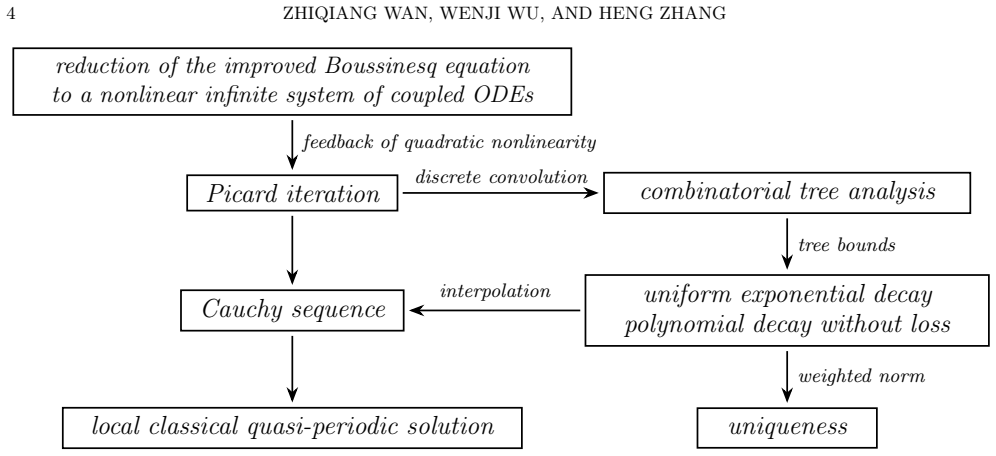
We study the Cauchy problem for the improved Boussinesq equation \[ u_{tt}-u_{xx}-u_{xxtt}-(u^2)_{xx}=0 \] on the real line with spatially quasi-periodic initial data. For a non-resonant frequency vector $\omega\in\mathbb R^\nu$, we prove local existence and uniqueness of classical spatially quasi-periodic solutions with the same frequency vector $\omega$ in two Fourier-side classes. First, for exponentially decaying initial Fourier coefficients, we obtain a spatially quasi-periodic solution whose Fourier coefficients remain exponentially decaying on an explicit time interval. Second, for initial Fourier coefficients $c(n)$ and $d(n)$ satisfying the polynomial decay $ |c(n)|+|d(n)|\lesssim (1+|n|)^{-r}, \; r>\nu+2, $ we prove that the corresponding spatially quasi-periodic solution preserves the same polynomial decay rate as the initial data. We also extend these results to the nonlinearity $u^p$ with integer $p \geq 3$.
Editorial analysis
A structured set of objections, weighed in public.
Referee Report
Summary. The paper establishes local existence and uniqueness of classical spatially quasi-periodic solutions to the improved Boussinesq equation u_tt - u_xx - u_xxtt - (u^2)_xx = 0 (and its u^p extension for p ≥ 3) on the real line, for non-resonant frequency vectors ω ∈ R^ν. Solutions are constructed in two Fourier-side classes: one with exponentially decaying coefficients (on an explicit time interval) and one with polynomial decay |c(n)| + |d(n)| ≲ (1 + |n|)^{-r} for r > ν + 2, with the same decay rate preserved. The argument proceeds via fixed-point contraction in suitable sequence spaces after reformulating the Cauchy problem as an integral equation, with non-resonance ensuring the linear frequencies remain bounded away from zero compatibly with the decay.
Significance. If the estimates close, the result provides a rigorous local well-posedness theory for quasi-periodic data in a dispersive nonlinear wave equation, with explicit control on the time of existence and preservation of decay classes. This is a natural extension of existing quasi-periodic results for other dispersive PDEs and could serve as a foundation for further analysis of long-time behavior or almost-periodic solutions. The direct fixed-point approach in weighted sequence spaces avoids heavy machinery and yields concrete decay thresholds.
major comments (2)
- §3 (proof of Theorem 1.1): the contraction mapping argument in the exponentially decaying class relies on the linear propagator preserving the exponential weight up to a factor e^{C|t|}; it is not immediately clear from the estimates whether the constant C can be made independent of the frequency vector ω under only the stated non-resonance condition, or whether an additional Diophantine-type lower bound on |λ(n·ω)| is implicitly required to close the fixed-point ball for |t| ≤ T with T explicit in the initial data size.
- §4 (polynomial decay case, Theorem 1.2): the claim that the solution preserves exactly the same decay rate r > ν + 2 appears to rest on a multilinear estimate for the nonlinearity in the weighted ℓ^1 space; however, the loss of derivatives or weights in the Duhamel term is not quantified explicitly, and it is unclear whether the threshold r > ν + 2 is sharp or merely sufficient for the contraction to close without further small-divisor losses.
minor comments (3)
- The notation for the sequence spaces (e.g., the precise definition of the exponential weight e^{r|n|} and the polynomial weight (1 + |n|)^r) should be stated once in a preliminary section rather than reintroduced in each theorem statement.
- Several estimates in the appendix (e.g., the bound on the linear solution operator) cite “standard arguments” without a short self-contained proof or reference to a precise lemma in the literature; adding one or two lines would improve readability.
- The extension to u^p (p ≥ 3) is stated in the abstract and introduction but the corresponding theorem statement and proof sketch appear only at the very end; a dedicated subsection would clarify the modifications needed for the higher-power case.
Simulated Author's Rebuttal
We thank the referee for the careful reading of our manuscript and the positive recommendation for minor revision. The comments raise valid points about the clarity of certain estimates, which we address point by point below. We have prepared revisions to improve the exposition without altering the main results.
read point-by-point responses
-
Referee: §3 (proof of Theorem 1.1): the contraction mapping argument in the exponentially decaying class relies on the linear propagator preserving the exponential weight up to a factor e^{C|t|}; it is not immediately clear from the estimates whether the constant C can be made independent of the frequency vector ω under only the stated non-resonance condition, or whether an additional Diophantine-type lower bound on |λ(n·ω)| is implicitly required to close the fixed-point ball for |t| ≤ T with T explicit in the initial data size.
Authors: The non-resonance assumption on ω guarantees a positive lower bound δ_ω = inf_{n≠0} |λ(n·ω)| > 0 that depends on the fixed frequency vector ω. The factor e^{C|t|} arises from a crude bound on the Duhamel integral in the exponentially weighted sequence space; the constant C depends on δ_ω (and hence on ω) but is independent of the solution itself. Since ω is prescribed and fixed, the existence time T can be chosen explicitly in terms of the initial-data size and δ_ω. No further Diophantine condition is required, because the linear propagator introduces no small-divisor losses beyond the uniform bound 1/δ_ω. We will insert a short paragraph in §3 making this dependence on ω explicit. revision: yes
-
Referee: §4 (polynomial decay case, Theorem 1.2): the claim that the solution preserves exactly the same decay rate r > ν + 2 appears to rest on a multilinear estimate for the nonlinearity in the weighted ℓ^1 space; however, the loss of derivatives or weights in the Duhamel term is not quantified explicitly, and it is unclear whether the threshold r > ν + 2 is sharp or merely sufficient for the contraction to close without further small-divisor losses.
Authors: The condition r > ν + 2 serves two purposes: (i) it ensures that the Fourier series and its first two derivatives converge absolutely, so that the quasi-periodic function is C^2 and the PDE holds classically (using that ∑_{n∈ℤ^ν} (1+|n|)^{-s} < ∞ for s > ν); (ii) it places the data in the Banach algebra ℓ^1_r under convolution. The nonlinearity, after the factor |n·ω|^2 from the xx derivative, maps ℓ^1_r into ℓ^1_{r-2}. The Duhamel multiplier sin((t-s)λ(n·ω))/λ(n·ω) is bounded by 1/δ_ω uniformly in n, thanks to non-resonance, and therefore preserves every weight exactly (no additional loss). Consequently the fixed-point map stays inside the same ℓ^1_r ball for any r > ν + 2; the threshold is sufficient for both contraction and regularity and is not asserted to be sharp. We will add an explicit paragraph quantifying the weight preservation in the Duhamel term. revision: yes
Circularity Check
No significant circularity; direct fixed-point existence proof
full rationale
The paper establishes local existence and uniqueness of quasi-periodic solutions via a contraction-mapping argument applied to the integral formulation of the Cauchy problem in Banach spaces of sequences with exponential or polynomial Fourier decay. The non-resonance assumption on ω is an explicit hypothesis that guarantees the linear frequencies remain bounded away from zero, allowing the contraction to close on a short time interval without small-divisor losses once r > ν + 2. No step defines a quantity in terms of its own output, renames a fitted parameter as a prediction, or relies on a self-citation chain whose validity is presupposed by the present work. The argument is self-contained within the stated function spaces and the standard Picard iteration for semilinear hyperbolic PDEs.
Axiom & Free-Parameter Ledger
axioms (2)
- domain assumption The frequency vector ω is non-resonant.
- standard math Standard Sobolev-type embeddings and product estimates hold in the chosen quasi-periodic function spaces.
Reference graph
Works this paper leans on
- [1]
- [2]
-
[3]
J. L. Bona, M. Chen and J.-C. Saut. Boussinesq equations and other systems for small-amplitude long waves in nonlinear dispersive media. I: Derivation and linear theory.J. Nonlinear Sci.12(4) (2002), 283–318
work page 2002
-
[4]
J. L. Bona, M. Chen and J.-C. Saut. Boussinesq equations and other systems for small-amplitude long waves in nonlinear dispersive media. II: The nonlinear theory.Nonlinearity17(3) (2004), 925–952
work page 2004
-
[5]
J. L. Bona and R. Smith. A model for the two-way propagation of water waves in a channel.Math. Proc. Cambridge Philos. Soc.79(1) (1976), 167–182
work page 1976
-
[6]
A. Chapouto, R. Killip and M. Vişan. Bounded solutions of KdV: uniqueness and the loss of almost periodicity. Duke Math. J.173(7) (2024), 1227–1267
work page 2024
- [7]
-
[8]
D. Damanik and M. Goldstein. On the existence and uniqueness of global solutions for the KdV equation with quasi-periodic initial data.J. Amer. Math. Soc.29(3) (2016), 825–856
work page 2016
-
[9]
D. Damanik, Y. Li and F. Xu. Local existence and uniqueness of spatially quasi-periodic solutions to the generalized KdV equation.J. Math. Pures Appl.(9) 186 (2024), 251–302. THE CAUCHY PROBLEM FOR THE IMPROVED BOUSSINESQ EQUATION WITH SPATIALLY QUASI-PERIODIC INITIAL DATA 33
work page 2024
-
[10]
D. Damanik, Y. Li and F. Xu. The quasi-periodic Cauchy problem for the generalized Benjamin–Bona–Mahony equation on the real line.J. Funct. Anal.286 (2024), 110238, 39 pp
work page 2024
-
[11]
D. Damanik, M. Lukić, A. Volberg and P. Yuditskii. The Deift conjecture: a program to construct a coun- terexample.arXiv:2111.09345 (2021)
-
[12]
P. Deift. Some open problems in random matrix theory and the theory of integrable systems. II.SIGMA13 (2017), 016, 23 pp
work page 2017
-
[13]
B. Eichinger, T. VandenBoom and P. Yuditskii. KdV hierarchy via Abelian coverings and operator identities. Trans. Amer. Math. Soc. Ser. B6 (2019), 1–44
work page 2019
-
[14]
Y. Gao, Y. Li and C. Su. Existence and uniqueness for “good” Boussinesq equations with quasi-periodic initial data.Commun. Math. Sci.21(5) (2023), 1247–1278
work page 2023
-
[15]
C. E. Kenig, G. Ponce and L. Vega. Well-posedness of the initial value problem for the Korteweg–de Vries equation.J. Amer. Math. Soc.4 (1991), no. 2, 323–347
work page 1991
- [16]
-
[17]
M. Lukić and G. Young. Uniqueness of solutions of the KdV-hierarchy via Dubrovin-type flows.J. Funct. Anal. 279(7) (2020), 108705, 30 pp
work page 2020
- [18]
-
[19]
R. Schippa. Strichartz estimates for quasi-periodic functions and applications.Proc. Lond. Math. Soc.130 (2025), no. 6, e70058
work page 2025
-
[20]
S. Wang and G. Chen. The Cauchy problem for the generalized IMBq equation inWs,p(Rn).J. Math. Anal. Appl.266(1) (2002), 38–54
work page 2002
-
[21]
S. Wang and G. Chen. Small amplitude solutions of the generalized IMBq equation.J. Math. Anal. Appl. 274(2) (2002), 846–866
work page 2002
-
[22]
Y.-Z. Wang. Global existence and asymptotic behaviour of solutions for the generalized Boussinesq equation. Nonlinear Anal.70(1) (2009), 465–482
work page 2009
-
[23]
F. Xu. The weakly nonlinear Schrödinger equation in higher dimensions with quasi-periodic initial data.Adv. Math.481 (2025), 110539, 32 pp
work page 2025
-
[24]
H. Zhao and H. Cheng. Time almost periodicity for solutions of Toda lattice equation with almost periodic initial datum.Ergod. Theory Dynam. Systems45(8) (2025), 2561–2600. School of Mathematical Sciences, University of Science and Technology of China, No. 96 Jinzhai Road, Baohe District, Hefei, Anhui Province, China Email address:ZhiQiang_Wan576@mail.ust...
work page 2025
discussion (0)
Sign in with ORCID, Apple, or X to comment. Anyone can read and Pith papers without signing in.