Recognition: no theorem link
Ground states of quantum XY dipoles on the Archimedean lattices
Pith reviewed 2026-05-11 03:22 UTC · model grok-4.3
The pith
Numerical ground states of the dipolar XY model on nine Archimedean lattices are mostly paramagnets or collinear Neel order, with competing phases on the triangular lattice.
A machine-rendered reading of the paper's core claim, the machinery that carries it, and where it could break.
Core claim
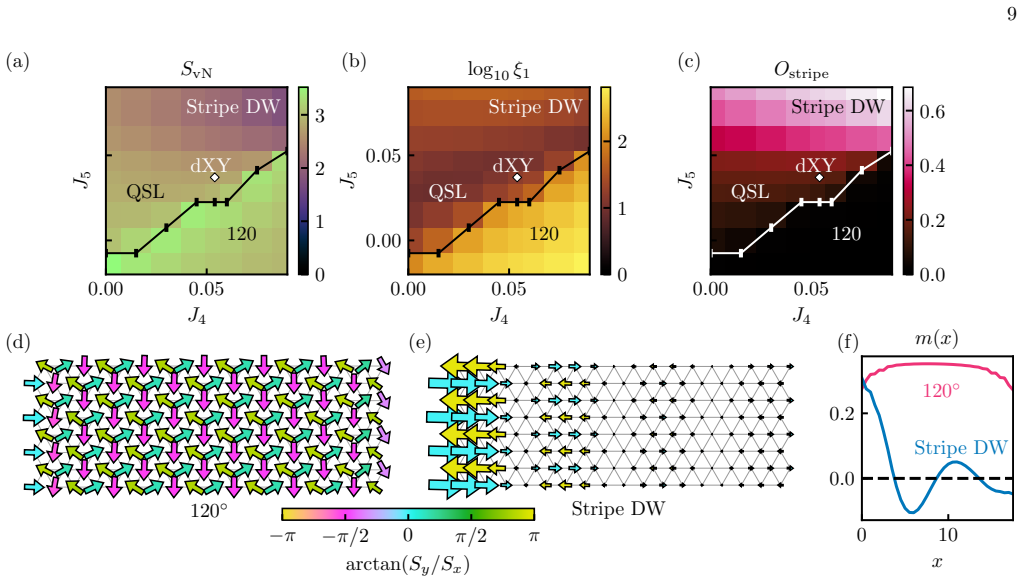
We report numerical ground states for the dipolar XY spin model on nine Archimedean lattices. Four of these host trivial paramagnets, while another four develop collinear Neel magnetic order. For the triangular lattice, several competing phases appear including coplanar magnetism, stripe density wave order, and a possible spin liquid, with their relative stability sensitive to the long-range couplings. The Archimedean classification is completed by the kagome lattice, which is likely a Dirac spin liquid.
What carries the argument
DMRG calculations on the long-range dipolar XY Hamiltonian defined on Archimedean lattice tilings, which track the extended antiferromagnetic interactions between spins.
If this is right
- Four Archimedean lattices realize trivial paramagnets as ground states of the dipolar XY model.
- Four lattices realize collinear Neel order whose magnetization, susceptibility, and stiffness match linear spin wave predictions.
- The triangular lattice supports competition among coplanar magnetism, stripe density waves, and a possible spin liquid whose balance shifts with the strength of long-range dipolar terms.
- The kagome lattice realizes a Dirac spin liquid.
Where Pith is reading between the lines
- The phase map can directly inform experiments that realize the dipolar XY model with Rydberg atoms or polar molecules by indicating which lattices favor simple order versus exotic states.
- Truncating the dipolar interaction range in simulations may alter the phase diagram on the triangular lattice, suggesting that full long-range treatments are necessary for accurate predictions.
- The classification provides a template for extending similar studies to other two-dimensional spin models or to three-dimensional lattices built from the same local motifs.
Load-bearing premise
That the DMRG simulations have converged to the true thermodynamic ground states for these long-range interacting systems and that the numerical signatures on the triangular lattice reliably indicate a spin liquid rather than an undetected ordered phase.
What would settle it
A larger-scale calculation or experiment on the triangular lattice that finds clear long-range magnetic order or density modulation instead of the proposed spin liquid, or that shows DMRG failing to converge on any lattice as system size increases.
Figures





read the original abstract
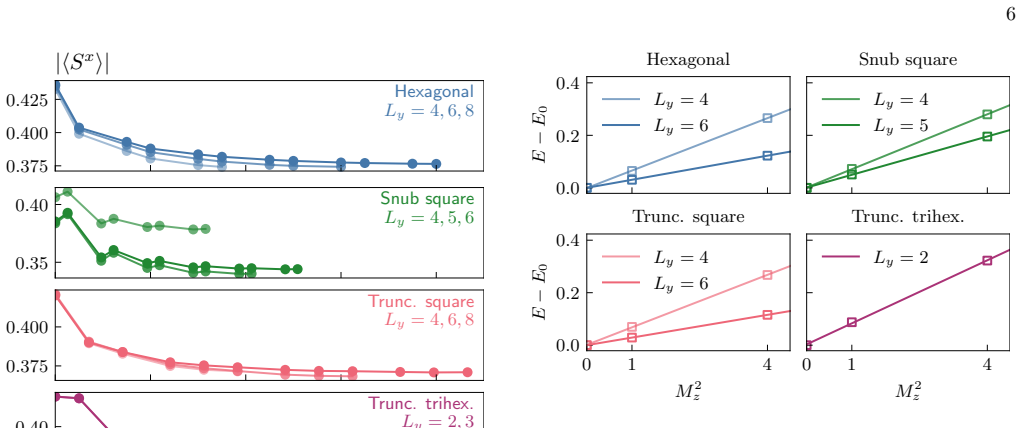
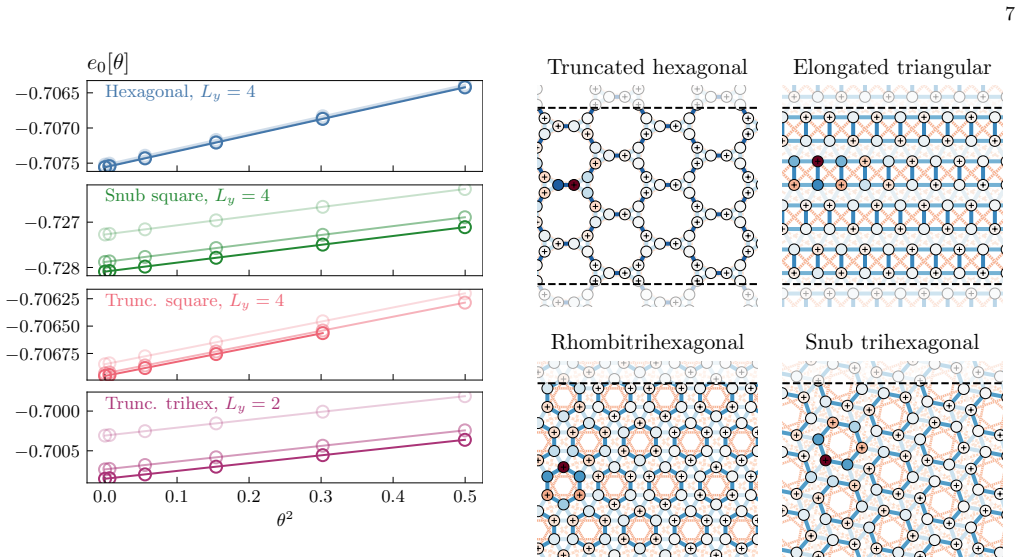
We report numerical ground states for the dipolar XY spin model, which describes extended antiferromagnetic interactions in two-dimensional arrays of polar molecules and two-level Rydberg atoms. Carrying out large-scale density matrix renormalization group (DMRG) calculations, we compute ground state properties on nine of the eleven Archimedean lattices--tilings of the plane by regular polygons. Four of these host trivial paramagnets, while another four develop collinear Neel magnetic order, as was found previously for the square lattice. For the ordered states, we calculate the hydrodynamic parameters (magnetization, susceptibility, and stiffness) and compare to linear spin wave theory. We also investigate the triangular lattice, for which we find several competing phases including coplanar magnetism, stripe density wave order, and a possible spin liquid; their relative stability is sensitive to the long-range couplings present in our dipolar model. Finally, the Archimedean classification is completed by the kagome lattice, which we argue in a companion work is likely to be a Dirac spin liquid.
Editorial analysis
A structured set of objections, weighed in public.
Referee Report
Summary. The manuscript reports large-scale DMRG calculations of ground states for the dipolar XY spin model on nine Archimedean lattices. Four lattices host trivial paramagnets and four exhibit collinear Néel order (with hydrodynamic parameters computed and compared to linear spin-wave theory). On the triangular lattice, competing phases are identified including coplanar magnetism, stripe density-wave order, and a possible spin liquid, with relative stability sensitive to the long-range dipolar couplings. The kagome lattice is argued to realize a Dirac spin liquid in a companion work.
Significance. If the DMRG results are robust, the work supplies a systematic numerical classification of phases for the dipolar XY model across Archimedean lattices, directly relevant to experiments with polar molecules and Rydberg atoms. The extraction of magnetization, susceptibility, and stiffness for the ordered phases, together with the demonstration that long-range tails can shift phase boundaries on the triangular lattice, adds concrete value beyond short-range models. The technical effort of applying DMRG to long-range interactions on multiple geometries is a clear strength.
major comments (2)
- [Triangular lattice results] Triangular-lattice subsection: the claim of a possible spin liquid (and the sensitivity of its stability to long-range couplings) rests on DMRG data whose convergence is not demonstrated. No bond-dimension extrapolations, truncation-error scaling, or finite-size analysis of order parameters (magnetic or density-wave) are reported, leaving open the possibility that weak order appears only at larger scales or with fuller treatment of the 1/r^3 tails.
- [Methods / DMRG implementation] DMRG implementation section (or equivalent methods paragraph): the handling of the long-range dipolar interactions is not specified (e.g., cutoff radius, Ewald summation, or approximation scheme). Because the phase competition on the triangular lattice is stated to depend on these tails, the absence of this information makes it impossible to assess whether the reported balance between coplanar magnetism, stripe order, and the disordered phase is an artifact of the truncation.
minor comments (2)
- [Abstract] Abstract: the phrase 'large-scale DMRG' is used without any quantitative indicators of bond dimension, cylinder width, or truncation error; adding even a single sentence with these numbers would strengthen the reader's ability to evaluate the claims.
- [Figures] Figure captions and legends: several plots of order parameters or correlation functions would benefit from explicit statements of the system sizes and bond dimensions used, as well as any error estimates.
Simulated Author's Rebuttal
We thank the referee for their careful reading of the manuscript and for the constructive comments. We address each major point below and have revised the manuscript to incorporate additional details and analyses where appropriate.
read point-by-point responses
-
Referee: [Triangular lattice results] Triangular-lattice subsection: the claim of a possible spin liquid (and the sensitivity of its stability to long-range couplings) rests on DMRG data whose convergence is not demonstrated. No bond-dimension extrapolations, truncation-error scaling, or finite-size analysis of order parameters (magnetic or density-wave) are reported, leaving open the possibility that weak order appears only at larger scales or with fuller treatment of the 1/r^3 tails.
Authors: We agree that explicit convergence checks strengthen the triangular-lattice claims. In the revised manuscript we have added bond-dimension extrapolations of the energy and order parameters (both magnetic and stripe density-wave) for the largest cylinders studied, together with a finite-size comparison across cylinder widths. These data show that the disordered regime remains stable with no detectable order emerging at higher bond dimensions or larger circumferences within the accessible range. We have also included a direct comparison of results obtained with different dipolar cutoffs to quantify the sensitivity to the long-range tails. We retain the phrasing 'possible spin liquid' to reflect the numerical limitations and the need for future work. revision: yes
-
Referee: [Methods / DMRG implementation] DMRG implementation section (or equivalent methods paragraph): the handling of the long-range dipolar interactions is not specified (e.g., cutoff radius, Ewald summation, or approximation scheme). Because the phase competition on the triangular lattice is stated to depend on these tails, the absence of this information makes it impossible to assess whether the reported balance between coplanar magnetism, stripe order, and the disordered phase is an artifact of the truncation.
Authors: We thank the referee for highlighting this omission. The revised Methods section now specifies that the dipolar 1/r^3 terms are truncated at a cutoff radius of ten lattice spacings, with the contribution of the remaining tails incorporated through a self-consistent mean-field correction based on the local magnetization. We have verified that increasing the cutoff to twelve spacings produces only small quantitative shifts in the triangular-lattice phase boundaries and does not change the qualitative competition among the reported phases. These implementation details are now provided explicitly so that the robustness of the results can be assessed. revision: yes
Circularity Check
No significant circularity: results from independent DMRG numerics on dipolar XY model
full rationale
The paper reports ground-state properties obtained via large-scale density matrix renormalization group (DMRG) calculations on nine Archimedean lattices. These are direct numerical outputs (magnetization, susceptibility, stiffness, phase identification) rather than algebraic derivations that could reduce to fitted parameters or self-referential definitions. The sole reference to a companion work concerns only the kagome lattice and is explicitly separated from the primary claims; it does not serve as a load-bearing premise for the reported phases on the other lattices. No equations are presented that equate a 'prediction' to an input by construction, and no ansatz or uniqueness theorem is smuggled via self-citation. The derivation chain is therefore self-contained against external numerical benchmarks.
Axiom & Free-Parameter Ledger
axioms (2)
- domain assumption DMRG with sufficient bond dimension accurately approximates the ground state of 2D quantum spin models with 1/r^3 interactions.
- domain assumption Linear spin wave theory provides a meaningful benchmark for hydrodynamic parameters in the collinear Neel phases.
Reference graph
Works this paper leans on
-
[1]
J. Richter, J. Schulenburg, and A. Honecker, inQuantum Magnetism, Vol. 645, edited by U. Schollw¨ ock, J. Richter, D. J. J. Farnell, and R. F. Bishop (Springer Berlin Hei- delberg, Berlin, Heidelberg, 2004) pp. 85–153
work page 2004
-
[2]
Manousakis, Reviews of Modern Physics63, 1 (1991)
E. Manousakis, Reviews of Modern Physics63, 1 (1991)
work page 1991
-
[3]
S. R. White and A. L. Chernyshev, Physical Review Let- ters99, 127004 (2007)
work page 2007
-
[4]
Elser, Physical Review Letters62, 2405 (1989)
V. Elser, Physical Review Letters62, 2405 (1989)
work page 1989
-
[5]
G. Misguich and C. Lhuillier, TWO-DIMENSIONAL QUANTUM ANTIFERROMAGNETS, inFrustrated Spin Systems(WORLD SCIENTIFIC, 2013) pp. 235– 319, 2nd ed
work page 2013
-
[6]
S. Yan, D. A. Huse, and S. R. White, Science332, 1173 (2011)
work page 2011
-
[7]
L. Savary and L. Balents, Reports on Progress in Physics 80, 016502 (2017)
work page 2017
-
[8]
H. Kim, W. Lee, H.-g. Lee, H. Jo, Y. Song, and J. Ahn, Nature Communications7, 13317 (2016)
work page 2016
-
[9]
D. Barredo, S. De L´ es´ eleuc, V. Lienhard, T. Lahaye, and A. Browaeys, Science354, 1021 (2016)
work page 2016
- [10]
-
[11]
A. M. Kaufman and K.-K. Ni, Nature Physics17, 1324 (2021)
work page 2021
- [12]
-
[13]
N.-C. Chiu, E. C. Trapp, J. Guo, M. H. Abobeih, L. M. Stewart, S. Hollerith, P. L. Stroganov, M. Kalinowski, A. A. Geim, S. J. Evered, S. H. Li, X. Lyu, L. M. Peters, D. Bluvstein, T. T. Wang, M. Greiner, V. Vuleti´ c, and M. D. Lukin, Nature646, 1075 (2025)
work page 2025
- [14]
- [15]
-
[16]
K. R. A. Hazzard, M. Van Den Worm, M. Foss-Feig, S. R. Manmana, E. G. Dalla Torre, T. Pfau, M. Kastner, and A. M. Rey, Physical Review A90, 063622 (2014)
work page 2014
- [17]
- [18]
- [19]
-
[20]
Y. Bao, S. S. Yu, L. Anderegg, E. Chae, W. Ketterle, K.-K. Ni, and J. M. Doyle, Science382, 1138 (2023)
work page 2023
-
[21]
J.-R. Li, K. Matsuda, C. Miller, A. N. Carroll, W. G. 12 Tobias, J. S. Higgins, and J. Ye, Nature614, 70 (2023)
work page 2023
-
[22]
D. K. Ruttley, T. R. Hepworth, A. Guttridge, and S. L. Cornish, Nature637, 827 (2025)
work page 2025
-
[23]
C. M. Holland, Y. Lu, and L. W. Cheuk, Science382, 1143 (2023)
work page 2023
-
[24]
L. Christakis, J. S. Rosenberg, R. Raj, S. Chi, A. Morn- ingstar, D. A. Huse, Z. Z. Yan, and W. S. Bakr, Nature 614, 64 (2023)
work page 2023
-
[25]
C. Chen, G. Bornet, M. Bintz, G. Emperauger, L. Leclerc, V. S. Liu, P. Scholl, D. Barredo, J. Hauschild, S. Chatterjee, M. Schuler, A. M. L¨ auchli, M. P. Zaletel, T. Lahaye, N. Y. Yao, and A. Browaeys, Nature616, 691 (2023)
work page 2023
- [26]
-
[27]
B. Sbierski, M. Bintz, S. Chatterjee, M. Schuler, N. Y. Yao, and L. Pollet, Physical Review B109, 144411 (2024)
work page 2024
- [28]
-
[29]
B. Gr¨ unbaum and G. C. Shephard,Tilings and Pat- terns, second edition ed. (Dover Publications, Inc, Mi- neola, New York, 2016)
work page 2016
-
[30]
S. R. White, Physical Review Letters69, 2863 (1992)
work page 1992
-
[31]
E. Stoudenmire and S. R. White, Annual Review of Con- densed Matter Physics3, 111 (2012)
work page 2012
-
[32]
J. Hauschild and F. Pollmann, SciPost Physics Lecture Notes , 5 (2018)
work page 2018
-
[33]
C. N. Yang, Reviews of Modern Physics34, 694 (1962)
work page 1962
-
[34]
P. W. Anderson, Physical Review86, 694 (1952)
work page 1952
-
[35]
A. Auerbach,Interacting Electrons and Quantum Mag- netism, Graduate Texts in Contemporary Physics (Springer-Verlag, New York Berlin Paris [etc.], 1994)
work page 1994
-
[36]
B. I. Halperin and P. C. Hohenberg, Physical Review 188, 898 (1969)
work page 1969
-
[37]
P. Hasenfratz and F. Niedermayer, Zeitschrift fur Physik B Condensed Matter92, 91 (1993)
work page 1993
-
[38]
A. W. Sandvik and C. J. Hamer, Physical Review B60, 6588 (1999)
work page 1999
-
[39]
See Supplemental Material for additional details
-
[40]
Colpa, Physica A: Statistical Mechanics and its Appli- cations93, 327 (1978)
J. Colpa, Physica A: Statistical Mechanics and its Appli- cations93, 327 (1978)
work page 1978
-
[41]
Xiao, Theory of transformation for the diagonal- ization of quadratic Hamiltonians (2009)
M.-w. Xiao, Theory of transformation for the diagonal- ization of quadratic Hamiltonians (2009)
work page 2009
-
[42]
E. M. Lifshitz and L. P. Pitaevskii,Statistical Physics: Theory of the Condensed State, 3rd ed., Course of Theo- retical Physics No. v.Vol. 2 (Elsevier Science, Saint Louis, 2013)
work page 2013
-
[43]
J. M. Luttinger and L. Tisza, Physical Review70, 954 (1946)
work page 1946
-
[44]
A. L. Chernyshev, Physical Review B112, 174413 (2025)
work page 2025
-
[45]
In this sum, we only include environment spins withrij < Rmax, using the same cutoff radiusR max =W/2 as for the intrasystem spin-spin interactions
-
[46]
Tasaki, Journal of Statistical Physics174, 735 (2019)
H. Tasaki, Journal of Statistical Physics174, 735 (2019)
work page 2019
- [47]
-
[48]
R. G. Melko, A. W. Sandvik, and D. J. Scalapino, Phys- ical Review B69, 014509 (2004)
work page 2004
-
[49]
Y.-C. He, M. P. Zaletel, M. Oshikawa, and F. Pollmann, Physical Review X7, 031020 (2017)
work page 2017
-
[50]
B. Sriram Shastry and B. Sutherland, Physica B+C108, 1069 (1981)
work page 1981
- [51]
-
[52]
E. Lieb, T. Schultz, and D. Mattis, Annals of Physics16, 407 (1961)
work page 1961
-
[53]
Oshikawa, Physical Review Letters84, 1535 (2000)
M. Oshikawa, Physical Review Letters84, 1535 (2000)
work page 2000
-
[54]
M. B. Hastings, Physical Review B69, 104431 (2004)
work page 2004
- [55]
-
[56]
Y. Iqbal, W.-J. Hu, R. Thomale, D. Poilblanc, and F. Becca, Physical Review B93, 144411 (2016)
work page 2016
-
[57]
S. Hu, W. Zhu, S. Eggert, and Y.-C. He, Physical Review Letters123, 207203 (2019)
work page 2019
-
[58]
N. E. Sherman, M. Dupont, and J. E. Moore, Physical Review B107, 165146 (2023)
work page 2023
-
[59]
M. Drescher, L. Vanderstraeten, R. Moessner, and F. Pollmann, Physical Review B108, L220401 (2023)
work page 2023
- [60]
-
[61]
O. Kovalska, E. P. Fontanella, B. Schneider, H.-H. Tu, and J. von Delft, Revisiting the$J 1$-$J 2$Heisen- berg Model on a Triangular Lattice: Quasi-Degenerate Ground States and Phase Competition (2026)
work page 2026
-
[62]
K. De’Bell, A. B. MacIsaac, and J. P. Whitehead, Re- views of Modern Physics72, 225 (2000)
work page 2000
- [63]
- [64]
- [65]
-
[66]
S. N. Saadatmand and I. P. McCulloch, Physical Review B94, 121111 (2016)
work page 2016
-
[67]
M. E. Zhitomirsky and A. L. Chernyshev, Reviews of Modern Physics85, 219 (2013)
work page 2013
-
[68]
M. E. Zhitomirsky and A. L. Chernyshev, Physical Re- view Letters82, 4536 (1999)
work page 1999
-
[69]
A. D. Kim, A. Khalifa, and S. Chatterjee, Physical Re- view Letters135, 046703 (2025)
work page 2025
-
[70]
C. Chen, G. Emperauger, G. Bornet, F. Caleca, B. G´ ely, M. Bintz, S. Chatterjee, V. Liu, D. Barredo, N. Y. Yao, T. Lahaye, F. Mezzacapo, T. Roscilde, and A. Browaeys, Science389, 483 (2025)
work page 2025
-
[71]
J. Sonnenschein, A. Maity, C. Liu, R. Thomale, F. Fer- rari, and Y. Iqbal, Physical Review B110, 014414 (2024)
work page 2024
-
[72]
P. L. Ebert, Y. Iqbal, and A. Wietek, Competing Para- magnetic Phases in the Maple-Leaf Heisenberg Antifer- romagnet (2026)
work page 2026
-
[73]
A. Keselman, X. Xu, H. Zhang, C. D. Batista, and O. A. Starykh,$J 1-J 2$Triangular Lattice Antiferromagnet in a Magnetic Field (2025)
work page 2025
- [74]
- [75]
- [76]
-
[77]
M. Tian, R. Samajdar, and B. Gadway, Physical Review Letters135, 253001 (2025)
work page 2025
-
[78]
Y. Lu, C. M. Holland, C. L. Welsh, X.-Y. Chen, and L. W. Cheuk, Probing Coherent Many-Body Spin Dy- namics in a Molecular Tweezer Array Quantum Simula- tor (2026)
work page 2026
- [79]
-
[80]
O. A. Starykh, Reports on Progress in Physics78, 052502 (2015)
work page 2015
discussion (0)
Sign in with ORCID, Apple, or X to comment. Anyone can read and Pith papers without signing in.