Recognition: 2 theorem links
· Lean TheoremFuture Validity is the Missing Statistic: From Impossibility to Φ-Estimation for Grammar-Faithful Speculative Decoding
Pith reviewed 2026-05-11 02:41 UTC · model grok-4.3
The pith
Speculative decoders with local masks sample from a projected distribution rather than the intended grammar-conditional distribution
A machine-rendered reading of the paper's core claim, the machinery that carries it, and where it could break.
Core claim
Any speculative decoder that has local mask access, uses Leviathan rejection, and maintains rollback soundness draws from the locally projected distribution rather than the grammar-conditional distribution. The future-validity function equals the probability under the base model that a given prefix admits a valid completion. Substituting this function for the constant-one mask recovers the desired distribution exactly when the function is known; approximate substitutes produce a quantifiable total-variation deviation from the target.
What carries the argument
The future-validity function, defined as the probability that a prefix admits a valid completion under the base model, which supplies the multiplicative correction term in the Doob transform that converts the projected distribution into the grammar-conditional distribution
Load-bearing premise
The speculative decoder must satisfy local mask access, Leviathan rejection, and rollback soundness, and the grammar must be enumerable so that the probability of valid future completions is well-defined.
What would settle it
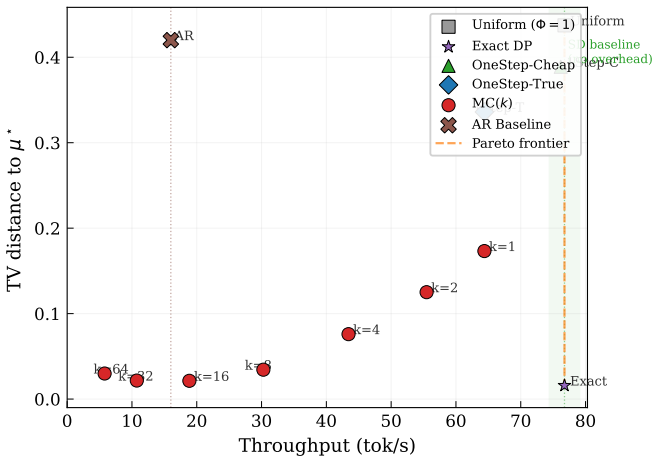
Measure the total-variation distance between samples drawn by a local-masked speculative decoder and the exact grammar-conditional distribution on Dyck grammars with Qwen3-8B, which the paper finds reaches 0.996 without correction.
Figures


read the original abstract
Grammar-constrained generation is often combined with local vocabulary masking and speculative decoding, but the resulting sampling law is not the grammar-conditional distribution users usually intend. We show that any speculative decoder with local mask access, Leviathan rejection, and rollback soundness samples from the locally projected distribution $\mu^{\mathrm{proj}}$ rather than the grammar-conditional distribution $\mu^\star$. This extends the GAD impossibility result to speculative decoding; on Dyck grammars with Qwen3-8B, the total-variation gap can reach 0.996. We identify the future-validity function $\Phi_t(y)=\Pr_p[\mathrm{valid\ completion}\mid y]$ as the missing correction statistic. The target distribution is a Doob transform of the base model with $h=\Phi$, while local masking corresponds to setting $h$ to one. With exact $\Phi$, our oracle decoder FVO-Spec samples exactly from $\mu^\star$; with approximate $\Phi$, we bound the resulting total-variation error. Because exact future validity is hard for general context-free grammars, we evaluate estimator hierarchies on tractable Dyck and finite JSON languages. OneStep reduces Dyck TV by 14% with under 1% throughput overhead, exact dynamic programming reduces it by 97%, and finite-language correction closes JSON gaps to numerical precision. All fidelity claims are scoped to enumerable grammars and token tries.
Editorial analysis
A structured set of objections, weighed in public.
Referee Report
Summary. The manuscript claims that any speculative decoder satisfying local mask access, Leviathan rejection, and rollback soundness samples from the locally projected distribution μ^proj rather than the grammar-conditional μ*, extending the GAD impossibility result. It identifies the future-validity function Φ_t(y) = Pr_p[valid completion | y] as the missing statistic, shows that μ* is the Doob h-transform of the base model with h = Φ (while local masking sets h ≡ 1), provides an oracle FVO-Spec that samples exactly from μ* given Φ, and bounds the TV error under approximate Φ. On enumerable Dyck and finite JSON grammars the paper reports concrete TV gaps up to 0.996 and reductions of 14% (OneStep), 97% (exact DP), and near-zero (finite correction) with low throughput overhead.
Significance. If the central identification and bounds hold, the work supplies a principled explanation and practical correction for a common mismatch in grammar-constrained speculative decoding. The Doob-transform framing cleanly separates the target law from the locally projected law, the empirical TV measurements on Dyck grammars illustrate the scale of the problem, and the estimator hierarchy demonstrates that even lightweight corrections yield measurable fidelity gains. The explicit scoping to enumerable grammars and token tries is appropriately cautious and strengthens the claims.
minor comments (3)
- The assumptions 'local mask access, Leviathan rejection, and rollback soundness' are load-bearing for the impossibility extension; a short dedicated paragraph (or appendix) defining them with citations to the original Leviathan paper would improve clarity and allow readers to verify applicability.
- The experimental section should report the precise Dyck grammar parameters (depth, alphabet size), prompt distribution, and method used to compute total-variation distances so that the reported gaps (0.996) and reductions (14 %, 97 %) are reproducible.
- A brief reminder of the Doob h-transform definition and its relation to conditional sampling would help readers outside the measure-theoretic probability community follow the central argument.
Simulated Author's Rebuttal
We thank the referee for the positive and insightful review, as well as the recommendation for minor revision. We appreciate the recognition that the Doob h-transform framing cleanly separates the target grammar-conditional law μ* from the locally projected law μ^proj, and that the TV measurements on enumerable Dyck grammars and the estimator hierarchy (OneStep, exact DP, finite correction) demonstrate both the scale of the mismatch and the practical value of even lightweight corrections. The scoping to enumerable grammars and token tries is indeed deliberate and we agree it strengthens the claims.
Circularity Check
No significant circularity; derivation is self-contained via standard probability
full rationale
The paper's core argument proceeds from explicit definitions of local mask access, Leviathan rejection, rollback soundness, and the future-validity function Φ as the conditional probability Pr[valid completion | y]. It identifies μ^proj as the law realized when h ≡ 1 (local masking) and μ* as the Doob h-transform with h = Φ, then bounds TV error for approximate Φ. These steps rely on the Doob transform theorem and standard conditional-probability identities rather than any fitted parameter, self-referential definition, or load-bearing self-citation. All claims are scoped to enumerable grammars; no equation reduces the target result to its own inputs by construction. The GAD impossibility extension is invoked as an external reference, not a self-citation chain.
Axiom & Free-Parameter Ledger
axioms (2)
- standard math Properties of the Doob transform for reweighting measures in sequential sampling
- domain assumption Rollback soundness and Leviathan rejection sampling behavior under local masks
invented entities (1)
-
future validity function Φ_t(y)
no independent evidence
Lean theorems connected to this paper
-
IndisputableMonolith/Cost/FunctionalEquation.leanwashburn_uniqueness_aczel unclear?
unclearRelation between the paper passage and the cited Recognition theorem.
The target distribution is a Doob transform of the base model with h=Φ, while local masking corresponds to setting h to one.
-
IndisputableMonolith/Foundation/RealityFromDistinction.leanreality_from_one_distinction unclear?
unclearRelation between the paper passage and the cited Recognition theorem.
Φt(y)=Prp[valid completion|y]
What do these tags mean?
- matches
- The paper's claim is directly supported by a theorem in the formal canon.
- supports
- The theorem supports part of the paper's argument, but the paper may add assumptions or extra steps.
- extends
- The paper goes beyond the formal theorem; the theorem is a base layer rather than the whole result.
- uses
- The paper appears to rely on the theorem as machinery.
- contradicts
- The paper's claim conflicts with a theorem or certificate in the canon.
- unclear
- Pith found a possible connection, but the passage is too broad, indirect, or ambiguous to say the theorem truly supports the claim.
Reference graph
Works this paper leans on
-
[1]
Proceedings of the 40th International Conference on Machine Learning , year=
Fast Inference from Transformers via Speculative Decoding , author=. Proceedings of the 40th International Conference on Machine Learning , year=
-
[2]
Accelerating Large Language Model Decoding with Speculative Sampling
Accelerating Large Language Model Decoding with Speculative Sampling , author=. arXiv:2302.01318 , year=
work page internal anchor Pith review arXiv
-
[3]
SpecInfer: Accelerating Large Language Model Serving with Tree-based Speculative Inference and Verification , author=. ASPLOS , year=
-
[4]
Proceedings of the 41st International Conference on Machine Learning , year=
EAGLE: Speculative Sampling Requires Rethinking Feature Uncertainty , author=. Proceedings of the 41st International Conference on Machine Learning , year=
-
[5]
Li, Yuhui and Wei, Fangyun and Zhang, Chao and Zhang, Hongyang , journal=. 2025 , eprint=
work page 2025
-
[6]
Cai, Tianle and Li, Yuhong and Geng, Zhengyang and Peng, Hongwu and Lee, Jason D and Chen, Deming and Dao, Tri , booktitle=. Medusa: Simple
-
[7]
Chen, Jian and Liang, Yesheng and Liu, Zhijian , journal=. 2026 , eprint=
work page 2026
-
[8]
and Cai, Yaxing and Lai, Ruihang and Xu, Ziyi and Zhao, Yilong and Chen, Tianqi , journal=
Dong, Yixin and Ruan, Charlie F. and Cai, Yaxing and Lai, Ruihang and Xu, Ziyi and Zhao, Yilong and Chen, Tianqi , journal=. 2024 , eprint=
work page 2024
-
[9]
Li, Linzhang and Dong, Yixin and Wang, Guanjie and Xu, Ziyi and Jiang, Alexander and Chen, Tianqi , journal=. 2026 , eprint=
work page 2026
-
[10]
Efficient Guided Generation for Large Language Models
Efficient Guided Generation for Large Language Models , author=. arXiv:2307.09702 , year=
work page internal anchor Pith review arXiv
-
[11]
Advances in Neural Information Processing Systems , year=
Grammar-Aligned Decoding , author=. Advances in Neural Information Processing Systems , year=
-
[12]
Efficient Memory Management for Large Language Model Serving with
Kwon, Woosuk and Li, Zhuohan and Zhuang, Siyuan and Sheng, Ying and Zheng, Lianmin and Yu, Cody Hao and Gonzalez, Joseph and Zhang, Hao and Stoica, Ion , booktitle=. Efficient Memory Management for Large Language Model Serving with
-
[13]
Zheng, Lianmin and Yin, Liangsheng and Xie, Zhiqiang and Sun, Chuyue and Huang, Jeff and Yu, Cody Hao and Cao, Shiyi and Kozyrakis, Christos and Gonzalez, Joseph and Stoica, Ion and Zhang, Hao , journal=
-
[14]
Classical Potential Theory and Its Probabilistic Counterpart , author=. 1984 , url=
work page 1984
-
[15]
Score-Based Generative Modeling through Stochastic Differential Equations , author=. ICLR , year=
-
[16]
Qin, Lianhui and Welleck, Sean and Khashabi, Daniel and Choi, Yejin , booktitle=
-
[17]
Attention Meets Reachability: Structural Equivalence and Efficiency in Grammar-Constrained
Alpay, Faruk and Senturk, Bilge , journal=. Attention Meets Reachability: Structural Equivalence and Efficiency in Grammar-Constrained
-
[18]
Efficient Adaptive Rejection Sampling for Accelerating Speculative Decoding in Large Language Models , author=. arXiv:2512.13194 , year=. 2512.13194 , archiveprefix=
-
[19]
Entropy-Aware Speculative Decoding Toward Improved
Su, Tiancheng and Zhang, Meicong and He, Guoxiu , journal=. Entropy-Aware Speculative Decoding Toward Improved. 2025 , eprint=
work page 2025
-
[20]
Computational Linguistics , volume=
An Efficient Probabilistic Context-Free Parsing Algorithm that Computes Prefix Probabilities , author=. Computational Linguistics , volume=
-
[21]
Computational Linguistics , volume=
Semiring Parsing , author=. Computational Linguistics , volume=
-
[22]
Information and Computation , volume=
A Quasi-Polynomial-Time Algorithm for Sampling Words from a Context-Free Language , author=. Information and Computation , volume=
discussion (0)
Sign in with ORCID, Apple, or X to comment. Anyone can read and Pith papers without signing in.