Recognition: no theorem link
Selectivity- and Activity-Aware Catalyst Descriptors for CO₂ Hydrogenation on Alloy Nanocatalysts using Machine-Learned Force Fields
Pith reviewed 2026-05-11 02:13 UTC · model grok-4.3
The pith
Facet-resolved adsorption energy distributions predict activity and methanol selectivity for CO2 hydrogenation on alloy nanocatalysts.
A machine-rendered reading of the paper's core claim, the machinery that carries it, and where it could break.
Core claim
By computing adsorption energy distributions across 2626 crystallographically distinct surfaces of 226 metals, binary alloys, and ternary alloys, the facet-resolved framework identifies highly active and methanol-selective facets through statistical and unsupervised analysis, thereby linking nanoparticle structure directly to both activity and selectivity metrics for CO2 hydrogenation.
What carries the argument
Facet-resolved adsorption energy distributions (AEDs), which aggregate site-specific adsorption energies across different crystallographic planes to represent the full catalytic surface of alloy nanoparticles.
If this is right
- Alloy surfaces can be ranked by predicted activity for CO2 hydrogenation based on their facet-specific distributions.
- Specific surface orientations on certain alloys are flagged as methanol-selective for C1 products.
- A concrete list of alloy compositions and orientations emerges as targets for experimental validation.
- The structure-performance relationships enable more rational screening of heterogeneous catalysts.
Where Pith is reading between the lines
- Nanoparticle synthesis could be tuned to expose the facets predicted to be most selective.
- The descriptor approach could transfer to other reactions where product distribution depends on site diversity.
- Pairing the distributions with targeted kinetic studies on the flagged facets would test and refine the predictions.
Load-bearing premise
Adsorption energy distributions computed for the alloy surfaces accurately predict catalytic activity and selectivity without explicit kinetic barriers or coverage effects.
What would settle it
Experimental measurement of methanol selectivity and reaction rate on one of the predicted top-performing alloy facets that shows substantially lower selectivity than indicated by the adsorption energy distribution.
Figures


read the original abstract
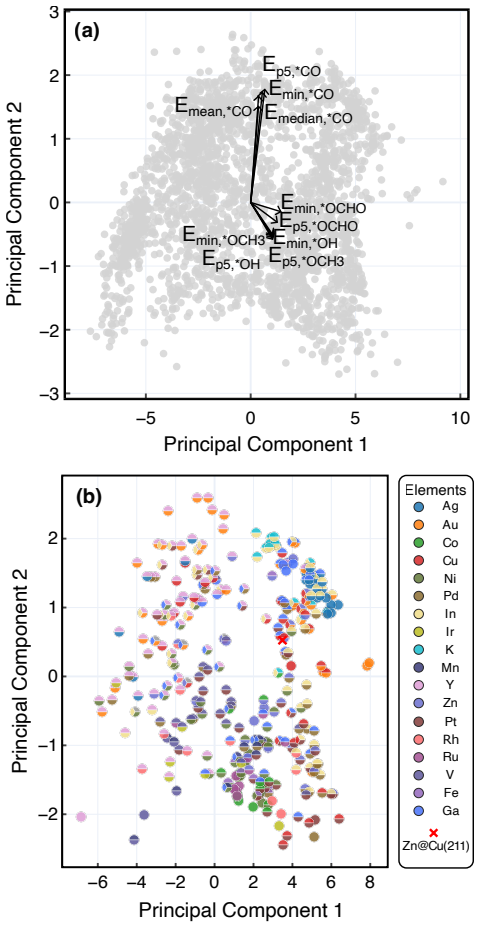
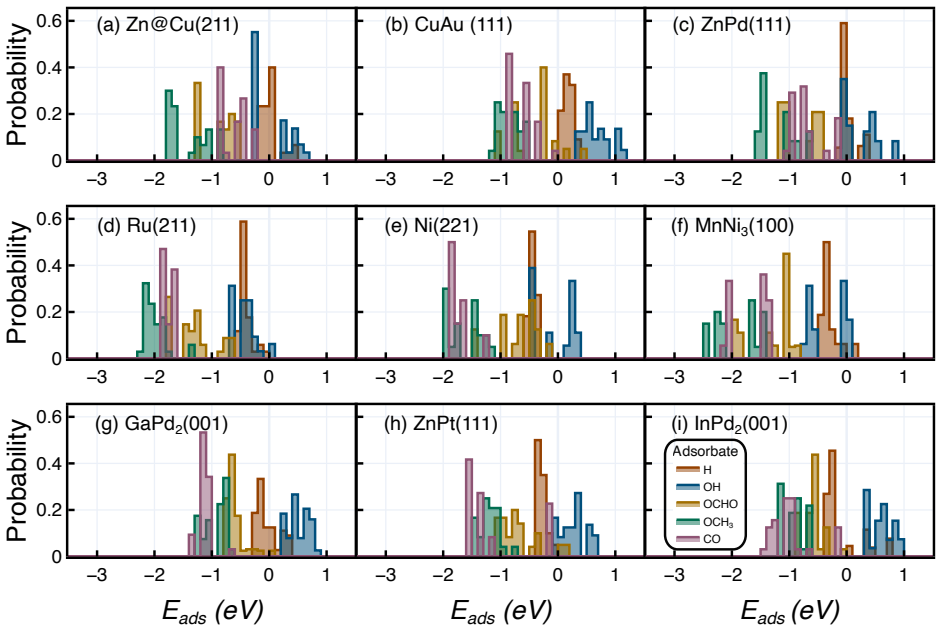
Adsorption energy distributions (AEDs) have emerged as a powerful and increasingly adopted descriptor for catalytic performance in high-entropy alloys and, more recently, in conventional metallic alloy nanocrystal catalysts. By accounting for diverse adsorption sites and crystallographic facets, AEDs more fully represent nanoparticle-based catalytic surfaces and show strong promise for accelerating rational design and discovery of heterogeneous catalysts, especially for CO$_2$ hydrogenation. However, previous approaches have not sufficiently resolved facet-specific contributions, despite the catalytic significance and prevalence of certain Miller planes in nanoscale catalysts, limiting their applicability in predicting activity and selectivity. Here, we introduce an updated facet-resolved framework for predicting catalytic activity, which also enables insight into selectivity toward C1 products. Universal machine-learned force fields trained on Open Catalyst Project data were employed to compute adsorption energetics across 226 experimentally observed metals, binary alloys, and ternary alloys, encompassing 1.4 million adsorption sites on 2,626 crystallographically distinct surfaces. Using statistical and unsupervised learning techniques, we analyzed facet-specific AEDs to identify highly active and methanol-selective facets. Our approach provides insight into the relationship between structure and catalytic performance metrics like activity and selectivity, and presents a set of alloy compositions and their respective surface orientations for experimental validation toward highly selective CO$_2$ hydrogenation.
Editorial analysis
A structured set of objections, weighed in public.
Referee Report
Summary. The manuscript introduces a facet-resolved framework for CO2 hydrogenation catalysis on alloy nanocatalysts. It employs universal ML force fields trained on Open Catalyst Project data to compute adsorption energy distributions (AEDs) over 1.4 million sites on 2,626 crystallographically distinct surfaces spanning 226 metals, binary alloys, and ternary alloys. Statistical analysis and unsupervised learning are then applied to facet-specific AEDs to predict activity and C1 (methanol) selectivity, yielding a shortlist of alloy compositions and surface orientations recommended for experimental validation.
Significance. If the MLFF accuracy holds for the studied alloys, the work offers a scalable, high-throughput route to screen nanoparticle catalysts while explicitly resolving Miller-plane contributions to activity and selectivity. The scale (1.4 million sites) and use of unsupervised methods on facet-resolved AEDs represent a clear advance over prior AED descriptors that lacked this resolution. The resulting candidate list provides concrete, falsifiable predictions for experiment.
major comments (3)
- [§3 and §4.1] §3 (Computational Methods) and §4.1 (Results on AEDs): No direct DFT benchmarks or error statistics are reported for the universal MLFFs on the binary and ternary alloy compositions or the specific Miller planes examined. Systematic deviations in adsorption energies for out-of-distribution alloys would propagate directly into the AED shapes, the unsupervised clustering, and the final activity/selectivity rankings, undermining the central claim that the framework predicts performance.
- [§4.3] §4.3 (Selectivity Analysis): The mapping from facet-resolved AED statistics to C1 selectivity is performed via unsupervised clustering without explicit kinetic modeling, coverage effects, or comparison to experimental turnover frequencies. This leaves the 'methanol-selective' designation as a correlation whose predictive power for real catalysts remains untested within the manuscript.
- [Table 1 and Figure 5] Table 1 and Figure 5: The reported activity and selectivity scores for the top candidate alloys lack uncertainty quantification arising from MLFF prediction variance or from the finite sampling of adsorption sites per facet. Without these, it is unclear whether the identified 'highly active and selective' surfaces are statistically distinguishable from the broader distribution.
minor comments (3)
- [Abstract and Introduction] The abstract states that the framework is 'updated' but does not cite the specific prior AED work being extended; a brief reference in the introduction would improve context.
- [§4.2] Notation for the statistical descriptors (e.g., mean, variance, skewness of AEDs) is introduced without a dedicated table or equation block, making it harder to reproduce the exact clustering procedure.
- [Figures 3-4] Figure captions for the surface visualizations could more explicitly state the Miller indices and alloy stoichiometry shown in each panel.
Simulated Author's Rebuttal
We thank the referee for their thorough and constructive review of our manuscript. We have addressed each major comment below and revised the manuscript accordingly where possible to strengthen the presentation and clarify limitations.
read point-by-point responses
-
Referee: [§3 and §4.1] §3 (Computational Methods) and §4.1 (Results on AEDs): No direct DFT benchmarks or error statistics are reported for the universal MLFFs on the binary and ternary alloy compositions or the specific Miller planes examined. Systematic deviations in adsorption energies for out-of-distribution alloys would propagate directly into the AED shapes, the unsupervised clustering, and the final activity/selectivity rankings, undermining the central claim that the framework predicts performance.
Authors: We agree that explicit validation on the specific alloys and facets is important for confidence in the results. The MLFFs employed are the universal models from the Open Catalyst Project, whose training set includes a broad range of binary and ternary alloys and whose validation statistics are reported in the original OCP publications. To directly address the concern, the revised manuscript now includes a new subsection in §3 reporting MAE and RMSE values for adsorption energies on a representative subset of 50 binary and ternary compositions drawn from our dataset (including the Miller planes appearing in the top candidates). These benchmarks were obtained by performing additional DFT calculations on the same structures used for MLFF evaluation and confirm that errors remain within the range reported for the OCP models, with no systematic bias that would alter the relative ordering of AED statistics or the unsupervised clustering outcomes. revision: yes
-
Referee: [§4.3] §4.3 (Selectivity Analysis): The mapping from facet-resolved AED statistics to C1 selectivity is performed via unsupervised clustering without explicit kinetic modeling, coverage effects, or comparison to experimental turnover frequencies. This leaves the 'methanol-selective' designation as a correlation whose predictive power for real catalysts remains untested within the manuscript.
Authors: We acknowledge that the selectivity assignment is descriptor-based rather than derived from full microkinetic modeling. Our unsupervised clustering on facet-resolved AEDs is intended to identify statistical patterns that prior literature has linked to C1 selectivity in CO2 hydrogenation; it is not presented as a substitute for explicit kinetics. In the revised §4.3 we have added an explicit limitations paragraph stating that the methanol-selective label reflects correlation with AED features known to favor methanol pathways and that coverage effects are only implicitly captured through the breadth of the distributions. We also note that the method is designed for high-throughput screening to generate falsifiable predictions for experimental validation, consistent with the scale of 1.4 million sites examined. Full kinetic modeling of the shortlisted candidates is left for future targeted studies. revision: partial
-
Referee: [Table 1 and Figure 5] Table 1 and Figure 5: The reported activity and selectivity scores for the top candidate alloys lack uncertainty quantification arising from MLFF prediction variance or from the finite sampling of adsorption sites per facet. Without these, it is unclear whether the identified 'highly active and selective' surfaces are statistically distinguishable from the broader distribution.
Authors: We agree that uncertainty estimates improve interpretability of the rankings. In the revised manuscript we have updated Table 1 and Figure 5 to include error bars on both activity and selectivity scores. These are obtained from (i) the standard deviation across an ensemble of MLFF predictions where available and (ii) bootstrap resampling (1000 iterations) of the adsorption-site populations per facet. The updated figures show that the top-ranked surfaces remain statistically distinguishable from the mean of the full distribution at the 95 % confidence level. revision: yes
Circularity Check
No circularity: derivation uses external OCP-trained MLFFs and standard statistical methods on computed AEDs
full rationale
The paper's chain starts from universal ML force fields trained on the independent Open Catalyst Project dataset to generate 1.4 million adsorption energies across 226 alloys and 2626 surfaces. It then applies statistical and unsupervised learning to facet-resolved AEDs for activity/selectivity insights. No step reduces by construction to a fitted parameter defined by the target result, no self-citation is load-bearing for uniqueness or ansatz, and no renaming of known results occurs. The central claims about alloy compositions for experimental validation are derived from the external-data-driven computations rather than tautological inputs.
Axiom & Free-Parameter Ledger
axioms (2)
- domain assumption Universal machine-learned force fields trained on Open Catalyst Project data accurately capture adsorption energetics on experimentally observed metals, binary, and ternary alloys.
- domain assumption Facet-specific adsorption energy distributions are sufficient descriptors for both catalytic activity and selectivity toward C1 products.
Reference graph
Works this paper leans on
-
[1]
and Zhong, Qin and Wang, Yujun and Russell, Christopher K
Ye, Run-Ping and Ding, Jie and Gong, Weibo and Argyle, Morris D. and Zhong, Qin and Wang, Yujun and Russell, Christopher K. and Xu, Zhenghe and Russell, Armistead G. and Li, Qiaohong and Fan, Maohong and Yao, Yuan-Gen , journal=
- [2]
-
[3]
npj Computational Materials , author =
Machine learning accelerated descriptor design for catalyst discovery in. npj Computational Materials , author =. doi:10.1038/s41524-025-01664-9 , language =
-
[4]
The. Chemical Reviews , author =. 2024 , note =. doi:10.1021/acs.chemrev.3c00148 , language =
-
[5]
How to. Joule , author =. 2019 , pages =. doi:10.1016/j.joule.2019.11.005 , language =
-
[6]
Proceedings of the National Academy of Sciences , author =
Density functional theory in surface chemistry and catalysis , volume =. Proceedings of the National Academy of Sciences , author =. 2011 , pages =. doi:10.1073/pnas.1006652108 , abstract =
-
[7]
Accounts of Chemical Research , author =
Large-. Accounts of Chemical Research , author =. 2020 , pages =. doi:10.1021/acs.accounts.0c00472 , language =
-
[8]
Tran, Richard and Lan, Janice and Shuaibi, Muhammed and Wood, Brandon M. and Goyal, Siddharth and Das, Abhishek and Heras-Domingo, Javier and Kolluru, Adeesh and Rizvi, Ammar and Shoghi, Nima and Sriram, Anuroop and Therrien, Félix and Abed, Jehad and Voznyy, Oleksandr and Sargent, Edward H. and Ulissi, Zachary and Zitnick, C. Lawrence , journal=. 2023 , ...
-
[9]
Lawrence and Ulissi, Zachary , year=
Chanussot, Lowik and Das, Abhishek and Goyal, Siddharth and Lavril, Thibaut and Shuaibi, Muhammed and Riviere, Morgane and Tran, Kevin and Heras-Domingo, Javier and Ho, Caleb and Hu, Weihua and Palizhati, Aini and Sriram, Anuroop and Wood, Brandon and Yoon, Junwoong and Parikh, Devi and Zitnick, C. Lawrence and Ulissi, Zachary , year=. Open. ACS Catalysis...
-
[10]
Nature Communications , author =
Visualizing the gas-sensitive structure of the. Nature Communications , author =. 2024 , note =. doi:10.1038/s41467-024-48168-6 , language =
-
[11]
Physical Review Materials , author =. 2018 , pages =. doi:10.1103/PhysRevMaterials.2.083802 , language =
-
[12]
Materials genes of heterogeneous catalysis from clean experiments and artificial intelligence , volume =. MRS Bulletin , author =. 2021 , keywords =. doi:10.1557/s43577-021-00165-6 , language =
-
[13]
and Barroso-Luque, Luis and Levine, Daniel S
Fu, Xiang and Wood, Brandon M. and Barroso-Luque, Luis and Levine, Daniel S. and Gao, Meng and Dzamba, Misko and Zitnick, C. Lawrence , month = feb, year =. Learning. doi:10.48550/arXiv.2502.12147 , urldate =
-
[15]
The Journal of Physical Chemistry C , author =
Adapting. The Journal of Physical Chemistry C , author =. 2024 , pages =. doi:10.1021/acs.jpcc.4c01704 , language =
-
[16]
Shyam Kattel and Pedro J. Ramírez and Jingguang G. Chen and José A. Rodriguez and Ping Liu , title =. Science , volume =. 2017 , doi =
work page 2017
-
[17]
The state of zinc in methanol synthesis over a. Science , author =. 2022 , keywords =. doi:10.1126/science.abj7747 , language =
-
[18]
The. Science , author =. 2012 , note =. doi:10.1126/science.1219831 , number =
-
[19]
Design of catalysts for selective. Nature Synthesis , author =. 2025 , note =. doi:10.1038/s44160-025-00747-1 , language =
-
[20]
Ramdas, Aaditya and Garc. On. Entropy , volume=. 2017 , publisher=
work page 2017
-
[21]
Principal components analysis (PCA) , journal =
Andrzej Maćkiewicz and Waldemar Ratajczak , keywords =. Principal components analysis (PCA) , journal =. 1993 , issn =. doi:https://doi.org/10.1016/0098-3004(93)90090-R , url =
-
[22]
Jain, Anubhav and Ong, Shyue Ping and Hautier, Geoffroy and Chen, Wei and Richards, William Davidson and Dacek, Stephen and Cholia, Shreyas and Gunter, Dan and Skinner, David and Ceder, Gerbrand and Persson, Kristin A. , title = ". APL Materials , volume =. 2013 , month =. doi:10.1063/1.4812323 , url =
-
[23]
Virtanen, Pauli and Gommers, Ralf and Oliphant, Travis E. and Haberland, Matt and Reddy, Tyler and Cournapeau, David and Burovski, Evgeni and Peterson, Pearu and Weckesser, Warren and Bright, Jonathan and. Nature Methods , year =
-
[24]
FAIR-Chem , title =. GitHub repository , url =. 2024 , publisher =
work page 2024
-
[25]
Hydrogenation of. Science , author =. 2025 , note =. doi:10.1126/science.adn9388 , number =
-
[26]
Benavides-Hernández, Jorge and Dumeignil, Franck , title =. ACS Catalysis , volume =. 2024 , doi =
work page 2024
-
[27]
The Canadian Journal of Chemical Engineering , author =
Experimental methods in chemical engineering:. The Canadian Journal of Chemical Engineering , author =. 2021 , pages =. doi:10.1002/cjce.24089 , language =
-
[28]
Mou, Li-Hui and Han, TianTian and Smith, Pieter E. S. and Sharman, Edward and Jiang, Jun , title =. Advanced Science , volume =. doi:https://doi.org/10.1002/advs.202301020 , url =. https://onlinelibrary.wiley.com/doi/pdf/10.1002/advs.202301020 , year =
-
[29]
Levchenko and Matthias Scheffler and Karsten Reuter , title =
Mie Andersen and Sergey V. Levchenko and Matthias Scheffler and Karsten Reuter , title =. ACS Catalysis , year =. doi:10.1021/acscatal.8b04478 , url =
-
[30]
Nellaiappan, Subramanian and Katiyar, Nirmal Kumar and Kumar, Ritesh and Parui, Arko and Malviya, Kirtiman Deo and Pradeep, K. G. and Singh, Abhishek K. and Sharma, Sudhanshu and Tiwary, Chandra Sekhar and Biswas, Krishanu , title =. ACS Catalysis , volume =. 2020 , doi =
work page 2020
-
[31]
High-. ACS Catalysis , author =. 2020 , pages =. doi:10.1021/acscatal.9b04343 , language =
-
[32]
Nature Communications , author =
Accelerated discovery of multi-elemental reverse water-gas shift catalysts using extrapolative machine learning approach , volume =. Nature Communications , author =. 2023 , note =. doi:10.1038/s41467-023-41341-3 , language =
-
[33]
npj Computational Materials , author =
Harnessing machine learning for high-entropy alloy catalysis: a focus on adsorption energy prediction , volume =. npj Computational Materials , author =. 2025 , note =. doi:10.1038/s41524-025-01579-5 , language =
-
[34]
Lawrence and Das, Abhishek , month = sep, year =
Gasteiger, Johannes and Shuaibi, Muhammed and Sriram, Anuroop and Günnemann, Stephan and Ulissi, Zachary and Zitnick, C. Lawrence and Das, Abhishek , month = sep, year =
-
[35]
Nature Communications , author =
Data-driven discovery of electrocatalysts for. Nature Communications , author =. 2023 , note =. doi:10.1038/s41467-023-43118-0 , language =
-
[36]
Accounts of Chemical Research , author =
Achieving. Accounts of Chemical Research , author =. 2022 , note =. doi:10.1021/acs.accounts.2c00058 , number =
-
[37]
Applied Catalysis B: Environmental , author =
From electricity to fuels:. Applied Catalysis B: Environmental , author =. 2020 , keywords =. doi:10.1016/j.apcatb.2020.119384 , urldate =
-
[38]
Journal of Open Source Software , author =. 2020 , pages =. doi:10.21105/joss.01944 , abstract =
-
[39]
Hammer, B. and Hansen, L. B. and N. Improved adsorption energetics within density-functional theory using revised. Phys. Rev. B , volume =. 1999 , month =. doi:10.1103/PhysRevB.59.7413 , url =
-
[40]
Ab initio molecular-dynamics simulation of the liquid-metal--amorphous-semiconductor transition in germanium , author =. Phys. Rev. B , volume =. 1994 , month =. doi:10.1103/PhysRevB.49.14251 , url =
-
[41]
Efficient iterative schemes for ab initio total-energy calculations using a plane-wave basis set , author =. Phys. Rev. B , volume =. 1996 , month =. doi:10.1103/PhysRevB.54.11169 , url =
-
[42]
Atomate: A high-level interface to generate, execute, and analyze computational materials science workflows , journal =. 2017 , issn =. doi:https://doi.org/10.1016/j.commatsci.2017.07.030 , url =
-
[43]
Jain, Anubhav and Ong, Shyue Ping and Chen, Wei and Medasani, Bharat and Qu, Xiaohui and Kocher, Michael and Brafman, Miriam and Petretto, Guido and Rignanese, Gian-Marco and Hautier, Geoffroy and Gunter, Daniel and Persson, Kristin A. , title =. Concurrency and Computation: Practice and Experience , volume =. doi:https://doi.org/10.1002/cpe.3505 , url =....
-
[44]
Shyue Ping Ong and William Davidson Richards and Anubhav Jain and Geoffroy Hautier and Michael Kocher and Shreyas Cholia and Dan Gunter and Vincent L. Chevrier and Kristin A. Persson and Gerbrand Ceder , keywords =. Python Materials Genomics (pymatgen): A robust, open-source python library for materials analysis , journal =. 2013 , issn =. doi:https://doi...
-
[45]
Large language model enhanced corpus of. Scientific Data , author =. 2024 , note =. doi:10.1038/s41597-024-03180-9 , language =
-
[46]
ACS Catalysis , author =. 2025 , pages =. doi:10.1021/acscatal.5c05527 , language =
-
[47]
Catalytic behavior of metal catalysts in high-temperature. Scientific Reports , author =. 2017 , note =. doi:10.1038/srep41207 , language =
-
[49]
Solid State Sciences , author =
Indium decorated nanoporous. Solid State Sciences , author =. 2022 , pages =. doi:10.1016/j.solidstatesciences.2022.106916 , language =
-
[51]
Ru nanoparticles stabilized by ionic liquids supported onto silica: highly active catalysts for low-temperature. Green Chemistry , author =. 2018 , note =. doi:10.1039/C8GC02337A , language =
-
[52]
The Journal of Physical Chemistry Letters , author =
Tuning. The Journal of Physical Chemistry Letters , author =. 2020 , note =. doi:10.1021/acs.jpclett.0c02011 , number =
-
[53]
Chai, Shanshan and Men, Yong and Wang, Jinguo and Liu, Shuang and Song, Qiaoling and An, Wei and Kolb, Gunther , month = oct, year =. Boosting. Journal of. doi:10.1016/j.jcou.2019.05.031 , urldate =
-
[55]
Flame. ACS Catalysis , author =. 2025 , pages =. doi:10.1021/acscatal.5c02380 , language =
-
[56]
Catalysis Science & Technology , author =
Highly active. Catalysis Science & Technology , author =. 2016 , note =. doi:10.1039/C6CY01252C , language =
-
[57]
The Journal of Physical Chemistry C , author =
Kinetic and. The Journal of Physical Chemistry C , author =. 2013 , note =. doi:10.1021/jp401566m , number =
-
[58]
Applied Surface Science , author =
Temperature-dependent surface free energy and the. Applied Surface Science , author =. 2020 , pages =. doi:10.1016/j.apsusc.2019.144859 , language =
-
[59]
Wulff. Nano Letters , author =. 2011 , note =. doi:10.1021/nl2018146 , number =
-
[60]
How. ACS Catalysis , author =. 2025 , pages =. doi:10.1021/acscatal.5c02008 , language =
-
[61]
Catalysis Science & Technology , author =
Scaling relations between adsorption energies for computational screening and design of catalysts , volume =. Catalysis Science & Technology , author =. 2014 , note =. doi:10.1039/C4CY00335G , language =
-
[62]
Accounts of Chemical Research , author =
Combining. Accounts of Chemical Research , author =. 2020 , note =. doi:10.1021/acs.accounts.0c00340 , number =
-
[63]
npj Computational Materials , author =
A high-throughput framework for determining adsorption energies on solid surfaces , volume =. npj Computational Materials , author =. 2017 , note =. doi:10.1038/s41524-017-0017-z , language =
-
[64]
Accelerated discovery of. Joule , author =. 2025 , note =. doi:10.1016/j.joule.2025.102213 , language =
-
[65]
Feng, Yuqing and Chen, Yushun and Zheng, Li and Chen, Xuetao and Li, Tan and Zhao, Wenbo , month = aug, year =. Descriptors construction and application in catalytic site design , volume =. iScience , publisher =. doi:10.1016/j.isci.2025.113080 , language =
-
[67]
Journal of CO2 Utilization , author =
Thermal, electrochemical, and photochemical conversion of. Journal of CO2 Utilization , author =. 2013 , keywords =. doi:10.1016/j.jcou.2013.03.004 , urldate =
-
[68]
Journal of Catalysis , author =
From the. Journal of Catalysis , author =. 2015 , keywords =. doi:10.1016/j.jcat.2014.12.033 , urldate =
-
[69]
Journal of Physics: Condensed Matter , author =
Using scaling relations to understand trends in the catalytic activity of transition metals , volume =. Journal of Physics: Condensed Matter , author =. 2008 , pages =. doi:10.1088/0953-8984/20/6/064239 , language =
-
[70]
Sun, Ruiyan and Liao, Yuhe and Bai, Shao-Tao and Zheng, Mingyuan and Zhou, Cheng and Zhang, Tao and Sels, Bert F. , month = mar, year =. Heterogeneous catalysts for. Energy & Environmental Science , publisher =. doi:10.1039/D0EE03575K , language =
-
[71]
Journal of Cleaner Production , author =
Meta-analysis approach for understanding the characteristics of. Journal of Cleaner Production , author =. 2022 , pages =. doi:10.1016/j.jclepro.2022.130653 , language =
-
[72]
Disentangling the activity-selectivity trade-off in. Chem , author =. 2026 , keywords =. doi:10.1016/j.chempr.2026.102942 , language =
-
[73]
Hu, B.; Guild, C.; Suib, S. L. Thermal, electrochemical, and photochemical conversion of CO2 to fuels and value-added products. Journal of CO2 Utilization 2013, 1, 18--27
work page 2013
-
[74]
D.; Zhong, Q.; Wang, Y.; Russell, C
Ye, R.-P.; Ding, J.; Gong, W.; Argyle, M. D.; Zhong, Q.; Wang, Y.; Russell, C. K.; Xu, Z.; Russell, A. G.; Li, Q.; Fan, M.; Yao, Y.-G. CO _2 hydrogenation to high-value products via heterogeneous catalysis. Nature Communications 2019, 10
work page 2019
-
[75]
How to Measure the Reaction Performance of Heterogeneous Catalytic Reactions Reliably
Zhang, M.; Wang, M.; Xu, B.; Ma, D. How to Measure the Reaction Performance of Heterogeneous Catalytic Reactions Reliably . Joule 2019, 3, 2876--2883
work page 2019
-
[76]
Beck, A.; Newton, M. A.; Water, L. G. A. v. d.; Bokhoven, J. A. v. The Enigma of Methanol Synthesis by Cu / ZnO / Al2O3 - Based Catalysts . Chemical Reviews 2024, Publisher: American Chemical Society
work page 2024
-
[77]
Ye, J.; Dimitratos, N.; Rossi, L. M.; Thonemann, N.; Beale, A. M.; Wojcieszak, R. Hydrogenation of CO2 for sustainable fuel and chemical production. Science 2025, 387, eadn9388, Publisher: American Association for the Advancement of Science
work page 2025
-
[78]
Bahri, S.; Pathak, S.; Singhahluwalia, A.; Malav, P.; Upadhyayula, S. Meta-analysis approach for understanding the characteristics of CO2 reduction catalysts for renewable fuel production. Journal of Cleaner Production 2022, 339, 130653
work page 2022
-
[79]
Zada, H.; Yu, J.; Fang, C.; Jian Sun Disentangling the activity-selectivity trade-off in CO2 hydrogenation to methanol. Chem 2026, 102942
work page 2026
-
[80]
Benavides-Hernández, J.; Dumeignil, F. From Characterization to Discovery: Artificial Intelligence, Machine Learning and High-Throughput Experiments for Heterogeneous Catalyst Design. ACS Catalysis 2024, 14, 11749--11779
work page 2024
-
[81]
Ortega, C.; Otyuskaya, D.; Ras, E.; Virla, L. D.; Patience, G. S.; Dathe, H. Experimental methods in chemical engineering: High throughput catalyst testing — HTCT . The Canadian Journal of Chemical Engineering 2021, 99, 1288--1306
work page 2021
-
[82]
Dongapure, P.; Tekawadia, J.; Thundiyil, S.; Caha, I.; Deepak, F. L.; Devi, R. N. Mechanistic Insights into Near Ambient Pressure Activity of Intermetallic NiZn / TiO2 Catalyst for CO2 Conversion to Methanol . ChemCatChem 2023, 15, e202201150, \_eprint: https://onlinelibrary.wiley.com/doi/pdf/10.1002/cctc.202201150
-
[83]
J.; Vojvodic, A.; Hummelshøj, J
Medford, A. J.; Vojvodic, A.; Hummelshøj, J. S.; Voss, J.; Abild-Pedersen, F.; Studt, F.; Bligaard, T.; Nilsson, A.; Nørskov, J. K. From the Sabatier principle to a predictive theory of transition-metal heterogeneous catalysis. Journal of Catalysis 2015, 328, 36--42
work page 2015
-
[84]
K.; Abild-Pedersen, F.; Studt, F.; Bligaard, T
Nørskov, J. K.; Abild-Pedersen, F.; Studt, F.; Bligaard, T. Density functional theory in surface chemistry and catalysis. Proceedings of the National Academy of Sciences 2011, 108, 937--943
work page 2011
-
[85]
Jones, G.; Bligaard, T.; Abild-Pedersen, F.; Nørskov, J. K. Using scaling relations to understand trends in the catalytic activity of transition metals. Journal of Physics: Condensed Matter 2008, 20, 064239
work page 2008
discussion (0)
Sign in with ORCID, Apple, or X to comment. Anyone can read and Pith papers without signing in.