Recognition: 2 theorem links
· Lean TheoremTransmission resonances in silicon subwavelength grating slot waveguide with functional host material for sensing applications
Pith reviewed 2026-05-11 02:02 UTC · model grok-4.3
The pith
A silicon subwavelength grating slot waveguide filled with PHMB detects CO2 at 12.9 pm/ppm sensitivity through strong light confinement in the functional material.
A machine-rendered reading of the paper's core claim, the machinery that carries it, and where it could break.
Core claim
Beyond the photonic bandgap of the SWG slot waveguide, transmission resonances arise that are sensitive to refractive index variations in the PHMB functional material induced by CO2 infiltration, yielding a simulated sensitivity of 12.9 pm/ppm due to strong light confinement in the filled slot gap.
What carries the argument
The subwavelength grating slot waveguide with PHMB filling the slot gap and inter-pillar spaces, which supports transmission resonances outside the photonic bandgap that shift with refractive index changes in the functional material.
Load-bearing premise
The refractive index change of PHMB upon CO2 infiltration is accurately modeled and the simulated transmission resonances remain observable in a real fabricated device without major losses or imperfections.
What would settle it
Fabricate the described silicon SWG slot waveguide device and measure the actual wavelength shift of the transmission resonance as a function of CO2 concentration to determine whether the shift reaches the simulated 12.9 pm per ppm.
Figures




read the original abstract
A highly sensitive and selective CO2 gas sensor is presented based on a subwavelength grating (SWG) slot waveguide. Polyhexamethylene biguanide (PHMB) as a functional material fills the slot gap as well as the space between the silicon pillars of the SWG structure. Beyond the photonic bandgap of the SWG slot waveguide, there are transmission resonances sensitive to the refractive index changes of PHMB due to the infiltration of CO2 molecules into the functional material. The numerical simulations indicate that the sensitivity of the structure is S=12.9 pm/ppm which is considerably higher than the previously designed gas sensors based on functional materials. The higher sensitivity of the proposed sensor is attributed to the strong confinement of the light in the slot gap filled with functional material while previous designs have limited light-matter interaction by placing the functional material in the cladding. The proposed structure may be used to design various sensors by utilizing different functional material sensitive to the desired analyte.
Editorial analysis
A structured set of objections, weighed in public.
Referee Report
Summary. The manuscript proposes a CO2 gas sensor based on a silicon subwavelength grating slot waveguide in which PHMB functional material fills both the slot gap and the spaces between silicon pillars. Transmission resonances located beyond the photonic bandgap are claimed to be sensitive to refractive-index changes in the PHMB caused by CO2 infiltration; numerical simulations are reported to yield a sensitivity of S = 12.9 pm/ppm, attributed to strong optical confinement within the functional-material-filled slot region.
Significance. If the underlying material response and numerical results are confirmed, the design offers a concrete route to higher sensitivity than earlier functional-material sensors by placing the active medium directly in the high-field slot region rather than in the cladding. The modular concept of swapping functional materials for different analytes is potentially extensible and could be of interest to the photonic-sensing community.
major comments (2)
- [Abstract] Abstract: the headline sensitivity S = 12.9 pm/ppm is stated to result from numerical simulations of resonance shifts, yet no information is supplied on the electromagnetic solver, mesh density, convergence criteria, or the dispersion models employed for silicon and PHMB. Because the quoted sensitivity scales directly with the modeled index change, this omission renders the central performance metric unverifiable.
- [Results] Results section (sensitivity calculation): the resonance shift and therefore S = 12.9 pm/ppm rest on an assumed refractive-index response Δn(PHMB, CO2 concentration). No experimental datum, literature reference, or functional form for this Δn is provided; if the assumed index change is overstated or infiltration is incomplete, the reported sensitivity scales proportionally with the error.
minor comments (2)
- [Abstract] Abstract: the phrase 'beyond the photonic bandgap' is used without specifying the operating wavelength window or the exact resonance wavelengths at which the sensitivity is evaluated.
- [Abstract] The comparison to 'previously designed gas sensors' would be strengthened by a brief table or explicit citations listing the sensitivities of those prior devices.
Simulated Author's Rebuttal
We thank the referee for the constructive and detailed comments on our manuscript. The points raised regarding the numerical methodology and the basis for the refractive-index change are well taken and will improve the clarity and verifiability of the work. We address each major comment below and commit to the indicated revisions.
read point-by-point responses
-
Referee: [Abstract] Abstract: the headline sensitivity S = 12.9 pm/ppm is stated to result from numerical simulations of resonance shifts, yet no information is supplied on the electromagnetic solver, mesh density, convergence criteria, or the dispersion models employed for silicon and PHMB. Because the quoted sensitivity scales directly with the modeled index change, this omission renders the central performance metric unverifiable.
Authors: We agree that the absence of these simulation parameters limits independent verification of the reported sensitivity. The original manuscript focused on the device concept rather than the computational details. In the revised version we will add a dedicated paragraph (or short subsection) describing the electromagnetic solver, mesh density, convergence criteria, and the dispersion models used for silicon and PHMB. This will directly substantiate the value S = 12.9 pm/ppm. revision: yes
-
Referee: [Results] Results section (sensitivity calculation): the resonance shift and therefore S = 12.9 pm/ppm rest on an assumed refractive-index response Δn(PHMB, CO2 concentration). No experimental datum, literature reference, or functional form for this Δn is provided; if the assumed index change is overstated or infiltration is incomplete, the reported sensitivity scales proportionally with the error.
Authors: The referee correctly notes that the sensitivity scales directly with the assumed Δn of PHMB. The manuscript does not explicitly state the functional form or cite a reference for this index change, which is an omission. In the revision we will specify the linear model employed for Δn versus CO2 concentration, provide the relevant literature reference(s) for the PHMB-CO2 interaction, and add a brief discussion acknowledging that the quoted sensitivity is proportional to this value and that experimental confirmation of the index shift would strengthen the claims. revision: yes
Circularity Check
No significant circularity; sensitivity is direct output of numerical simulation on modeled index shift.
full rationale
The paper reports S=12.9 pm/ppm as the result of numerical simulations of transmission resonance shifts when the refractive index of PHMB changes due to CO2 infiltration. No equations, derivations, or self-referential steps are shown that reduce this sensitivity value to a fitted parameter, self-citation chain, or input by construction. The central performance metric is presented as an external simulation output applied to a described waveguide geometry and an assumed material response; the index change itself is treated as an external modeling input rather than derived from the paper's own results or prior self-citations. No load-bearing uniqueness theorems, ansatzes smuggled via citation, or renaming of known results appear in the provided text. The derivation chain is therefore self-contained against external simulation benchmarks.
Axiom & Free-Parameter Ledger
Lean theorems connected to this paper
-
IndisputableMonolith/Foundation/RealityFromDistinction.leanreality_from_one_distinction unclear?
unclearRelation between the paper passage and the cited Recognition theorem.
The numerical simulations indicate that the sensitivity of the structure is S=12.9 pm/ppm... attributed to the strong confinement of the light in the slot gap filled with functional material
-
IndisputableMonolith/Cost/FunctionalEquation.leanwashburn_uniqueness_aczel unclear?
unclearRelation between the paper passage and the cited Recognition theorem.
center of the photonic bandgap of the SWG structure is λB=2Λneff... bandwidth... determined by [equations with κ, ng]
What do these tags mean?
- matches
- The paper's claim is directly supported by a theorem in the formal canon.
- supports
- The theorem supports part of the paper's argument, but the paper may add assumptions or extra steps.
- extends
- The paper goes beyond the formal theorem; the theorem is a base layer rather than the whole result.
- uses
- The paper appears to rely on the theorem as machinery.
- contradicts
- The paper's claim conflicts with a theorem or certificate in the canon.
- unclear
- Pith found a possible connection, but the passage is too broad, indirect, or ambiguous to say the theorem truly supports the claim.
Reference graph
Works this paper leans on
-
[1]
Introduction SWG in the silicon-on-insulator (SOI) platform consists of a periodic arrangement of high-index inclusion and low-index host materials with a period of Λ. This periodic arrangement of the two different materials provides an innovative tool for controlling light propagation and refractive index engineering. When the light, with an operating wa...
-
[2]
Within the bandgap of the structure, the light is reflected back
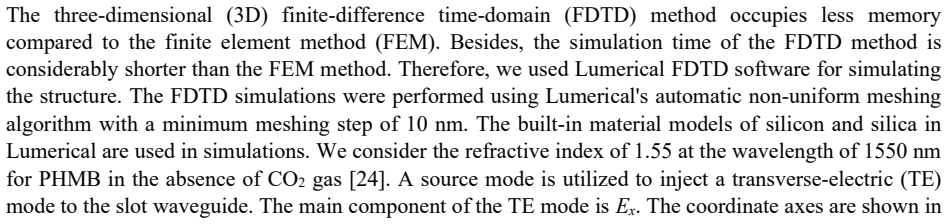
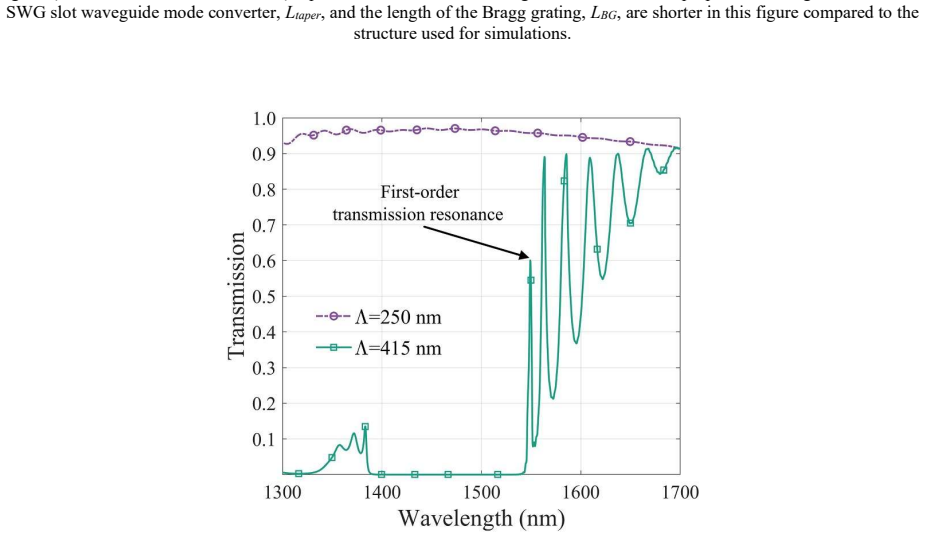
Subwavelength grating slot waveguide To design transmission resonances based on the SWG slot waveguide for sensing applications, we choose the geometrical parameters of the SWG structure to operate in the Bragg reflection regime. Within the bandgap of the structure, the light is reflected back. However, beyond the bandgap, some transmission peaks appear d...
-
[3]
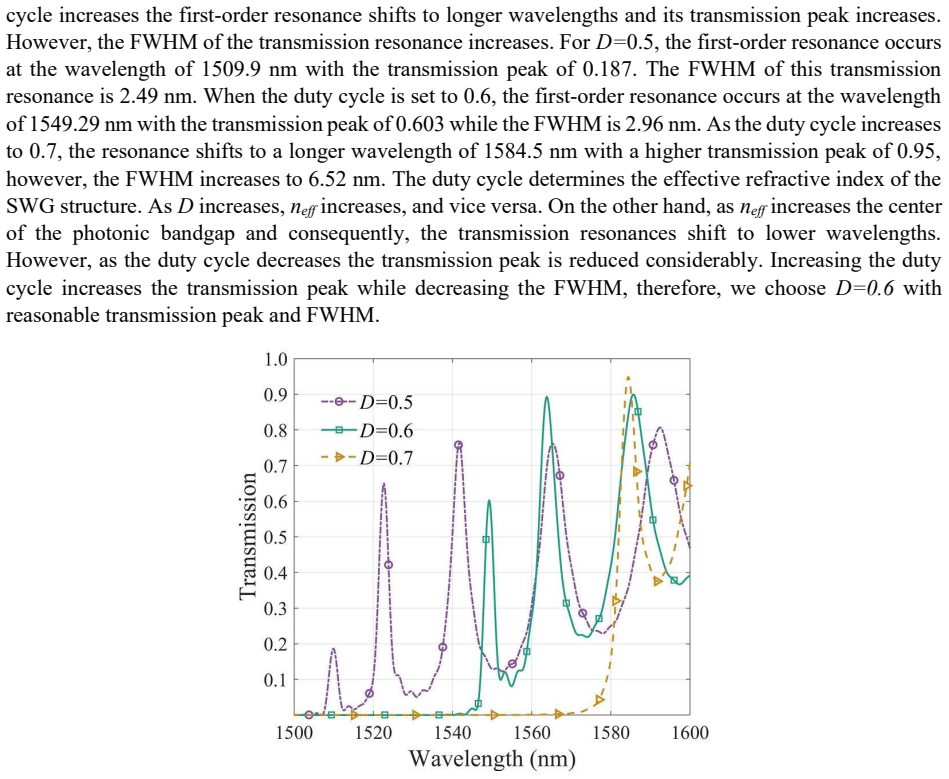
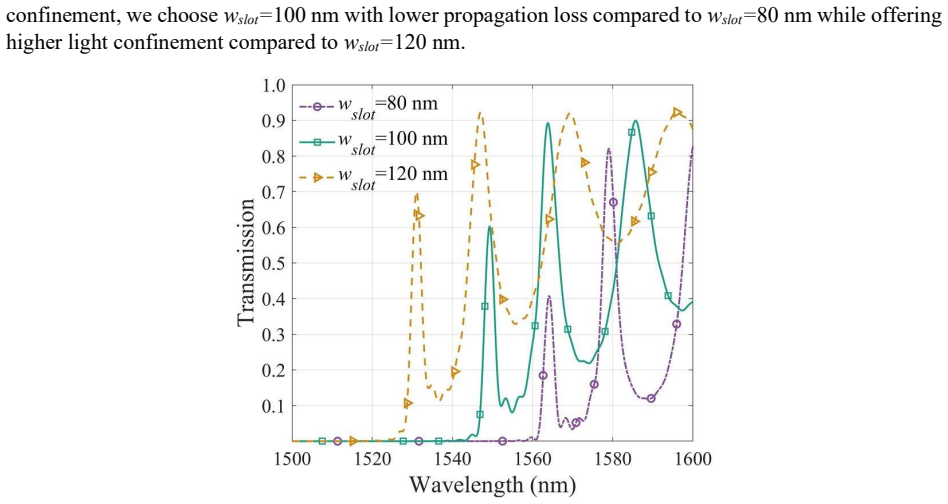
Results and discussion The location of the resonance peaks depends on the geometrical parameters of the SWG slot waveguide. In the following subsections, we investigate the effect of geometrical parameters on the transmission resonances of the proposed structure. In each case, we vary one of the geometrical parameters while the other parameters are fixed....
-
[4]
is S=2.4×10⁻³ pm/ppm while in our design the calculated sensitivity is S=12.9 pm/ppm. In a dual-gas sensor based on microring resonators, the measured sensitivity to the sensor to CO2, coated with a 620 nm- thick PHMB as the functional material, is S=4.83×10⁻⁴ pm/ppm [22]. The lower sensitivity of this sensor compared to the design of [21] is attributed t...
-
[5]
Subwavelength integrated photonics,
P. Cheben, R. Halir, J. H. Schmid, H. A. Atwater, and D. R. Smith, "Subwavelength integrated photonics," Nature 560, 565-572 (2018)
work page 2018
-
[6]
Analysis and design of grating couplers,
T. Tamir, and S.-T. Peng, "Analysis and design of grating couplers," Applied physics 14, 235-254 (1977)
work page 1977
-
[7]
Grating-assisted fiber to chip coupling for SOI photonic circuits,
S. Nambiar, P. Sethi, and S. K. Selvaraja, "Grating-assisted fiber to chip coupling for SOI photonic circuits," Applied Sciences 8, 1142 (2018)
work page 2018
-
[8]
M. Kuramoto, S. Kobayashi, T. Akagi, K. Tazawa, K. Tanaka, T. Saito, and T. Takeuchi, "High-power GaN- based vertical-cavity surface-emitting lasers with AlInN/GaN distributed Bragg reflectors," Applied Sciences 9, 416 (2019)
work page 2019
-
[9]
Toward commercial polymer fiber Bragg grating sensors: Review and applications,
C. Broadway, R. Min, A. G. Leal-Junior, C. Marques, and C. Caucheteur, "Toward commercial polymer fiber Bragg grating sensors: Review and applications," Journal of Lightwave Technology 37, 2605-2615 (2019)
work page 2019
-
[10]
N. L. Kazanskiy, S. N. Khonina, and M. A. Butt, "Subwavelength Grating Double Slot Waveguide Racetrack Ring Resonator for Refractive Index Sensing Application," Sensors 20, 3416 (2020)
work page 2020
-
[11]
S. H. Badri, and M. Gilarlue, "Silicon nitride waveguide devices based on gradient-index lenses implemented by subwavelength silicon grating metamaterials," Applied Optics 59, 5269-5275 (2020)
work page 2020
-
[12]
Coupling silica waveguides to photonic crystal waveguides through a multilayered Luneburg lens,
S. H. Badri, and M. Gilarlue, "Coupling silica waveguides to photonic crystal waveguides through a multilayered Luneburg lens," JOSA B 37, 104-109 (2020)
work page 2020
-
[13]
S. H. Badri, M. M. Gilarlue, and H. Taghipour-Farshi, "Rectangular Maxwell’s fisheye lens via transformation optics as a crossing medium for dissimilar waveguides," JOSA B 37, 2437-2443 (2020)
work page 2020
-
[14]
Ultrashort waveguide tapers based on Luneburg lens,
S. H. Badri, and M. M. Gilarlue, "Ultrashort waveguide tapers based on Luneburg lens," Journal of Optics 21, 125802 (2019)
work page 2019
-
[15]
S. H. Badri, M. Gilarlue, and S. Gavgani, "Ultra-thin silicon-on-insulator waveguide bend based on truncated Eaton lens implemented by varying the guiding layer thickness," Photonics and Nanostructures-Fundamentals and Applications 39, 100766 (2020)
work page 2020
-
[16]
Z. Ruan, N. Zhou, S. Zheng, X. Cao, Y. Long, L. Chen, and J. Wang, "Releasing the light field in subwavelength grating slot microring resonators for athermal and sensing applications," Nanoscale (2020)
work page 2020
-
[17]
Optical sensing by optimized silicon slot waveguides,
F. Dell’Olio, and V. M. Passaro, "Optical sensing by optimized silicon slot waveguides," Optics Express 15, 4977-4993 (2007)
work page 2007
-
[18]
Subwavelength grating slot (SWGS) waveguide on silicon platform,
Z. Ruan, L. Shen, S. Zheng, and J. Wang, "Subwavelength grating slot (SWGS) waveguide on silicon platform," Optics express 25, 18250-18264 (2017)
work page 2017
-
[19]
Design and analysis of slow-light Bloch slot waveguides for on-chip gas sensing,
G. Xu, J. Wang, Q. Ji, M. Yang, T. Huang, J. Pan, Y. Xie, and P. P. Shum, "Design and analysis of slow-light Bloch slot waveguides for on-chip gas sensing," JOSA B 37, 257-263 (2020)
work page 2020
-
[20]
Mode sensitivity analysis of subwavelength grating slot waveguides,
M. Odeh, K. Twayana, K. Sloyan, J. E. Villegas, S. Chandran, and M. S. Dahlem, "Mode sensitivity analysis of subwavelength grating slot waveguides," IEEE Photonics Journal 11, 1-10 (2019)
work page 2019
-
[21]
T. Jin, J. Zhou, and P. T. Lin, "Real-time and non-destructive hydrocarbon gas sensing using mid-infrared integrated photonic circuits," RSC Advances 10, 7452-7459 (2020)
work page 2020
-
[22]
S. N. Khonina, N. L. Kazanskiy, and M. A. Butt, "Evanescent field ratio enhancement of a modified ridge waveguide structure for methane gas sensing application," IEEE Sensors Journal 20, 8469-8476 (2020)
work page 2020
-
[23]
Opportunities for photonic integrated circuits in optical gas sensors,
A. Hänsel, and M. J. Heck, "Opportunities for photonic integrated circuits in optical gas sensors," Journal of Physics: Photonics 2, 012002 (2020)
work page 2020
-
[24]
H. Li, B. Sun, Y. Yuan, and J. Yang, "Guanidine derivative polymer coated microbubble resonator for high sensitivity detection of CO 2 gas concentration," Optics express 27, 1991-2000 (2019)
work page 1991
-
[25]
Silicon microring refractometric sensor for atmospheric CO 2 gas monitoring,
G. Mi, C. Horvath, M. Aktary, and V. Van, "Silicon microring refractometric sensor for atmospheric CO 2 gas monitoring," Optics express 24, 1773-1780 (2016)
work page 2016
-
[26]
Silicon photonic dual-gas sensor for H 2 and CO 2 detection,
G. Mi, C. Horvath, and V. Van, "Silicon photonic dual-gas sensor for H 2 and CO 2 detection," Optics Express 25, 16250-16259 (2017)
work page 2017
-
[27]
Compact silicon photonic refractometric sensor for atmospheric CO 2 gas monitoring,
G. Mi, C. Horvath, M. Aktary, and V. Van, "Compact silicon photonic refractometric sensor for atmospheric CO 2 gas monitoring," in 2015 IEEE Photonics Conference (IPC)(IEEE2015), pp. 619-620
work page 2015
-
[28]
Optical Micro-ring Resonator for Detection of Carbon Dioxide Gas,
K. P. Koushik, and S. Malathi, "Optical Micro-ring Resonator for Detection of Carbon Dioxide Gas," in Emerging Trends in Photonics, Signal Processing and Communication Engineering(Springer, 2020), pp. 157-161
work page 2020
-
[29]
Strongly resonant transmission of electromagnetic radiation in periodic anisotropic layered media,
A. Chabanov, "Strongly resonant transmission of electromagnetic radiation in periodic anisotropic layered media," Physical Review A 77, 033811 (2008)
work page 2008
-
[30]
Gigantic transmission band-edge resonance in periodic stacks of anisotropic layers,
A. Figotin, and I. Vitebskiy, "Gigantic transmission band-edge resonance in periodic stacks of anisotropic layers," Physical review E 72, 036619 (2005)
work page 2005
-
[31]
D. Oser, D. Pérez-Galacho, C. Alonso-Ramos, X. Le Roux, S. Tanzilli, L. Vivien, L. Labonté, and É. Cassan, "Subwavelength engineering and asymmetry: two efficient tools for sub-nanometer-bandwidth silicon Bragg filters," Optics letters 43, 3208-3211 (2018)
work page 2018
-
[32]
Coherency-Broken Bragg Filters: Overcoming On-Chip Rejection Limitations,
D. Oser, F. Mazeas, X. Le Roux, D. Pérez-Galacho, O. Alibart, S. Tanzilli, L. Labonté, D. Marris-Morini, L. Vivien, and É. Cassan, "Coherency-Broken Bragg Filters: Overcoming On-Chip Rejection Limitations," Laser & Photonics Reviews 13, 1800226 (2019)
work page 2019
-
[33]
Design of narrowband Bragg spectral filters in subwavelength grating metamaterial waveguides,
J. Čtyroký, J. G. Wangüemert-Pérez, P. Kwiecien, I. Richter, J. Litvik, J. H. Schmid, Í. Molina-Fernández, A. Ortega-Moñux, M. Dado, and P. Cheben, "Design of narrowband Bragg spectral filters in subwavelength grating metamaterial waveguides," Optics express 26, 179-194 (2018)
work page 2018
-
[34]
Performance analysis of slot waveguide using aluminum nitride in slot region,
V. Chandra, and R. Ranjan, "Performance analysis of slot waveguide using aluminum nitride in slot region," Optical and Quantum Electronics 52, 1-15 (2020)
work page 2020
-
[35]
Degenerate band edge resonances in coupled periodic silicon optical waveguides,
J. R. Burr, N. Gutman, C. M. de Sterke, I. Vitebskiy, and R. M. Reano, "Degenerate band edge resonances in coupled periodic silicon optical waveguides," Optics Express 21, 8736-8745 (2013)
work page 2013
discussion (0)
Sign in with ORCID, Apple, or X to comment. Anyone can read and Pith papers without signing in.