Recognition: 2 theorem links
· Lean TheoremA Diffeological Construction of Singer's Universal Connection
Pith reviewed 2026-05-11 01:49 UTC · model grok-4.3
The pith
Diffeology constructs Singer's universal connection on path bundles and shows holonomy representations determine diffeological principal bundles with connections up to equivalence.
A machine-rendered reading of the paper's core claim, the machinery that carries it, and where it could break.
Core claim
We construct Singer's universal connection on the diffeological path bundle associated to a manifold. In the diffeological setting this construction yields a functor that reconstructs any diffeological principal bundle with connection from its holonomy representation; two such pairs are equivalent whenever their holonomies are conjugate, and the correspondence gives an equivalence of categories between the holonomy category and the category of diffeological bundle-connection pairs.
What carries the argument
The holonomy representation, obtained by parallel transport along paths in the diffeological sense, which acts as a functor from the path category to the automorphism group and determines the bundle and connection up to equivalence.
If this is right
- Any diffeological principal bundle with connection arises, up to equivalence, from its holonomy representation.
- Conjugate holonomy representations produce equivalent bundle-connection pairs.
- The universal connection on the path bundle models all connections in the diffeological category.
- The reconstruction and equivalence are preserved by morphisms, making the correspondence functorial.
Where Pith is reading between the lines
- The equivalence may let researchers classify singular or non-manifold bundles by studying their path-transport representations instead of the bundles directly.
- It suggests that gauge-equivalence classes of connections could be read off from holonomy data alone in diffeological models of field theories.
- Applying the construction to concrete examples such as the circle or the sphere would give explicit checks that standard bundles match their expected holonomy representations.
Load-bearing premise
The definitions of diffeological principal bundles, connections, and holonomy via parallel transport make the holonomy representation determine the pair up to the paper's notion of equivalence.
What would settle it
An explicit pair of non-equivalent diffeological principal bundles with connections that share the same holonomy representation would falsify the claimed categorical equivalence.
Figures
read the original abstract
We provide a rigorous construction of I.M. Singer's universal connection, a natural connection on a bundle of paths associated to any manifold, using the theory of diffeology. Furthermore, we generalize the universal connection to the diffeological setting, which enables the reconstruction of diffeological principal bundles with connections from their holonomy representations. We show that any two diffeological bundle-connection pairs with conjugate holonomy representations must be equivalent in a certain sense. These constructions are functorial in that, ultimately, our results can be summarized as an equivalence of categories between the so-called holonomy category and the category of diffeological bundle-connection pairs.
Editorial analysis
A structured set of objections, weighed in public.
Referee Report
Summary. The manuscript constructs Singer's universal connection on a path bundle using diffeological methods, generalizes the construction to diffeological principal bundles and connections, shows that such pairs can be reconstructed from their holonomy representations, proves that pairs with conjugate holonomy representations are equivalent, and establishes a categorical equivalence between the holonomy category and the category of diffeological bundle-connection pairs.
Significance. If the definitions of diffeological holonomy, parallel transport, and equivalence are chosen so that the functors are fully faithful and essentially surjective, the categorical equivalence provides a clean reconstruction theorem in the diffeological setting. This extends classical results on universal connections and holonomy to a framework that accommodates singular or infinite-dimensional spaces, and the functoriality supplies a precise dictionary between holonomy data and geometric objects.
major comments (2)
- [The equivalence of categories (final section)] The central claim that the holonomy functor is an equivalence of categories rests on the diffeological definitions of parallel transport being smooth and on the chosen notion of equivalence (conjugate representations) coinciding with the morphisms of both categories. The manuscript must verify that these definitions do not introduce hidden assumptions that make the equivalence tautological or restrict the result to a proper subcategory.
- [Reconstruction from holonomy] The reconstruction of a diffeological bundle-connection pair from its holonomy representation is asserted to be unique up to the paper's equivalence; this requires an explicit check that the universal connection on the path bundle induces the original connection when pulled back along the holonomy map, without additional smoothness or regularity conditions beyond those stated in the diffeological axioms.
minor comments (2)
- [Abstract] The abstract uses the phrase 'in a certain sense' for equivalence; replace it with a forward reference to the precise definition introduced later in the text.
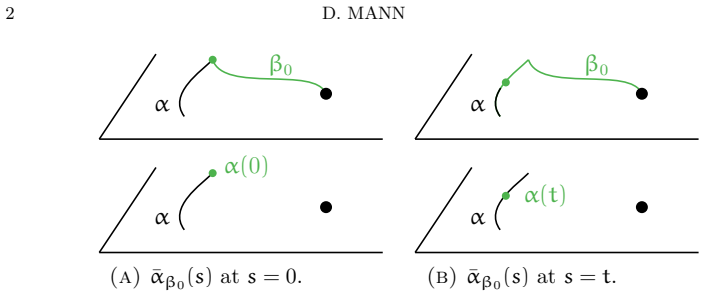
- [Introduction] Notation for the path bundle and its diffeological structure should be introduced with a short diagram or explicit set-theoretic description to aid readers unfamiliar with diffeology.
Simulated Author's Rebuttal
We thank the referee for their thorough review and positive recommendation for minor revision. We address each major comment below, providing clarifications and indicating revisions made to the manuscript.
read point-by-point responses
-
Referee: [The equivalence of categories (final section)] The central claim that the holonomy functor is an equivalence of categories rests on the diffeological definitions of parallel transport being smooth and on the chosen notion of equivalence (conjugate representations) coinciding with the morphisms of both categories. The manuscript must verify that these definitions do not introduce hidden assumptions that make the equivalence tautological or restrict the result to a proper subcategory.
Authors: We thank the referee for highlighting this important point. The holonomy category is defined independently via representations of the path groupoid into the structure group, without reference to the bundle. The functor to the category of diffeological bundle-connection pairs is constructed by associating to each representation the reconstructed bundle via the universal path bundle. We prove that parallel transport is smooth as a consequence of the diffeological smoothness of the evaluation map and the connection form. The equivalence of morphisms (conjugacy) is shown to match the bundle morphisms by direct computation of the induced maps. This is not tautological, as the geometric category includes all possible diffeological bundles, and we demonstrate essential surjectivity by explicit reconstruction. To further clarify, we have added a paragraph in the final section explaining why the definitions align without restricting to a subcategory. revision: partial
-
Referee: [Reconstruction from holonomy] The reconstruction of a diffeological bundle-connection pair from its holonomy representation is asserted to be unique up to the paper's equivalence; this requires an explicit check that the universal connection on the path bundle induces the original connection when pulled back along the holonomy map, without additional smoothness or regularity conditions beyond those stated in the diffeological axioms.
Authors: We agree that making this check more explicit will improve the manuscript. In the reconstruction theorem, the holonomy map is a diffeological morphism by construction, and the pullback of the universal connection is shown to coincide with the original connection using the characterizing property that the universal connection has holonomy equal to the given representation. This holds within the diffeological framework, where smoothness is defined via plots, and no additional conditions are imposed. We have revised the proof to include a detailed computation of the pullback in terms of the connection form and parallel transport, confirming the recovery without extra assumptions. revision: yes
Circularity Check
No significant circularity; construction is self-contained from diffeological definitions
full rationale
The paper presents a direct construction of Singer's universal connection in the diffeological setting, followed by a functorial equivalence of categories between the holonomy category and diffeological bundle-connection pairs. This equivalence is derived from the definitions of diffeological principal bundles, connections, and parallel transport (holonomy), without any reduction to fitted parameters, self-definitional loops, or load-bearing self-citations that presuppose the result. The reconstruction from holonomy representations follows standard categorical arguments in diffeology and does not rely on renaming known results or smuggling ansatzes via prior work by the same authors. The derivation chain is independent and externally grounded in the theory of diffeology.
Axiom & Free-Parameter Ledger
axioms (2)
- domain assumption Diffeology axioms that generalize smooth manifolds to allow singular spaces
- standard math Standard category theory axioms for functors and equivalences of categories
Lean theorems connected to this paper
-
IndisputableMonolith/Foundation/RealityFromDistinction.leanreality_from_one_distinction unclearWe provide a rigorous construction of I.M. Singer’s universal connection... equivalence of categories between the holonomy category and the category of diffeological bundle-connection pairs.
Reference graph
Works this paper leans on
-
[1]
Iglesias-Zemmour, Patrick , TITLE =. 2013 , PAGES =. doi:10.1090/surv/185 , URL =
- [2]
-
[3]
Functional Analysis on the Eve of the 21st Century , year = 1995, publisher =
Isadore Manuel Singer , title =. Functional Analysis on the Eve of the 21st Century , year = 1995, publisher =
work page 1995
-
[4]
Kobayashi, Sh\^oshichi , TITLE =. C. R. Acad. Sci. Paris , FJOURNAL =. 1954 , PAGES =
work page 1954
-
[5]
Barrett, J. W. , TITLE =. Internat. J. Theoret. Phys. , FJOURNAL =. 1991 , NUMBER =. doi:10.1007/BF00671007 , URL =
- [6]
-
[7]
Rosenstock, Sarita and Weatherall, James Owen , TITLE =. J. Math. Phys. , FJOURNAL =. 2018 , NUMBER =. doi:10.1063/1.5019748 , URL =
-
[8]
Gauge theory and gravity in the loop formulation
Loll, Renate. Gauge theory and gravity in the loop formulation. Canonical Gravity: From Classical to Quantum. 1994
work page 1994
-
[9]
Chatterjee, Saikat and Lahiri, Amitabha and Sengupta, Ambar N. , TITLE =. Rev. Math. Phys. , FJOURNAL =. 2010 , NUMBER =. doi:10.1142/S0129055X10004156 , URL =
-
[10]
Thin homotopy and the holonomy approach to gauge theories , ISSN=
Meneses, Claudio , year=. Thin homotopy and the holonomy approach to gauge theories , ISSN=. doi:10.1090/conm/775/15594 , journal=
-
[11]
I. Satake , journal =. On a Generalization of the Notion of Manifold , volume =
-
[12]
Abstract covariant derivative , url =
Roman Sikorski , journal =. Abstract covariant derivative , url =
- [13]
-
[14]
Baez, John C. and Hoffnung, Alexander E. , TITLE =. Trans. Amer. Math. Soc. , FJOURNAL =. 2011 , NUMBER =. doi:10.1090/S0002-9947-2011-05107-X , URL =
-
[15]
Chen, Kuo Tsai , TITLE =. Ann. of Math. (2) , FJOURNAL =. 1973 , PAGES =. doi:10.2307/1970846 , URL =
-
[16]
Categories in continuum physics (
Chen, Kuo Tsai , TITLE =. Categories in continuum physics (. 1986 , ISBN =. doi:10.1007/BFb0076932 , URL =
- [17]
-
[18]
Hamilton, Mark J. D. , TITLE =. 2017 , PAGES =. doi:10.1007/978-3-319-68439-0 , URL =
-
[19]
Baez, John C. and Schreiber, Urs , TITLE =. Categories in algebra, geometry and mathematical physics , SERIES =. 2007 , ISBN =. doi:10.1090/conm/431/08264 , URL =
-
[20]
Tangent spaces and tangent bundles for diffeological spaces , author=. 2015 , eprint=
work page 2015
-
[21]
Gibilisko, P. , TITLE =. Mat. Zametki , FJOURNAL =. 1997 , NUMBER =. doi:10.1007/BF02354986 , URL =
-
[22]
Chatterjee, Saikat and Lahiri, Amitabha and Sengupta, Ambar N. , TITLE =. J. Geom. Phys. , FJOURNAL =. 2014 , PAGES =. doi:10.1016/j.geomphys.2013.09.006 , URL =
-
[23]
Chatterjee, Saikat and Lahiri, Amitabha and Sengupta, Ambar N. , TITLE =. J. Geom. Phys. , FJOURNAL =. 2017 , PAGES =. doi:10.1016/j.geomphys.2016.11.002 , URL =
-
[24]
Fibrations diff\' e ologiques et homotopie
Iglesias-Zemmour, Patrick. Fibrations diff\' e ologiques et homotopie. 1985
work page 1985
discussion (0)
Sign in with ORCID, Apple, or X to comment. Anyone can read and Pith papers without signing in.