Recognition: no theorem link
Suitability of the Data Distribution Service for Next-Generation Ethernet-Based Agricultural Machinery Networking
Pith reviewed 2026-05-11 02:42 UTC · model grok-4.3
The pith
Data Distribution Service fulfills requirements for next-generation Ethernet-based agricultural machinery networking.
A machine-rendered reading of the paper's core claim, the machinery that carries it, and where it could break.
Core claim
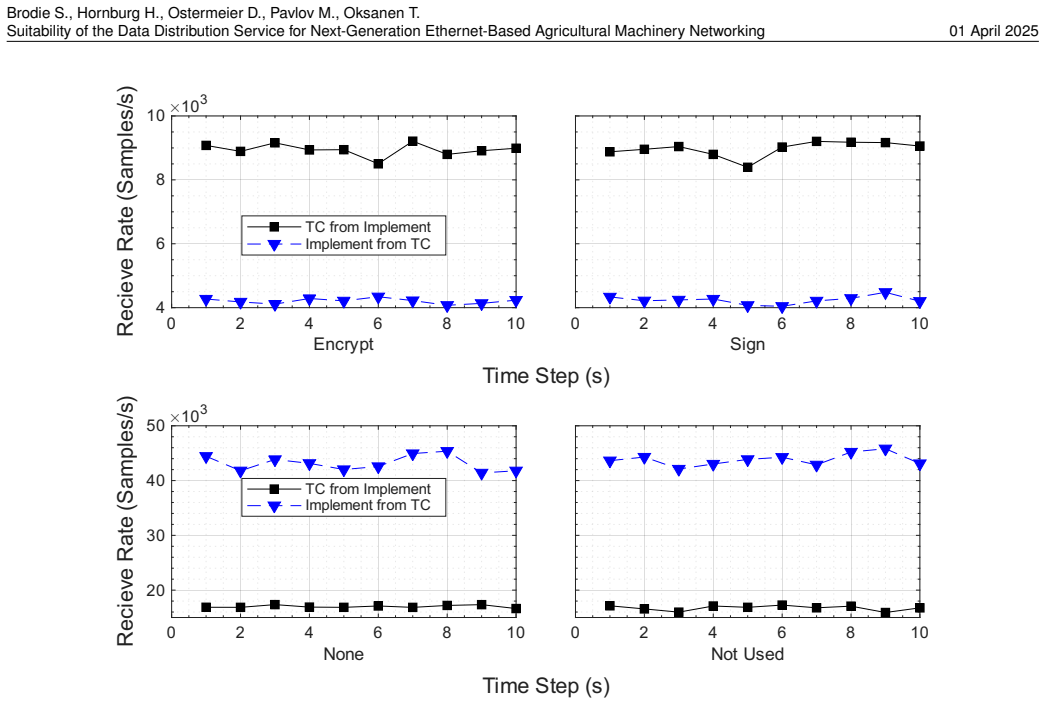
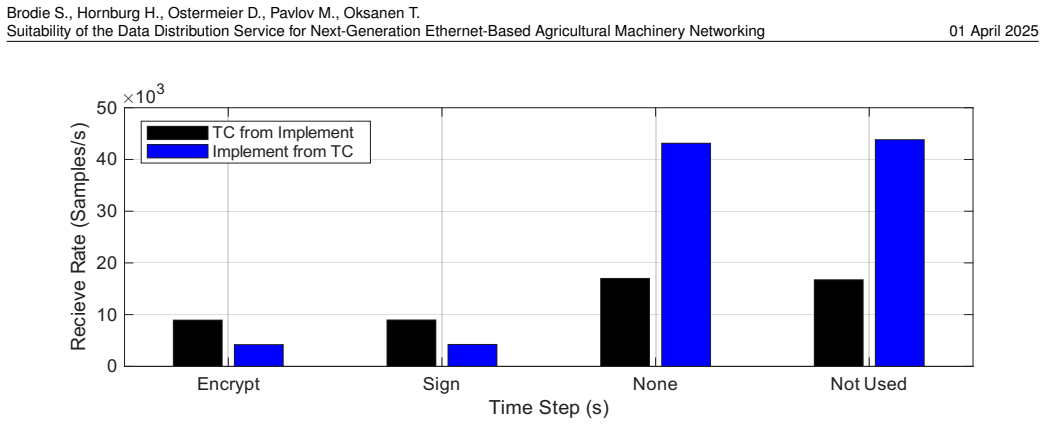
The authors establish that DDS provides a suitable middleware layer for next-generation Ethernet-based networks in agricultural machinery by implementing a proof-of-concept Task Controller and implement that fulfills all specified requirements. They further propose a new DDI concept breaking down the monolithic numeric Data Dictionary Identifier from ISO 11783 into separate typed Enums for handling group, handling feature, and SI units to support more flexible signal definitions. Security evaluations across four configurations confirm the requirements are met but show a notable throughput impact when security features are active.
What carries the argument
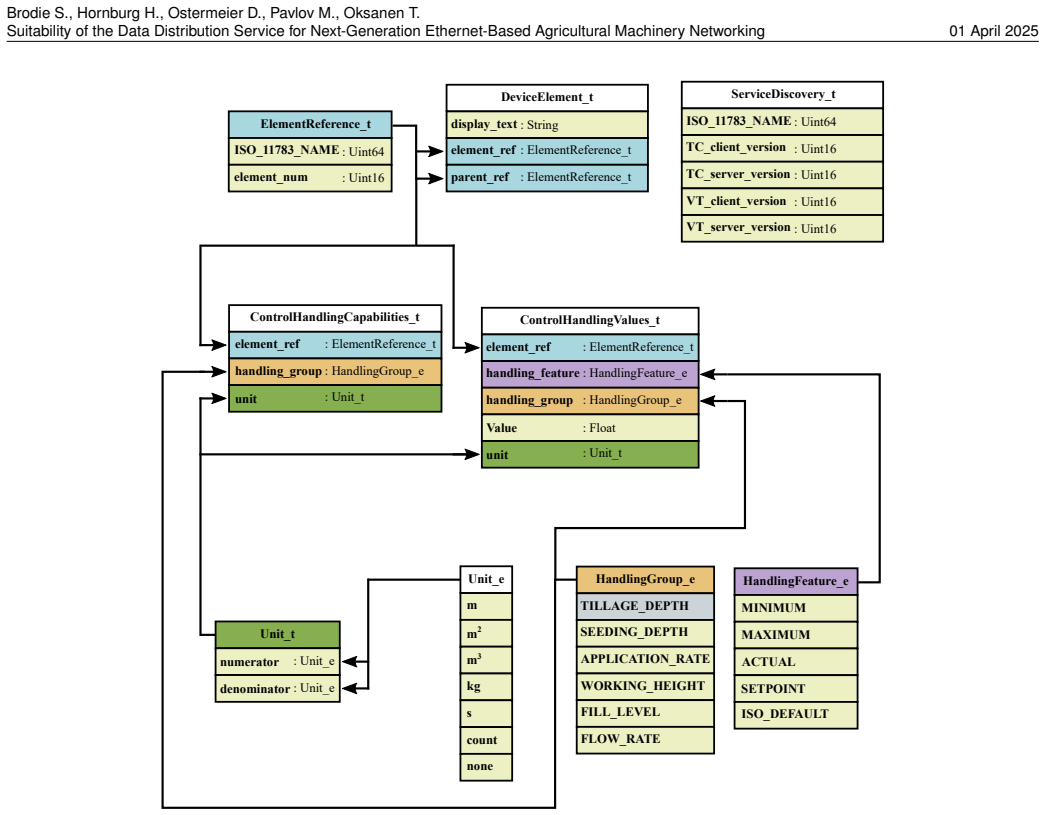
The new DDI concept that decomposes the monolithic numeric DDI of ISO 11783 into separate typed Enums for handling group, handling feature, and SI units. This mechanism enables more flexible signal definitions while supporting modern data types in the DDS-based network.
If this is right
- Higher levels of automation become feasible through DDS features absent from current ISO 11783.
- Additional data logging and modern data types can be incorporated into machine communications.
- Quality of service configuration and cybersecurity best practices can be applied as needed.
- The overall system meets requirements even with security enabled, though at lower throughput.
Where Pith is reading between the lines
- This middleware choice could support broader interoperability across manufacturers in Ethernet-based fleets.
- The decomposed DDI approach might reduce the need for numeric identifier management in future updates to related standards.
- Real-world deployment would need to verify whether the observed throughput reduction remains acceptable for typical agricultural data flows.
Load-bearing premise
The proof-of-concept design with Task Controller and implement can be extended to production agricultural machinery without unforeseen compatibility, scalability, or real-time performance issues under actual field conditions.
What would settle it
Deploying the DDS-based Task Controller and implement on commercial agricultural machines operating in real field conditions and checking for any failures in compatibility, real-time performance, or scalability.
Figures





read the original abstract
The current state of the art in the agricultural industry for inter-manufacturer, plug-and-play communications is the ISO 11783 standard series, which mandates the use of 250 Kb/s CAN bus. To support higher data rates, the ISO 23870 series is under development, defining a gigabit automotive Ethernet physical layer for next-generation machine-to-machine communication networks. However, middleware is needed to handle the complexity of the system by providing an additional layer of abstraction. It should address the future needs of the industry such as higher levels of automation, additional data logging, modern data types, quality of service configuration, and best-practice cybersecurity. Data Distribution Service (DDS) is a potential middleware for use in such a network. DDS provides many features not present in the current ISO 11783, it is a standardised protocol for data sharing between distributed applications. This work analyses the extent to which DDS can be used to develop a system which meets the requirements for next-generation communication networking for agricultural machinery. A proof-of-concept design is presented, including a Task Controller and implement and it is shown that the requirements are fulfilled. A new DDI concept is proposed that decomposes the monolithic numeric DDI of ISO 11783 into separate typed Enums for handling group, handling feature, and SI units, enabling more flexible signal definitions. Four security configurations are tested in the proof-of-concept implementation and it is shown that enabling security features has a significant impact on throughput.
Editorial analysis
A structured set of objections, weighed in public.
Referee Report
Summary. The manuscript claims that the Data Distribution Service (DDS) is suitable middleware for next-generation Ethernet-based agricultural machinery networks under the developing ISO 23870 standard, as demonstrated by a proof-of-concept implementation of a Task Controller and implement that fulfills requirements for higher automation, data logging, QoS, and cybersecurity. It further proposes decomposing the monolithic numeric DDI of ISO 11783 into separate typed Enums for handling group, handling feature, and SI units to enable more flexible signal definitions, and reports that enabling security features in four tested configurations has a significant impact on throughput.
Significance. If the central claims hold under broader validation, the work would provide concrete evidence supporting DDS adoption in agricultural networking to address limitations of the current 250 kb/s CAN-based ISO 11783, particularly for emerging needs in automation and security. The POC implementation and direct security-throughput tests represent strengths as implementation-based evaluation without fitted parameters or circular derivations, offering practical insights into middleware trade-offs for the industry transition to gigabit Ethernet.
major comments (4)
- [Abstract and POC Evaluation] The assertion in the abstract that 'the requirements are fulfilled' rests on a single POC implementation of Task Controller and implement without reported quantitative metrics (e.g., latency distributions, packet loss rates, or scalability under variable loads), error bars, or full validation data confirming all stated requirements such as deterministic real-time performance.
- [DDI Concept Proposal] The proposed DDI decomposition into typed Enums for group, feature, and SI units is presented as enabling more flexible signals, but without a compliance matrix or interoperability tests against existing ISO 11783 implementations, it is unclear whether all prior signal semantics are preserved or if boundary mapping errors arise.
- [Security Configurations and Throughput Tests] The security evaluation tests four configurations and shows throughput impact, yet does not assess whether observed degradation remains acceptable when real sensor/actuator cycles and safety-critical timing constraints are incorporated, which are load-bearing for the cybersecurity suitability claim.
- [Discussion and Conclusions] The POC design is not evaluated for extension to production constraints including multi-vendor plug-and-play, electromagnetic robustness, or seamless coexistence with legacy 250 kb/s CAN segments during the ISO 23870 transition, undermining the claim that DDS meets next-generation networking requirements in actual field conditions.
minor comments (2)
- [Abstract] The abstract lacks any numerical results, error bars, or specific throughput values, which would improve the reader's ability to gauge the strength of the 'requirements are fulfilled' claim.
- [DDI Concept] The DDI proposal would benefit from concrete examples of before-and-after signal definitions to illustrate the flexibility gains from the Enum decomposition.
Simulated Author's Rebuttal
We thank the referee for the constructive and detailed comments. We address each major comment point by point, clarifying the scope of the proof-of-concept while indicating where revisions will strengthen the manuscript.
read point-by-point responses
-
Referee: [Abstract and POC Evaluation] The assertion in the abstract that 'the requirements are fulfilled' rests on a single POC implementation of Task Controller and implement without reported quantitative metrics (e.g., latency distributions, packet loss rates, or scalability under variable loads), error bars, or full validation data confirming all stated requirements such as deterministic real-time performance.
Authors: We agree that the abstract phrasing implies a stronger level of validation than the POC provides. The implementation demonstrates functional support for the listed requirements (higher automation, modern data types, QoS, and security) in a controlled setup, but does not include comprehensive metrics such as latency distributions, packet loss rates, or scalability under variable loads. We will revise the abstract to state that the POC indicates fulfillment of key requirements and add explicit discussion of these limitations in the evaluation section. revision: partial
-
Referee: [DDI Concept Proposal] The proposed DDI decomposition into typed Enums for group, feature, and SI units is presented as enabling more flexible signals, but without a compliance matrix or interoperability tests against existing ISO 11783 implementations, it is unclear whether all prior signal semantics are preserved or if boundary mapping errors arise.
Authors: The DDI decomposition is offered as a conceptual proposal to support more flexible, typed signal definitions rather than a fully validated replacement. We did not include a compliance matrix or interoperability tests, as the paper's primary focus is DDS middleware suitability. We will revise the relevant section to include a high-level mapping discussion showing preservation of core semantics and explicitly note that boundary cases and full interoperability testing remain future work for standard evolution. revision: yes
-
Referee: [Security Configurations and Throughput Tests] The security evaluation tests four configurations and shows throughput impact, yet does not assess whether observed degradation remains acceptable when real sensor/actuator cycles and safety-critical timing constraints are incorporated, which are load-bearing for the cybersecurity suitability claim.
Authors: The four-configuration tests quantify throughput overhead in the POC environment. We acknowledge that acceptability under real sensor/actuator cycles and safety-critical timing is not assessed and would require application-specific integration. We will revise the security discussion to state this limitation clearly and position the results as an initial baseline for such future assessments. revision: partial
-
Referee: [Discussion and Conclusions] The POC design is not evaluated for extension to production constraints including multi-vendor plug-and-play, electromagnetic robustness, or seamless coexistence with legacy 250 kb/s CAN segments during the ISO 23870 transition, undermining the claim that DDS meets next-generation networking requirements in actual field conditions.
Authors: The work is scoped to a controlled POC demonstrating middleware features for the stated requirements. Production aspects such as multi-vendor plug-and-play, electromagnetic robustness, and legacy CAN coexistence are important but outside this study's scope. We will expand the discussion and conclusions to explicitly acknowledge these as necessary future validations for the ISO 23870 transition while retaining the claim that the POC supports DDS suitability for the core requirements. revision: yes
Circularity Check
No circularity; claims rest on POC implementation and direct testing
full rationale
The paper evaluates DDS suitability for next-generation agricultural networking via a proof-of-concept Task Controller and implement implementation, security configuration tests, and a proposed typed-Enum DDI decomposition of the existing ISO 11783 numeric DDI. No mathematical derivations, equations, fitted parameters, or predictions are present that could reduce to inputs by construction. Central claims (requirements fulfillment, throughput impact of security, flexibility of new DDI) are supported by described experimental outcomes rather than self-referential definitions or self-citation chains. The work is self-contained as an engineering demonstration.
Axiom & Free-Parameter Ledger
axioms (2)
- domain assumption ISO 11783 defines the current 250 Kb/s CAN bus standard for inter-manufacturer plug-and-play communications
- domain assumption ISO 23870 series defines gigabit automotive Ethernet physical layer for next-generation networks
invented entities (1)
-
Decomposed DDI using separate typed Enums for group, feature, and SI units
no independent evidence
Reference graph
Works this paper leans on
-
[1]
ISO, “ISO 11783-1:2017 Tractors and machinery for agriculture and forestry — Serial control and communications data network — Part 1: General standard for mobile data communication,” 2017. [Online]. Available: https://www.iso.org/standard/57556. html
work page 2017
-
[2]
S. Brodie, T. Oksanen, and H. Auernhammer, “Buz- zword ISOBUS,”Informatik Spektrum, vol. 46, no. 1, pp. 46–50, 2023
work page 2023
-
[3]
Full digital video solution as a forward-looking technology for High Speed ISOBUS,
N. Niebrügge, M. Terhaag, and M. Ensink, “Full digital video solution as a forward-looking technology for High Speed ISOBUS,” inLAND.TECHNIK 2020, VDI Wis- sensforum GmbH, Ed., vol. 2374. VDI Verlag, 2020, Conference Proceedings, pp. 295–302
work page 2020
-
[4]
Middleware: a model for distributed system services,
P . A. Bernstein, “Middleware: a model for distributed system services,”Communications of the ACM, vol. 39, no. 2, pp. 86–98, 1996
work page 1996
-
[5]
Next generation task controller for agricultural machin- ery using OPC Unified Architecture,
M. Siponen, I. Seilonen, S. Brodie, and T. Oksanen, “Next generation task controller for agricultural machin- ery using OPC Unified Architecture,”Computers and Electronics in Agriculture, vol. 203, p. 107475, 2022
work page 2022
- [6]
-
[7]
Object Management Group (OMG), “Data distribution service,” 2015. [Online]. Available: https://www.omg.org/ spec/DDS/1.4/PDF
work page 2015
-
[8]
DDS interoperability wire protocol,
——, “DDS interoperability wire protocol,” 2022. [Online]. Available: https://www.omg.org/spec/DDSI- RTPS/2.5/PDF
work page 2022
-
[9]
——, “DDS security version 1.2,” Object Management Group (OMG), 2024. [Online]. Available: https://www. omg.org/spec/DDS-SECURITY/1.2/PDF
work page 2024
-
[10]
A security analysis of the data distribution service (DDS) protocol,
F . Maggi, R. Vosseler, M. Cheng, P . Kuo, C. Toyama, T. Y en, and E. B. V. Vilches, “A security analysis of the data distribution service (DDS) protocol,” 2022. [Online]. Available: https://documents.trendmicro.com/ assets/white_papers/wp-a-security-analysis-of-the- data-distribution-service-dds-protocol.pdf
work page 2022
-
[11]
Avoid sending permissions as part of Authentication Handshake,
G. Pardo-Castellote, “Avoid sending permissions as part of Authentication Handshake,” OMG Task Force, Report, 2017. [Online]. Available: https://issues.omg. org/issues/DDSSEC13-12
work page 2017
-
[12]
RTI Connext perfor- mance benchmarks — Testing different security gov- ernance configuration levels,
Real-Time Innovations Inc, “RTI Connext perfor- mance benchmarks — Testing different security gov- ernance configuration levels,” 2024. [Online]. Avail- able: https://community.rti.com/static/documentation/ performance/benchmarks/srcDoc/pro/7.3/secure/ discovery/discovery_report_security.html#testing- different-security-governance-configuration-levels
work page 2024
-
[13]
Performance study of the Robot Operating System 2 with QoS and cyber security settings,
J. Fernandez, B. Allen, P . Thulasiraman, and B. Bing- ham, “Performance study of the Robot Operating System 2 with QoS and cyber security settings,” in 2020 IEEE International Systems Conference (SysCon), 2020, Conference Proceedings, pp. 1–6
work page 2020
-
[14]
Robot Operating System 2: Design, archi- tecture, and uses in the wild,
S. Macenski, T. Foote, B. Gerkey, C. Lalancette, and W. Woodall, “Robot Operating System 2: Design, archi- tecture, and uses in the wild,”Science Robotics, vol. 7, no. 66, p. eabm6074, 2022
work page 2022
-
[15]
NATO Standardization Office (NSO), “AEP-4754: NATO generic vehicle architecture (NGVA) for land systems Volume V: Data model, Version 1, Edition B,” 2023. [Online]. Available: https://nso.nato.int/nso/nsdd/main/ standards/ap-details/3252/EN
work page 2023
-
[16]
Specification of communication manage- ment AUTOSAR AP R22-11,
AUTOSAR, “Specification of communication manage- ment AUTOSAR AP R22-11,” 2022. [Online]. Available: https://www.autosar.org/fileadmin/standards/R22-11/ AP/AUTOSAR_SWS_CommunicationManagement.pdf
work page 2022
-
[17]
Industry whitepaper • enabling flexible vehicle architectures with AUTOSAR and DDS,
K. Richter and E. G. Cameros, “Industry whitepaper • enabling flexible vehicle architectures with AUTOSAR and DDS,” 2021. [Online]. Available: https://www.rti. com/hubfs/_Collateral/Whitepapers/Enabling-Flexible- Vehicle-with-AUTOSAR-and-DDS.pdf
work page 2021
-
[18]
ROS 2 alternative middleware report,
ROS2 core team, “ROS 2 alternative middleware report,” 2023. [Online]. Available: https://discourse.ros. org/t/ros-2-alternative-middleware-report/33771
work page 2023
-
[19]
Specification of DDS service discov- ery protocol AUTOSAR FO R24-11,
AUTOSAR, “Specification of DDS service discov- ery protocol AUTOSAR FO R24-11,” 2024. [Online]. Available: https://www.autosar.org/fileadmin/standards/ R24-11/FO/AUTOSAR_FO_PRS_ DDSServiceDiscoveryProtocol.pdf
work page 2024
-
[20]
DDS Secu- rity+: Enhancing the Data Distribution Service with TPM- based remote attestation,
P . G. Wagner, P . Birnstill, and J. Beyerer, “DDS Secu- rity+: Enhancing the Data Distribution Service with TPM- based remote attestation,” inProceedings of the 19th International Conference on Availability, Reliability and Security. Association for Computing Machinery, 2024, Conference Proceedings, p. 159
work page 2024
-
[21]
Oops! it’s too late. your autonomous driving system needs a faster middleware,
T. Wu, B. Wu, S. Wang, L. Liu, S. Liu, Y . Bao, and W. Shi, “Oops! it’s too late. your autonomous driving system needs a faster middleware,”IEEE Robotics and Automation Letters, vol. 6, no. 4, pp. 7301–7308, 2021
work page 2021
-
[22]
A. Hakiri, P . Berthou, A. Gokhale, and S. Abdellatif, “Publish/subscribe-enabled software defined network- ing for efficient and scalable IoT communications,”IEEE Communications Magazine, vol. 53, no. 9, pp. 48–54, 2015
work page 2015
-
[23]
Systematic analysis of DDS implementa- tions,
V. Bode, D. Buettner, T. Preclik, C. Trinitis, and M. Schulz, “Systematic analysis of DDS implementa- tions,” inProceedings of the 24th International Middle- Technical University of Munich Professorship of Agrimechatronics 14 Brodie S., Hornburg H., Ostermeier D., Pavlov M., Oksanen T. Suitability of the Data Distribution Service for Next-Generation Ether...
work page 2025
-
[24]
OpenICE: An open, interoperable platform for medical cyber-physical systems,
J. Plourde, D. Arney, and J. M. Goldman, “OpenICE: An open, interoperable platform for medical cyber-physical systems,” in2014 ACM/IEEE International Conference on Cyber-Physical Systems (ICCPS). IEEE, 2014, Conference Proceedings, pp. 221–221
work page 2014
-
[25]
OpenICE medical device interoperability platform overview and requirement analysis,
D. Arney, J. Plourde, and J. M. Gold- man, “OpenICE medical device interoperability platform overview and requirement analysis,”Biomedical Engi- neering/Biomedizinische Technik, vol. 63, no. 1, pp. 39– 47, 2018
work page 2018
-
[26]
Introduction to time-sensitive networking,
N. Finn, “Introduction to time-sensitive networking,” IEEE Communications Standards Magazine, vol. 2, no. 2, pp. 22–28, 2018
work page 2018
-
[27]
J. Lu, H. Zhu, T. Huang, H. Zhang, and G. Han, “TS- DDS: Data distribution service (DDS) over in-vehicle time-sensitive networking (TSN) mechanism research,” in2023 15th International Conference on Communica- tion Software and Networks (ICCSN). IEEE, 2023, Conference Proceedings, pp. 30–36
work page 2023
-
[28]
Z. Zhang, K. Cui, Y . Zhu, C. Jiang, X. Y ao, and K. Lu, “A lightweight implementation of data distribution service (DDS) incorporating time sensitive networking (TSN) on the AUTOSAR Classic Platform,” in2024 IEEE Intelli- gent Vehicles Symposium (IV). IEEE, 2024, Confer- ence Proceedings, pp. 3356–3362
work page 2024
-
[29]
Bloom filter-based discovery protocol for DDS middleware,
J. Sanchez-Monedero, J. Povedano-Molina, J. M. Lopez-Vega, and J. M. Lopez-Soler, “Bloom filter-based discovery protocol for DDS middleware,”Journal of Par- allel and Distributed Computing, vol. 71, no. 10, pp. 1305–1317, 2011
work page 2011
-
[30]
Node discovery scheme of DDS for combat management system,
H. A. Putra and D.-S. Kim, “Node discovery scheme of DDS for combat management system,”Computer Standards & Interfaces, vol. 37, no. C, pp. 20–28, 2015
work page 2015
-
[31]
W. Nwadiugwu, D. Kim, W. Ejaz, and A. Anpalagan, “MAD-DDS: Memory-efficient automatic discovery data distribution service for large-scale distributed control network,”IET Communications, vol. 17, no. 12, pp. 1432–1446, 2023
work page 2023
-
[32]
Fast RTPS discovery mechanisms analysis,
E. P . Segrelles and R. S.-M. Lizano, “Fast RTPS discovery mechanisms analysis,” 2020. [Online]. Available: https://www.eprosima.com/images/ PDFs/Fast_RTPS_Discovery_Mechanisms_Study.pdf
work page 2020
-
[33]
RTI Enterprise Discovery Service user’s manual version 5.0,
Real-Time Innovations Inc, “RTI Enterprise Discovery Service user’s manual version 5.0,” 2012. [Online]. Available: https://community.rti.com/rti-doc/500/ndds/ doc/pdf_html/RTI_EDS_UsersManual.pd
work page 2012
-
[34]
AEF – High Speed ISOBUS – Technology readiness for a next generation network,
D. Smart and V. Brill, “AEF – High Speed ISOBUS – Technology readiness for a next generation network,” in LAND.TECHNIK 2022, VDI Wissensforum GmbH, Ed., vol. 2395. VDI Verlag, 2022, Conference Proceedings, pp. 551–558
work page 2022
-
[35]
C. Scordino, A. G. Marino, and F . Fons, “Hardware ac- celeration of data distribution service (DDS) for auto- motive communication and computing,”IEEE Access, vol. 10, pp. 109 626–109 651, 2022
work page 2022
-
[36]
Z. Abdellaoui and S. Hasnaoui, “DDS middleware on top of FlexRay networks: Simulink blockset implementation of electrical vehicle using FlexRay protocol and its adap- tation to DDS concept,”Soft Computing, vol. 23, no. 22, pp. 11 539–11 556, 2019
work page 2019
-
[37]
ISO, “ISO/AWI 23870-3 Mobile machinery — High speed interconnect (HSI) — Part 3: Single communica- tion channel coupling connector (under development),” 2025
work page 2025
-
[38]
Best practices — RTI security plugins user’s manual 7.6.0 documentation,
Real-Time Innovations Inc, “Best practices — RTI security plugins user’s manual 7.6.0 documentation,”
-
[39]
[Online]. Available: https://community.rti.com/ static/documentation/connext-dds/7.6.0/doc/manuals/ connext_dds_secure/users_manual/p3_advanced/ best_practices.html#using-serialized-data-protection- along-with-submessage-rtps-protection
-
[40]
Test results — DDS interoperability tests version 1.1 (2024) documentation,
Real-Time Innovations Inc., Atostek Oy, Proyectos y Sistemas de Mantenimiento SL (eProsima), Kongsberg Defence & Aerospace, Object Computing Inc., OpenDDS Foundation, and Twin Oaks Computing Inc., “Test results — DDS interoperability tests version 1.1 (2024) documentation,” 2024. [Online]. Available: https://omg-dds.github.io/dds-rtps/test_results.html
work page 2024
-
[41]
ISO, “ISO 25119-3:2018 Tractors and machinery for agriculture and forestry — Safety-related parts of control systems — Part 3: Series development, hardware and software,” 2018. [Online]. Available: https://www.iso.org/standard/69027.html
work page 2018
-
[42]
High Speed ISOBUS, an AEF project for next generation ag networking,
D. Smart and V. Brill, “High Speed ISOBUS, an AEF project for next generation ag networking,” in LAND.TECHNIK 2019, VDI Wissensforum GmbH, Ed., vol. 2361. VDI Verlag, 2019, Conference Proceedings, pp. 91–106
work page 2019
-
[43]
FastDDS C++ API reference — timebasedfilterqospolicy,
eProsima, “FastDDS C++ API reference — timebasedfilterqospolicy,” 2019. [Online]. Avail- able: https://fast-dds.docs.eprosima.com/en/v3.0.1/ fastdds/api_reference/dds_pim/core/policy/ timebasedfilterqospolicy.html#timebasedfilterqospolicy
work page 2019
-
[44]
8.2. access control plu- gin: DDS:access:permissions — fast DDS 3.0.1 documentation,
——, “8.2. access control plu- gin: DDS:access:permissions — fast DDS 3.0.1 documentation,” 2019. [Online]. Avail- able: https://fast-dds.docs.eprosima.com/en/v3.0.1/ fastdds/security/access_control_plugin/access_ control_plugin.html#domain-rules
work page 2019
- [45]
-
[46]
Available: https://opcfoundation.org/ certification/how-to-certify/
[Online]. Available: https://opcfoundation.org/ certification/how-to-certify/
-
[47]
OPC UA versus ROS, DDS, and MQTT: Per- formance evaluation of Industry 4.0 protocols,
S. Profanter, A. Tekat, K. Dorofeev, M. Rickert, and A. Knoll, “OPC UA versus ROS, DDS, and MQTT: Per- formance evaluation of Industry 4.0 protocols,” in2019 IEEE International Conference on Industrial Technology (ICIT), 2019, Conference Proceedings, pp. 955–962. Technical University of Munich Professorship of Agrimechatronics 15
work page 2019
discussion (0)
Sign in with ORCID, Apple, or X to comment. Anyone can read and Pith papers without signing in.