Recognition: no theorem link
SMT-Based Active Learning of Weighted Automata
Pith reviewed 2026-05-11 03:19 UTC · model grok-4.3
The pith
An SMT-based algorithm actively learns minimal weighted automata over any semiring and terminates for all finite cases.
A machine-rendered reading of the paper's core claim, the machinery that carries it, and where it could break.
Core claim
The authors introduce an SMT-based active learning algorithm for nondeterministic weighted automata that is parametric in a given semiring. If the algorithm terminates, the automaton it returns is minimal. Partial correctness is proved in general, and a termination condition is supplied that guarantees termination whenever the semiring is finite.
What carries the argument
The SMT-based active learning procedure that iteratively formulates and solves constraint problems over the semiring to find the smallest WFA consistent with membership and equivalence answers.
Load-bearing premise
The method requires a teacher that can answer membership and equivalence queries correctly and an SMT solver that can decide the generated constraints in finite time.
What would settle it
A concrete finite semiring together with a target WFA on which the algorithm either fails to terminate or returns a non-minimal automaton would falsify the termination or minimality claims.
Figures


read the original abstract
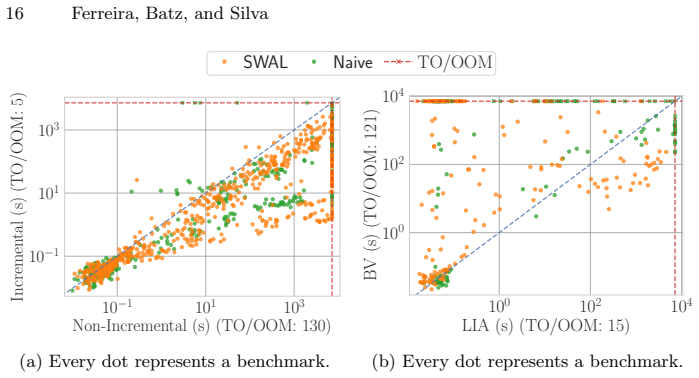
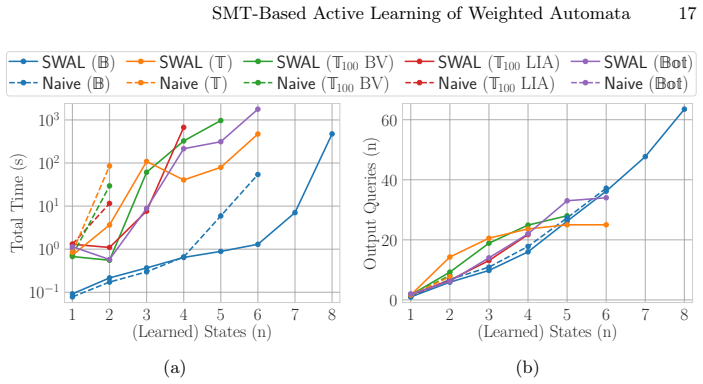
We present an SMT-based active learning algorithm for nondeterministic weighted automata (WFAs) as a practical and robust alternative to Hankel/L*-style methods. Our algorithm is parametric in a given semiring and, if it terminates, guaranteed to produce minimal WFAs. We prove partial correctness and provide a sufficient termination condition, which in particular implies termination for all finite semirings. Our extensive experimental evaluation shows that our algorithm is capable of learning numerous minimal WFAs over both finite and infinite semirings, vastly outperforms a naive baseline, and is competitive with a state-of-the-art algorithm while producing significantly smaller automata and requiring less interaction with the teacher.
Editorial analysis
A structured set of objections, weighed in public.
Referee Report
Summary. The manuscript presents an SMT-based active learning algorithm for nondeterministic weighted automata (WFAs) that is parametric over a given semiring. If the algorithm terminates, it is guaranteed to produce minimal WFAs. The authors prove partial correctness and supply a sufficient termination condition that implies termination for all finite semirings. Experiments show the algorithm learns numerous minimal WFAs over both finite and infinite semirings, vastly outperforming a naive baseline while remaining competitive with a state-of-the-art method, producing smaller automata and requiring less teacher interaction.
Significance. If the partial-correctness proof and the sufficient termination condition hold, the work supplies a practical, robust alternative to Hankel/L*-style methods for learning weighted automata. The parametric design over semirings, the explicit teacher interface (membership and equivalence queries), the SMT encoding, and the experimental confirmation of practical termination on finite and selected infinite semirings are clear strengths. These elements could advance automata-learning techniques in verification and formal methods.
minor comments (3)
- The abstract states that the algorithm 'vastly outperforms a naive baseline' and is 'competitive with a state-of-the-art algorithm'; a brief quantitative summary (e.g., query counts or automaton sizes) would help readers assess the extent of these improvements without consulting the experimental section.
- In the description of the termination condition, the paper could add a short remark on whether the condition is also necessary or whether termination can occur outside the stated sufficient condition, to clarify the practical scope for infinite semirings.
- The experimental section would benefit from an explicit statement of the SMT solver and timeout settings used, as these parameters directly affect the reported runtimes and success rates.
Simulated Author's Rebuttal
We thank the referee for their positive assessment of our work, including the recognition of the partial-correctness proof, the sufficient termination condition, the parametric semiring design, and the experimental results showing smaller automata with fewer queries. We appreciate the recommendation for minor revision.
Circularity Check
No significant circularity in the derivation chain
full rationale
The paper's core claims rest on an explicit algorithmic construction (SMT encoding of membership/equivalence constraints for WFAs), a direct proof of partial correctness, and a separately stated sufficient termination condition whose finite-semiring case is derived from standard semiring properties rather than from the algorithm's outputs. No step reduces a prediction or minimality guarantee to a fitted parameter, a self-referential definition, or a load-bearing self-citation; the teacher interface and SMT solver are treated as external oracles with stated assumptions. Experiments compare against independent baselines using observable metrics (automaton size, query count), keeping the argument self-contained.
Axiom & Free-Parameter Ledger
Reference graph
Works this paper leans on
-
[1]
Handbook of weighted automata (2009).https://doi.org/10.1007/ 978-3-642-01492-5,https://link.springer.com/10.1007/978-3-642-01492-5
-
[2]
Aarts,F.,Ruiter,J.D.,Poll,E.:Formalmodelsofbankcardsforfree.In:2013IEEE Sixth International Conference on Software Testing, Verification and Validation Workshops. pp. 461–468 (2013).https://doi.org/10.1109/ICSTW.2013.60
-
[3]
Aarts, F., Schmaltz, J., Vaandrager, F.: Inference and abstraction of the biometric passport. In: Margaria, T., Steffen, B. (eds.) Leveraging Applications of Formal Methods, Verification, and Validation. pp. 673–686. Lecture Notes in Computer Science, Springer (2010).https://doi.org/10.1007/978-3-642-16558-0_54
-
[4]
1016/j.ic.2020.104651,https://linkinghub.elsevier.com/retrieve/pii/ S0890540120301395
Almagor, S., Boker, U., Kupferman, O.: What’s decidable about weighted automata? Information and Computation282, 104651.https://doi.org/10. 1016/j.ic.2020.104651,https://linkinghub.elsevier.com/retrieve/pii/ S0890540120301395
-
[5]
Angluin, D.: Learning regular sets from queries and counterexamples. Infor- mation and Computation75(2), 87–106 (1987).https://doi.org/10.1016/ 0890-5401(87)90052-6,https://linkinghub.elsevier.com/retrieve/pii/ 0890540187900526
work page 1987
-
[6]
In: 2025 40th An- nual ACM/IEEE Symposium on Logic in Computer Science (LICS)
Aristote, Q., Van Gool, S., Petrişan, D., Shirmohammadi, M.: Learning weighted automata over number rings, concretely and categorically. In: 2025 40th An- nual ACM/IEEE Symposium on Logic in Computer Science (LICS). pp. 417–
work page 2025
-
[7]
IEEE (2025).https://doi.org/10.1109/LICS65433.2025.00038,https:// ieeexplore.ieee.org/document/11186332/
-
[8]
Pro- ceedings of the ACM on Programming Languages6(OOPSLA1), 1–30 (2022)
Batz, K., Gallus, A., Kaminski, B.L., Katoen, J.P., Winkler, T.: Weighted pro- gramming: A programming paradigm for specifying mathematical models. Pro- ceedings of the ACM on Programming Languages6(OOPSLA1), 1–30 (2022). https://doi.org/10.1145/3527310
-
[9]
Bergadano, F., Varricchio, S.: Learning behaviors of automata from multi- plicity and equivalence queries. SIAM Journal on Computing25(6), 1268– 1280 (1996).https://doi.org/10.1137/S009753979326091X,http://epubs. siam.org/doi/10.1137/S009753979326091X
-
[10]
IEEE Transactions on ComputersC-21(6), 592–597 (1972).https://doi.org/10.1109/TC.1972.5009015
Biermann, A.W., Feldman, J.A.: On the synthesis of finite-state machines from samples of their behavior. IEEE Transactions on ComputersC-21(6), 592–597 (1972).https://doi.org/10.1109/TC.1972.5009015
-
[11]
In: Proceedings of the 21st International Joint Conference on Artificial Intelligence
Bollig, B., Habermehl, P., Kern, C., Leucker, M.: Angluin-style learning of NFA. In: Proceedings of the 21st International Joint Conference on Artificial Intelligence. pp. 1004–1009. IJCAI’09, Morgan Kaufmann Publishers Inc
-
[12]
Bonsangue, M.M., Milius, S., Silva, A.: Sound and complete axiomatizations of coalgebraic language equivalence. ACM Transactions on Computational Logic 14(1), 1–52 (2013).https://doi.org/10.1145/2422085.2422092,https://dl. acm.org/doi/10.1145/2422085.2422092
-
[13]
Buna-Marginean, A., Cheval, V., Shirmohammadi, M., Worrell, J.: On learning polynomial recursive programs. Proceedings of the ACM on Programming Lan- guages8, 1001–1027.https://doi.org/10.1145/3632876,https://dl.acm.org/ doi/10.1145/3632876
-
[14]
In: Finkbeiner, B., Pu, G., Zhang, L
Chapman, M., Chockler, H., Kesseli, P., Kroening, D., Strichman, O., Tautschnig, M.: Learning the language of error. In: Finkbeiner, B., Pu, G., Zhang, L. (eds.) Au- tomated Technology for Verification and Analysis, vol. 9364, pp. 114–130. Springer InternationalPublishing(2015).https://doi.org/10.1007/978-3-319-24953-7_ 22 Ferreira, Batz, and Silva 9,http...
-
[15]
ACM Transactions on Computational Logic19(3), 1–52 (Jul 2018).https://doi.org/10.1145/3230639
Cimatti, A., Griggio, A., Irfan, A., Roveri, M., Sebastiani, R.: Incremental Lin- earization for Satisfiability and Verification Modulo Nonlinear Arithmetic and Transcendental Functions. ACM Transactions on Computational Logic19(3), 1–52 (Jul 2018).https://doi.org/10.1145/3230639
-
[16]
Logical Methods in Computer ScienceV olume 21, Issue 3, 13612.https://doi
Daviaud, L., Johnson, M.: Feasability of learning weighted automata on a semiring. Logical Methods in Computer ScienceV olume 21, Issue 3, 13612.https://doi. org/10.46298/lmcs-21(3:15)2025,https://doi.org/10.46298/lmcs-21(3:15) 2025
-
[17]
Denis, F., Lemay, A., Terlutte, A.: Residual finite state automata. In: Ferreira, A., Reichel, H. (eds.) STACS 2001, vol. 2010, pp. 144–157. Springer Berlin Hei- delberg.https://doi.org/10.1007/3-540-44693-1_13,http://link.springer. com/10.1007/3-540-44693-1_13, series Title: Lecture Notes in Computer Science
-
[18]
Dierl, S., Fiterau-Brostean, P., Howar, F., Jonsson, B., Sagonas, K., Tåquist, F.: Scalable tree-based register automata learning. In: Finkbeiner, B., Kovács, L. (eds.) Tools and Algorithms for the Construction and Anal- ysis of Systems, vol. 14571, pp. 87–108. Springer Nature Switzerland. https://doi.org/10.1007/978-3-031-57249-4_5,https://link.springer....
-
[19]
Mattukat, Vincent Schmandt, Langstrof Timo, Zerbe Michael, and Horst Lichter
Ferreira, T., Batz, K., Silva, A.: SMT-Based Active Learning of Weighted Automata (artifact). Zenodo (Apr 2026).https://doi.org/10.5281/ZENODO. 19701329
-
[20]
Ferreira, T., Brewton, H., D’Antoni, L., Silva, A.: Prognosis: closed-box analysis of network protocol implementations. In: SIGCOMM. pp. 762–774. ACM.https: //doi.org/10.1145/3452296.3472938
-
[21]
Fiterau-Brostean, P., Janssen, R., Vaandrager, F.W.: Combining model learning and model checking to analyze TCP implementations. In: CAV. LNCS, vol. 9780, pp. 454–471. Springer (2016).https://doi.org/10.1007/978-3-319-41540-6_25
-
[22]
Fujiwara, S., V. Bochmann, G., Khendek, F., Amalou, M., Ghedamsi, A.: Test selection based on finite state models17(6), 591–603.https://doi.org/10.1109/ 32.87284
-
[23]
In: Gramlich, B., Miller, D., Sattler, U
Gao, S., Avigad, J., Clarke, E.M.:δ-Complete Decision Procedures for Satis- fiability over the Reals. In: Gramlich, B., Miller, D., Sattler, U. (eds.) Auto- mated Reasoning, vol. 7364, pp. 286–300. Springer Berlin Heidelberg.https: //doi.org/10.1007/978-3-642-31365-3_23
-
[24]
van Heerdt, G.: Efficient inference of mealy machines (2014)
work page 2014
-
[25]
In: Goubault-Larrecq, J., König, B
van Heerdt, G., Kupke, C., Rot, J., Silva, A.: Learning weighted automata over principal ideal domains. In: Goubault-Larrecq, J., König, B. (eds.) Foundations of Software Science and Computation Structures, vol. 12077, pp. 602–621. Springer InternationalPublishing(2020).https://doi.org/10.1007/978-3-030-45231-5_ 31,http://link.springer.com/10.1007/978-3-0...
-
[26]
In: Sem- pere, J.M., García, P
Heule, M., Verwer, S.: Exact DFA identification using SAT solvers. In: Sem- pere, J.M., García, P. (eds.) Grammatical Inference: Theoretical Results and Ap- plications, 10th International Colloquium, ICGI 2010, Valencia, Spain, Septem- ber 13-16, 2010. Proceedings. Lecture Notes in Computer Science, vol. 6339, pp. 66–79. Springer (2010).https://doi.org/10...
-
[27]
In: Proceedings of the 19th International Conference on Availability, Reliability and Security
Marksteiner, S., Sirjani, M., Sjödin, M.: Automated passport control: Mining and checking models of machine readable travel documents. In: Proceedings of the 19th International Conference on Availability, Reliability and Security. pp. 1–8. ARES ’24, Association for Computing Machinery (2024).https://doi.org/10. 1145/3664476.3670454,https://dl.acm.org/doi/...
-
[28]
Moeller, M., Wiener, T., Solko-Breslin, A., Koch, C., Foster, N., Silva, A.: Automata learning with an incomplete teacher. In: Ali, K., Salvaneschi, G. (eds.) 37th European Conference on Object-Oriented Programming, ECOOP 2023, Seattle, Washington, United States, July 17-21, 2023. LIPIcs, vol. 263, pp. 21:1–21:30. Schloss Dagstuhl - Leibniz-Zentrum für In...
-
[29]
de Moura, L., Bjørner, N.: Z3: An efficient SMT solver. In: Ramakrishnan, C.R., Rehof, J. (eds.) Tools and Algorithms for the Construction and Anal- ysis of Systems. pp. 337–340. Lecture Notes in Computer Science, Springer. https://doi.org/10.1007/978-3-540-78800-3_24
-
[30]
In: Margaria, T., Graf, S., Larsen, K.G
Neider, D., Smetsers, R., Vaandrager, F., Kuppens, H.: Benchmarks for Au- tomata Learning and Conformance Testing. In: Margaria, T., Graf, S., Larsen, K.G. (eds.) Models, Mindsets, Meta: The What, the How, and the Why Not?, vol. 11200, pp. 390–416. Springer International Publishing.https://doi.org/10. 1007/978-3-030-22348-9_23
-
[31]
Oliveira, A.L., Silva, J.P.M.: Efficient algorithms for the inference of minimum size dfas. Mach. Learn.44(1/2), 93–119 (2001).https://doi.org/10.1023/A: 1010828029885,https://doi.org/10.1023/A:1010828029885
work page doi:10.1023/a: 2001
-
[32]
In: Al-Onaizan, Y., Bansal, M., Chen, Y.N
Pasti, C., Karagöz, T., Nowak, F., Svete, A., Boumasmoud, R., Cotterell, R.: An l* algorithm for deterministic weighted regular languages. In: Proceedings of the 2024 Conference on Empirical Methods in Natural Language Processing. pp. 8197–8210. Association for Computational Linguistics.https://doi.org/10.18653/v1/2024. emnlp-main.468,https://aclanthology...
-
[33]
In: Wu, J., Chanson, S.T., Gao, Q
Peled, D., Vardi, M.Y., Yannakakis, M.: Black box checking. In: Wu, J., Chanson, S.T., Gao, Q. (eds.) Formal Methods for Protocol Engineer- ing and Distributed Systems, vol. 28, pp. 225–240. Springer US (1999). https://doi.org/10.1007/978-0-387-35578-8_13,http://link.springer. com/10.1007/978-0-387-35578-8_13, series Title: IFIP Advances in Information an...
-
[34]
Proceedings of the ACM on Programming Languages10(PLDI) (Jun 2026)
Suárez Acevedo, E., Ferreira, T., Batz, K., Bøving, O., Foster, N., Silva, A.: Weighted NetKAT: A programming language for quantitative network verifica- tion. Proceedings of the ACM on Programming Languages10(PLDI) (Jun 2026). https://doi.org/10.1145/3808318
-
[35]
In: Sutcliffe, G., Voronkov, A
Tabakov, D., Vardi, M.Y.: Experimental evaluation of classical automata con- structions. In: Sutcliffe, G., Voronkov, A. (eds.) Logic for Programming, Artifi- cial Intelligence, and Reasoning, vol. 3835, pp. 396–411. Springer Berlin Heidel- berg.https://doi.org/10.1007/11591191_28,http://link.springer.com/10. 1007/11591191_28, series Title: Lecture Notes ...
-
[36]
In: Deshmukh, J.V., Havelund, K., Perez, I
Tappler, M., Aichernig, B.K., Lorber, F.: Timed Automata Learning via SMT Solving. In: Deshmukh, J.V., Havelund, K., Perez, I. (eds.) NASA Formal Methods, vol. 13260, pp. 489–507. Springer International Publishing.https://doi.org/10. 1007/978-3-031-06773-0_26
-
[37]
Communications of the ACM60, 86–95 (2017)
Vaandrager, F.W.: Model learning. Communications of the ACM60, 86–95 (2017). https://doi.org/10.1145/2967606
discussion (0)
Sign in with ORCID, Apple, or X to comment. Anyone can read and Pith papers without signing in.