Recognition: no theorem link
Emergence of Social Reality of Emotion through a Social Allostasis Model with Dynamic Interpretants
Pith reviewed 2026-05-11 03:04 UTC · model grok-4.3
The pith
Two agents adapting interoceptive priors and symbol interpretations converge to shared emotional concepts.
A machine-rendered reading of the paper's core claim, the machinery that carries it, and where it could break.
Core claim
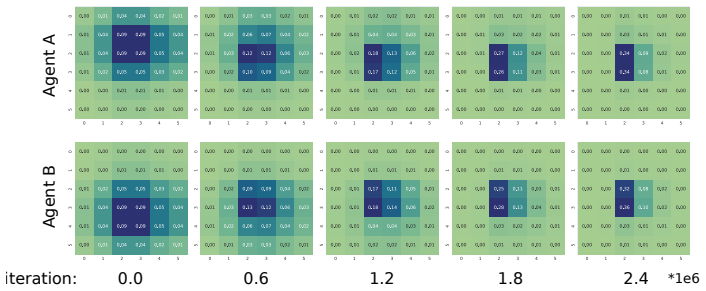
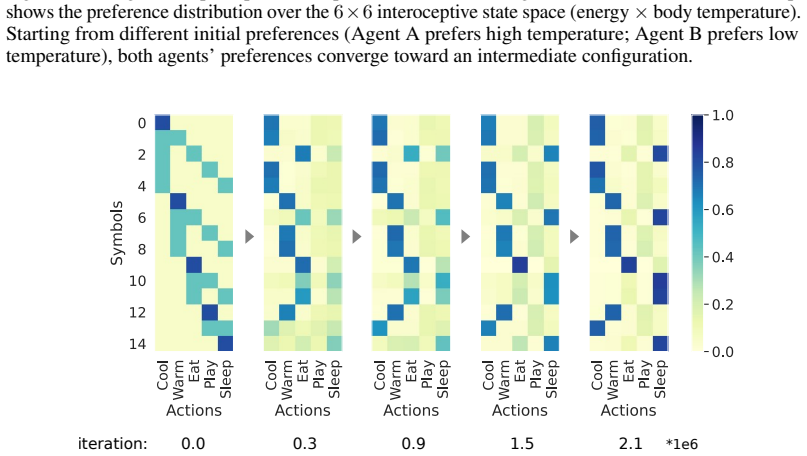
In the social allostasis model, two agents exchange inferred symbols while each adapts its interoceptive prior preferences and symbol probability distributions; the resulting convergence demonstrates that social reality of emotion can emerge directly from mutual adjustment grounded in active inference and dynamic interpretants.
What carries the argument
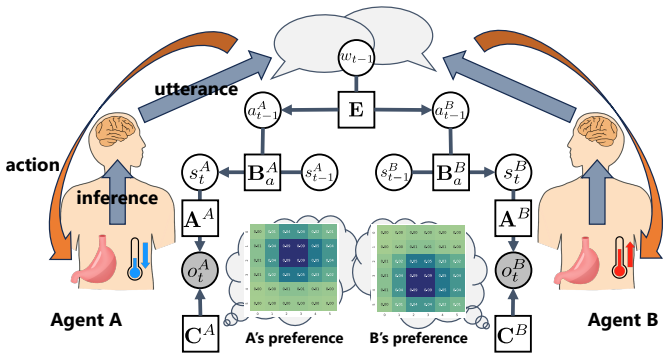
Social allostasis model with dynamic interpretants, in which agents jointly adapt bodily control goals and symbol interpretations through symbol exchange and active inference.
If this is right
- Shared emotion concepts can form through local dyadic interactions without external authority or pre-shared lexicon.
- Interoceptive bodily signals become aligned across agents as a direct consequence of symbol exchange and mutual goal adaptation.
- The model predicts that disrupting symbol exchange or adaptation will prevent convergence and thus block formation of social emotional reality.
- The same mechanism can be scaled to larger agent populations to study how consensus propagates beyond pairs.
Where Pith is reading between the lines
- The framework suggests experiments in which human participants perform joint tasks while their physiological signals and emotion-labeling choices are tracked for alignment after interaction.
- Cultural variation in emotion concepts could be modeled by varying the initial symbol sets or interaction frequencies between agent groups.
- If the convergence depends on specific active-inference update rules, the model offers a way to test whether human emotional consensus requires similar inference processes.
Load-bearing premise
Convergence produced by the chosen adaptation rules in the two-agent simulation corresponds to the actual emergence of social emotional reality in humans.
What would settle it
Run the same simulation with altered adaptation rates or initial symbol distributions and observe whether convergence still occurs; if it fails across reasonable parameter ranges, the claimed emergence mechanism is falsified.
Figures

read the original abstract
The theory of constructed emotion defines social reality as the community-level consensus on emotion concepts assigned to interoceptive sensations arising from bodily allostasis and social interaction. In this study, we simulate this emergence process using a computational model that integrates symbol emergence with degrees of freedom in symbol interpretation and active inference. Two agents receive interoceptive signals, exchange inferred symbols, and simultaneously adapt their bodily control goals and symbol interpretations to each other. Experimental results show that the interoceptive prior preferences and symbol probability distributions of the two agents converge, confirming the emergence of social reality grounded in social consensus.
Editorial analysis
A structured set of objections, weighed in public.
Referee Report
Summary. The paper claims that a computational model integrating symbol emergence, degrees of freedom in symbol interpretation, and active inference can simulate the emergence of social reality of emotion per the theory of constructed emotion. In the model, two agents receive interoceptive signals from bodily allostasis, exchange inferred symbols during social interaction, and simultaneously adapt their bodily control goals (interoceptive prior preferences) and symbol probability distributions to each other; experimental results are reported to show convergence of these distributions, which is taken to confirm emergence of social consensus on emotion concepts.
Significance. If the convergence can be shown to arise specifically from the integration of active inference, allostasis, and interpretive degrees of freedom rather than from the mutual adaptation rules alone, the work could offer a mechanistic illustration of how social reality of emotion is constructed. The explicit linkage of interoceptive priors to symbol use is a positive feature that aligns with the target theory.
major comments (2)
- [Abstract] Abstract: the claim that 'experimental results show that the interoceptive prior preferences and symbol probability distributions of the two agents converge, confirming the emergence of social reality' is not supported by any reported details on number of trials, statistical tests, parameter values, baseline comparisons, or sensitivity analyses. Without these, it is impossible to determine whether the outcome is robust or an artifact of the chosen settings.
- [Model description] Model description: agents are explicitly described as adapting 'their bodily control goals and symbol interpretations to each other' via reciprocal updating. This mutual adaptation rule directly pulls the distributions together by construction; the central claim that convergence demonstrates emergent social consensus therefore requires evidence that convergence fails under non-social controls (e.g., independent adaptation without symbol exchange or asymmetric rules).
minor comments (2)
- [Abstract] Abstract: the description of the adaptation process could be clarified by briefly indicating the form of the update rules (e.g., whether they are gradient-based, Bayesian, or heuristic) to make the mechanism more transparent.
- [Experimental results] The manuscript would benefit from a table or figure summarizing the free parameters (adaptation rates, initial symbol probabilities) and their ranges, as these are noted as present in the model.
Simulated Author's Rebuttal
We thank the referee for the constructive and insightful comments. We address each major comment below and have revised the manuscript to strengthen the presentation of results and add necessary controls.
read point-by-point responses
-
Referee: [Abstract] Abstract: the claim that 'experimental results show that the interoceptive prior preferences and symbol probability distributions of the two agents converge, confirming the emergence of social reality' is not supported by any reported details on number of trials, statistical tests, parameter values, baseline comparisons, or sensitivity analyses. Without these, it is impossible to determine whether the outcome is robust or an artifact of the chosen settings.
Authors: We agree that the original abstract overstated the confirmatory nature of the results without supporting details. In the revised manuscript we have toned down the abstract language to state that the simulations demonstrate convergence under the tested conditions. We have also added a new 'Experimental Setup' subsection that reports the number of independent trials (100 runs with varied random seeds), all parameter values (interoceptive prior strengths, symbol update rates, and allostatic thresholds), quantitative convergence metrics (mean KL divergence between agents' distributions with standard errors), and sensitivity analyses across parameter ranges. Baseline comparisons with randomized symbol mappings are now included to show that convergence is not guaranteed under all settings. revision: yes
-
Referee: [Model description] Model description: agents are explicitly described as adapting 'their bodily control goals and symbol interpretations to each other' via reciprocal updating. This mutual adaptation rule directly pulls the distributions together by construction; the central claim that convergence demonstrates emergent social consensus therefore requires evidence that convergence fails under non-social controls (e.g., independent adaptation without symbol exchange or asymmetric rules).
Authors: The referee is correct that reciprocal updating is an explicit design choice. However, the updates are not arbitrary; each agent performs active inference to select symbols that best explain its own interoceptive signals before exchanging them, and the degrees of freedom in interpretation allow non-trivial alignment rather than forced identity. To demonstrate specificity, the revised manuscript now includes two control conditions: (1) agents perform independent allostatic adaptation with no symbol exchange, resulting in no convergence of symbol probability distributions; (2) asymmetric adaptation where only one agent updates its priors based on the other's symbols. These controls show that symbol-mediated interaction is required for the observed consensus, supporting the claim that the integrated model produces emergent social reality rather than a trivial averaging effect. revision: yes
Circularity Check
Convergence of agent distributions is a direct consequence of the built-in mutual adaptation rules rather than an independent emergence result.
specific steps
-
self definitional
[Abstract]
"Two agents receive interoceptive signals, exchange inferred symbols, and simultaneously adapt their bodily control goals and symbol interpretations to each other. Experimental results show that the interoceptive prior preferences and symbol probability distributions of the two agents converge, confirming the emergence of social reality grounded in social consensus."
The model definition includes simultaneous mutual adaptation of goals and interpretations; the observed convergence of the very quantities being adapted is therefore equivalent to the input rule by construction. The claim that this convergence 'confirms' emergence of social reality adds no new content beyond the programmed interaction dynamics.
full rationale
The paper's central claim rests on a two-agent simulation in which agents are explicitly defined to exchange symbols and simultaneously adapt their interoceptive prior preferences and symbol interpretations to each other. The reported convergence is therefore produced by the interaction mechanics themselves. No independent derivation, control condition, or external benchmark is shown to establish that this outcome arises specifically from the claimed integration of symbol emergence, active inference, and social allostasis rather than from the reciprocal updating rule. The result therefore reduces to the model's definitional inputs.
Axiom & Free-Parameter Ledger
free parameters (1)
- Adaptation rates and initial symbol probabilities
axioms (3)
- domain assumption Interoceptive sensations arise from bodily allostasis and are assigned emotion concepts by social consensus
- domain assumption Agents perform active inference and exchange inferred symbols
- domain assumption Symbol interpretations possess degrees of freedom that allow mutual adaptation
Reference graph
Works this paper leans on
-
[1]
Emotions are real.Emotion, 12(3):413–429, June 2012
Lisa Feldman Barrett. Emotions are real.Emotion, 12(3):413–429, June 2012
work page 2012
-
[2]
Lisa Feldman Barrett.How Emotions Are Made: The Secret Life of the Brain. HarperCollins, 2017
work page 2017
-
[3]
Lisa Feldman Barrett. The theory of constructed emotion: an active inference account of interoception and categorization.Soc. Cogn. Affect. Neurosci., 12(1):1–23, January 2017
work page 2017
-
[4]
The theory of constructed emotion: More than a feeling.Perspect
Lisa Feldman Barrett, Shir Atzil, Eliza Bliss-Moreau, Lorena Chanes, Maria Gendron, Katie Hoemann, Yuta Katsumi, Ian R Kleckner, Kristen A Lindquist, Karen S Quigley, Ajay B Satpute, Eli Sennesh, Clare Shaffer, Jordan E Theriault, Michele Tugade, and Christiana Westlin. The theory of constructed emotion: More than a feeling.Perspect. Psychol. Sci., 20(3):...
work page 2025
-
[5]
Categorization is ’baked’ into the brain.Nat
Lisa Feldman Barrett and Earl K Miller. Categorization is ’baked’ into the brain.Nat. Rev. Neurosci., pages 1–22, April 2026
work page 2026
-
[6]
An active inference theory of allostasis and interoception in depression.Philos
Lisa Feldman Barrett, Karen S Quigley, and Paul Hamilton. An active inference theory of allostasis and interoception in depression.Philos. Trans. R. Soc. Lond. B Biol. Sci., 371(1708):20160011, November 2016
work page 2016
-
[7]
Peter L. Berger and Thomas Luckmann.The social construction of reality: a treatise in the sociology of knowledge. Doubleday, Garden City, N.Y ., [1st ed.] edition, 1966
work page 1966
-
[8]
The construction of emotion in interactions, relationships, and cultures.Emot
Michael Boiger and Batja Mesquita. The construction of emotion in interactions, relationships, and cultures.Emot. Rev., 4(3):221–229, July 2012
work page 2012
-
[9]
Active inference on discrete state-spaces: A synthesis.J
Lancelot Da Costa, Thomas Parr, Noor Sajid, Sebastijan Veselic, Victorita Neacsu, and Karl Friston. Active inference on discrete state-spaces: A synthesis.J. Math. Psychol., 99(102447):102447, December 2020. 9
work page 2020
-
[10]
Oxford Studies in Philosophy of Science
Brian Epstein.The ant trap: Rebuilding the foundations of the social sciences. Oxford Studies in Philosophy of Science. Oxford University Press, New York, NY , June 2015
work page 2015
-
[11]
Nguyen Le Hoang, Tadahiro Taniguchi, Yoshinobu Hagiwara, and Akira Taniguchi. Emergent communication of multimodal deep generative models based on metropolis-hastings naming game.Front. Robot. AI, 10:1290604, 2023
work page 2023
-
[12]
Cultural differences in emotions: a context for interpreting emotional experiences.Behav
B Mesquita and R Walker. Cultural differences in emotions: a context for interpreting emotional experiences.Behav. Res. Ther ., 41(7):777–793, July 2003
work page 2003
- [13]
-
[14]
Oxford University Press, New York, NY , January 2010
John R Searle.Making the social world: The structure of human civilization. Oxford University Press, New York, NY , January 2010
work page 2010
-
[15]
Tadahiro Taniguchi. Collective predictive coding hypothesis: symbol emergence as decentral- ized bayesian inference.Front. Robot. AI, 11:1353870, July 2024
work page 2024
-
[16]
Emergent communication through metropolis-hastings naming game with deep generative models.Adv
Tadahiro Taniguchi, Yuto Yoshida, Yuta Matsui, Nguyen Le Hoang, Akira Taniguchi, and Yoshinobu Hagiwara. Emergent communication through metropolis-hastings naming game with deep generative models.Adv. Robot., 37(19):1266–1282, October 2023
work page 2023
-
[17]
Kazuki Tsurumaki, Chie Hieida, and Kazuki Miyazawa. Study of emotion concept formation by integrating vision, physiology, and word information using multilayered multimodal latent dirichlet allocation.IEEE Trans. Affect. Comput., 16(4):2975–2987, October 2025. 10
work page 2025
discussion (0)
Sign in with ORCID, Apple, or X to comment. Anyone can read and Pith papers without signing in.