Recognition: no theorem link
Control and Scheduling of Behind-the-Meter Battery Energy Storage Systems for Stacked Grid and Building Services
Pith reviewed 2026-05-11 03:00 UTC · model grok-4.3
The pith
A two-stage scheduler lets one behind-the-meter battery deliver stacked building and grid frequency services at once.
A machine-rendered reading of the paper's core claim, the machinery that carries it, and where it could break.
Core claim
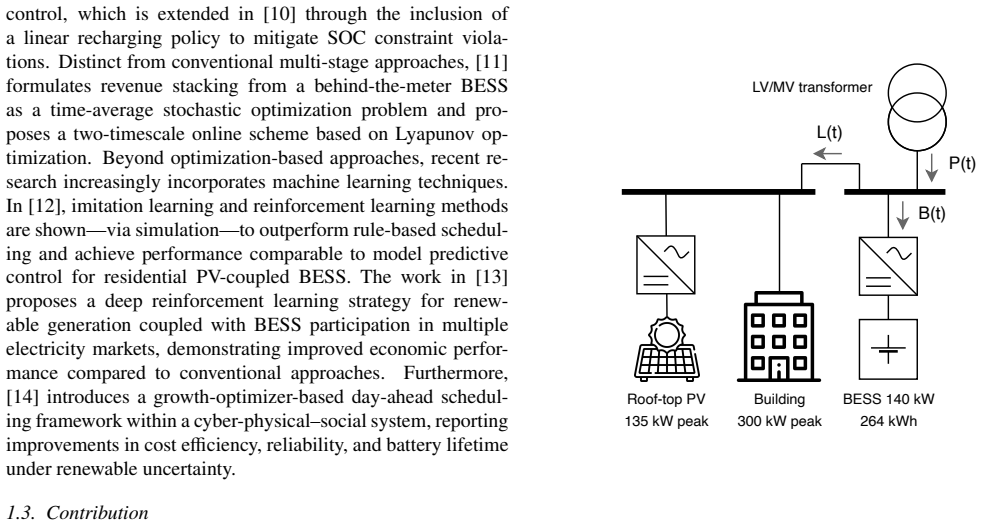
The central discovery is that a two-stage scheduling framework, consisting of a scenario-based day-ahead capacity allocation across local and balancing services and a high-resolution real-time control layer, can successfully actuate the provision of PV self-consumption maximization, peak-load reduction, and aFRR secondary frequency control from a single behind-the-meter BESS, as validated through experiments on a 300 kW peak-demand building equipped with a 264 kWh lithium-ion battery.
What carries the argument
The two-stage scheduler with scenario-based day-ahead allocation across local and aFRR services plus periodic real-time set-point computation using updated prices, net load, and state of charge.
If this is right
- Battery capacity is allocated across local and balancing services without fixed power commitments for aFRR.
- Real-time BESS set-points are recomputed periodically at high resolution from current balancing prices, net load, and state of charge.
- Local services such as PV self-consumption and peak-load reduction can be stacked with grid frequency control on the same asset.
- Experimental tests on a real 300 kW building confirm effective scheduling and actuation of both behind-the-meter and front-of-the-meter services.
Where Pith is reading between the lines
- Distributed batteries using this method could reduce the need for dedicated grid-scale storage by contributing to frequency balancing from customer sites.
- The approach may extend to additional grid services such as voltage support if the real-time layer is updated with new signals.
- Scaling to fleets of buildings would require testing whether aggregate aFRR bids remain feasible when local load patterns differ across sites.
Load-bearing premise
The day-ahead stage can allocate battery capacity using scenarios that reflect potential aFRR remuneration without committing to fixed power availability in advance.
What would settle it
If the real-time experiments had shown the battery failing to meet aFRR activation requirements while also missing local peak-reduction or PV self-consumption targets during periods of high load and high balancing prices, the stacked-services claim would not hold.
Figures




read the original abstract
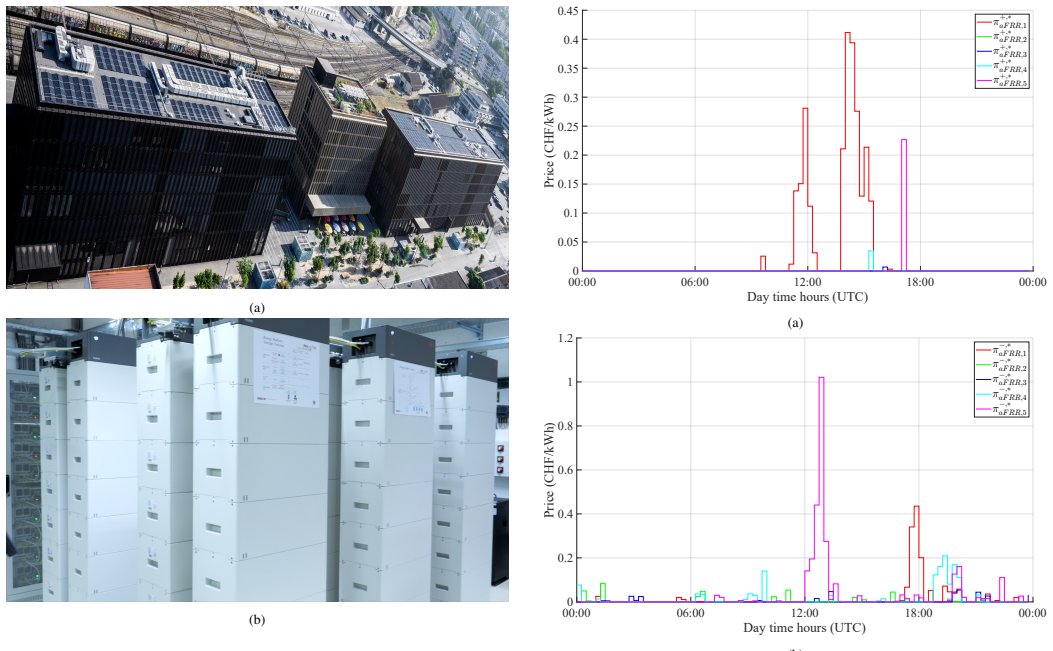
This paper proposes and experimentally validates a two-stage scheduling and control strategy for a behind-the-meter battery energy storage system (BESS) delivering both local and grid services. Considered services are the maximization of PV self-consumption, peak-load reduction, and secondary frequency control (aFRR).The day-ahead stage allocates battery capacity across local and balancing services using a scenario based approach, reflecting potential remuneration from aFRR participation without committing to fixed power availability; in the real-time stage, BESS set-points are computed in a periodic fashion at a high time resolution based on updated information on balancing prices, net load realization and BESS state of charge. The strategy is experimentally validated on a building at the Energypolis Campus of HES-SO Valais (Sion, Switzerland), which exhibits a peak power demand of 300 kW and is equipped with a 264 kWh / 140 kW lithium-ion BESS. The experimental results demonstrate the effectiveness of the proposed framework in scheduling and actuating the provision of both behind-the-meter and front-of-the-meter services.
Editorial analysis
A structured set of objections, weighed in public.
Referee Report
Summary. The paper proposes a two-stage scheduling and control strategy for a behind-the-meter BESS to simultaneously maximize PV self-consumption, reduce peak load, and provide aFRR secondary frequency control. The day-ahead stage uses scenario-based optimization to allocate battery capacity across services without fixed power commitments, while the real-time stage periodically computes set-points using updated prices, net load, and SOC. The framework is experimentally validated on a real building with 300 kW peak demand equipped with a 264 kWh / 140 kW lithium-ion BESS.
Significance. If the results hold, the work is significant for demonstrating practical stacking of local building services with grid balancing services on a real 300 kW installation. The experimental setup on an actual building provides direct evidence of feasibility that is stronger than simulation-only studies.
major comments (1)
- [Experimental validation] Experimental validation section: the paper reports overall BESS operation and scheduling but omits quantitative aFRR performance metrics such as tracking error, ramp compliance, activation success rate, or adherence to Swiss aFRR technical requirements. Without these, the central claim that the real-time stage successfully actuates front-of-the-meter aFRR service cannot be fully substantiated from the presented data.
minor comments (1)
- [Abstract] Abstract: states that experimental results demonstrate effectiveness but includes no quantitative results, error metrics, or key performance indicators to support this assertion.
Simulated Author's Rebuttal
We thank the referee for the constructive comment on the experimental validation. We address the point below.
read point-by-point responses
-
Referee: [Experimental validation] Experimental validation section: the paper reports overall BESS operation and scheduling but omits quantitative aFRR performance metrics such as tracking error, ramp compliance, activation success rate, or adherence to Swiss aFRR technical requirements. Without these, the central claim that the real-time stage successfully actuates front-of-the-meter aFRR service cannot be fully substantiated from the presented data.
Authors: We acknowledge that the experimental validation section focuses on overall BESS operation, scheduling outcomes, and the integration of services, but does not provide detailed quantitative metrics specifically for aFRR performance. The presented results do show the BESS responding to aFRR activations in real-time as part of the stacked services. However, to fully substantiate the claim, we agree that additional metrics are beneficial. In the revised manuscript, we will include quantitative aFRR performance metrics such as tracking error, ramp compliance, activation success rate, and a discussion on adherence to Swiss aFRR technical requirements, derived from the experimental data collected during the validation period. revision: yes
Circularity Check
No circularity: experimental validation is independent of the proposed strategy
full rationale
The paper proposes a two-stage scheduling and control framework (day-ahead scenario-based capacity allocation across local and aFRR services, followed by real-time set-point computation from updated prices, net load, and SOC) and validates it via direct experiments on a physical 264 kWh/140 kW BESS in a real building. No equations, parameters, or performance metrics are defined in terms of the same experimental outcomes they are later claimed to predict; the central effectiveness claim rests on independent hardware measurements rather than any self-referential fit, renaming, or self-citation chain. This is the normal case of a control paper whose derivation chain remains self-contained.
Axiom & Free-Parameter Ledger
Reference graph
Works this paper leans on
- [1]
- [2]
-
[3]
Y . Shi, B. Xu, D. Wang, B. Zhang, Using battery stor- age for peak shaving and frequency regulation: Joint op- timization for superlinear gains, IEEE Transactions on Power Systems 33 (3) (2018) 2882–2894
work page 2018
- [4]
-
[5]
H. Almasalma, G. Deconinck, Simultaneous provision of voltage and frequency control by pv-battery systems, IEEE access 8 (2020) 152820–152836
work page 2020
- [6]
-
[7]
A. M. Ali, Y . Raeisi, P. Grammatikos, D. Pavanello, P. Ro- duit, F. Sossan, Large-scale processing and validation of grid data for assessing the fair spatial distribution of pv hosting capacity, ACM SIGENERGY Energy Informatics Review 5 (3) (2025) 224–232
work page 2025
- [8]
-
[9]
H. Su, D. Feng, Y . Zhao, Y . Zhou, Q. Zhou, C. Fang, U. Rahman, Optimization of customer-side battery stor- age for multiple service provision: Arbitrage, peak shav- ing, and regulation, IEEE Transactions on Industrial Ap- plications 58 (2) (2022) 2559–2573
work page 2022
-
[10]
B. Claessens, J. Engels, G. Deconinck, Combined stochastic optimization of frequency control and self- consumption with a battery, IEEE Transactions on Smart Grid 10 (2) (2019) 1971–1981
work page 2019
-
[11]
S. Chen, S. Zhang, S. He, H. Yang, Two-timescale on- line optimization of behind-the-meter battery storage for stacked revenue by providing multi-services, IEEE Trans- actions on Smart Grid (2025)
work page 2025
-
[12]
F. Mueller, S. de Jongh, C. A. Cañizares, T. Leibfried, K. Bhattacharya, Comparison of machine learning and mpc methods for control of home battery storage systems in distribution grids, Applied Energy 400 (2025) 126465
work page 2025
-
[13]
J. Cardo-Miota, H. Beltran, E. Pérez, S. Khadem, M. Bahloul, Deep reinforcement learning-based strategy for maximizing returns from renewable energy and energy storage systems in multi-electricity markets, Applied En- ergy 388 (2025) 125561
work page 2025
- [14]
- [15]
-
[16]
ENTSO-E, Survey on ancillary services procurement and balancing market design, Tech. rep., ENTSO-E (2019)
work page 2019
- [17]
-
[18]
S. Cassano, F. Sossan, Scheduling power-intensive oper- ations of battery energy storage systems and application to hybrid hydropower plants, Applied Energy 386 (2025) 125559
work page 2025
-
[19]
F. Sossan, E. Scolari, R. Gupta, M. Paolone, Solar irra- diance estimations for modeling the variability of photo- voltaic generation and assessing violations of grid con- straints: A comparison between satellite and pyranome- ters measurements with load flow simulations, Journal of Renewable and Sustainable Energy 11 (5) (2019)
work page 2019
-
[20]
A. Shaqour, T. Ono, A. Hagishima, H. Farzaneh, Elec- trical demand aggregation effects on the performance of deep learning-based short-term load forecasting of a resi- dential building, Energy and AI 8 (2022) 100141
work page 2022
-
[21]
L. Nespoli, V . Medici, Global forecasting models for res- idential load flexibility and grid optimization, Frontiers in Energy Research 13 (2025) 1547617
work page 2025
-
[22]
Y . Ding, X. Sun, W. Shi, J. Ruan, J. Chen, Y . Zhao, Z. Xu, Optimal distributed energy management for local energy community: A decision regret oriented smart predict and optimize approach, IEEE Transactions on Industrial Infor- matics (2025). 13
work page 2025
-
[23]
L. Nespoli, V . Medici, K. Lopatichki, F. Sossan, Hier- archical demand forecasting benchmark for the distribu- tion grid, Electric Power Systems Research 189 (2020) 106755
work page 2020
-
[24]
A. Miyasawa, S. Akira, Y . Fujimoto, Y . Hayashi, Spatial demand forecasting based on smart meter data for improv- ing local energy self-sufficiency in smart cities, IET Smart Cities 3 (2) (2021) 107–120
work page 2021
-
[25]
F. Pavirani, J. Van Gompel, S. S. K. Madahi, B. Claessens, C. Develder, Predicting and publishing accurate imbal- ance prices using monte carlo tree search, Applied Energy 392 (2025) 125944
work page 2025
-
[26]
URLhttps://oiken.ch/publications/2024/
Oiken, Tarifs de l’électricité 2024 (2024). URLhttps://oiken.ch/publications/2024/
work page 2024
-
[27]
URLhttps://www.swissgrid.ch/en/home/ customers/topics/energy-data-ch.html
Swissgrid, Aggregated energy data of the control block switzerland (2024). URLhttps://www.swissgrid.ch/en/home/ customers/topics/energy-data-ch.html
work page 2024
-
[28]
Swissgrid, Principles of ancillary services products, Tech. rep., Swissgrid (2024)
work page 2024
-
[29]
URLhttps://www.elia.be/ Appendix A
Elia, afrr energy management strategy requirements, Technical Report Report Number, Elia, Brussels, Belgium (2022). URLhttps://www.elia.be/ Appendix A. Necessary conditions for convexity The electricity cost in Eq. (3) can be written as CEnergy =c ⊤[x]+ −d ⊤[x]−,(A.1) wherecandddenote the import and feed-in tariffs, respec- tively, and [·]+ and [·]− repre...
work page 2022
discussion (0)
Sign in with ORCID, Apple, or X to comment. Anyone can read and Pith papers without signing in.