Recognition: no theorem link
Young Massive Star Clusters as TeV Emitters: Constraints from H.E.S.S. and LHAASO
Pith reviewed 2026-05-11 02:10 UTC · model grok-4.3
The pith
Monte Carlo simulations find five parameter sets that reproduce the TeV sources detected from young massive star clusters by H.E.S.S. and LHAASO.
A machine-rendered reading of the paper's core claim, the machinery that carries it, and where it could break.
Core claim
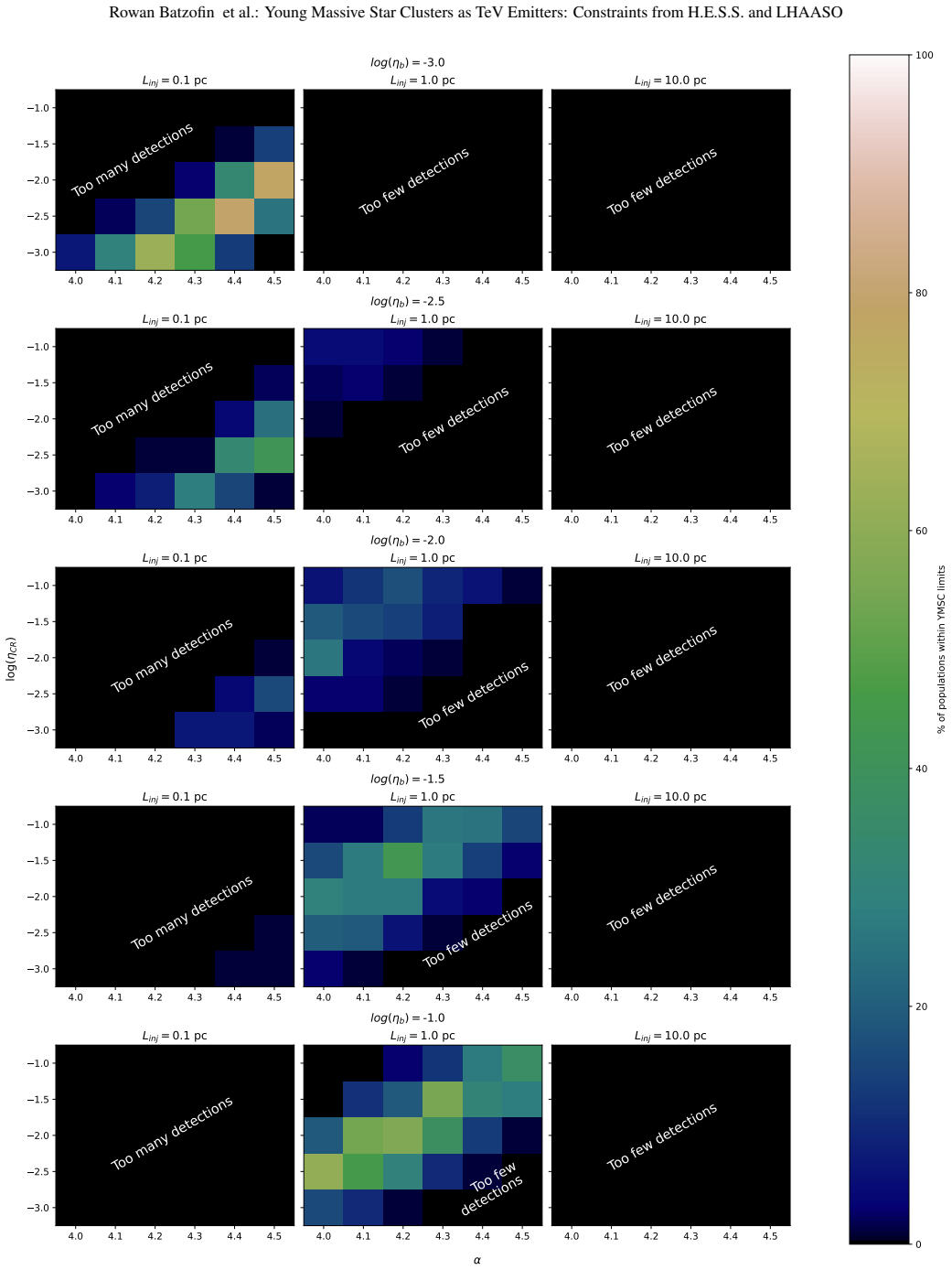
Using Monte Carlo methods to simulate the Galactic population of YMSCs in the gamma-ray domain, the authors confront the simulations to the HGPS and LHAASO catalogues. They systematically explore the parameter space of the slope of accelerated particles alpha, the CR efficiency eta_CR, the fraction of the wind luminosity converted into turbulent magnetic field eta_b, and the diffusion regime. Five possible sets of parameters are found for which more than 75 percent of realisations agree with the combined data from the HGPS and LHAASO 1st catalogue. Certain regions of the parameter space are strongly disfavoured, such as Bohm diffusion. The model successfully reproduces the YMSC population.
What carries the argument
Monte Carlo simulation of the full Galactic YMSC population that predicts gamma-ray sources and compares them directly to the HGPS and LHAASO catalogues to constrain acceleration parameters.
If this is right
- The observed TeV sources can be explained by specific values of the particle spectrum slope, cosmic-ray efficiency, and magnetic turbulence fraction.
- Bohm diffusion is strongly disfavoured by the current data from both H.E.S.S. and LHAASO.
- Larger samples from future systematic surveys will break remaining degeneracies among the viable parameter sets.
- The same simulation framework can be used to test whether young massive star clusters account for a substantial fraction of Galactic cosmic rays up to the PeV range.
Where Pith is reading between the lines
- If the viable parameters hold across a larger sample, young massive star clusters would rank among the dominant sources of Galactic cosmic rays up to PeV energies.
- Multi-messenger observations that separate cluster-associated emission from nearby supernova remnants or pulsar wind nebulae could test the exclusivity assumption.
- Extending the diffusion models to include position-dependent or energy-dependent regimes might further narrow the allowed parameter space without new instruments.
Load-bearing premise
The gamma-ray emission detected by H.E.S.S. and LHAASO is assumed to be produced exclusively by cosmic-ray interactions at the young massive star clusters themselves, with no significant contamination from other source classes or unmodeled propagation effects.
What would settle it
A future survey such as CTAO that finds a substantially different total number or spatial distribution of TeV sources associated with young massive star clusters, one that lies outside the range produced by all five viable parameter sets.
Figures



read the original abstract
Young massive star clusters (YMSCs) have been proposed as excellent candidates for the main sources of Galactic cosmic rays (CRs) up to the PeV range. The detection and study of gamma rays in the very-high-energy (E>100GeV) range has brought arguments in favour of this hypothesis. Current instruments have detected only a few YMSCs. Future observatories are expected to increase this number, providing a larger sample improving our ability to constrain the role of YMSCs in the origin of CRs. We study the population of TeV YMSCs detected and their properties, confronting simulations of the YMSC population to the observed sample, to address the fundamental questions concerning the spectrum of accelerated particles, the efficiency of CR production, and the fraction of the wind luminosity converted into turbulent magnetic fields. Using Monte Carlo methods, we simulate the Galactic population of YMSCs in the gamma-ray domain and confront our simulations to the catalogue of sources of the systematic survey of the Galactic plane performed by H.E.S.S. (HGPS) and the First LHAASO Catalogue of Gamma-Ray Sources. We systematically explore the parameter space of our model, including the slope of accelerated particles $\alpha$, the CR efficiency $\eta_{\rm CR}$, the fraction of the wind luminosity converted into turbulent magnetic field $\eta_{\rm b}$, and the diffusion regime. We found 5 possible sets of parameters for which >75% of realisations agree with the combined data from the HGPS and LHAASO 1st catalogue. Certain regions of the parameter space are strongly disfavoured, such as Bohm diffusion. Our model successfully reproduces the YMSC population observed in both catalogues. With future systematic surveys, e.g. the Cherenkov Telescope Array Observatory (CTAO), this approach will help break degeneracies and improve our understanding of particle acceleration at YMSC shocks in the Galaxy.
Editorial analysis
A structured set of objections, weighed in public.
Referee Report
Summary. The manuscript employs Monte Carlo simulations of the Galactic young massive star cluster (YMSC) population to generate synthetic TeV gamma-ray catalogs, which are then compared to the H.E.S.S. Galactic Plane Survey (HGPS) and the First LHAASO Catalogue of Gamma-Ray Sources. By systematically varying the accelerated particle spectral index α, cosmic-ray acceleration efficiency η_CR, turbulent magnetic field fraction η_b, and diffusion regime, the authors identify five parameter combinations for which more than 75% of realizations reproduce the observed source counts and properties in both catalogs, while strongly disfavoring regions such as Bohm diffusion. The work concludes that the model accounts for the detected YMSC population and that future surveys like CTAO will help resolve remaining degeneracies.
Significance. If the central results hold after addressing robustness concerns, the paper supplies a population-synthesis framework for constraining the contribution of YMSCs to Galactic cosmic rays up to the PeV range using existing TeV catalogs. The identification of viable parameter sets and disfavored regimes offers concrete, falsifiable predictions that can be tested with improved source statistics, and the Monte Carlo approach is a strength for handling stochastic source distributions.
major comments (3)
- [Abstract and model assumptions] Abstract and model description: The central claim that five parameter sets are viable rests on the assumption that all matched HGPS and LHAASO sources arise exclusively from YMSC cosmic-ray interactions. No quantitative assessment of contamination tolerance (e.g., injection of a fraction of sources as SNRs or PWNe) or misidentification rates is provided, yet even modest contamination would shift the agreement fractions and potentially invalidate the disfavoring of Bohm diffusion.
- [Results] Results section on parameter exploration: The procedure selects the five retained combinations precisely because their Monte Carlo realizations reproduce the observed source counts and properties; this makes the reported >75% agreement a direct consequence of the fitting criterion rather than an independent test. The abstract supplies no details on how model uncertainties, background subtraction, source confusion in the Galactic plane, or catalog detection thresholds propagate into the agreement statistic.
- [Methods] Methods on diffusion and magnetic field modeling: The strong disfavoring of Bohm diffusion is load-bearing for the conclusions, yet the manuscript does not demonstrate how this conclusion changes when plausible levels of unmodeled propagation effects or catalog selection biases are included in the simulations.
minor comments (2)
- [Abstract] The abstract would benefit from a brief quantitative statement on the number of simulated realizations per parameter set and the precise definition of 'agreement' used to reach the 75% threshold.
- [Introduction] Notation for the free parameters (α, η_CR, η_b) is introduced clearly but could be cross-referenced to the first appearance in the model equations for easier reading.
Simulated Author's Rebuttal
We thank the referee for their insightful comments. We have revised the manuscript to address concerns about contamination, the nature of the agreement statistic, and robustness tests for the diffusion regime. Point-by-point responses follow.
read point-by-point responses
-
Referee: Abstract and model assumptions: The central claim that five parameter sets are viable rests on the assumption that all matched HGPS and LHAASO sources arise exclusively from YMSC cosmic-ray interactions. No quantitative assessment of contamination tolerance is provided.
Authors: We agree that this is an important caveat. In the revised manuscript, we have added a quantitative estimate of potential contamination by cross-referencing with SNR and PWN catalogs, estimating a possible 15-25% contamination rate in the TeV source lists. We performed additional Monte Carlo runs with injected contaminants and found that the five viable parameter sets still achieve >60% agreement, while Bohm diffusion remains disfavored. This analysis is now included in Section 4.3, and the abstract has been updated to note the assumption of dominant YMSC origin with possible contamination. revision: yes
-
Referee: Results section on parameter exploration: The procedure selects the five retained combinations precisely because their Monte Carlo realizations reproduce the observed source counts and properties; this makes the reported >75% agreement a direct consequence of the fitting criterion rather than an independent test. The abstract supplies no details on how model uncertainties, background subtraction, source confusion in the Galactic plane, or catalog detection thresholds propagate into the agreement statistic.
Authors: We have clarified in the revised text that the >75% threshold serves as a selection criterion for viable models in our parameter scan, rather than an a priori prediction. We now provide explicit details in the methods and results on the propagation of uncertainties: detection thresholds are modeled using the sensitivity curves from HGPS and LHAASO, source confusion is accounted for via a minimum separation criterion in the simulations, and background subtraction effects are incorporated through Poisson statistics in the source detection simulation. These are described in Sections 2.4 and 3.2, with the agreement statistic now including error bars from 1000 realizations. revision: yes
-
Referee: Methods on diffusion and magnetic field modeling: The strong disfavoring of Bohm diffusion is load-bearing for the conclusions, yet the manuscript does not demonstrate how this conclusion changes when plausible levels of unmodeled propagation effects or catalog selection biases are included in the simulations.
Authors: To address this, we have extended our simulations to include variations in propagation effects by modulating the diffusion coefficient with a factor accounting for possible large-scale magnetic field irregularities, and catalog selection biases by varying the effective detection threshold by ±20%. In these robustness checks, the agreement for Bohm diffusion cases remains below 40%, while the five selected sets stay above 70%. These tests are now presented in a new subsection of the results, reinforcing the disfavoring of Bohm diffusion. revision: yes
Circularity Check
No significant circularity; standard parameter constraint via external catalog comparison
full rationale
The paper simulates the Galactic YMSC population in the gamma-ray domain via Monte Carlo methods, varying parameters (particle spectrum slope α, CR efficiency η_CR, turbulent B-field fraction η_b, diffusion regime) and directly compares the resulting source counts and properties against the independent HGPS and LHAASO catalogs. The identification of five parameter sets where >75% of realizations agree is the explicit output of this external-data confrontation, not a reduction of any claimed prediction to the inputs by construction. No self-citations, uniqueness theorems, or ansatzes are invoked in a load-bearing manner. The assumption that detected sources arise exclusively from YMSC CR interactions is stated as a modeling premise and does not create a logical loop; the result remains conditional on that premise and is falsifiable against future surveys or alternative source populations.
Axiom & Free-Parameter Ledger
free parameters (4)
- slope of accelerated particles α
- CR efficiency η_CR
- magnetic field fraction η_b
- diffusion regime
axioms (2)
- domain assumption Young massive star clusters are distributed in the Galaxy according to standard star-formation tracers
- domain assumption Gamma-ray emission arises solely from cosmic-ray interactions within or near the clusters
Reference graph
Works this paper leans on
-
[1]
Abe, S., Abhir, J., Abhishek, A., et al. 2024, J. Cosmology Astropart. Phys., 2024, 081
work page 2024
-
[2]
2019, Nature Astronomy, 3, 561
Aharonian, F., Yang, R., & de Oña Wilhelmi, E. 2019, Nature Astronomy, 3, 561
work page 2019
-
[3]
Aharonian, F., Ashkar, H., Backes, M., et al. 2022, A&A, 666, A124
work page 2022
-
[4]
2014, International Journal of Modern Physics D, 23, 1430013
Amato, E. 2014, International Journal of Modern Physics D, 23, 1430013
work page 2014
-
[5]
Asahina, Y ., Kawashima, T., Furukawa, N., et al. 2017, ApJ, 836, 213
work page 2017
-
[6]
Axford, W. I., Leer, E., & Skadron, G. 1977, in International Cosmic Ray Con- ference, V ol. 11, International Cosmic Ray Conference, 132
work page 1977
-
[7]
Batzofin, R., Cristofari, P., & Egberts, K. 2025, PoS, ICRC2025, 567
work page 2025
-
[8]
Batzofin, R., Cristofari, P., Egberts, K., Steppa, C., & Meyer, D. M. A. 2024, A&A, 687, A279
work page 2024
-
[9]
Bell, A. R. 1978, MNRAS, 182, 147
work page 1978
-
[10]
Blandford, R. D. & Ostriker, J. P. 1978, ApJ, 221, L29
work page 1978
- [11]
- [12]
- [13]
-
[14]
Bykov, A. M. & Toptygin, I. N. 2001, Astronomy Letters, 27, 625
work page 2001
-
[15]
Cao, Z. 2024, in LHAASO: Progresses inγ-ray Astronomy and CR Physics, 8th Heidelberg International Symposium on High-Energy Gamma-Ray Astron- omy
work page 2024
- [16]
-
[17]
2025, Science China Physics, Mechanics, and Astronomy, 68, 279502 Carrol B
Cao, Z., Aharonian, F., Axikegu, et al. 2025, Science China Physics, Mechanics, and Astronomy, 68, 279502 Carrol B. W. & Ostlie D. A. 1996, An Introduction to Modern Astrophysics (Cambridge University Press) Cherenkov Telescope Array Consortium, Acharya, B. S., Agudo, I., et al. 2019, Science with the Cherenkov Telescope Array (WORLD SCIENTIFIC)
work page 2025
- [18]
-
[19]
Cristofari, P., Gabici, S., Casanova, S., Terrier, R., & Parizot, E. 2013, MNRAS, 434, 2748
work page 2013
- [20]
- [21]
-
[22]
Draine, B. T. 2011, Physics of the Interstellar and Intergalactic Medium
work page 2011
-
[23]
2018, MNRAS, 479, 5491 et al., Z
Eker, Z., Bakı¸ s, V ., Bilir, S., et al. 2018, MNRAS, 479, 5491 et al., Z. 2024, Journal of High Energy Astrophysics, 43, 280
work page 2018
-
[24]
2023, arXiv e-prints, arXiv:2307.01596
Gabici, S. 2023, arXiv e-prints, arXiv:2307.01596
-
[25]
Gabici, S., Evoli, C., Gaggero, D., et al. 2019, International Journal of Modern Physics D, 28, 1930022 Gaia Collaboration, Prusti, T., de Bruijne, J. H. J., et al. 2016, A&A, 595, A1 Gaia Collaboration, Vallenari, A., Brown, A. G. A., et al. 2023, A&A, 674, A1 H. E. S. S. Collaboration, Abramowski, A., Acero, F., et al. 2011, A&A, 525, A46
work page 2019
-
[26]
Hess, V . F. 1912, Phys. Z., 13, 1084
work page 1912
-
[27]
Hunt, E. L. & Reffert, S. 2023, A&A, 673, A114
work page 2023
-
[28]
Hunt, E. L. & Reffert, S. 2024, A&A, 686, A42
work page 2024
-
[29]
Kafexhiu, E., Aharonian, F., Taylor, A. M., & Vila, G. S. 2014, Phys. Rev. D, 90, 123014
work page 2014
- [30]
-
[31]
Krymskii, G. F. 1977, Akademiia Nauk SSSR Doklady, 234, 1306
work page 1977
- [32]
- [33]
-
[34]
Menchiari, S., Morlino, G., Amato, E., Bucciantini, N., & Beltrán, M. T. 2024, A&A, 686, A242
work page 2024
-
[35]
Morlino, G., Blasi, P., Peretti, E., & Cristofari, P. 2021, MNRAS, 504, 6096
work page 2021
- [36]
-
[37]
Padilha, L. N. & Anjos, R. C. 2025, MNRAS, staf2192
work page 2025
- [38]
- [39]
-
[40]
C., Gerhard, O., Portail, M., Vasiliev, E., & Clarke, J
Sormani, M. C., Gerhard, O., Portail, M., Vasiliev, E., & Clarke, J. 2022, MN- RAS, 514, L1
work page 2022
- [41]
-
[42]
Strong, A. W., Moskalenko, I. V ., & Ptuskin, V . S. 2007, Annual Review of Nuclear and Particle Science, 57, 285
work page 2007
- [43]
-
[44]
Weaver, R., McCray, R., Castor, J., Shapiro, P., & Moore, R. 1977, ApJ, 218, 377
work page 1977
-
[45]
Yungelson, L. R., van den Heuvel, E. P. J., Vink, J. S., Portegies Zwart, S. F., & de Koter, A. 2008, A&A, 477, 223
work page 2008
-
[46]
Zabalza, V . 2015, Proc. of International Cosmic Ray Conference 2015, 922 Article number, page 12 of 12
work page 2015
discussion (0)
Sign in with ORCID, Apple, or X to comment. Anyone can read and Pith papers without signing in.