Recognition: 2 theorem links
· Lean TheoremSpectral Surgery: Class-Targeted Post-Hoc Rebalancing via Hessian Spike Perturbation
Pith reviewed 2026-05-11 03:30 UTC · model grok-4.3
The pith
Perturbing model weights along Hessian spike eigenvectors rebalances per-class accuracy without retraining.
A machine-rendered reading of the paper's core claim, the machinery that carries it, and where it could break.
Core claim
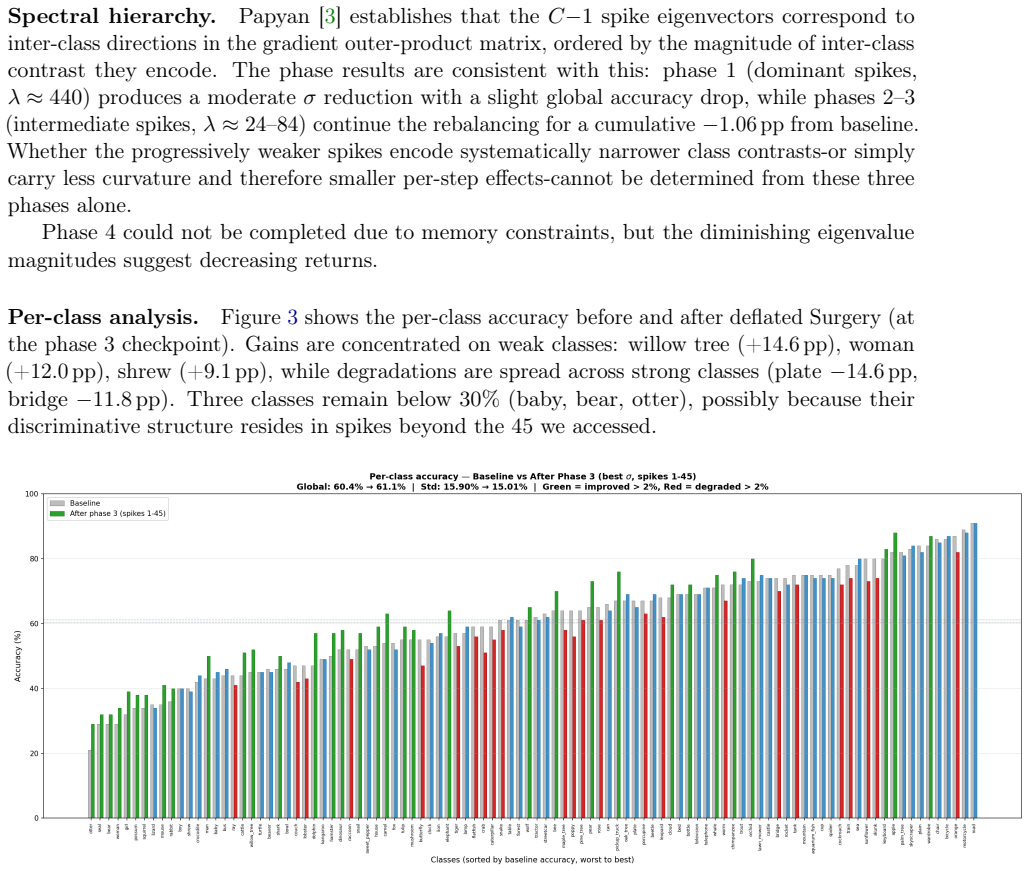
Spectral Surgery directly perturbs model weights along the spike eigenvectors of the Hessian. It introduces a spike-class sensitivity matrix that records the directional derivative of each class accuracy along each spike, then solves a constrained optimization over the perturbation coefficients to raise accuracy on weak classes while preserving it on strong classes. An adaptive amplitude controller raises or lowers the total perturbation budget according to whether successive steps produce improvement signals. Experiments on CIFAR-10 and ISIC-2019 report gains in balanced accuracy together with lower standard deviation across classes.
What carries the argument
The spike eigenvectors of the Hessian, whose count matches the number of classes minus one, together with the spike-class sensitivity matrix that quantifies how each eigenvector affects per-class accuracy.
Load-bearing premise
The spike eigenvectors align with class-specific directions such that small perturbations chosen via the sensitivity matrix can improve weak-class accuracy without harming strong-class accuracy.
What would settle it
Applying the optimized perturbations to a model trained on CIFAR-10 and finding no increase in balanced accuracy or an increase in per-class standard deviation on the test set would falsify the central claim.
Figures



read the original abstract
The Hessian spectrum of trained deep networks exhibits a characteristic structure: a continuous bulk of near-zero eigenvalues and a small number of large outlier eigenvalues (spikes), confirming the relevance of Random Matrix Theory in deep learning. The spike count matches the number of classes minus one. While prior work has described this structure, no method has exploited it operationally to improve classification performance. We propose Spectral Surgery, a post-hoc optimization method that directly perturbs model weights along spike eigenvectors to rebalance per-class accuracy without retraining. We introduce (i) a spike-class sensitivity matrix that quantifies the directional derivative of each class's accuracy along each spike eigenvector, (ii) a constrained optimization of perturbation coefficients that targets weak classes while preserving strong ones, and (iii) an adaptive amplitude control that raises or lowers the perturbation budget based on iteration-level improvement signals. We obtain encouraging results on CIFAR-10 and ISIC-2019 on both balanced accuracy and standard deviation.
Editorial analysis
A structured set of objections, weighed in public.
Referee Report
Summary. The manuscript proposes Spectral Surgery, a post-hoc optimization technique that perturbs the weights of a trained deep network along the eigenvectors of the large outlier eigenvalues (spikes) of the Hessian to rebalance per-class accuracies without retraining. It introduces a spike-class sensitivity matrix that quantifies directional derivatives of each class accuracy along these eigenvectors, solves a constrained optimization over perturbation coefficients to boost weak classes while preserving strong ones, and uses an adaptive amplitude control driven by iteration-level improvement signals. Encouraging results are claimed on CIFAR-10 and ISIC-2019 in terms of balanced accuracy and its standard deviation.
Significance. If the central claims can be substantiated with rigorous definitions and quantitative evidence, the work would offer a novel operational exploitation of the known low-rank spike structure in the Hessian spectrum (whose count matches the number of classes minus one) for efficient post-hoc fairness adjustments. This could be practically significant for imbalanced or biased models where retraining is costly, extending random matrix theory insights into actionable interventions.
major comments (2)
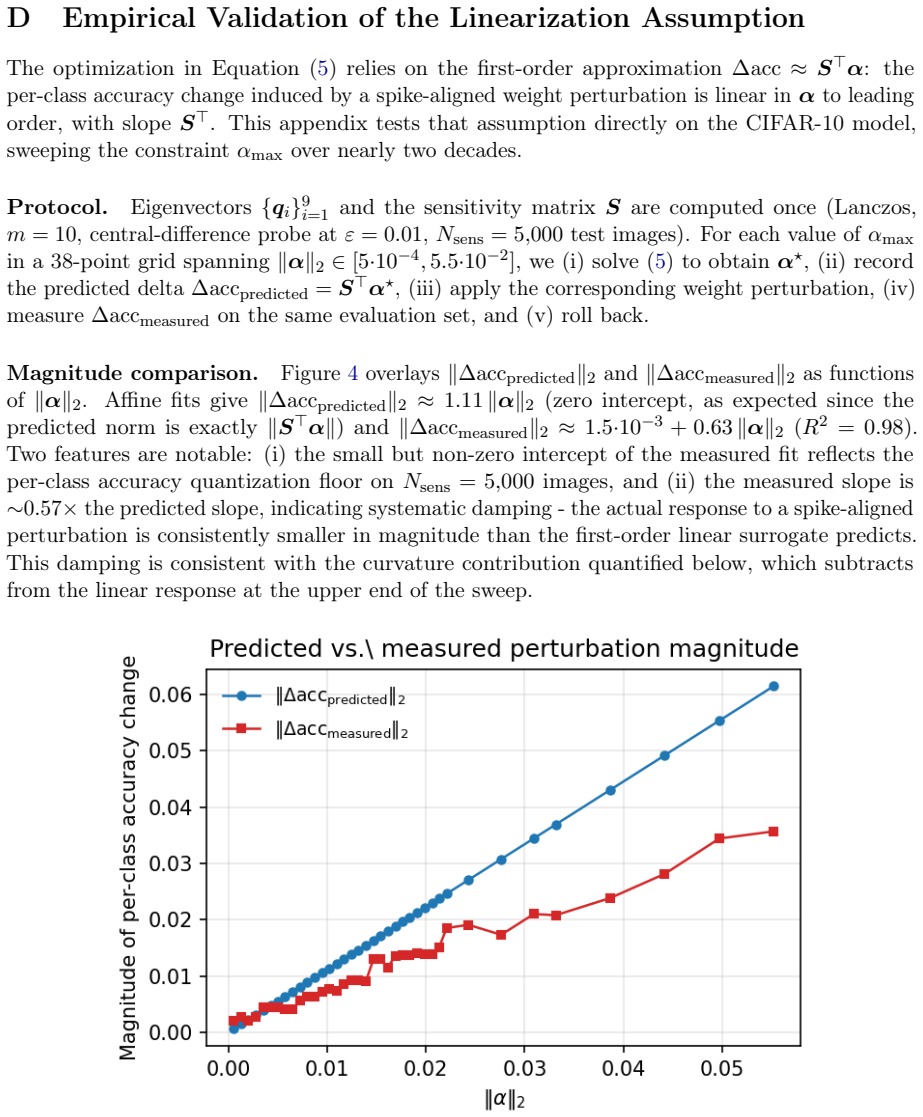
- [Abstract / Method] Abstract and method description: the spike-class sensitivity matrix is defined via the directional derivative of per-class accuracy (an indicator-based discontinuous quantity) along each spike eigenvector. No surrogate (e.g., softmax probabilities, smoothed accuracy, or finite-difference protocol with explicit step size) is referenced, yet the constrained optimization of perturbation coefficients and the adaptive amplitude control both depend on this matrix being well-defined and stable.
- [Abstract] Abstract: the claim of 'encouraging results' on CIFAR-10 and ISIC-2019 supplies no quantitative deltas versus baselines, error bars, number of runs, or optimization details (e.g., how the perturbation amplitude budget is initialized or updated). This prevents verification that the rebalancing is statistically meaningful or that the sensitivity-matrix-driven perturbations outperform simpler alternatives.
minor comments (2)
- Clarify whether perturbations are applied to all layers or selected ones, and provide pseudocode or explicit equations for the constrained optimization and adaptive amplitude update rule to aid reproducibility.
- The manuscript should include a brief comparison to prior post-hoc rebalancing methods (e.g., logit adjustment or threshold tuning) to situate the novelty of the Hessian-based approach.
Simulated Author's Rebuttal
We thank the referee for their insightful comments, which have helped us identify areas for clarification and improvement in our manuscript. We address each major comment in detail below.
read point-by-point responses
-
Referee: [Abstract / Method] Abstract and method description: the spike-class sensitivity matrix is defined via the directional derivative of per-class accuracy (an indicator-based discontinuous quantity) along each spike eigenvector. No surrogate (e.g., softmax probabilities, smoothed accuracy, or finite-difference protocol with explicit step size) is referenced, yet the constrained optimization of perturbation coefficients and the adaptive amplitude control both depend on this matrix being well-defined and stable.
Authors: We acknowledge that per-class accuracy, being based on indicator functions, is discontinuous, which could make direct derivatives ill-defined. However, in our implementation, we approximate these directional derivatives using finite differences with a small, fixed step size along the eigenvector. This provides a numerically stable sensitivity matrix that is used in the optimization. We will update the method description to explicitly detail this approximation, including the step size selection and any averaging procedures to ensure stability. revision: yes
-
Referee: [Abstract] Abstract: the claim of 'encouraging results' on CIFAR-10 and ISIC-2019 supplies no quantitative deltas versus baselines, error bars, number of runs, or optimization details (e.g., how the perturbation amplitude budget is initialized or updated). This prevents verification that the rebalancing is statistically meaningful or that the sensitivity-matrix-driven perturbations outperform simpler alternatives.
Authors: We agree that including quantitative details in the abstract would make the claims more verifiable. The full manuscript contains the specific results, including deltas in balanced accuracy and its standard deviation, along with experimental details such as the number of runs and baseline comparisons. We will revise the abstract to incorporate key quantitative findings, such as the improvement margins and optimization parameters, to better substantiate the encouraging results. revision: yes
Circularity Check
No circularity: new constructs and explicit optimization remain independent of inputs
full rationale
The paper introduces the spike-class sensitivity matrix as a novel quantification of directional derivatives along Hessian spike eigenvectors, followed by a constrained optimization over perturbation coefficients and adaptive amplitude control. These elements are defined and applied as algorithmic contributions rather than reductions of the claimed rebalancing improvement to any fitted parameter, self-citation, or tautological renaming. Prior observations on Hessian spike structure are cited as background (not load-bearing uniqueness theorems from the same authors), and the central post-hoc perturbation procedure is presented as an operational exploitation of that structure via new optimization machinery. No step equates the output performance gain to the input definitions by construction.
Axiom & Free-Parameter Ledger
free parameters (1)
- perturbation amplitude budget
axioms (1)
- domain assumption The Hessian spectrum of trained deep networks exhibits a continuous bulk of near-zero eigenvalues and a small number of large outlier eigenvalues whose count equals the number of classes minus one.
invented entities (1)
-
spike-class sensitivity matrix
no independent evidence
Lean theorems connected to this paper
-
IndisputableMonolith/Cost/FunctionalEquation.leanwashburn_uniqueness_aczel unclearspike–class sensitivity matrix that quantifies the directional derivative of each class’s accuracy along each spike eigenvector
-
IndisputableMonolith/Foundation/AlexanderDuality.leanalexander_duality_circle_linking unclearC−1 large isolated eigenvalues called spikes
Reference graph
Works this paper leans on
-
[1]
Empirical Analysis of the Hessian of Over-Parametrized Neural Networks
L. Sagun, U. Evci, V. U. Güney, Y. Dauphin, and L. Bottou. Empirical analysis of the Hessian of over-parametrized neural networks.arXiv:1706.04454, 2017
work page Pith review arXiv 2017
-
[2]
B. Ghorbani, S. Krishnan, and Y. Xiao. An investigation into neural net optimization via Hessian eigenvalue density. InICML, 2019
work page 2019
-
[3]
V. Papyan. Traces of class/cross-class structure pervade deep learning spectra.JMLR, 21(167):1–64, 2020
work page 2020
-
[4]
B. A. Pearlmutter. Fast exact multiplication by the Hessian.Neural Computation, 6(1):147– 160, 1994
work page 1994
-
[5]
C. Lanczos. An iteration method for the solution of the eigenvalue problem of linear differential and integral operators.J. Res. Nat. Bur. Standards, 45:255–282, 1950
work page 1950
-
[6]
K. He, X. Zhang, S. Ren, and J. Sun. Deep residual learning for image recognition. In CVPR, 2016
work page 2016
-
[7]
T.-Y. Lin, P. Goyal, R. Girshick, K. He, and P. Dollar. Focal loss for dense object detection. InICCV, 2017
work page 2017
-
[8]
Y. Cui, M. Jia, T.-Y. Lin, Y. Song, and S. Belongie. Class-balanced loss based on effective number of samples. InCVPR, 2019
work page 2019
-
[9]
K. Cao, C. Wei, A. Gaidon, N. Arechiga, and T. Ma. Learning imbalanced datasets with label-distribution-aware margin loss. InNeurIPS, 2019
work page 2019
- [10]
- [11]
-
[12]
S. Fort and S. Ganguli. Emergent properties of the local geometry of neural loss landscapes. arXiv:1910.05929, 2019
-
[13]
Z. Yao, A. Gholami, K. Keutzer, and M. W. Mahoney. PyHessian: Neural networks through the lens of the Hessian. InIEEE Big Data, 2020
work page 2020
-
[14]
Y. Saad. On the rates of convergence of the Lanczos and the block-Lanczos methods.SIAM J. Numer. Anal., 17(5):687–706, 1980
work page 1980
-
[15]
B. Kang, S. Xie, M. Rohrbach, Z. Yan, A. Gordo, J. Feng, and Y. Kalantidis. Decoupling representation and classifier for long-tailed recognition. InInternational Conference on Learning Representations (ICLR), 2020
work page 2020
-
[16]
A. K. Menon, S. Jayasumana, A. S. Rawat, H. Jain, A. Veit, and S. Kumar. Long-tail learning via logit adjustment. InInternational Conference on Learning Representations (ICLR), 2021
work page 2021
- [17]
discussion (0)
Sign in with ORCID, Apple, or X to comment. Anyone can read and Pith papers without signing in.