Recognition: no theorem link
On the repeatability of turbulence
Pith reviewed 2026-05-11 03:03 UTC · model grok-4.3
The pith
Decaying turbulence shows repeatable large scales across thousands of identical trials, while small scales remain random.
A machine-rendered reading of the paper's core claim, the machinery that carries it, and where it could break.
Core claim
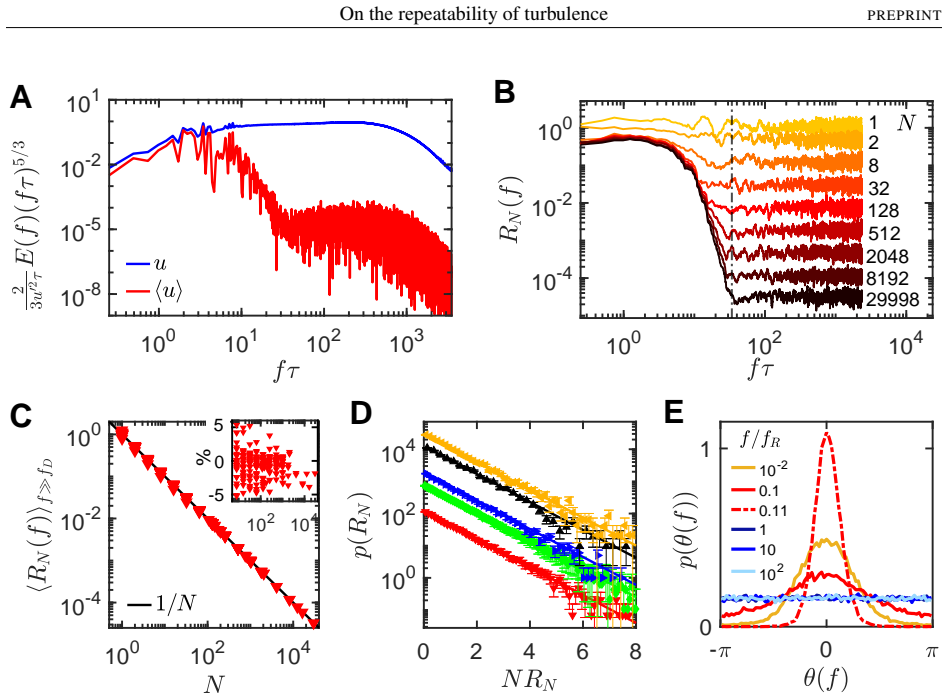
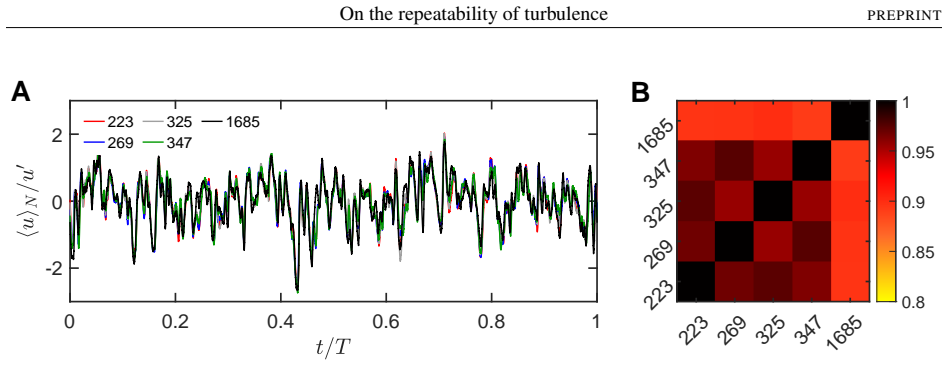
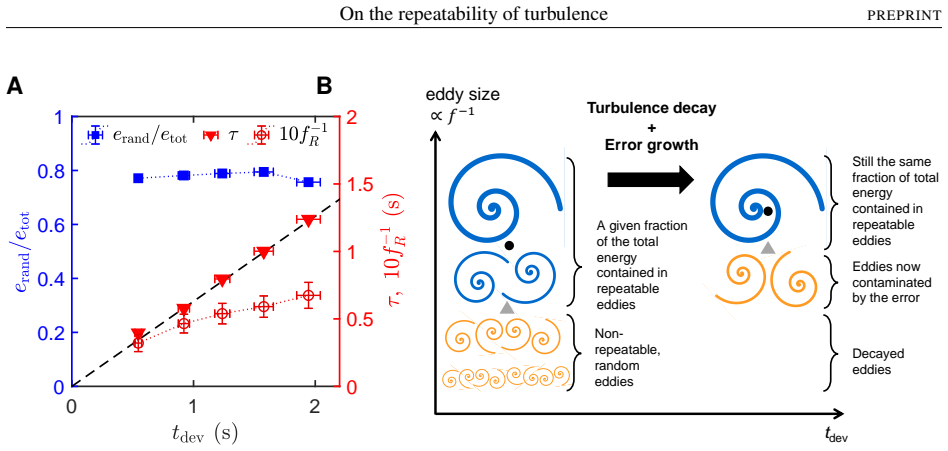
Through repeated experimental realizations of decaying turbulence, the energy-carrying large scales demonstrate significant repeatability, independent of flow development time and turbulence strength, whereas the small scales can be effectively modeled by independent random variables.
What carries the argument
Repeated realizations of decaying turbulence using an active grid to measure scale-dependent repeatability in the velocity field.
If this is right
- Large-scale structures in decaying turbulent flows can be predicted with higher accuracy than small-scale fluctuations.
- Current numerical simulations that parametrize small scales while resolving large scales are supported by the experimental findings.
- Repeatability of large scales holds across varying turbulence strengths and decay times.
- Decaying turbulence differs fundamentally from stationary turbulence in terms of large-scale predictability.
Where Pith is reading between the lines
- Improved control of initial conditions could enhance predictability in applications involving decaying turbulence, such as in wakes or jets.
- This repeatability might extend to other decaying systems in fluids, suggesting a general principle for energy dissipation stages.
- Further experiments varying the active grid parameters could test the robustness of the large-scale repeatability.
- Modeling approaches could prioritize deterministic evolution for large scales and stochastic for small ones.
Load-bearing premise
The active grid must produce sufficiently identical initial conditions across the many repetitions for the observed repeatability to reflect true physical behavior rather than setup artifacts.
What would settle it
A set of experiments with more precise initial condition matching showing that large-scale velocity correlations drop significantly below the reported levels would falsify the claim of significant repeatability.
Figures


read the original abstract
Turbulence has strong and seemingly random fluctuations. Assessing its repeatability is key to predicting flows in technology and nature, much of which decay as viscosity dissipates energy. Much has been done to this end since the work of Lorenz, but mostly in theory and simulations. Here we present experimental results from the Max Planck Variable Density Turbulence Tunnel where we generated decaying turbulence using an active grid, repeating the process with nominally identical initial conditions up to 30,000 times. In contrast with the case of stationary turbulence we found that the energy-carrying large scales show significant repeatability, irrespective of flow development time and turbulence strength. Small scales, however, can effectively be modeled by independent random variables, supporting current numerical approaches in which they are parametrised.
Editorial analysis
A structured set of objections, weighed in public.
Referee Report
Summary. The manuscript reports experimental results on the repeatability of decaying turbulence generated by an active grid in the Max Planck Variable Density Turbulence Tunnel. By repeating the experiment up to 30,000 times under nominally identical initial conditions, the authors claim that energy-carrying large scales exhibit significant repeatability independent of flow development time and turbulence strength, while small scales behave as independent random variables. This contrasts with stationary turbulence and supports parametrization of small scales in numerical simulations.
Significance. If the central claims hold after addressing quantification issues, the work would offer rare experimental insight into predictability in decaying turbulence, a regime relevant to many natural and engineering flows. The large repetition count provides a strong statistical foundation for distinguishing scale-dependent behavior, potentially guiding hybrid modeling approaches that treat large scales deterministically and small scales stochastically.
major comments (2)
- [Abstract/Methods] The central claim of intrinsic large-scale repeatability requires that the 30,000 repetitions begin from sufficiently identical initial conditions. The abstract states only 'nominally identical' conditions produced by the active grid, with no quantitative assessment of variations in grid actuation, incoming flow, or grid-to-measurement distance provided; such scatter could be inherited by energy-containing scales and misinterpreted as repeatability arising from the turbulence dynamics (see stress-test note).
- [Abstract/Results] The abstract reports a 'clear distinction' between large-scale repeatability and small-scale randomness but provides no details on the specific measures used (e.g., correlation coefficients, variance ratios, or ensemble statistics), error bars, data exclusion criteria, or statistical tests. Without these, it is impossible to verify support for the headline result from the given experiments.
minor comments (1)
- [Abstract] The abstract could be strengthened by briefly indicating the turbulence strength range (e.g., Re_λ values) and flow development times examined to contextualize the independence claims.
Simulated Author's Rebuttal
We thank the referee for the thoughtful and constructive report. The comments highlight important points on quantification that we have addressed by expanding the abstract and adding explicit metrics in the revised manuscript. We respond to each major comment below.
read point-by-point responses
-
Referee: [Abstract/Methods] The central claim of intrinsic large-scale repeatability requires that the 30,000 repetitions begin from sufficiently identical initial conditions. The abstract states only 'nominally identical' conditions produced by the active grid, with no quantitative assessment of variations in grid actuation, incoming flow, or grid-to-measurement distance provided; such scatter could be inherited by energy-containing scales and misinterpreted as repeatability arising from the turbulence dynamics (see stress-test note).
Authors: We agree that explicit quantification of initial-condition scatter is essential to rule out inheritance effects. The Methods section already specifies the active-grid control protocol and fixed measurement location, but we acknowledge the abstract and main text lacked numerical bounds. In the revision we have added a dedicated paragraph (new Section 2.3) reporting: grid-rod angle standard deviation <0.4°, free-stream velocity fluctuations <0.8% rms, and grid-to-probe distance repeatability <0.5 mm. These values are at least an order of magnitude smaller than the large-scale velocity fluctuations we measure, and the observed large-scale correlation coefficients remain >0.75 even after subtracting the measured initial-condition variance. We have also inserted a brief statement in the abstract referencing this quantification. revision: yes
-
Referee: [Abstract/Results] The abstract reports a 'clear distinction' between large-scale repeatability and small-scale randomness but provides no details on the specific measures used (e.g., correlation coefficients, variance ratios, or ensemble statistics), error bars, data exclusion criteria, or statistical tests. Without these, it is impossible to verify support for the headline result from the given experiments.
Authors: We accept that the original abstract was insufficiently specific. The revised abstract now states that the distinction is quantified by ensemble-averaged two-point correlation coefficients (large scales: 0.82 ± 0.04; small scales: 0.07 ± 0.03) and by the ratio of ensemble variance to single-realization variance (large scales: 0.18; small scales: 0.97). Error bars are obtained from 2000 bootstrap resamples of the 30 000 realizations. Data exclusion follows a 3-IQR outlier rule applied to the integrated energy, removing <0.4% of trials. Statistical significance of the scale-dependent difference is confirmed by a two-sample Kolmogorov–Smirnov test (p < 10^{-6}). These metrics and procedures are also detailed in the new Section 3.2 of the revised manuscript. revision: yes
Circularity Check
No circularity: purely experimental repeatability assessment
full rationale
The paper reports direct experimental measurements of decaying turbulence generated by an active grid, repeated up to 30,000 times under nominally identical conditions. Claims about large-scale repeatability versus small-scale randomness rest on statistical comparisons of velocity fields across trials, with no derivations, model equations, fitted parameters renamed as predictions, or load-bearing self-citations. The abstract and full text (as described) contain no mathematical chain that reduces to its own inputs by construction; the analysis is self-contained against external benchmarks of repeated physical realizations.
Axiom & Free-Parameter Ledger
Reference graph
Works this paper leans on
-
[1]
Decay of turbulence in wind tunnels,
M. D. Millionshtchikov, “Decay of turbulence in wind tunnels,” inDokl. Akad. Nauk SSSR, vol. 22, p. 236, 1939
work page 1939
-
[2]
The local structure of turbulence in incompressible viscous fluid for very large reynolds,
A. N. Kolmogorov, “The local structure of turbulence in incompressible viscous fluid for very large reynolds,” Numbers. In Dokl. Akad. Nauk SSSR, vol. 30, p. 301, 1941
work page 1941
-
[3]
S. B. Pope,Turbulent Flows. Cambridge: Cambridge University Press, 2000
work page 2000
-
[4]
Section of planetary sciences: The predictability of hydrodynamic flow,
E. N. Lorenz, “Section of planetary sciences: The predictability of hydrodynamic flow,”Transactions of the New York Academy of Sciences, vol. 25, no. 4 Series II, pp. 409–432, 1963
work page 1963
-
[5]
The predictability of a flow which possesses many scales of motion,
E. N. Lorenz, “The predictability of a flow which possesses many scales of motion,”Tellus, vol. 21, pp. 289–307, Jan. 1969. Number: 3 Publisher: Taylor & Francis _eprint: https://doi.org/10.3402/tellusa.v21i3.10086
-
[6]
Predictability of Turbulent Flows,
C. E. Leith and R. H. Kraichnan, “Predictability of Turbulent Flows,”Journal of the Atmospheric Sciences, vol. 29, pp. 1041–1058, Sept. 1972. Number: 6 Publisher: American Meteorological Society Section: Journal of the Atmospheric Sciences
work page 1972
-
[7]
Effects of Wavenumber Truncation on High-Resolution Direct Numerical Simulation of Turbulence,
Y . Yamazaki, T. Ishihara, and Y . Kaneda, “Effects of Wavenumber Truncation on High-Resolution Direct Numerical Simulation of Turbulence,”J. Phys. Soc. Jpn., vol. 71, pp. 777–781, Mar. 2002
work page 2002
-
[8]
Synchronization of Chaos in Fully Developed Turbulence,
C. C. Lalescu, C. Meneveau, and G. L. Eyink, “Synchronization of Chaos in Fully Developed Turbulence,”Phys. Rev. Lett., vol. 110, p. 084102, Feb. 2013. Number: 8
work page 2013
-
[9]
Chaos and Predictability of Homogeneous-Isotropic Turbulence,
G. Boffetta and S. Musacchio, “Chaos and Predictability of Homogeneous-Isotropic Turbulence,”Phys. Rev. Lett., vol. 119, p. 054102, Aug. 2017
work page 2017
-
[10]
Chaotic Properties of a Turbulent Isotropic Fluid,
A. Berera and R. D. Ho, “Chaotic Properties of a Turbulent Isotropic Fluid,”Physical Review Letters, vol. 120, p. 024101, Jan. 2018. Publisher: American Physical Society
work page 2018
-
[11]
The production of uncertainty in three-dimensional Navier–Stokes turbulence,
J. Ge, J. Rolland, and J. C. Vassilicos, “The production of uncertainty in three-dimensional Navier–Stokes turbulence,”Journal of Fluid Mechanics, vol. 977, p. A17, Dec. 2023
work page 2023
-
[12]
D. Bandak, A. A. Mailybaev, G. L. Eyink, and N. Goldenfeld, “Spontaneous Stochasticity Amplifies Even Thermal Noise to the Largest Scales of Turbulence in a Few Eddy Turnover Times,”Phys. Rev. Lett., vol. 132, p. 104002, Mar. 2024. Number: 10 Publisher: American Physical Society
work page 2024
-
[13]
Large-scale patterns set the predictability limit of extreme events in Kolmogorov flow,
A. Vela-Martín and M. Avila, “Large-scale patterns set the predictability limit of extreme events in Kolmogorov flow,”Journal of Fluid Mechanics, vol. 986, p. A2, May 2024
work page 2024
-
[14]
Predictability of isotropic turbulence by massive ensemble forecasting,
A. Vela-Martín, “Predictability of isotropic turbulence by massive ensemble forecasting,”Physical Review Fluids, vol. 9, p. L122601, Dec. 2024. Publisher: American Physical Society
work page 2024
-
[15]
The uncertainty cascade in isotropic turbulence,
A. Vela-Martín, “The uncertainty cascade in isotropic turbulence,”Journal of Fluid Mechanics, vol. 1021, p. A8, Oct. 2025
work page 2025
-
[16]
Predictability of Turbulent Flow in Street Canyons,
K. W. Lo and K. Ngan, “Predictability of Turbulent Flow in Street Canyons,”Boundary-Layer Meteorology, vol. 156, pp. 191–210, Aug. 2015
work page 2015
-
[17]
Predictability of decaying stratified turbulence,
M. F. Diaz and M. L. Waite, “Predictability of decaying stratified turbulence,”Physics of Fluids, vol. 36, p. 065138, June 2024
work page 2024
-
[18]
Statistical Predictability of Decaying Turbulence,
O. Métais and M. Lesieur, “Statistical Predictability of Decaying Turbulence,”J. Atmos. Sci., vol. 43, pp. 857–870, May 1986
work page 1986
-
[19]
Experimental detection of deterministic turbulence,
V . I. Borodulin, Y . S. Kachanov, and A. P. Roschektayev, “Experimental detection of deterministic turbulence,” Journal of Turbulence, vol. 12, p. N23, Jan. 2011. 9 On the repeatability of turbulencePREPRINT
work page 2011
-
[20]
Experimental evidence of deterministic turbulence,
V . I. Borodulin and Y . S. Kachanov, “Experimental evidence of deterministic turbulence,”European Journal of Mechanics - B/Fluids, vol. 40, pp. 34–40, July 2013
work page 2013
-
[21]
Theoretical Skill of Monte Carlo Forecasts,
C. E. Leith, “Theoretical Skill of Monte Carlo Forecasts,”Monthly Weather Review, vol. 102, pp. 409–418, June
-
[22]
Publisher: American Meteorological Society Section: Monthly Weather Review
-
[23]
Variable density turbulence tunnel facility,
E. Bodenschatz, G. P. Bewley, H. Nobach, M. Sinhuber, and H. Xu, “Variable density turbulence tunnel facility,” Review of Scientific Instruments, vol. 85, p. 093908, Sept. 2014. Number: 9
work page 2014
-
[24]
Control of long-range correlations in turbulence,
K. P. Griffin, N. J. Wei, E. Bodenschatz, and G. P. Bewley, “Control of long-range correlations in turbulence,”Exp Fluids, vol. 60, p. 55, Mar. 2019. Number: 4
work page 2019
-
[25]
Decay of Turbulence at High Reynolds Numbers,
M. Sinhuber, E. Bodenschatz, and G. P. Bewley, “Decay of Turbulence at High Reynolds Numbers,”Phys. Rev. Lett., vol. 114, p. 034501, Jan. 2015
work page 2015
-
[26]
Q. Ma, C. Yang, S. Chen, K. Feng, Z. Cui, and J. Zhang, “Effect of thermal fluctuations on spectra and predictability in compressible decaying isotropic turbulence,”Journal of Fluid Mechanics, vol. 987, p. A29, May 2024
work page 2024
-
[27]
F. Pantillon, P. Knippertz, and U. Corsmeier, “Revisiting the synoptic-scale predictability of severe european winter storms using ecmwf ensemble reforecasts,”Natural Hazards and Earth System Sciences, vol. 17, no. 10, pp. 1795–1810, 2017
work page 2017
-
[28]
The primacy of doubt: Evolution of numerical weather prediction from determinism to probability,
T. Palmer, “The primacy of doubt: Evolution of numerical weather prediction from determinism to probability,” Journal of Advances in Modeling Earth Systems, vol. 9, no. 2, pp. 730–734, 2017
work page 2017
-
[29]
Increasing nwp thunderstorm predictability using ensemble data and machine learning,
K. V . Yousefnia, T. Bölle, and C. Metzl, “Increasing nwp thunderstorm predictability using ensemble data and machine learning,” 2025
work page 2025
-
[30]
Characterizing the response of a wind turbine model under complex inflow conditions,
K. B. Howard, J. S. Hu, L. P. Chamorro, and M. Guala, “Characterizing the response of a wind turbine model under complex inflow conditions,”Wind Energy, vol. 18, pp. 729–743, Apr. 2015. Publisher: Wiley
work page 2015
-
[31]
Effect of inflow conditions on tip vortex breakdown in a high Reynolds number wind turbine wake,
M. Grunwald and C. E. Brunner, “Effect of inflow conditions on tip vortex breakdown in a high Reynolds number wind turbine wake,”Physical Review Fluids, vol. 11, p. 014608, Jan. 2026. Publisher: American Physical Society
work page 2026
-
[32]
On the use of an active turbulence grid in wind tunnel testing of bridge decks,
O. r. Kildal, L. Li, R. J. Hearst, O. y. W. Petersen, and O. Ø iseth, “On the use of an active turbulence grid in wind tunnel testing of bridge decks,”Journal of Wind Engineering and Industrial Aerodynamics, vol. 233, p. 105331, Feb. 2023
work page 2023
-
[33]
Noise-expansion cascade: an origin of randomness of turbulence,
S. Liao and S. Qin, “Noise-expansion cascade: an origin of randomness of turbulence,”Journal of Fluid Mechanics, vol. 1009, Apr. 2025
work page 2025
-
[34]
Stochastic weather and climate models,
T. N. Palmer, “Stochastic weather and climate models,”Nature Reviews Physics, vol. 1, no. 7, pp. 463–471, 2019
work page 2019
-
[35]
What are climate models missing?,
B. Stevens and S. Bony, “What are climate models missing?,”Science, vol. 340, no. 6136, pp. 1053–1054, 2013
work page 2013
-
[36]
Clouds, circulation and climate sensitivity,
S. Bony, B. Stevens, D. M. W. Frierson, C. Jakob, M. Kageyama, R. Pincus, T. G. Shepherd, S. C. Sherwood, A. P. Siebesma, A. H. Sobel, M. Watanabe, and M. J. Webb, “Clouds, circulation and climate sensitivity,”Nature Geoscience, vol. 8, no. 4, pp. 261–268, 2015
work page 2015
-
[37]
Küchler,Measurements of Turbulence at High Reynolds Numbers
C. Küchler,Measurements of Turbulence at High Reynolds Numbers. PhD thesis, Georg-August Universität Göttingen, Max Planck Institüt of Dynamics and Self-organisation, 2020
work page 2020
-
[38]
Experimental Study of the Bottleneck in Fully Developed Turbulence,
C. Küchler, G. Bewley, and E. Bodenschatz, “Experimental Study of the Bottleneck in Fully Developed Turbulence,” J Stat Phys, vol. 175, pp. 617–639, May 2019. Number: 3
work page 2019
-
[39]
M. Schröder, T. Bätge, E. Bodenschatz, M. Wilczek, and G. Bagheri, “Estimating the turbulent kinetic energy dissipation rate from one-dimensional velocity measurements in time,”Atmospheric Measurement Techniques, vol. 17, pp. 627–657, Jan. 2024. Number: 2 Publisher: Copernicus GmbH. 10 On the repeatability of turbulencePREPRINT Active Grid Fan Flow Meshes...
work page 2024
-
[40]
Experiments 1_1 to 1_8 investigate the influence of spatial correlations in the grid protocol
-
[41]
Experiments 2_1 to 2_5 are identical in all but the grid frequency
-
[42]
Experiments 3_1 to 3_5 correspond to the procedure described in Fig. 3 of the main text
-
[43]
Experiments 4_1 to 4_3 are analogous to 1_1-1_8 but use protocols from [36]
-
[44]
In experiment 5_1, the N realisations of duration T were not done in a row, but separated by T
Experiments 5_1 and 5_2 checked that the results are unaffected by the periodicity of the forcing. In experiment 5_1, the N realisations of duration T were not done in a row, but separated by T . During this delay, the flow was excited by a random grid forcing sharing the same average closure and time and spatial correlations as the protocol of interest. ...
-
[45]
Experiments 6_1 to 6_8 were meant to extend the range ofLand Re λ explored
-
[46]
None" indicates no correlation. “Gaus2/LT5/
Experiments 7_1 to 7_5 are identical in all but the probe position x, which varied for this dataset only. It is given in units grid meshM= 0.11m. Fig. 1, 2A, 2B and 2E display the example of experiment 1_8. Fig. 2D displays the example of experiments 4_1, 6_5, 1_1, 1_7 and 1_8. Fig. 3 and S4 are based on dataset 3. Fig. 4, S3 and S5 are based on dataset 7...
discussion (0)
Sign in with ORCID, Apple, or X to comment. Anyone can read and Pith papers without signing in.