Recognition: no theorem link
Potamides: Mapping Dark Matter Halo Shapes from Stellar Stream Tracks in the Local Universe
Pith reviewed 2026-05-11 01:59 UTC · model grok-4.3
The pith
Stellar stream curvature can constrain dark matter halo shapes around individual external galaxies.
A machine-rendered reading of the paper's core claim, the machinery that carries it, and where it could break.
Core claim
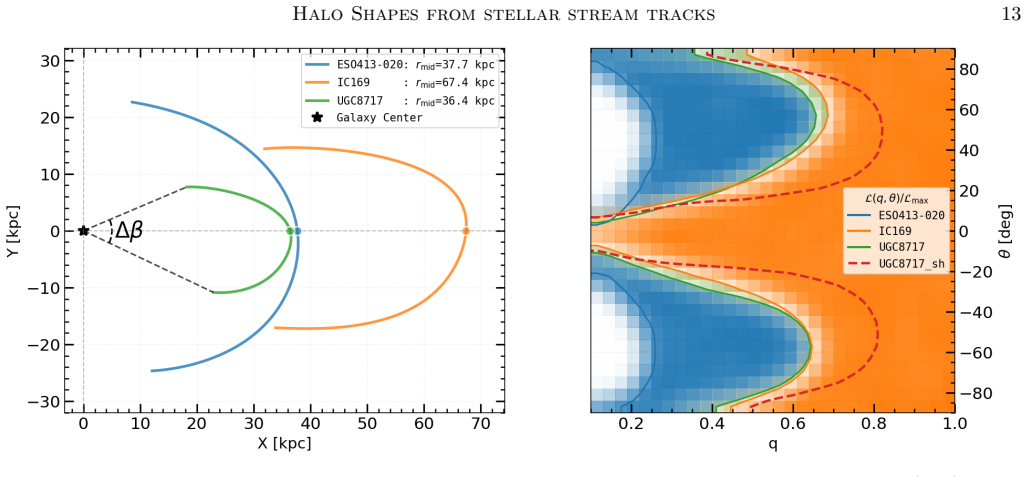
Potamides shows that the curvature of extragalactic stellar streams directly encodes information about the projected axis ratios and orientation of their host dark matter halos. Applied to fifteen streams from the Stellar Stream Legacy Survey, streams displaying edge-on wrapping loops or abrupt turning points exclude large volumes of the flattening-orientation parameter space, whereas great-circle-like streams remain largely uninformative. All streams examined are compatible with a spherical halo once an appropriate flattening direction is chosen.
What carries the argument
Potamides, the curvature-based mapping from observed stellar stream tracks to constraints on halo axis ratios and orientation.
If this is right
- Some of the fifteen streams exclude large regions of the possible halo flattening and orientation parameter space.
- Streams with edge-on wrapping loops or sharp turning points supply the tightest constraints.
- Every stream in the sample permits a spherical halo for at least one choice of flattening direction.
- Future wide-field surveys are expected to yield many more streams, enabling statistical comparisons of halo shapes with baryonic and dark matter models across cosmic time.
Where Pith is reading between the lines
- Stream-derived halo shapes could be cross-checked against disk orientations in the same galaxies to search for predicted misalignments.
- Once applied to streams at higher redshift, the method could track whether halo flattening evolves with galaxy mass or environment.
- Quantifying the contribution of baryonic substructure separately would sharpen the residual signal available for testing dark matter models.
Load-bearing premise
The curvature seen in stellar streams is produced mainly by the static shape of the dark matter halo rather than by time-dependent effects, substructure, or non-equilibrium dynamics.
What would settle it
A stream whose detailed three-dimensional path, once reconstructed from proper motions and distances, deviates systematically from the halo flattening and orientation that the same galaxy's other streams or dynamical tracers would predict.
Figures




read the original abstract
Stellar streams trace the gravitational potential of their host galaxies and offer a direct probe of dark matter halo geometry. Cosmological simulations predict that halo shapes depend on both baryonic physics and the nature of dark matter, yet observational constraints on halo flattening and orientation remain limited, especially for individual galaxies. We present Potamides, which utilizes the curvature of extragalactic stellar streams to derive constraints on halo shapes. We apply Potamides to 15 stellar streams from the Stellar Stream Legacy Survey to infer the projected axis ratios and orientation of their host halos. We find that some streams in our sample exclude large regions of halo flattenings and halo orientations. Systems with edge-on wrapping loops or sharp turning points yield the strongest constraints, whereas great circle-like streams remain largely uninformative. All streams in our sample support a spherical halo for a given flattening direction. These results demonstrate that stream morphology can provide halo shape constraints for individual external galaxies. With upcoming surveys (such as Euclid, Rubin, Roman, and ARRAKIHS) expected to discover large numbers of stellar streams, this curvature-based technique will enable rapid statistical tests of dark matter and baryonic physics through the shapes and alignments of halos and disks across cosmic time.
Editorial analysis
A structured set of objections, weighed in public.
Referee Report
Summary. The paper introduces 'Potamides', a method to map dark matter halo shapes using the curvature of stellar streams in the local universe. It applies this to 15 stellar streams from the Stellar Stream Legacy Survey, deriving constraints on the projected axis ratios and orientations of the host halos. The authors report that streams with edge-on wrapping loops or sharp turning points provide the strongest constraints, excluding large regions of halo flattening and orientation parameter space, while great circle-like streams are uninformative. All streams are found to be consistent with spherical halos for a given flattening direction. The work highlights the potential for this technique with upcoming surveys to test dark matter and baryonic physics models.
Significance. This work has the potential to significantly advance the field by providing a new observational probe of individual dark matter halo shapes, which are currently poorly constrained for external galaxies. If the method is robust, it could allow statistical comparisons with cosmological simulations to distinguish between different dark matter models and baryonic feedback prescriptions. The application to real data from 15 streams is a strength, demonstrating practical utility. However, the significance is tempered by the need for rigorous validation against complex dynamical effects.
major comments (3)
- [§3 (Method)] §3 (Method): The mapping from stream curvature to halo axis ratios assumes a static, time-independent halo potential. No tests are presented showing that time-dependent effects, such as those from disk crossings or orbiting subhalos, produce curvature signals smaller than those attributed to halo flattening. This is load-bearing for the claim that morphology provides reliable halo shape constraints.
- [§4.3 (Results for individual streams)] §4.3 (Results for individual streams): For the streams claimed to yield strong constraints (e.g., those with sharp turns), the paper should quantify the reduction in allowed parameter space (e.g., via volume of posterior or fraction excluded) and compare to the prior volume to demonstrate the exclusions are data-driven rather than prior-dominated.
- [§5 (Discussion)] §5 (Discussion): The statement that 'all streams support a spherical halo' requires clarification on whether this is a result of the data or follows from the model parameterization allowing q=1 as a special case without penalty.
minor comments (3)
- [Abstract] Abstract: The abstract claims 'some streams in our sample exclude large regions' but does not specify which streams or the quantitative measure of 'large'.
- [Figure captions] Figure captions: Several figures showing stream tracks and fitted models would benefit from including the best-fit halo parameters and uncertainty ranges directly on the plots for clarity.
- [References] References: The manuscript would benefit from citing recent works on stellar stream modeling in external galaxies, such as those using Gaia data or other surveys.
Simulated Author's Rebuttal
We thank the referee for their constructive and detailed report. We have revised the manuscript to address the major comments and believe these changes strengthen the presentation of the Potamides method and its application to the Stellar Stream Legacy Survey data.
read point-by-point responses
-
Referee: [§3 (Method)] The mapping from stream curvature to halo axis ratios assumes a static, time-independent halo potential. No tests are presented showing that time-dependent effects, such as those from disk crossings or orbiting subhalos, produce curvature signals smaller than those attributed to halo flattening. This is load-bearing for the claim that morphology provides reliable halo shape constraints.
Authors: We agree that the static-potential assumption is central and merits explicit discussion. In the revised §3 we now include a dedicated paragraph on timescales: for the local-universe streams in our sample the orbital periods are ≳ few Gyr, recent disk crossings are identifiable by vertical heating signatures (absent in the selected streams), and subhalo encounters capable of producing comparable curvature are statistically rare at the stellar masses probed. We have also added a forward-looking statement that full time-dependent N-body validation is a natural next step once larger stream samples become available. The core mapping remains an instantaneous-curvature diagnostic under the static approximation, with the added caveats now clearly stated. revision: partial
-
Referee: [§4.3 (Results for individual streams)] For the streams claimed to yield strong constraints (e.g., those with sharp turns), the paper should quantify the reduction in allowed parameter space (e.g., via volume of posterior or fraction excluded) and compare to the prior volume to demonstrate the exclusions are data-driven rather than prior-dominated.
Authors: This suggestion is well taken. We have added a new quantitative summary in §4.3 (and an accompanying table) that reports, for each stream, (i) the fraction of the uniform prior volume in (q, ϕ) excluded at 68 % and 95 % credible level and (ii) the ratio of posterior to prior volume. Streams with sharp turning points now show >70 % exclusion of the prior volume at 95 % credibility, while great-circle streams exclude <10 %, confirming that the reported constraints are data-driven rather than prior-dominated. revision: yes
-
Referee: [§5 (Discussion)] The statement that 'all streams support a spherical halo' requires clarification on whether this is a result of the data or follows from the model parameterization allowing q=1 as a special case without penalty.
Authors: We have revised the relevant paragraph in §5 to remove any ambiguity. The statement now reads that every stream’s posterior is consistent with q = 1 (i.e., the spherical point lies inside the 68 % credible region) and that no stream shows a statistically significant preference for q ≠ 1. Because the parameterization is continuous and places no extra prior weight on q = 1, this consistency is data-driven; the revised text explicitly notes that the data do not require flattening while also acknowledging that the current precision does not yet rule out modest deviations. revision: yes
Circularity Check
No significant circularity; derivation is self-contained inference from data
full rationale
The paper defines Potamides as a curvature-to-halo-shape mapping and applies it directly to 15 observed streams from the Stellar Stream Legacy Survey to infer projected axis ratios and orientations. No equations or steps are shown that reduce a claimed prediction or first-principles result to its own fitted inputs by construction. The central demonstration—that stream morphology yields individual-galaxy halo constraints—rests on external observational tracks rather than self-citation chains, uniqueness theorems imported from prior author work, or ansatzes smuggled via citation. All streams supporting spherical halos for given flattenings is an output of the fit to data, not a tautology. The method is therefore independent of the target result and receives the default non-circularity finding.
Axiom & Free-Parameter Ledger
Reference graph
Works this paper leans on
-
[1]
Abbott, T. M. C., Abdalla, F. B., Allam, S., et al. 2018, ApJS, 239, 18, doi: 10.3847/1538-4365/aae9f0
-
[2]
Allgood, B., Flores, R. A., Primack, J. R., et al. 2006, MNRAS, 367, 1781, doi: 10.1111/j.1365-2966.2006.10094.x
-
[3]
C., Martinez-Delgado, D., & Schedler, J
Amorisco, N. C., Martinez-Delgado, D., & Schedler, J. 2015, arXiv e-prints, arXiv:1504.03697, doi: 10.48550/arXiv.1504.03697 Anthropic. 2026, Claude. https://www.anthropic.com/claude Astropy Collaboration, Robitaille, T. P., Tollerud, E. J., et al. 2013, A&A, 558, A33, doi: 10.1051/0004-6361/201322068 Astropy Collaboration, Price-Whelan, A. M., Sip˝ ocz, ...
-
[4]
Bailin, J., Kawata, D., Gibson, B. K., et al. 2005, ApJL, 627, L17, doi: 10.1086/432157
-
[5]
Bariego-Quintana, A., & Llanes-Estrada, F. J. 2024, A&A, 687, A46, doi: 10.1051/0004-6361/202347502
-
[6]
Barnes, J. E., & Hibbard, J. E. 2009, AJ, 137, 3071, doi: 10.1088/0004-6256/137/2/3071
-
[7]
F., Harmsen, B., Cosby, M., et al
Bell, E. F., Harmsen, B., Cosby, M., et al. 2026, ApJ, 997, 153, doi: 10.3847/1538-4357/ae2c5e 24Wu et al
-
[8]
1997, Introduction to Matrix Analysis, 2nd edn., Classics in Applied Mathematics No
Bellman, R. 1997, Introduction to Matrix Analysis, 2nd edn., Classics in Applied Mathematics No. 19 (Philadelphia: Society for Industrial and Applied Mathematics)
work page 1997
-
[9]
2026, arXiv e-prints, arXiv:2601.23013, doi: 10.48550/arXiv.2601.23013
Benitez-Walz, E., Mes, J., Mir´ o-Carretero, J., Kuijken, K., & Helmi, A. 2026, arXiv e-prints, arXiv:2601.23013, doi: 10.48550/arXiv.2601.23013
-
[10]
Bonaca, A., Conroy, C., Price-Whelan, A. M., & Hogg, D. W. 2019, ApJL, 881, L37, doi: 10.3847/2041-8213/ab36ba
-
[11]
Bonaca, A., & Hogg, D. W. 2018, ApJ, 867, 101, doi: 10.3847/1538-4357/aae4da
-
[12]
Bovy, J., Bahmanyar, A., Fritz, T. K., & Kallivayalil, N. 2016, ApJ, 833, 31, doi: 10.3847/1538-4357/833/1/31
-
[13]
2021, JAX: Autograd and XLA, Astrophysics Source Code Library, record ascl:2111.002
Bradbury, J., Frostig, R., Hawkins, P., et al. 2021, JAX: Autograd and XLA, Astrophysics Source Code Library, record ascl:2111.002. http://ascl.net/2111.002
work page 2021
-
[14]
Brooks, R. A. N., Garavito-Camargo, N., Johnston, K. V., et al. 2025, ApJ, 978, 79, doi: 10.3847/1538-4357/ad93a7
-
[15]
Bullock, J. S., & Boylan-Kolchin, M. 2017, ARA&A, 55, 343, doi: 10.1146/annurev-astro-091916-055313
-
[16]
Bullock, J. S., & Johnston, K. V. 2005, ApJ, 635, 931, doi: 10.1086/497422
-
[17]
2026, arXiv e-prints, arXiv:2601.15373, doi: 10.48550/arXiv.2601.15373
Chemaly, D., Sola, E., Belokurov, V., et al. 2026, arXiv e-prints, arXiv:2601.15373, doi: 10.48550/arXiv.2601.15373
-
[18]
2019, MNRAS, 484, 476, doi: 10.1093/mnras/sty3531 Crnojevi´ c, D., Sand, D
Hernquist, L. 2019, MNRAS, 484, 476, doi: 10.1093/mnras/sty3531 Crnojevi´ c, D., Sand, D. J., Spekkens, K., et al. 2016, ApJ, 823, 19, doi: 10.3847/0004-637X/823/1/19 Dav´ e, R., Spergel, D. N., Steinhardt, P. J., & Wandelt, B. D. 2001, ApJ, 547, 574, doi: 10.1086/318417
-
[19]
2017, MNRAS, 466, 181, doi: 10.1093/mnras/stw3129
Tormen, G. 2017, MNRAS, 466, 181, doi: 10.1093/mnras/stw3129
-
[20]
2026, A&A, 708, A47, doi: 10.1051/0004-6361/202558686
Despali, G., Giocoli, C., Moscardini, L., et al. 2026, A&A, 708, A47, doi: 10.1051/0004-6361/202558686
-
[21]
2025, A&A, 697, A213, doi: 10.1051/0004-6361/202553836
Despali, G., Moscardini, L., Nelson, D., et al. 2025, A&A, 697, A213, doi: 10.1051/0004-6361/202553836
-
[22]
Despali, G., Walls, L. G., Vegetti, S., et al. 2022, MNRAS, 516, 4543, doi: 10.1093/mnras/stac2521
-
[23]
Dey, A., Schlegel, D. J., Lang, D., et al. 2019, AJ, 157, 168, doi: 10.3847/1538-3881/ab089d
-
[24]
Diemer, B., & Kravtsov, A. V. 2014, ApJ, 789, 1, doi: 10.1088/0004-637X/789/1/1
-
[25]
Price-Whelan, A. M. 2022, MNRAS, 516, 1685, doi: 10.1093/mnras/stac2311
-
[26]
Dubinski, J., Mihos, J. C., & Hernquist, L. 1996, ApJ, 462, 576, doi: 10.1086/177174
-
[27]
Escala, I., Gilbert, K. M., Fardal, M., et al. 2022, AJ, 164, 20, doi: 10.3847/1538-3881/ac7146
-
[28]
Euclid, Starkman, Starkman, N., Nibauer, J., et al. 2026
work page 2026
-
[29]
Fardal, M. A., Weinberg, M. D., Babul, A., et al. 2013, MNRAS, 434, 2779, doi: 10.1093/mnras/stt1121
-
[30]
Foster, C., Lux, H., Romanowsky, A. J., et al. 2014, MNRAS, 442, 3544, doi: 10.1093/mnras/stu1074
-
[31]
Geha, M., Wechsler, R. H., Mao, Y.-Y., et al. 2017, ApJ, 847, 4, doi: 10.3847/1538-4357/aa8626
-
[32]
2021, A&A, 647, A185, doi: 10.1051/0004-6361/201937405
Georgiou, C., Hoekstra, H., Kuijken, K., et al. 2021, A&A, 647, A185, doi: 10.1051/0004-6361/201937405
-
[33]
2026, A&A, 706, A340, doi: 10.1051/0004-6361/202558400 Google
Giocoli, C., Despali, G., Moscardini, L., et al. 2026, A&A, 706, A340, doi: 10.1051/0004-6361/202558400 Google. 2026, Gemini. https://gemini.google.com
-
[34]
2022, in EAS2022, European Astronomical Society Annual Meeting, 1507
Guzman, R., G´ omez-Flechoso, M., Mart´ ınez-Delgado, D., et al. 2022, in EAS2022, European Astronomical Society Annual Meeting, 1507
work page 2022
-
[35]
Hughes, A. K., Sand, D. J., Seth, A., et al. 2023, ApJ, 947, 34, doi: 10.3847/1538-4357/acbf43
-
[36]
Hunter, J. D. 2007, Computing in Science and Engineering, 9, 90, doi: 10.1109/MCSE.2007.55 Ivezi´ c,ˇZ., Kahn, S. M., Tyson, J. A., et al. 2019, ApJ, 873, 111, doi: 10.3847/1538-4357/ab042c
-
[37]
Jing, Y. P., & Suto, Y. 2002, ApJ, 574, 538, doi: 10.1086/341065
-
[38]
Johnston, K. V., Zhao, H., Spergel, D. N., & Hernquist, L. 1999, ApJL, 512, L109, doi: 10.1086/311876
-
[39]
Kazantzidis, S., Abadi, M. G., & Navarro, J. F. 2010, ApJL, 720, L62, doi: 10.1088/2041-8205/720/1/L62
-
[40]
2014, ApJS, 210, 14, doi: 10.1088/0067-0049/210/1/14
Kim, J.-h., Abel, T., Agertz, O., et al. 2014, ApJS, 210, 14, doi: 10.1088/0067-0049/210/1/14
-
[41]
Kim, T., Sheth, K., Hinz, J. L., et al. 2012, ApJ, 753, 43, doi: 10.1088/0004-637X/753/1/43
-
[42]
Koposov, S. E., Rix, H.-W., & Hogg, D. W. 2010, ApJ, 712, 260, doi: 10.1088/0004-637X/712/1/260 K¨ upper, A. H. W., Balbinot, E., Bonaca, A., et al. 2015, ApJ, 803, 80, doi: 10.1088/0004-637X/803/2/80
-
[43]
Law, D. R., & Majewski, S. R. 2010, ApJ, 714, 229, doi: 10.1088/0004-637X/714/1/229
-
[44]
Law, D. R., Majewski, S. R., & Johnston, K. V. 2009, ApJL, 703, L67, doi: 10.1088/0004-637X/703/1/L67
-
[45]
Li, T. S., Koposov, S. E., Erkal, D., et al. 2021, ApJ, 911, 149, doi: 10.3847/1538-4357/abeb18
-
[46]
Lovell, M. R., Frenk, C. S., Eke, V. R., et al. 2014, MNRAS, 439, 300, doi: 10.1093/mnras/stt2431
-
[47]
Lux, H., Read, J. I., Lake, G., & Johnston, K. V. 2013, MNRAS, 436, 2386, doi: 10.1093/mnras/stt1744 Halo Shapes from stellar stream tracks25
-
[48]
Malhan, K., & Ibata, R. A. 2019, MNRAS, 486, 2995, doi: 10.1093/mnras/stz1035
-
[49]
Mandelbaum, R., Seljak, U., Kauffmann, G., Hirata, C. M., & Brinkmann, J. 2006, MNRAS, 368, 715, doi: 10.1111/j.1365-2966.2006.10156.x
-
[50]
Mantha, K. B., McIntosh, D. H., Ciaschi, C. P., et al. 2019, MNRAS, 486, 2643, doi: 10.1093/mnras/stz872 Mart´ ınez-Delgado, D., Pe˜ narrubia, J., Gabany, R. J., et al. 2008, ApJ, 689, 184, doi: 10.1086/592555 Mart´ ınez-Delgado, D., Cooper, A. P., Rom´ an, J., et al. 2023, A&A, 671, A141, doi: 10.1051/0004-6361/202245011 Mir´ o-Carretero, J., Mart´ ınez-...
-
[51]
2023, ApJS, 269, 3, doi: 10.3847/1538-4365/acfaa2 M¨ uller, O., Vudragovi´ c, A., & B´ ılek, M
Moustakas, J., Lang, D., Dey, A., et al. 2023, ApJS, 269, 3, doi: 10.3847/1538-4365/acfaa2 M¨ uller, O., Vudragovi´ c, A., & B´ ılek, M. 2019, A&A, 632, L13, doi: 10.1051/0004-6361/201937077 M¨ uller, O., Rejkuba, M., Fahrion, K., et al. 2025, A&A, 699, A207, doi: 10.1051/0004-6361/202452923
-
[52]
2022, ApJ, 940, 22, doi: 10.3847/1538-4357/ac93ee
Ho, S. 2022, ApJ, 940, 22, doi: 10.3847/1538-4357/ac93ee
-
[53]
Nibauer, J., & Bonaca, A. 2025, ApJL, 985, L22, doi: 10.3847/2041-8213/add0a9
-
[54]
Nibauer, J., Bonaca, A., & Johnston, K. V. 2023, ApJ, 954, 195, doi: 10.3847/1538-4357/ace9bc
-
[55]
2026, The Astrophysical Journal, 1002, 204, doi: 10.3847/1538-4357/ae5bb0 O’Brien, J
Nibauer, J., & Pearson, S. 2026, The Astrophysical Journal, 1002, 204, doi: 10.3847/1538-4357/ae5bb0 O’Brien, J. C., Freeman, K. C., & van der Kruit, P. C. 2010, A&A, 515, A62, doi: 10.1051/0004-6361/200912567 OpenAI. 2026, ChatGPT. https://openai.com/chatgpt
-
[56]
Pearson, S., Clark, S. E., Demirjian, A. J., et al. 2022a, ApJ, 926, 166, doi: 10.3847/1538-4357/ac4496
-
[57]
Price-Whelan, A. M. 2015, ApJ, 799, 28, doi: 10.1088/0004-637X/799/1/28
-
[58]
Pearson, S., Price-Whelan, A. M., Hogg, D. W., et al. 2022b, ApJ, 941, 19, doi: 10.3847/1538-4357/ac9bfb Planck Collaboration, Aghanim, N., Akrami, Y., et al. 2020, A&A, 641, A6, doi: 10.1051/0004-6361/201833910
-
[59]
Pop, A.-R., Pillepich, A., Amorisco, N. C., & Hernquist, L. 2018, MNRAS, 480, 1715, doi: 10.1093/mnras/sty1932
-
[60]
Prada, J., Forero-Romero, J. E., Grand, R. J. J., Pakmor, R., & Springel, V. 2019, MNRAS, 490, 4877, doi: 10.1093/mnras/stz2873
-
[61]
D., Laureijs, R., Stagnaro, L., et al
Racca, G. D., Laureijs, R., Stagnaro, L., et al. 2016, in Society of Photo-Optical Instrumentation Engineers (SPIE) Conference Series, Vol. 9904, Space Telescopes and Instrumentation 2016: Optical, Infrared, and Millimeter Wave, ed. H. A. MacEwen, G. G. Fazio, M. Lystrup, N. Batalha, N. Siegler, & E. C. Tong, 99040O, doi: 10.1117/12.2230762
-
[62]
H., Basu, K., Ettori, S., et al
Reiprich, T. H., Basu, K., Ettori, S., et al. 2013, SSRv, 177, 195, doi: 10.1007/s11214-013-9983-8
-
[63]
H., van de Sande, J., Croom, S
Rutherford, T. H., van de Sande, J., Croom, S. M., et al. 2024, MNRAS, 529, 810, doi: 10.1093/mnras/stae398
-
[64]
D., Mart´ ınez-Delgado, D., Pearson, S., et al
Sakowska, J. D., Mart´ ınez-Delgado, D., Pearson, S., et al. 2026, A&A, 707, L1, doi: 10.1051/0004-6361/202558313
-
[65]
Sanderson, R. E., & Helmi, A. 2013, MNRAS, 435, 378, doi: 10.1093/mnras/stt1307
-
[66]
The Astrophysical Journal , author =
Schlafly, E. F., & Finkbeiner, D. P. 2011, ApJ, 737, 103, doi: 10.1088/0004-637X/737/2/103
work page internal anchor Pith review doi:10.1088/0004-637x/737/2/103 2011
-
[67]
Sesar, B., Price-Whelan, A. M., Cohen, J. G., et al. 2016, ApJL, 816, L4, doi: 10.3847/2041-8205/816/1/L4
-
[68]
Shajib, A. J., Vernardos, G., Collett, T. E., et al. 2024, SSRv, 220, 87, doi: 10.1007/s11214-024-01105-x
-
[69]
Skrutskie, M. F., Cutri, R. M., Stiening, R., et al. 2006, AJ, 131, 1163, doi: 10.1086/498708
-
[70]
2017, PASJ, 69, R1, doi: 10.1093/pasj/psw103
Sofue, Y. 2017, PASJ, 69, R1, doi: 10.1093/pasj/psw103
-
[71]
Sola, E., Duc, P.-A., Richards, F., et al. 2022, A&A, 662, A124, doi: 10.1051/0004-6361/202142675
-
[72]
2025, MNRAS, 544, 735, doi: 10.1093/mnras/staf1647
Sola, E., Chemaly, D., Belokurov, V., et al. 2025, MNRAS, 544, 735, doi: 10.1093/mnras/staf1647
-
[73]
Wide-Field InfrarRed Survey Telescope-Astrophysics Focused Telescope Assets WFIRST-AFTA 2015 Report
Spergel, D., Gehrels, N., Baltay, C., et al. 2015, arXiv e-prints, arXiv:1503.03757, doi: 10.48550/arXiv.1503.03757
work page internal anchor Pith review Pith/arXiv arXiv doi:10.48550/arxiv.1503.03757 2015
-
[74]
2024, GalacticDynamics/Galax: V0.0.2, Zenodo, doi: 10.5281/zenodo.11553485
Starkman, N., Price-Whelan, A., & Nibauer, J. 2024, GalacticDynamics/Galax: V0.0.2, Zenodo, doi: 10.5281/zenodo.11553485
-
[75]
2025, The Journal of Open Source Software, 10, 7771, doi: 10.21105/joss.07771
Starkman, N., Price-Whelan, A., & Nibauer, J. 2025, The Journal of Open Source Software, 10, 7771, doi: 10.21105/joss.07771
-
[76]
2026, GalacticDynamics/coordinax: v0.23.2, v0.23.2, Zenodo, doi: 10.5281/zenodo.18444711
Starkman, N., Price-Whelan, A., & Wagg, T. 2026, GalacticDynamics/coordinax: v0.23.2, v0.23.2, Zenodo, doi: 10.5281/zenodo.18444711
-
[77]
Toloba, E., Guhathakurta, P., Romanowsky, A. J., et al. 2016, ApJ, 824, 35, doi: 10.3847/0004-637X/824/1/35
-
[78]
, year = 1972, month = dec, volume =
Toomre, A., & Toomre, J. 1972, ApJ, 178, 623, doi: 10.1086/151823
-
[79]
2011, ApJ, 729, 127, doi: 10.1088/0004-637X/729/2/127
Hsu, L.-Y. 2011, ApJ, 729, 127, doi: 10.1088/0004-637X/729/2/127
-
[80]
Deep Imaging Meets Motion: Complementing Stream Photometry Through Planetary Nebula Kinematics
Valenzuela, L. M., Stoiber, J., & Remus, R.-S. 2026, arXiv e-prints, arXiv:2604.14272, doi: 10.48550/arXiv.2604.14272 26Wu et al. van Dokkum, P., Gilhuly, C., Bonaca, A., et al. 2019, ApJL, 883, L32, doi: 10.3847/2041-8213/ab40c9 van Uitert, E., Hoekstra, H., Schrabback, T., et al. 2012, A&A, 545, A71, doi: 10.1051/0004-6361/201219295
work page internal anchor Pith review Pith/arXiv arXiv doi:10.48550/arxiv.2604.14272 2026
discussion (0)
Sign in with ORCID, Apple, or X to comment. Anyone can read and Pith papers without signing in.