Recognition: 2 theorem links
· Lean TheoremDetection of persistent helium absorption in the 91bg-like type Ia Supernova 2022an
Pith reviewed 2026-05-11 01:50 UTC · model grok-4.3
The pith
Persistent helium absorption in SN 2022an reveals unburnt material in the outer ejecta of a 91bg-like Type Ia supernova.
A machine-rendered reading of the paper's core claim, the machinery that carries it, and where it could break.
Core claim
The central claim is that the narrow, persistent absorption feature at 1.037 μm is the He I 1.083 μm line blueshifted by 1.3×10^4 km s^{-1} with FWHM of 2.1×10^3 km s^{-1}, supported by earlier optical He I lines at ~1.5×10^4 km s^{-1}. Because this velocity rules out external stripped helium from a companion, the feature must arise from unburnt helium in the outer ejecta, constituting the most compelling evidence yet for helium-bearing ejecta in a 91bg-like SN Ia and favoring sub-Chandrasekhar-mass double-detonation explosions with a surface helium shell.
What carries the argument
The narrow absorption feature near 1.037 μm identified as blueshifted He I 1.083 μm, whose velocity, width, and persistence distinguish internal unburnt helium from external companion-stripped material.
Load-bearing premise
The narrow 1.037 μm feature is correctly identified as blueshifted He I 1.083 μm rather than another species or artifact, and its velocity is too high to be stripped helium from a companion star.
What would settle it
A re-analysis showing the feature belongs to a different atomic species or velocity measurements matching those expected for companion-stripped helium would falsify the internal-ejecta interpretation.
Figures


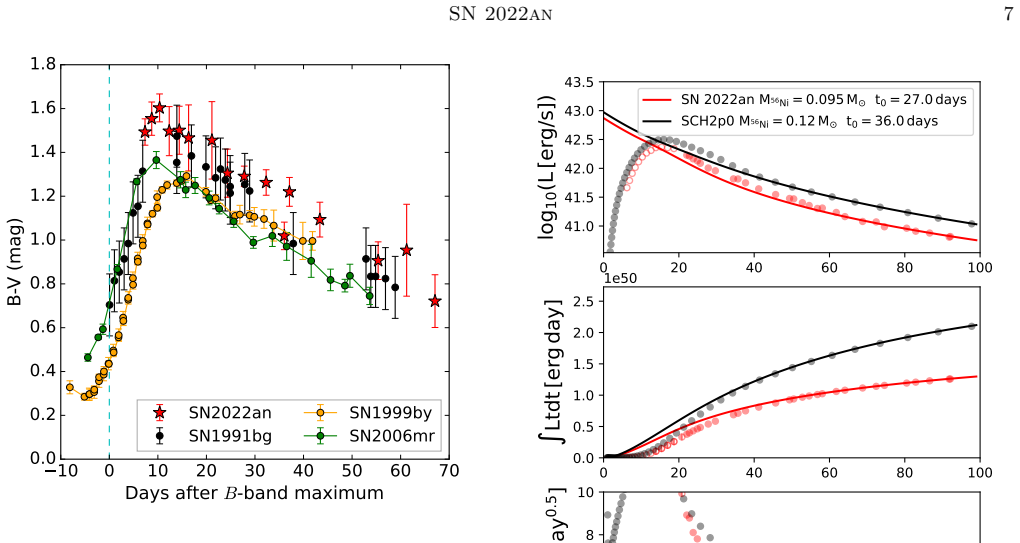


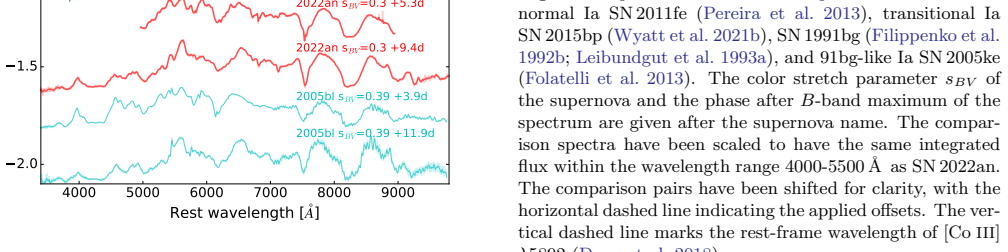


read the original abstract
We present optical and near-infrared observations of the fast-declining Type Ia supernova (SN Ia) 2022an. The photometric and spectroscopic properties identify it as a standard 91bg-like event; however, our data reveal a relatively narrow absorption feature with a full width at half maximum (FWHM) of 75 angstroms near $1.037\,\mu$m in the rest frame of the observed spectra that persists from around 30 days to nearly 90 days after maximum light. We attribute this feature to He I $1.083\,\mu$m line with a blueshifted velocity of $1.3\times10^{4}$ km s$^{-1}$ and a FWHM of $2.1\times10^{3}$ km s$^{-1}$, supported by the detection of multiple optical He I transitions in earlier epochs at a higher velocity around $1.5\times10^{4}$ km s$^{-1}$. The high velocity of the helium could not be explained by helium external to the progenitor at the explosion, such as the stripped surface helium from a companion star. The properties of the helium absorption in SN 2022an spectra instead point to unburnt material in the outer ejecta, thus providing the most compelling evidence to date for helium-bearing ejecta in a 91bg-like SN Ia. Such helium has been predicted for sub-Chandrasekhar-mass double-detonation explosions involving a surface helium shell. No theoretical calculations of modern helium-shell double detonation have been performed at epochs similar to those observed for SN 2022an to study the effect of helium on their spectra, revealing a gap between observations and theoretical calculations in understanding the manifestation of helium in SNe Ia. Nevertheless, the discovery of persistent helium absorption in SN 2022an demonstrates the diagnostic power of NIR spectroscopy for understanding thermonuclear supernova explosions by probing the abundance and structure of their ejecta.
Editorial analysis
A structured set of objections, weighed in public.
Referee Report
Summary. The manuscript presents optical and NIR observations of SN 2022an, classifying it as a standard 91bg-like Type Ia supernova. It reports a narrow, persistent absorption feature (FWHM 75 Å) near 1.037 μm from +30 to +90 days post-maximum, identified as blueshifted He I λ1.083 μm at v ≈ 1.3×10^4 km s^{-1} (FWHM 2.1×10^3 km s^{-1}), supported by earlier optical He I lines at ~1.5×10^4 km s^{-1}. The authors argue this indicates unburnt helium in the outer ejecta rather than stripped companion material, providing evidence for helium-shell double-detonation progenitors, while noting the absence of relevant theoretical spectral models at these epochs.
Significance. If the line identification is robust, the result would be significant for linking 91bg-like events to sub-Chandrasekhar double-detonation models that predict unburnt outer helium. The multi-epoch NIR coverage and consistency across multiple He I transitions represent a clear observational strength, and the work correctly highlights the diagnostic value of NIR spectroscopy for ejecta structure. However, the lack of quantitative late-time spectral synthesis limits the strength of the unburnt-helium attribution relative to prior claims.
major comments (2)
- [Abstract] Abstract: The central claim that the observed feature provides 'the most compelling evidence to date for helium-bearing ejecta in a 91bg-like SN Ia' is not fully supported. The manuscript explicitly states that 'no theoretical calculations of modern helium-shell double detonation have been performed at epochs similar to those observed,' so the attribution to unburnt outer helium rests solely on velocity arguments and earlier optical lines rather than direct comparison to synthetic spectra. This leaves open the possibility that the narrow 1.037 μm feature arises from a different species, ionization state, or unmodeled effect.
- [Abstract] Abstract: The assertion that the helium velocity 'could not be explained by helium external to the progenitor at the explosion, such as the stripped surface helium from a companion star' is load-bearing for ruling out the alternative origin, yet the text provides no quantitative comparison (e.g., expected velocity or line profile from stripped-helium hydrodynamical models at +30–90 d). A specific reference or calculation showing the inconsistency is required to make this exclusion robust.
minor comments (2)
- [Abstract] The abstract and main text should include at least one representative spectrum (with error bars and continuum subtraction) showing the 1.037 μm feature and the optical He I lines to allow independent assessment of the identification and FWHM measurement.
- Add a brief discussion of possible contaminating lines or telluric artifacts near 1.037 μm in the observed frame, even if ultimately ruled out, to address potential alternative identifications.
Simulated Author's Rebuttal
We thank the referee for their careful and constructive review of our manuscript. The comments highlight important points regarding the strength of our claims in the abstract, and we address each one below. We have revised the manuscript to moderate the language and add supporting discussion where feasible.
read point-by-point responses
-
Referee: [Abstract] Abstract: The central claim that the observed feature provides 'the most compelling evidence to date for helium-bearing ejecta in a 91bg-like SN Ia' is not fully supported. The manuscript explicitly states that 'no theoretical calculations of modern helium-shell double detonation have been performed at epochs similar to those observed,' so the attribution to unburnt outer helium rests solely on velocity arguments and earlier optical lines rather than direct comparison to synthetic spectra. This leaves open the possibility that the narrow 1.037 μm feature arises from a different species, ionization state, or unmodeled effect.
Authors: We agree that the original phrasing in the abstract implies a level of conclusiveness that exceeds what the available theoretical comparisons can support at these epochs. The line identification is based on the detection of multiple He I transitions at consistent high velocities across optical and NIR wavelengths, together with the feature's persistence and narrow profile. However, we will revise the abstract to state that the observations provide 'compelling evidence' for helium-bearing ejecta rather than 'the most compelling evidence to date,' while retaining the explicit mention of the gap in late-time spectral models. This change preserves the observational significance without overstating the direct link to specific progenitor models. revision: yes
-
Referee: [Abstract] Abstract: The assertion that the helium velocity 'could not be explained by helium external to the progenitor at the explosion, such as the stripped surface helium from a companion star' is load-bearing for ruling out the alternative origin, yet the text provides no quantitative comparison (e.g., expected velocity or line profile from stripped-helium hydrodynamical models at +30–90 d). A specific reference or calculation showing the inconsistency is required to make this exclusion robust.
Authors: We acknowledge that the manuscript would benefit from a more explicit quantitative argument on this point. The observed helium velocity of ~1.3×10^4 km s^{-1} is substantially higher than the orbital velocities and post-interaction speeds expected for stripped companion material in hydrodynamical simulations of Type Ia events. We will add a concise discussion in the revised text, including a reference to relevant stripped-material models (such as those examining velocity distributions of companion ejecta), to demonstrate the inconsistency with the observed high-velocity, narrow feature. This addition will strengthen the exclusion of the external-helium scenario without altering the core observational results. revision: yes
- The absence of published late-time (+30 to +90 d) spectral synthesis calculations for modern helium-shell double-detonation models, which prevents direct quantitative comparison of the observed feature to synthetic spectra.
Circularity Check
No circularity: purely observational line identification and velocity argument
full rationale
The manuscript reports NIR and optical spectra of SN 2022an, measures a narrow absorption at 1.037 μm (FWHM 75 Å) persisting +30 to +90 d, identifies it as blueshifted He I 1.083 μm at v ≈ 1.3×10^4 km s^{-1}, and notes consistency with earlier optical He I lines at slightly higher velocity. The claim that this indicates unburnt outer helium (rather than stripped companion material) rests on the observed velocity and line persistence, not on any fitted parameter, self-citation chain, or equation that reduces the conclusion to its own inputs. No theoretical spectral synthesis or model fitting is performed; the paper explicitly notes the absence of relevant late-time helium-shell double-detonation calculations. The derivation chain is therefore self-contained observational reporting with no load-bearing circular step.
Axiom & Free-Parameter Ledger
axioms (1)
- domain assumption The 1.037 μm absorption is blueshifted He I 1.083 μm
Lean theorems connected to this paper
-
IndisputableMonolith/Foundation/RealityFromDistinction.leanreality_from_one_distinction unclear?
unclearRelation between the paper passage and the cited Recognition theorem.
We attribute this feature to He I 1.083 µm line with a blueshifted velocity of 1.3×10^4 km s^{-1} ... point to unburnt material in the outer ejecta ... sub-Chandrasekhar-mass double-detonation explosions involving a surface helium shell.
-
IndisputableMonolith/Cost/FunctionalEquation.leanwashburn_uniqueness_aczel unclear?
unclearRelation between the paper passage and the cited Recognition theorem.
No theoretical calculations of modern helium-shell double detonation have been performed at epochs similar to those observed for SN 2022an
What do these tags mean?
- matches
- The paper's claim is directly supported by a theorem in the formal canon.
- supports
- The theorem supports part of the paper's argument, but the paper may add assumptions or extra steps.
- extends
- The paper goes beyond the formal theorem; the theorem is a base layer rather than the whole result.
- uses
- The paper appears to rely on the theorem as machinery.
- contradicts
- The paper's claim conflicts with a theorem or certificate in the canon.
- unclear
- Pith found a possible connection, but the passage is too broad, indirect, or ambiguous to say the theorem truly supports the claim.
Reference graph
Works this paper leans on
-
[1]
2026, A&A, 707, A91, doi: 10.1051/0004-6361/202555976 Barkhudaryan, L
Alburai, A., Galbany, L., Burgaz, U., et al. 2026, A&A, 707, A91, doi: 10.1051/0004-6361/202555976 Barkhudaryan, L. V., Hakobyan, A. A., Karapetyan, A. G., et al. 2019, MNRAS, 490, 718, doi: 10.1093/mnras/stz2585 Bildsten, L., Shen, K. J., Weinberg, N. N., & Nelemans, G. 2007, ApJL, 662, L95, doi: 10.1086/519489 Blondin, S., Dessart, L., & Hillier, D. J. ...
-
[2]
The images were reduced with the LCOGT/BANZAI pipeline (McCully et al. 2018). We downloaded the reduced frames from the Las Cumbres Observatory science archive. NTT/EFOSC2—We observed two epochs of photo- metric data inBVbands with the ESO Faint Object Spectrograph and Camera version 2 (EFOSC2; Buzzoni et al
work page 2018
-
[3]
on the ESO 3.58m New Technology Tele- scope (NTT). The basic data reduction, including bias subtraction, flat-field correction, and astrometric solu- tion, was performed using the PESSTO pipeline (Smartt et al. 2015b). We also obtained four epochs of acquisi- tion images in theVband from the spectroscopic obser- vations. Magellan/IMACS—We obtained three e...
work page 2011
-
[4]
We performed PSF photometry with thedaophottask inIRAF(Tody 1986, 1993)
on the NTT telescope. We performed PSF photometry with thedaophottask inIRAF(Tody 1986, 1993). The host galaxy background flux was modelled using an isophote model and iter- atively subtracted from the image (see the method in Chen et al. 2022). We utilize the ATLAS All-sky Stel- lar Reference Catalog (ATLAS-REFCAT2; Tonry et al
work page 1986
-
[5]
to derive the photometric zero-point of the optical photometry. Before being used for photometric calibra- tion of our target, the ATLAS-REFCAT2 magnitudes of the reference stars in the fields are first converted to the JohnsonBVand Sloan-grizbands using the trans- formations given in Tonry et al. (2012). Reference stars in the field of view from the 2MAS...
work page 2012
-
[6]
All these photometry procedures were performed using thepmpyeasypipeline (Chen et al
were used to derive the photometric zeropoint for theJ HKsbands. All these photometry procedures were performed using thepmpyeasypipeline (Chen et al. 2022). The photometry data for SN 2022an are summarized in Table 1 for theBV gribands and in Table 2 for the J HKbands. Thegrimagnitudes are reported in the AB system, while theBV J HKmagnitudes are based o...
work page 2022
-
[7]
Image Subtraction (No reference flux added)
from the ASAS-SN Sky Patrol 3 (Kochanek et al. 2017). We adopted the “Image Subtraction (No reference flux added)” photometry method, which performs aperture photometry on the coadded image- subtracted data for each epoch but does not add the source flux from the reference image to the light curve. The result is present in Table
work page 2017
-
[8]
The details of the follow-up campaign and data reduction are described below. SOAR/GHTS—SN 2022an was observed on 2022 Jan- uary 7 by the Goodman High Throughput Spectrograph (GHTS; Clemens et al
work page 2022
-
[9]
′′0 wide slit and the “400 SYZY” grating. The spectrum4 was first presented in the classification report (Jacobson-Gal´ an et al. 2022). We obtained the raw data from the Las Cumbres Ob- servatory Science Archive 5 and performed the data re- duction. We reduced the spectrum withIRAF(Tody 1986, 1993), including bias subtraction, flat-field correc- tion, co...
work page 2022
-
[10]
on 2022 Febru- ary 26 and March 31, through a DDT program (Pro- gram ID: 108.23MS, P.I.: P. Chen). All observations were performed in nodding mode and with 1.′′0/0.′′9/0.′′9 wide slits (UVB/VIS/NIR). The observations covered the entire spectral range of the X-shooter spectrograph from 3000 to 24800˚A. We first removed cosmic rays with 24Chen Ping T able 2...
work page 2022
-
[11]
We obtained another epoch of IMACS spectroscopy of SN 2022an on 2022 May
work page 2022
-
[12]
Both FIRE and IMACS are mounted on the 6.5m Magellan Baade telescope. The FIRE spectrum was taken with the long-slit mode, and the data were reduced with the IDL pipelinefirehose (Simcoe et al. 2013). The IMACS spectra were reduced withIRAF(Tody 1986, 1993), including bias subtraction, flat-field correction, cosmic-ray removal, wavelength cal- ibration (u...
work page 2013
discussion (0)
Sign in with ORCID, Apple, or X to comment. Anyone can read and Pith papers without signing in.