Recognition: no theorem link
Stable phase retrieval from short-time linear canonical transforms of signals in Gaussian shift-invariant spaces
Pith reviewed 2026-05-11 02:02 UTC · model grok-4.3
The pith
Signals in a Gaussian shift-invariant space are uniquely recovered up to phase from phaseless short-time linear canonical transform measurements on a semi-discrete grid, with stability controlled by anchor spacing.
A machine-rendered reading of the paper's core claim, the machinery that carries it, and where it could break.
Core claim
Every signal in V_β^∞(ϕ) is uniquely determined, up to a global unimodular constant, by its phaseless STLCT measurements on the semi-discrete set β/2 ℤ × ℝ, and an explicit reconstruction formula is derived. Stability on intervals holds under an anchor-point condition, with the stability constant governed by the maximal spacing between adjacent anchor points rather than the radius of the whole interval. An explicit reconstruction algorithm from finitely many discrete noisy magnitude samples is given, with error controlled by discretization parameters, noise level, and anchor conditioning. In the Fourier case the results recover prior Gabor phase retrieval statements with improved constants.
What carries the argument
The semi-discrete sampling set β/2 ℤ × ℝ for phaseless short-time linear canonical transform measurements, combined with the anchor-point condition that ties the stability constant to the largest gap between selected reference locations.
If this is right
- An explicit formula reconstructs the signal directly from the magnitude data without separate phase recovery.
- Stability holds for intervals of arbitrary length provided the largest gap between anchors stays fixed.
- Reconstruction error from noisy discrete samples is bounded explicitly in terms of noise level, discretization step, and anchor conditioning.
- The Fourier specialization recovers earlier Gabor results while supplying strictly better stability constants.
Where Pith is reading between the lines
- The anchor-spacing control suggests sampling designs that keep reconstruction reliable even for very long observation windows.
- The same separation of discretization and conditioning effects may guide algorithm choices when only finite noisy magnitude data are available in related time-frequency settings.
Load-bearing premise
The signal must belong to the Gaussian shift-invariant space generated by the window ϕ and the chosen anchor points must have bounded maximal spacing.
What would settle it
Two distinct signals in the space that produce identical phaseless STLCT values on β/2 ℤ × ℝ, or a sequence of intervals where the reconstruction error grows exponentially with length despite fixed anchor spacing.
Figures

read the original abstract
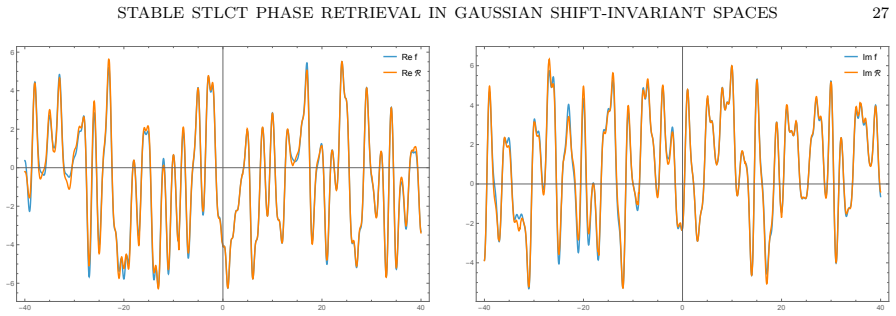
Gabor phase retrieval for signals has attracted considerable attention in recent years. For the more general short-time linear canonical transform (STLCT), which arises naturally in optical systems and canonical time--frequency analysis, existing work has so far focused mainly on uniqueness and sampling conditions. Explicit reconstruction formulas, quantitative stability estimates, and robust reconstruction algorithms, however, are still missing. In this paper, we study uniqueness, stability, and robust reconstruction for phase retrieval from phaseless STLCT measurements in the complex Gaussian shift-invariant space $V_\beta^\infty(\varphi)$. We first prove that every signal in $V_\beta^\infty(\varphi)$ is uniquely determined, up to a global unimodular constant, by its phaseless STLCT measurements on the semi-discrete set $\frac{\beta}{2}\mathbb Z\times\mathbb R$, and we derive an explicit reconstruction formula. We then establish stability on intervals under an anchor-point condition, showing that the stability constant is governed by the maximal spacing between adjacent anchor points rather than by the radius of the whole interval. This prevents exponential deterioration with respect to the interval size. Motivated by the practical setting in which only finitely many discrete noisy magnitude samples are available, we further develop an explicit reconstruction algorithm with quantitative robustness guarantees, where the reconstruction error is controlled by the discretization parameters, the noise level, and the conditioning induced by the anchor points. In the Fourier case, our results recover the corresponding Gabor phase retrieval results of Grohs and Liehr and provide improved stability constants.
Editorial analysis
A structured set of objections, weighed in public.
Referee Report
Summary. The manuscript claims to prove that every signal in the Gaussian shift-invariant space V_β^∞(ϕ) is uniquely determined, up to a global unimodular constant, by its phaseless short-time linear canonical transform (STLCT) measurements on the semi-discrete grid β/2ℤ × ℝ, and derives an explicit reconstruction formula. It further establishes stability on intervals under an anchor-point condition, with the stability constant controlled by the maximal spacing between adjacent anchor points rather than the interval radius. The paper also develops an explicit discrete reconstruction algorithm with quantitative robustness guarantees, where the error is bounded in terms of discretization parameters, noise level, and anchor-point conditioning. In the special case of the Fourier transform, the results recover the Gabor phase retrieval theorems of Grohs and Liehr while providing improved stability constants.
Significance. If the derivations hold, the work makes a substantive contribution to phase retrieval by extending uniqueness, stability, and algorithmic results from the Gabor setting to the more general STLCT framework, which is relevant for optical systems and canonical time-frequency analysis. The explicit reconstruction formula, the anchor-point stability that avoids exponential dependence on interval length, and the robust discrete algorithm with error bounds are all strengths. The recovery of prior results with improved constants provides a useful benchmark and strengthens the overall contribution.
minor comments (3)
- The abstract states that the stability constant is governed by maximal anchor spacing rather than interval radius, but the precise definition of the anchor-point condition (e.g., how anchors are chosen relative to the interval) is not stated in the abstract; adding a one-sentence clarification would improve readability for readers who do not proceed immediately to the main text.
- The claim of 'improved stability constants' relative to Grohs-Liehr is made in the abstract and introduction; a brief quantitative comparison (e.g., the ratio of the new constant to the previous one, or the dependence on the Gaussian parameter) would make the improvement concrete and easier to verify.
- Notation for the generator ϕ and the space V_β^∞(ϕ) is introduced without an explicit reminder of the Gaussian decay or shift-invariance properties used in the proofs; a short paragraph or reference to the relevant lemma in §2 would help readers track the hypotheses.
Simulated Author's Rebuttal
We thank the referee for the positive and accurate summary of our manuscript, the recognition of its contributions to uniqueness, stability, and robust reconstruction in the STLCT setting, and the recommendation for minor revision. We are pleased that the work is viewed as extending the Gabor results of Grohs and Liehr with improved constants and as a substantive contribution to phase retrieval in canonical time-frequency analysis.
Circularity Check
No significant circularity detected
full rationale
The paper establishes uniqueness, an explicit reconstruction formula, interval stability under an anchor-point condition, and a robust algorithm for phase retrieval in the Gaussian shift-invariant space V_β^∞(ϕ) from phaseless STLCT measurements on β/2 ℤ × ℝ. These rest on direct mathematical arguments using standard properties of the space, the Gaussian window under the linear canonical transform, and the explicit anchor-point assumption (maximal spacing governs the constant, avoiding radius dependence). The recovery of Grohs-Liehr Gabor results occurs via external citation with improved constants, supplying independent content rather than self-referential reduction. No self-definitional steps, fitted inputs renamed as predictions, load-bearing self-citations, uniqueness theorems imported from the authors, ansatz smuggling, or renaming of known results appear in the derivation chain. The proofs are self-contained against the stated function-space and transform properties.
Axiom & Free-Parameter Ledger
axioms (2)
- domain assumption Standard properties of the Gaussian window ϕ and the shift-invariant space V_β^∞(ϕ)
- standard math Classical results from functional analysis and time-frequency analysis
Reference graph
Works this paper leans on
-
[1]
Akutowicz, E.J.: On the determination of the phase of a Fourier integral. I. Trans. Am. Math. Soc. 83(1), 179–192 (1956)
work page 1956
-
[2]
Alaifari, R., Bartolucci, F., Steinerberger, S., Wellershoff, M.: On the connection between uniqueness from samples and stability in Gabor phase retrieval. Sampl. Theory Signal Process. Data Anal. 22, Article No. 6 (2024)
work page 2024
-
[3]
Alaifari, R., Grohs, P.: Phase retrieval in the general setting of continuous frames for Banach spaces. SIAM J. Math. Anal. 49(3), 1895–1911 (2017)
work page 1911
-
[4]
Alaifari, R., Grohs, P.: Gabor phase retrieval is severely ill-posed. Appl. Comput. Harmon. Anal. 50, 401–419 (2021)
work page 2021
-
[5]
Alaifari, R., Wellershoff, M.: Uniqueness of STFT phase retrieval for bandlimited functions. Appl. Comput. Harmon. Anal. 50, 34–48 (2021)
work page 2021
-
[6]
Alaifari, R., Wellershoff, M.: Phase retrieval from sampled Gabor transform magnitudes: Counterexam- ples. J. Fourier Anal. Appl. 28, Article No. 9 (2022)
work page 2022
- [7]
-
[8]
Aldroubi, A., Sun, Q., Tang, W.-S.: p-frames and shift invariant subspaces ofL p. J. Fourier Anal. Appl. 7(1), 1–21 (2001)
work page 2001
-
[9]
Aldroubi, A., Sun, Q., Tang, W.-S.: Convolution, average sampling, and a Calderon resolution of the identity for shift-invariant spaces. J. Fourier Anal. Appl. 11(2), 215–244 (2005)
work page 2005
-
[10]
Balan, R., Casazza, P., Edidin, D.: On signal reconstruction without phase. Appl. Comput. Harmon. Anal. 20(3), 345–356 (2006)
work page 2006
-
[11]
Bartusel, D.: Injectivity conditions for STFT phase retrieval onZ,Z d andR d. J. Fourier Anal. Appl. 29, Article No. 53 (2023)
work page 2023
-
[12]
Beinert, R., Plonka, G.: Ambiguities in one-dimensional discrete phase retrieval from Fourier magnitudes. J. Fourier Anal. Appl. 21, 1169–1198 (2015)
work page 2015
-
[13]
Bunk, O., Diaz, A., Pfeiffer, F., David, C., Schmitt, B., Satapathy, D.K., van der Veen, J.F.: Diffrac- tive imaging for periodic samples: Retrieving one-dimensional concentration profiles across microfluidic channels. Acta Crystallogr. Sect. A 63, 306–314 (2007). 34 CHENG CHENG, BAIXIANG WU, JUN XIAN
work page 2007
-
[14]
Cahill, J., Casazza, P.G., Daubechies, I.: Phase retrieval in infinite-dimensional Hilbert spaces. Trans. Am. Math. Soc., Ser. B 3(3), 63–76 (2016)
work page 2016
-
[15]
Chen, T., Lu, H., Sun, W.: Sampling density for Gabor phase retrieval. arXiv:2511.13500 (2025)
-
[16]
Chen, Y., Cheng, C.: Conjugate phase retrieval in shift-invariant spaces generated by a Gaussian. arXiv:2412.03807 (2024)
-
[17]
Chen, Y., Cheng, C., Sun, Q.: Phase retrieval of complex and vector-valued functions. J. Funct. Anal. 283(7), Article No. 109593 (2022)
work page 2022
-
[18]
Chen, Y., Cheng, C., Sun, Q., Wang, H.: Phase retrieval of real-valued signals in a shift-invariant space. Appl. Comput. Harmon. Anal. 49(1), 56–73 (2020)
work page 2020
-
[19]
Cheng, C., Daubechies, I., Dym, N., Lu, J.: Stable phase retrieval from locally stable and conditionally connected measurements. Appl. Comput. Harmon. Anal. 55, 440–465 (2021)
work page 2021
-
[20]
Cheng, C., Jiang, J., Sun, Q.: Phaseless sampling and reconstruction of real-valued signals in shift- invariant spaces. J. Fourier Anal. Appl. 25, 1361–1394 (2019)
work page 2019
- [21]
-
[22]
Cheng, C., Wu, B., Xian, J.: Conjugate phase retrieval on graphs and with applications in shift-invariant spaces. arXiv:2507.22468 (2025)
-
[23]
Christensen, O.: An Introduction to Frames and Riesz Bases, Second Edition. Birkh¨ auser, Cham (2016)
work page 2016
-
[24]
de Boor, C., DeVore, R.A., Ron, A.: The structure of finitely generated shift-invariant spaces inL 2(Rd). J. Funct. Anal. 119(1), 37–78 (1994)
work page 1994
-
[25]
Dong, Y., Liu, R., Wang, H.: Uniqueness of the short-time linear canonical transform phase retrieval. arXiv:2508.18973 (2025)
-
[26]
Fannjiang, A., Strohmer, T.: The numerics of phase retrieval. Acta Numer. 29, 125–228 (2020)
work page 2020
-
[27]
Gr¨ ochenig, K.: Foundations of Time-Frequency Analysis. Birkh¨ auser, Boston (2001)
work page 2001
-
[28]
Gr¨ ochenig, K.: Phase-retrieval in shift-invariant spaces with Gaussian generator. J. Fourier Anal. Appl, 26, Article No. 52 (2020)
work page 2020
-
[29]
Gr¨ ochenig, K., Romero, J.L., St¨ ockler, J.: Sampling theorems for shift-invariant spaces, Gabor frames, and totally positive functions. Invent. Math. 211, 1119–1148 (2018)
work page 2018
- [30]
-
[31]
Grohs, P., Liehr, L.: On foundational discretization barriers in STFT phase retrieval. J. Fourier Anal. Appl. 28, Article No. 39 (2022)
work page 2022
-
[32]
Grohs, P., Liehr, L.: Injectivity of Gabor phase retrieval from lattice measurements. Appl. Comput. Harmon. Anal. 62, 173–193 (2023)
work page 2023
-
[33]
Grohs, P., Liehr, L.: Non-uniqueness theory in sampled STFT phase retrieval. SIAM J. Math. Anal. 55(5), 4695–4726 (2023)
work page 2023
-
[34]
Grohs, P., Liehr, L.: Stable Gabor phase retrieval in Gaussian shift-invariant spaces via biorthogonality. Constr. Approx. 59(1), 61–111 (2024)
work page 2024
-
[35]
Grohs, P., Liehr, L., Shafkulovska, I.: From completeness of discrete translates to phaseless sampling of the short-time Fourier transform. Adv. Comput. Math. 51, Article No. 28 (2025)
work page 2025
-
[36]
Grohs, P., Rathmair, M.: Stable Gabor phase retrieval and spectral clustering. Commun. Pure Appl. Math. 72(5), 981–1043 (2019)
work page 2019
-
[37]
Grohs, P., Rathmair, M.: Stable Gabor phase retrieval for multivariate functions. J. Eur. Math. Soc. 24, 1593–1615 (2022)
work page 2022
-
[38]
Healy, J.J., Kutay, M.A., Ozaktas, H.M., Sheridan, J.T.: Linear Canonical Transforms: Theory and Applications. Springer, New York (2016)
work page 2016
-
[39]
Kluwer Academic Publishers, Dordrecht (1989)
Hurt, N.E.: Phase Retrieval and Zero Crossings: Mathematical Methods in Image Reconstruction. Kluwer Academic Publishers, Dordrecht (1989)
work page 1989
-
[40]
Janssen, A.J.E.M.: Some Weyl-Heisenberg frame bound calculations. Indag. Math.-New Ser. 7(2), 165–183 (1996)
work page 1996
-
[41]
Kou, K.-I., Xu, R.-H.: Windowed linear canonical transform and its applications. Signal Process. 92(1), 179–188 (2012)
work page 2012
-
[42]
Lai, C.-K., Littmann, F., Weber, E.S.: Conjugate phase retrieval in Paley-Wiener space. J. Fourier Anal. Appl. 27, Article No. 89 (2021)
work page 2021
-
[43]
Li, R., Liu, B., Zhang, Q.: Global phaseless sampling in spline spaces with arbitrary knots. IEEE Trans. Inf. Theory 71(7), 5755–5770 (2025). STABLE STLCT PHASE RETRIEVAL IN GAUSSIAN SHIFT-INVARIANT SPACES 35
work page 2025
-
[44]
Li, R., Zhang, Q.: Uniqueness of phase retrieval with short-time linear canonical transform. Anal. Appl. 22(7), 1181–1193 (2024)
work page 2024
-
[45]
Li, Y., Zhang, Q., Li, R., Liu, B.: Uniqueness of short-time linear canonical transform phase retrieval for bandlimited signals. Circ. Syst. Signal Process. 44(2), 1120–1137 (2025)
work page 2025
-
[46]
Liu, J., Huo, H.: Uniqueness of phase retrieval from offset linear canonical transform. Math. Methods Appl. Sci. 0, 1–21 (2026)
work page 2026
-
[47]
McDonald, J.N.: Phase retrieval and magnitude retrieval of entire functions. J. Fourier Anal. Appl. 10(3), 259–267 (2004)
work page 2004
-
[48]
Millane, R.P.: Phase retrieval in crystallography and optics. J. Opt. Soc. Am. A 7(3), 394–411 (1990)
work page 1990
-
[49]
Moshinsky, M., Quesne, C.: Linear canonical transformations and their unitary representations. J. Math. Phys. 12, 1772–1780 (1971)
work page 1971
-
[50]
Romero, J.L.: Sign retrieval in shift-invariant spaces with totally positive generator. J. Fourier Anal. Appl. 27, Article No. 27 (2021)
work page 2021
-
[51]
Stern, A.: Uncertainty principles in linear canonical transform domains and some of their implications in optics. J. Opt. Soc. Am. A 25(3), 647–652 (2008)
work page 2008
-
[52]
Sun, W.: Local and global phaseless sampling in real spline spaces. Math. Comp. 90(330), 1899–1929 (2021)
work page 1929
-
[53]
Thakur, G.: Reconstruction of bandlimited functions from unsigned samples. J. Fourier Anal. Appl. 17, 720–732 (2011)
work page 2011
- [54]
-
[55]
Walther, A.: The question of phase retrieval in optics. Opt. Acta 10(1), 41–49 (1963)
work page 1963
-
[56]
Wellershoff, M.: Injectivity of sampled Gabor phase retrieval in spaces with general integrability condi- tions. J. Math. Anal. Appl. 530(2), Article No. 127692 (2024)
work page 2024
-
[57]
Wellershoff, M.: Phase retrieval of entire functions and its implications for Gabor phase retrieval. J. Funct. Anal. 286, Article No. 110403 (2024)
work page 2024
-
[58]
On a dense set of functions determined by sampled Gabor magnitude
Wellershoff, M.: On a dense set of functions determined by sampled Gabor magnitude. arXiv:2507.14556 (2025)
work page internal anchor Pith review Pith/arXiv arXiv 2025
-
[59]
Xu, T.-Z., Li, B.-Z.: Linear Canonical Transform and its Applications. Science Press, Beijing (2013)
work page 2013
discussion (0)
Sign in with ORCID, Apple, or X to comment. Anyone can read and Pith papers without signing in.