Recognition: no theorem link
A Roadmap of Mixed Reality Body Doubling for Adults with ADHD
Pith reviewed 2026-05-11 02:30 UTC · model grok-4.3
The pith
A twelve-dimension framework maps the design space for mixed-reality body doubling to help adults with ADHD complete tasks.
A machine-rendered reading of the paper's core claim, the machinery that carries it, and where it could break.
Core claim
We developed a framework on body doubling with twelve dimensions to better understand the characteristics of body doubling and discover future research directions for developing and testing body doubling for adults with ADHD. Our framework accounts for individual motivation, agent-related dimensions, interaction related dimensions, contextual dimensions, and efficacy. These dimensions show existing research gaps such as limited mixed reality prototypes, possibilities for more interactive body doubles, and the need for empirical studies to further understand of body doubling and adults with ADHD.
What carries the argument
The twelve-dimension framework for body doubling, which categorizes factors into individual motivation, agent-related aspects, interaction dimensions, contextual elements, and efficacy measures to structure understanding and research directions.
If this is right
- Existing research on body doubling lacks mixed-reality prototypes.
- Body doubles could become more interactive than current passive versions.
- Empirical studies are needed to test how the dimensions affect outcomes for ADHD adults.
- Future designs can target specific combinations of dimensions to improve task initiation and completion.
Where Pith is reading between the lines
- Designers could build MR systems where virtual agents adjust their presence based on user motivation levels.
- This framework might extend to other neurodiverse conditions or general productivity tools beyond ADHD.
- Testing could involve comparing efficacy of different dimension configurations in controlled task settings.
Load-bearing premise
That the twelve dimensions comprehensively capture the relevant characteristics of body doubling for ADHD adults in mixed reality without missing key factors or requiring empirical grounding to be useful for guiding future work.
What would settle it
A study that identifies a significant factor influencing body doubling efficacy for ADHD adults that does not fit into any of the twelve dimensions, or an experiment showing that the framework does not help generate effective new MR prototypes.
Figures

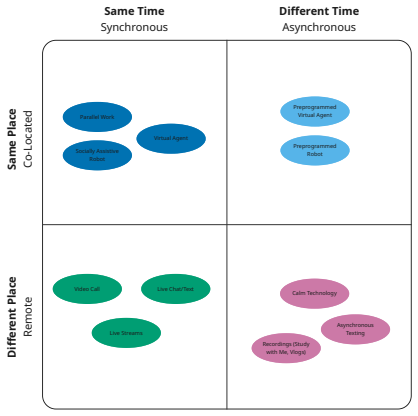
read the original abstract
Adults with ADHD may use a self-management technique known as Body Doubling, in which the participant employs the presence of one or more agents as a means of initiating and completing tasks. We developed a framework on body doubling with twelve dimensions to better understand the characteristics of body doubling and discover future research directions for developing and testing body doubling for adults with ADHD. Our framework accounts for individual motivation, agent-related dimensions, interaction related dimensions, contextual dimensions, and efficacy. These dimensions show existing research gaps such as limited mixed reality prototypes, possibilities for more interactive body doubles, and the need for empirical studies to further understand of body doubling and adults with ADHD.
Editorial analysis
A structured set of objections, weighed in public.
Referee Report
Summary. The paper proposes a conceptual framework consisting of twelve dimensions for characterizing body doubling (a self-management technique using the presence of agents to support task initiation and completion) in mixed-reality settings for adults with ADHD. The dimensions are grouped into categories of individual motivation, agent-related factors, interaction-related factors, contextual factors, and efficacy; the work positions the framework as a roadmap to identify research gaps, such as the scarcity of existing MR prototypes and the need for more interactive designs and empirical studies.
Significance. If the framework proves useful, it could provide a structured lens for an emerging intersection of HCI, mixed reality, and ADHD self-management research, where empirical work is currently limited. Its value would lie in surfacing testable directions (e.g., interactive agent behaviors or contextual variables) rather than in immediate validation or quantitative prediction.
major comments (1)
- The manuscript does not describe the process by which the twelve dimensions were identified, selected, or grouped (e.g., via systematic literature review, thematic coding of prior studies, or expert input). This is load-bearing for the central claim because the framework is presented as a comprehensive organizing tool; without a transparent derivation method, it is difficult to evaluate whether key factors have been omitted or whether the groupings are reproducible.
minor comments (2)
- The abstract states that the framework 'accounts for' the listed categories but does not preview how many dimensions fall under each or give one-sentence examples; adding this would improve readability for readers scanning for research gaps.
- Several dimensions are introduced without citing the specific prior body-doubling or ADHD literature that motivated their inclusion; adding targeted references would strengthen the roadmap character of the work.
Simulated Author's Rebuttal
We thank the referee for their constructive feedback and the recommendation for minor revision. We address the major comment below and will incorporate the requested clarification in the revised manuscript.
read point-by-point responses
-
Referee: The manuscript does not describe the process by which the twelve dimensions were identified, selected, or grouped (e.g., via systematic literature review, thematic coding of prior studies, or expert input). This is load-bearing for the central claim because the framework is presented as a comprehensive organizing tool; without a transparent derivation method, it is difficult to evaluate whether key factors have been omitted or whether the groupings are reproducible.
Authors: We agree that explicitly describing the derivation process is necessary to support the framework's claim as a comprehensive roadmap. The twelve dimensions were developed through an iterative synthesis of the literature on body doubling as an ADHD self-management strategy, combined with reviews of mixed-reality HCI applications and psychological factors influencing task initiation. Relevant papers were identified via targeted searches in HCI, psychology, and ADHD domains; key concepts were extracted and thematically grouped into the five categories (motivation, agent, interaction, context, efficacy) based on functional similarity and empirical grounding in prior work. In the revised manuscript we will add a new subsection (e.g., 'Framework Development') that details the literature sources consulted, inclusion criteria, and the rationale for selection and grouping. This addition will improve transparency and reproducibility without changing the framework itself. revision: yes
Circularity Check
No significant circularity
full rationale
The paper presents an original conceptual framework consisting of twelve dimensions grouped under individual motivation, agent-related, interaction, contextual, and efficacy categories. No equations, derivations, fitted parameters, or self-referential definitions appear in the provided text or abstract. The framework is explicitly framed as a roadmap to surface research gaps rather than a validated model or derived result, with direct acknowledgment of the scarcity of existing MR prototypes and the need for future empirical studies. This structure is self-contained as an organizing tool without any reduction of claims to prior inputs by construction.
Axiom & Free-Parameter Ledger
axioms (1)
- domain assumption Body doubling is an effective self-management technique for adults with ADHD that can be translated into mixed reality agents.
Reference graph
Works this paper leans on
-
[1]
S. Weibel, O. Menard, A. Ionita, M. Boumendjel, C. Cabelguen, C. Kraemer, J.-A. Micoulaud-Franchi, S. Bioulac, N. Perroud, A. Sauvaget, L. Carton, M. Gachet, R. Lopez, Practical considerations for the evaluation and management of attention deficit hyperactivity disorder (ADHD) in adults, Encephale 46 (2020) 30–40
work page 2020
-
[2]
Y. Ginsberg, J. Quintero, E. Anand, M. Casillas, H. P. Upadhyaya, Underdiagnosis of attention- deficit/hyperactivity disorder in adult patients: a review of the literature, Prim. Care Companion CNS Disord. 16 (2014)
work page 2014
-
[3]
W. H. Organization., International Classification of Diseases 11th Revision. The global standard for diagnostic health information, 2025. URL: https://icd.who.int/en
work page 2025
-
[4]
D. Sjöwall, L. Roth, S. Lindqvist, L. B. Thorell, Multiple deficits in ADHD: executive dysfunction, delay aversion, reaction time variability, and emotional deficits, J. Child Psychol. Psychiatry 54 (2013) 619–627
work page 2013
-
[5]
Y. Holst, L. B. Thorell, Functional impairments among adults with ADHD: A comparison with adults with other psychiatric disorders and links to executive deficits, Applied Neuropsychology: Adult 27 (2019) 243–255. URL: http://dx.doi.org/10.1080/23279095.2018.1532429. doi: 10.1080/ 23279095.2018.1532429
-
[6]
B. Gjervan, T. Torgersen, H. M. Nordahl, K. Rasmussen, Functional impairment and occupational outcome in adults with ADHD, J. Atten. Disord. 16 (2012) 544–552
work page 2012
- [7]
-
[8]
It was something I naturally found worked and heard about later
T. Eagle, L. B. Baltaxe-Admony, K. E. Ringland, “It was something I naturally found worked and heard about later”: An investigation of body doubling with neurodivergent participants, ACM Trans. Access. Comput. (2024)
work page 2024
- [9]
-
[10]
T. Eagle, L. B. Baltaxe-Admony, K. E. Ringland, Proposing body doubling as a continuum of space/time and mutuality: An investigation with neurodivergent participants, in: The 25th International ACM SIGACCESS Conference on Computers and Accessibility, ACM, New York, NY, USA, 2023, pp. 1–4
work page 2023
-
[11]
Y. Lee, J. J. Y. Chung, J. Y. Song, M. Chang, J. Kim, Personalizing ambience and illusionary presence: How people use “study with me” videos to create effective studying environments, in: Proceedings of the 2021 CHI Conference on Human Factors in Computing Systems, ACM, New York, NY, USA, 2021
work page 2021
- [12]
-
[13]
URL: https://www.youtube.com/@LofiGirl, accessed: 2026-02-20
Lofi Girl, Lofi girl - YouTube channel, 2026. URL: https://www.youtube.com/@LofiGirl, accessed: 2026-02-20
work page 2026
- [14]
- [15]
- [16]
-
[17]
A. O’Connell, A. Banga, J. Ayissi, N. Yaminrafie, E. Ko, A. Le, B. Cislowski, M. Mataric, Design and evaluation of a socially assistive robot schoolwork companion for college students with ADHD, in: Proceedings of the 2024 ACM/IEEE International Conference on Human-Robot Interaction, HRI ’24, Association for Computing Machinery, New York, NY, USA, 2024, p...
-
[18]
H. Lalwani, M. Saleh, H. Salam, A study companion for productivity: Exploring the role of a social robot for college students with ADHD, in: Proceedings of the 2025 ACM/IEEE International Conference on Human-Robot Interaction, HRI ’25, IEEE Press, 2025, p. 1438–1442
work page 2025
-
[19]
R. Deshmukh, Toward neurodivergent-aware productivity: A systems and AI-based human-in-the- loop framework for ADHD-affected professionals, in: Proceedings of the 16th Biannual Conference of the Italian SIGCHI Chapter, ACM, New York, NY, USA, 2025, pp. 1–6
work page 2025
-
[20]
Annavarapu, Comparative study of body doubling in extended reality, 2024
S. Annavarapu, Comparative study of body doubling in extended reality, 2024
work page 2024
-
[21]
Discord FAQ - Body Doubling — bodydoubling.com, https://bodydoubling.com/discord-faq/, 2025. [Accessed 27-05-2025]
work page 2025
- [22]
-
[23]
R. Johansen, J. Charles, R. Mittman, P. Saffo, Groupware: Computer Support for Business Teams, Free Press, New York, 1988
work page 1988
-
[24]
V. Penichet, I. Marin, J. Gallud, M. Lozano, R. Tesoriero, A classification method for CSCW systems, Electronic Notes in Theoretical Computer Science 168 (2007) 237–247. URL: https://www. sciencedirect.com/science/article/pii/S1571066107000394. doi:https://doi.org/10.1016/j. entcs.2006.12.007, proceedings of the Second International Workshop on Views on D...
work page doi:10.1016/j 2007
-
[25]
Y.-C. Jhuang, Y. H. Chiu, H.-J. Lee, Y. T. Lee, G.-Y. Lin, N.-H. Wu, P.-Y. P. Kuo, Exploring the effect of study with me on parasocial interaction and learning productivity: Lessons learned in a field study, in: C. Stephanidis, M. Antona, S. Ntoa (Eds.), HCI International 2022 Posters, Springer International Publishing, Cham, 2022, pp. 43–49
work page 2022
-
[26]
A. E. Team, The ADHD Body Double: A Unique Tool for Getting Things Done - ADDA - Attention Deficit Disorder Association — add.org, https://add.org/the-body-double/, 2024. [Accessed 27-05- 2025]
work page 2024
-
[27]
E. W. Weisstein, Complete Digraph, From MathWorld—A Wolfram Web Resource, 2026. URL: https://mathworld.wolfram.com/CompleteDigraph.html, accessed: 2026-02-10
work page 2026
-
[28]
S. Born, The Effects of Accountability and Body Doubling on Productivity for People With Attention Deficits, Master’s thesis, Lamar University-Beaumont, 2024
work page 2024
discussion (0)
Sign in with ORCID, Apple, or X to comment. Anyone can read and Pith papers without signing in.