Recognition: no theorem link
From Synthetic to Real: Toward Identity-Consistent Makeup Transfer with Synthetic and Real Data
Pith reviewed 2026-05-11 02:19 UTC · model grok-4.3
The pith
Curated synthetic data combined with reinforcement learning on real images improves identity preservation in makeup transfer.
A machine-rendered reading of the paper's core claim, the machinery that carries it, and where it could break.
Core claim
ConsistentBeauty creates synthetic training data that enforces both makeup fidelity and identity consistency, while RealBeauty performs supervised learning on this data followed by reinforcement learning with novel verifiable rewards that measure identity preservation and makeup accuracy on real images, allowing the model to generalize beyond synthetic supervision.
What carries the argument
RealBeauty post-training framework, which adapts a model from supervised training on identity-consistent synthetic data to real scenarios via reinforcement learning driven by makeup-transfer-specific verifiable rewards.
If this is right
- State-of-the-art performance on existing makeup transfer benchmarks.
- Stronger identity preservation across diverse skin tones, ages, genders, and poses.
- Improved handling of complex real-world makeup styles and backgrounds.
- The new diverse benchmark supports more thorough testing of real-world robustness.
Where Pith is reading between the lines
- The curation-plus-RL pattern may transfer to other image-to-image tasks that suffer from synthetic-to-real gaps, such as face editing or style transfer.
- Verifiable rewards could reduce reliance on paired real-world annotations in beauty-related computer vision applications.
- Consumer tools for virtual makeup try-on might become more accurate for varied user demographics without additional manual calibration.
Load-bearing premise
The verifiable rewards used in reinforcement learning reliably quantify and improve both identity consistency and makeup fidelity on real data without creating new distortions or overfitting to the new benchmark.
What would settle it
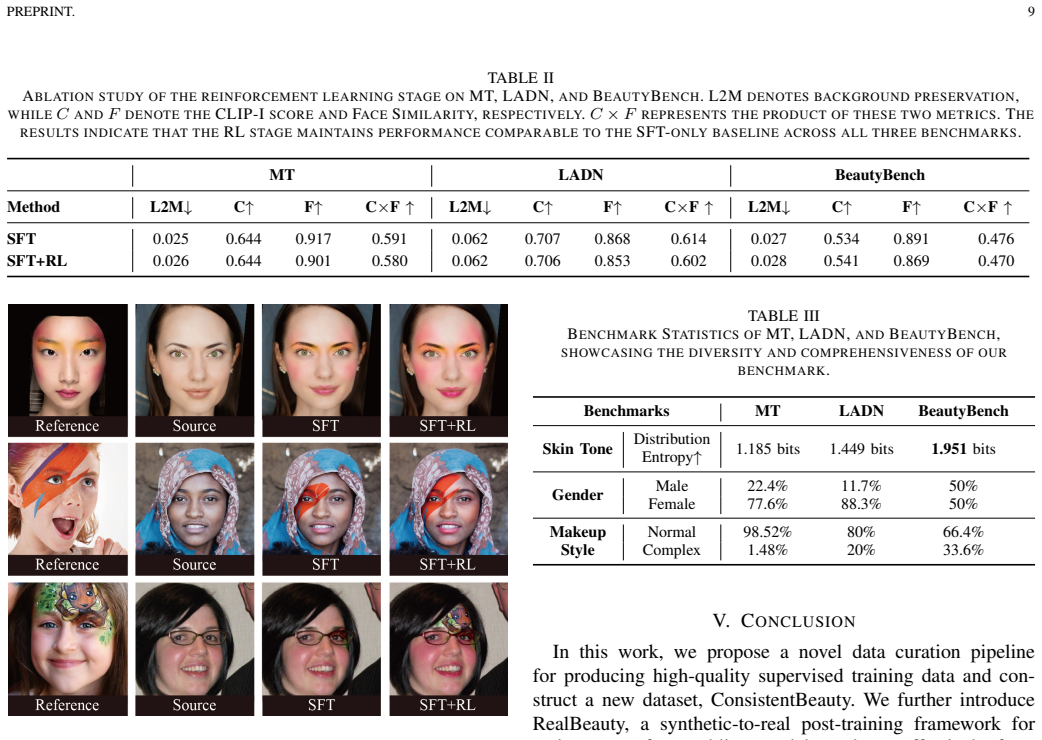
A comparison on the new benchmark showing that the reinforcement-learning-adapted model produces lower identity preservation scores or more visible artifacts than the version trained only on the curated synthetic data.
Figures




read the original abstract
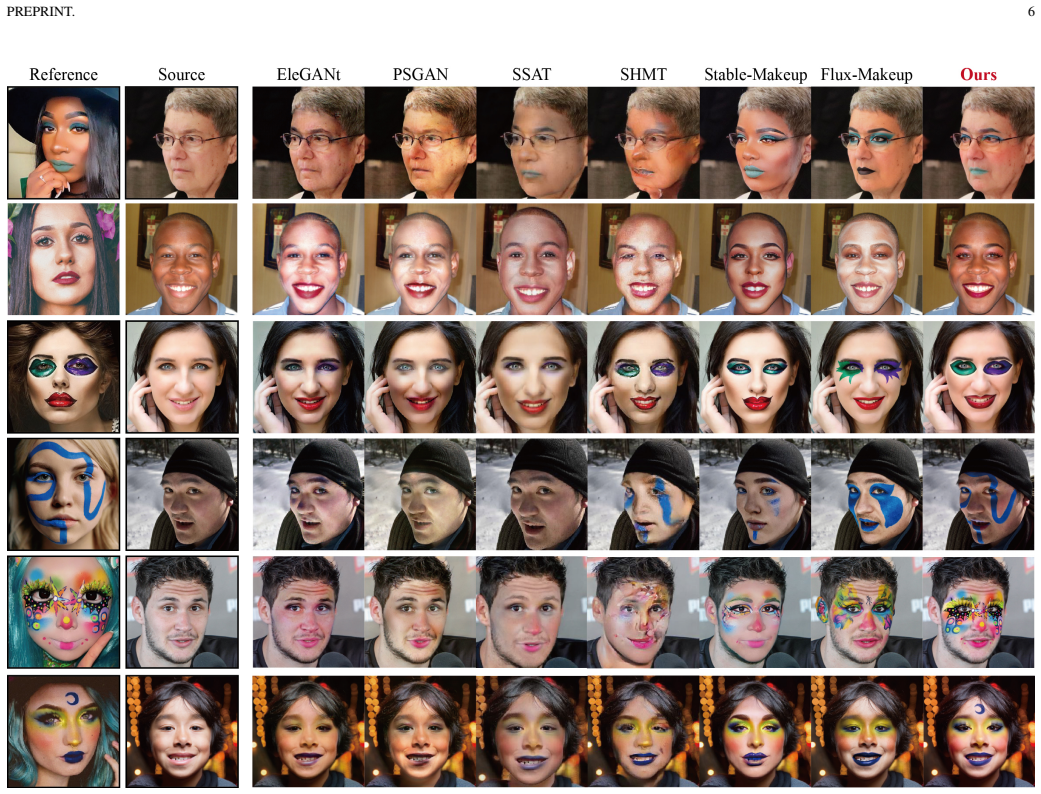
Makeup transfer aims to apply the makeup style of a reference portrait to a source portrait while preserving identity and background. Early methods formulate this task as unsupervised image-to-image translation, relying on surrogate objectives and often yielding limited performance. Recent diffusion- and flow-based approaches instead exploit synthetic data for supervised training, leading to significant improvements. However, these methods still face two critical challenges: synthetic supervision frequently fails to faithfully preserve identity, and the domain gap between synthetic and real data limits generalization, resulting in degraded performance in complex real-world scenarios. To address these issues, this paper first proposes ConsistentBeauty, a novel data curation pipeline that ensures makeup fidelity and strict identity consistency within the synthesized data. Second, we propose RealBeauty, a synthetic-to-real post-training framework. Beyond supervised learning on curated synthetic data, we further adapt the model to real-world scenarios through reinforcement learning and design novel verifiable rewards tailored to the makeup transfer task. It allows the model to further benefit from real makeup patterns beyond synthetic supervision. In addition, we establish a new diverse benchmark for makeup transfer, covering a wide range of skin tones, ages, genders, poses, and makeup styles, thereby enabling a more comprehensive evaluation of model performance under diverse real-world conditions. Extensive experiments show that our method achieves state-of-the-art performance on multiple benchmarks and demonstrates clear advantages in identity preservation and performance on complex real-world cases.
Editorial analysis
A structured set of objections, weighed in public.
Referee Report
Summary. The paper claims that prior synthetic-supervised makeup transfer methods suffer from poor identity preservation and domain gaps to real data; it addresses this via ConsistentBeauty, a curation pipeline producing identity-consistent synthetic pairs, followed by RealBeauty, a supervised pre-training plus RL post-training stage that uses novel task-specific verifiable rewards on real images to adapt the model, plus a new diverse benchmark spanning skin tones, ages, genders, poses and styles, ultimately reporting SOTA performance on identity preservation and complex real-world cases.
Significance. If the empirical claims hold, the work would be significant for the makeup-transfer and broader synthetic-to-real adaptation literature by demonstrating a practical pipeline that leverages curated synthetic supervision then refines with RL on real data without full labels. The new benchmark is a clear positive contribution that enables more representative evaluation across demographics. The verifiable-reward RL idea is a strength that could transfer to other image-editing tasks if the rewards prove robust.
major comments (1)
- [RealBeauty framework] RealBeauty section (RL adaptation stage): the central claim that the novel verifiable rewards reliably improve identity consistency and makeup fidelity on real data without new artifacts or extensive tuning is load-bearing for the synthetic-to-real contribution, yet the manuscript provides insufficient detail on their exact formulation, weighting coefficients, or verification procedure; this directly relates to the reader's noted weakest assumption and must be clarified with equations or pseudocode before the SOTA and generalization claims can be fully assessed.
minor comments (2)
- Table captions and figure legends should explicitly state which metrics correspond to identity preservation versus makeup fidelity so readers can directly map quantitative gains to the two stated advantages.
- The abstract and introduction mention 'multiple benchmarks'; a consolidated table listing all evaluated datasets, metrics, and prior methods would improve clarity.
Simulated Author's Rebuttal
We thank the referee for the constructive review and the recommendation of minor revision. The single major comment identifies a valid need for greater transparency in the RealBeauty framework, which we will address directly in the revision to strengthen the synthetic-to-real claims.
read point-by-point responses
-
Referee: [RealBeauty framework] RealBeauty section (RL adaptation stage): the central claim that the novel verifiable rewards reliably improve identity consistency and makeup fidelity on real data without new artifacts or extensive tuning is load-bearing for the synthetic-to-real contribution, yet the manuscript provides insufficient detail on their exact formulation, weighting coefficients, or verification procedure; this directly relates to the reader's noted weakest assumption and must be clarified with equations or pseudocode before the SOTA and generalization claims can be fully assessed.
Authors: We agree that the verifiable rewards are central to RealBeauty and that the current manuscript description is insufficient for full evaluation. In the revised manuscript we will add the exact mathematical formulations of the identity-consistency and makeup-fidelity reward terms, the specific weighting coefficients used in the composite reward, and pseudocode for the verification step and RL update loop. These additions will clarify how the rewards are computed from verifiable signals on real images and why they improve performance without introducing artifacts or requiring extensive retuning. revision: yes
Circularity Check
No significant circularity in derivation chain
full rationale
The paper describes an empirical pipeline: ConsistentBeauty for curating identity-consistent synthetic makeup data, followed by RealBeauty which applies supervised training on that data and then RL adaptation to real images using task-specific verifiable rewards. Performance is evaluated on external benchmarks plus a newly introduced diverse real-world benchmark. No mathematical derivations, fitted parameters renamed as predictions, or load-bearing self-citations appear; all claims reduce to experimental results measured against independent metrics rather than quantities defined in terms of the method's own outputs.
Axiom & Free-Parameter Ledger
free parameters (1)
- reward weighting coefficients
axioms (2)
- domain assumption Paired synthetic data with strict identity consistency can be generated at scale without introducing artifacts that harm downstream real-world generalization.
- domain assumption Verifiable rewards can be defined that accurately reflect human-perceived identity consistency and makeup fidelity on real images.
invented entities (1)
-
verifiable rewards for makeup transfer
no independent evidence
Reference graph
Works this paper leans on
-
[1]
Unpaired image-to-image translation using cycle-consistent adversarial networks,
J.-Y . Zhu, T. Park, P. Isola, and A. A. Efros, “Unpaired image-to-image translation using cycle-consistent adversarial networks,” inProceedings of the IEEE international conference on computer vision, 2017, pp. 2223–2232
work page 2017
-
[2]
Beautygan: Instance-level facial makeup transfer with deep generative adversarial network,
T. Li, R. Qian, C. Dong, S. Liu, Q. Yan, W. Zhu, and L. Lin, “Beautygan: Instance-level facial makeup transfer with deep generative adversarial network,” inProceedings of the 26th ACM international conference on Multimedia, 2018, pp. 645–653
work page 2018
-
[3]
Psgan: Pose and expression robust spatial-aware gan for customizable makeup transfer,
W. Jiang, S. Liu, C. Gao, J. Cao, R. He, J. Feng, and S. Yan, “Psgan: Pose and expression robust spatial-aware gan for customizable makeup transfer,” inProceedings of the IEEE/CVF conference on computer vision and pattern recognition, 2020, pp. 5194–5202
work page 2020
-
[4]
Beautyrec: Ro- bust, efficient, and component-specific makeup transfer,
Q. Yan, C. Guo, J. Zhao, Y . Dai, C. C. Loy, and C. Li, “Beautyrec: Ro- bust, efficient, and component-specific makeup transfer,” inProceedings of the IEEE/CVF conference on computer vision and pattern recognition, 2023, pp. 1102–1110
work page 2023
-
[5]
Elegant: Exquisite and locally editable gan for makeup transfer,
C. Yang, W. He, Y . Xu, and Y . Gao, “Elegant: Exquisite and locally editable gan for makeup transfer,” inEuropean conference on computer vision. Springer, 2022, pp. 737–754
work page 2022
-
[6]
Ssat: A symmetric semantic-aware transformer network for makeup transfer and removal,
Z. Sun, Y . Chen, and S. Xiong, “Ssat: A symmetric semantic-aware transformer network for makeup transfer and removal,” inProceedings of the AAAI Conference on artificial intelligence, vol. 36, no. 2, 2022, pp. 2325–2334
work page 2022
-
[7]
High- resolution image synthesis with latent diffusion models,
R. Rombach, A. Blattmann, D. Lorenz, P. Esser, and B. Ommer, “High- resolution image synthesis with latent diffusion models,” inProceedings of the IEEE/CVF conference on computer vision and pattern recognition, 2022, pp. 10 684–10 695. PREPRINT. 10
work page 2022
-
[8]
SDXL: Improving Latent Diffusion Models for High-Resolution Image Synthesis
D. Podell, Z. English, K. Lacey, A. Blattmann, T. Dockhorn, J. M ¨uller, J. Penna, and R. Rombach, “Sdxl: Improving latent diffusion models for high-resolution image synthesis,”arXiv preprint arXiv:2307.01952, 2023
work page internal anchor Pith review Pith/arXiv arXiv 2023
-
[9]
Scaling rectified flow transformers for high-resolution image synthesis,
P. Esser, S. Kulal, A. Blattmann, R. Entezari, J. M ¨uller, H. Saini, Y . Levi, D. Lorenz, A. Sauer, F. Boeselet al., “Scaling rectified flow transformers for high-resolution image synthesis,” inForty-first international conference on machine learning, 2024
work page 2024
-
[10]
FLUX.1 Kontext: Flow Matching for In-Context Image Generation and Editing in Latent Space
B. F. Labs, S. Batifol, A. Blattmann, F. Boesel, S. Consul, C. Diagne, T. Dockhorn, J. English, Z. English, P. Esseret al., “Flux. 1 kontext: Flow matching for in-context image generation and editing in latent space,”arXiv preprint arXiv:2506.15742, 2025
work page internal anchor Pith review Pith/arXiv arXiv 2025
-
[11]
Cyclediff: Cycle diffusion models for unpaired image-to-image translation,
S. Zou, Y . Huang, R. Yi, C. Zhu, and K. Xu, “Cyclediff: Cycle diffusion models for unpaired image-to-image translation,”IEEE Transactions on Image Processing, 2026
work page 2026
-
[12]
Consistent image layout editing with diffusion models,
T. Xia, Y . Zhang, T. Liu, and L. Zhang, “Consistent image layout editing with diffusion models,”IEEE Transactions on Image Processing, vol. 34, pp. 6978–6992, 2025
work page 2025
-
[13]
Stablemakeup: When real-world makeup transfer meets diffusion model,
Y . Zhang, Y . Yuan, Y . Song, and J. Liu, “Stablemakeup: When real-world makeup transfer meets diffusion model,” inProceedings of the Special Interest Group on Computer Graphics and Interactive Techniques Con- ference Conference Papers, 2025, pp. 1–9
work page 2025
-
[14]
Ffhq- makeup: Paired synthetic makeup dataset with facial consistency across multiple styles,
X. Yang, S. Ueda, Y . Huang, T. Akiyama, and T. Taketomi, “Ffhq- makeup: Paired synthetic makeup dataset with facial consistency across multiple styles,”arXiv preprint arXiv:2508.03241, 2025
-
[15]
J. Zhu, S. Liu, L. Li, Y . Gong, H. Wang, B. Cheng, Y . Ma, L. Wu, X. Wu, D. Lenget al., “Flux-makeup: High-fidelity, identity-consistent, and robust makeup transfer via diffusion transformer,”arXiv preprint arXiv:2508.05069, 2025
-
[16]
Evomakeup: High-fidelity and controllable makeup editing with makeupquad,
H. Wu, Y . Fu, Y . Li, Y . Gao, and K. Du, “Evomakeup: High-fidelity and controllable makeup editing with makeupquad,”arXiv preprint arXiv:2508.05994, 2025
-
[17]
Ladn: Local adversarial disentangling network for facial makeup and de-makeup,
Q. Gu, G. Wang, M. T. Chiu, Y .-W. Tai, and C.-K. Tang, “Ladn: Local adversarial disentangling network for facial makeup and de-makeup,” inProceedings of the IEEE/CVF International conference on computer vision, 2019, pp. 10 481–10 490
work page 2019
-
[18]
Generative adversarial networks,
I. Goodfellow, J. Pouget-Abadie, M. Mirza, B. Xu, D. Warde-Farley, S. Ozair, A. Courville, and Y . Bengio, “Generative adversarial networks,” Communications of the ACM, vol. 63, no. 11, pp. 139–144, 2020
work page 2020
-
[19]
Shmt: Self-supervised hierarchical makeup transfer via latent diffusion models,
Z. Sun, S. Xiong, Y . Chen, F. Du, W. Chen, F. Wang, and Y . Rong, “Shmt: Self-supervised hierarchical makeup transfer via latent diffusion models,”Advances in Neural Information Processing Systems, vol. 37, pp. 16 016–16 042, 2024
work page 2024
-
[20]
Seededit 3.0: Fast and high-quality generative image editing.arXiv preprint arXiv:2506.05083, 2025
P. Wang, Y . Shi, X. Lian, Z. Zhai, X. Xia, X. Xiao, W. Huang, and J. Yang, “Seededit 3.0: Fast and high-quality generative image editing,” arXiv preprint arXiv:2506.05083, 2025
-
[21]
Generative modeling by estimating gradients of the data distribution,
Y . Song and S. Ermon, “Generative modeling by estimating gradients of the data distribution,”Advances in neural information processing systems, vol. 32, 2019
work page 2019
-
[22]
Denoising diffusion probabilistic models,
J. Ho, A. Jain, and P. Abbeel, “Denoising diffusion probabilistic models,” Advances in neural information processing systems, vol. 33, pp. 6840– 6851, 2020
work page 2020
-
[23]
Score-Based Generative Modeling through Stochastic Differential Equations
Y . Song, J. Sohl-Dickstein, D. P. Kingma, A. Kumar, S. Ermon, and B. Poole, “Score-based generative modeling through stochastic differ- ential equations,”arXiv preprint arXiv:2011.13456, 2020
work page internal anchor Pith review Pith/arXiv arXiv 2011
-
[24]
Denoising Diffusion Implicit Models
J. Song, C. Meng, and S. Ermon, “Denoising diffusion implicit models,” arXiv preprint arXiv:2010.02502, 2020
work page internal anchor Pith review Pith/arXiv arXiv 2010
-
[25]
Hierarchical Text-Conditional Image Generation with CLIP Latents
A. Ramesh, P. Dhariwal, A. Nichol, C. Chu, and M. Chen, “Hierarchical text-conditional image generation with clip latents,”arXiv preprint arXiv:2204.06125, vol. 1, no. 2, p. 3, 2022
work page internal anchor Pith review Pith/arXiv arXiv 2022
-
[26]
Ip-adapter: Text compatible image prompt adapter for text-to-image diffusion models,
H. Ye, J. Zhang, S. Liu, X. Han, and W. Yang, “Ip-adapter: Text compatible image prompt adapter for text-to-image diffusion models,”
-
[27]
IP-Adapter: Text Compatible Image Prompt Adapter for Text-to-Image Diffusion Models
[Online]. Available: https://arxiv.org/abs/2308.06721
work page internal anchor Pith review Pith/arXiv arXiv
-
[28]
Dreambooth: Fine tuning text-to-image diffusion models for subject- driven generation,
N. Ruiz, Y . Li, V . Jampani, Y . Pritch, M. Rubinstein, and K. Aberman, “Dreambooth: Fine tuning text-to-image diffusion models for subject- driven generation,” inProceedings of the IEEE/CVF conference on computer vision and pattern recognition, 2023, pp. 22 500–22 510
work page 2023
-
[29]
Instructpix2pix: Learning to follow image editing instructions,
T. Brooks, A. Holynski, and A. A. Efros, “Instructpix2pix: Learning to follow image editing instructions,” inProceedings of the IEEE/CVF conference on computer vision and pattern recognition, 2023, pp. 18 392–18 402
work page 2023
-
[30]
Conditional Generative Adversarial Nets
M. Mirza and S. Osindero, “Conditional generative adversarial nets,” arXiv preprint arXiv:1411.1784, 2014
work page internal anchor Pith review arXiv 2014
-
[31]
Perceptual adversarial networks for image-to-image transformation,
C. Wang, C. Xu, C. Wang, and D. Tao, “Perceptual adversarial networks for image-to-image transformation,”IEEE Transactions on Image Pro- cessing, vol. 27, no. 8, pp. 4066–4079, 2018
work page 2018
-
[32]
Scalable diffusion models with transformers,
W. Peebles and S. Xie, “Scalable diffusion models with transformers,” inProceedings of the IEEE/CVF international conference on computer vision, 2023, pp. 4195–4205
work page 2023
-
[33]
Flow Straight and Fast: Learning to Generate and Transfer Data with Rectified Flow
X. Liu, C. Gong, and Q. Liu, “Flow straight and fast: Learning to generate and transfer data with rectified flow,”arXiv preprint arXiv:2209.03003, 2022
work page internal anchor Pith review Pith/arXiv arXiv 2022
-
[34]
Flow Matching for Generative Modeling
Y . Lipman, R. T. Chen, H. Ben-Hamu, M. Nickel, and M. Le, “Flow matching for generative modeling,”arXiv preprint arXiv:2210.02747, 2022
work page internal anchor Pith review Pith/arXiv arXiv 2022
-
[35]
Aligning Text-to-Image Models using Human Feedback
K. Lee, H. Liu, M. Ryu, O. Watkins, Y . Du, C. Boutilier, P. Abbeel, M. Ghavamzadeh, and S. S. Gu, “Aligning text-to-image models using human feedback,”arXiv preprint arXiv:2302.12192, 2023
work page internal anchor Pith review arXiv 2023
-
[36]
Dpok: Reinforcement learning for fine-tuning text-to-image diffusion models,
Y . Fan, O. Watkins, Y . Du, H. Liu, M. Ryu, C. Boutilier, P. Abbeel, M. Ghavamzadeh, K. Lee, and K. Lee, “Dpok: Reinforcement learning for fine-tuning text-to-image diffusion models,”Advances in Neural Information Processing Systems, vol. 36, pp. 79 858–79 885, 2023
work page 2023
-
[37]
Training Diffusion Models with Reinforcement Learning
K. Black, M. Janner, Y . Du, I. Kostrikov, and S. Levine, “Train- ing diffusion models with reinforcement learning,”arXiv preprint arXiv:2305.13301, 2023
work page internal anchor Pith review arXiv 2023
-
[38]
Diffusion model alignment using direct preference optimization,
B. Wallace, M. Dang, R. Rafailov, L. Zhou, A. Lou, S. Purushwalkam, S. Ermon, C. Xiong, S. Joty, and N. Naik, “Diffusion model alignment using direct preference optimization,” inProceedings of the IEEE/CVF Conference on Computer Vision and Pattern Recognition, 2024, pp. 8228–8238
work page 2024
-
[39]
Direct preference optimization: Your language model is secretly a reward model,
R. Rafailov, A. Sharma, E. Mitchell, C. D. Manning, S. Ermon, and C. Finn, “Direct preference optimization: Your language model is secretly a reward model,”Advances in neural information processing systems, vol. 36, pp. 53 728–53 741, 2023
work page 2023
-
[40]
DeepSeekMath: Pushing the Limits of Mathematical Reasoning in Open Language Models
Z. Shao, P. Wang, Q. Zhu, R. Xu, J. Song, X. Bi, H. Zhang, M. Zhang, Y . Li, Y . Wuet al., “Deepseekmath: Pushing the limits of mathematical reasoning in open language models,”arXiv preprint arXiv:2402.03300, 2024
work page internal anchor Pith review Pith/arXiv arXiv 2024
-
[41]
Flow-GRPO: Training Flow Matching Models via Online RL
J. Liu, G. Liu, J. Liang, Y . Li, J. Liu, X. Wang, P. Wan, D. Zhang, and W. Ouyang, “Flow-grpo: Training flow matching models via online rl,” arXiv preprint arXiv:2505.05470, 2025
work page internal anchor Pith review arXiv 2025
-
[42]
DanceGRPO: Unleashing GRPO on Visual Generation
Z. Xue, J. Wu, Y . Gao, F. Kong, L. Zhu, M. Chen, Z. Liu, W. Liu, Q. Guo, W. Huanget al., “Dancegrpo: Unleashing grpo on visual generation,”arXiv preprint arXiv:2505.07818, 2025
work page internal anchor Pith review arXiv 2025
-
[43]
MixGRPO: Unlocking Flow-based GRPO Efficiency with Mixed ODE-SDE
J. Li, Y . Cui, T. Huang, Y . Ma, C. Fan, M. Yang, and Z. Zhong, “Mixgrpo: Unlocking flow-based grpo efficiency with mixed ode-sde,” arXiv preprint arXiv:2507.21802, 2025
work page internal anchor Pith review arXiv 2025
-
[44]
A style-based generator architecture for generative adversarial networks,
T. Karras, S. Laine, and T. Aila, “A style-based generator architecture for generative adversarial networks,” inProceedings of the IEEE/CVF conference on computer vision and pattern recognition, 2019, pp. 4401– 4410
work page 2019
-
[45]
Facenet: A unified embed- ding for face recognition and clustering,
F. Schroff, D. Kalenichenko, and J. Philbin, “Facenet: A unified embed- ding for face recognition and clustering,” inProceedings of the IEEE conference on computer vision and pattern recognition, 2015, pp. 815– 823
work page 2015
-
[46]
Imagereward: Learning and evaluating human preferences for text-to- image generation,
J. Xu, X. Liu, Y . Wu, Y . Tong, Q. Li, M. Ding, J. Tang, and Y . Dong, “Imagereward: Learning and evaluating human preferences for text-to- image generation,”Advances in Neural Information Processing Systems, vol. 36, pp. 15 903–15 935, 2023
work page 2023
-
[47]
Learning transferable visual models from natural language supervision,
A. Radford, J. W. Kim, C. Hallacy, A. Ramesh, G. Goh, S. Agarwal, G. Sastry, A. Askell, P. Mishkin, J. Clarket al., “Learning transferable visual models from natural language supervision,” inInternational conference on machine learning. PmLR, 2021, pp. 8748–8763
work page 2021
-
[48]
Emerging properties in self-supervised vision transformers,
M. Caron, H. Touvron, I. Misra, H. J ´egou, J. Mairal, P. Bojanowski, and A. Joulin, “Emerging properties in self-supervised vision transformers,” inProceedings of the IEEE/CVF international conference on computer vision, 2021, pp. 9650–9660
work page 2021
-
[49]
Lipstick ain’t enough: Beyond color matching for in-the-wild makeup transfer,
T. Nguyen, A. T. Tran, and M. Hoai, “Lipstick ain’t enough: Beyond color matching for in-the-wild makeup transfer,” inProceedings of the IEEE/CVF Conference on computer vision and pattern recognition, 2021, pp. 13 305–13 314
work page 2021
-
[50]
Lora: Low-rank adaptation of large language models
E. J. Hu, Y . Shen, P. Wallis, Z. Allen-Zhu, Y . Li, S. Wang, L. Wang, W. Chenet al., “Lora: Low-rank adaptation of large language models.” ICLR, vol. 1, no. 2, p. 3, 2022
work page 2022
-
[51]
Photomaker: Customizing realistic human photos via stacked id embedding,
Z. Li, M. Cao, X. Wang, Z. Qi, M.-M. Cheng, and Y . Shan, “Photomaker: Customizing realistic human photos via stacked id embedding,” in Proceedings of the IEEE/CVF conference on computer vision and pattern recognition, 2024, pp. 8640–8650
work page 2024
-
[52]
Bisenet: Bilateral segmentation network for real-time semantic segmentation,
C. Yu, J. Wang, C. Peng, C. Gao, G. Yu, and N. Sang, “Bisenet: Bilateral segmentation network for real-time semantic segmentation,” in Proceedings of the European conference on computer vision (ECCV), 2018, pp. 325–341. PREPRINT. 11 VI. BIOGRAPHYSECTION Yue Yureceived the Bachelor’s degree and M.S. degree from the Chinese University of Hong Kong, Hong Kon...
work page 2018
discussion (0)
Sign in with ORCID, Apple, or X to comment. Anyone can read and Pith papers without signing in.