Recognition: no theorem link
Per-Phase Fidelity Attribution for Quantum Compilers using HBR Decomposition
Pith reviewed 2026-05-11 02:30 UTC · model grok-4.3
The pith
HBR decomposition attributes fidelity loss to high-level, basis, and routing phases in quantum compilation, showing losses vary by circuit class and optimization level.
A machine-rendered reading of the paper's core claim, the machinery that carries it, and where it could break.
Core claim
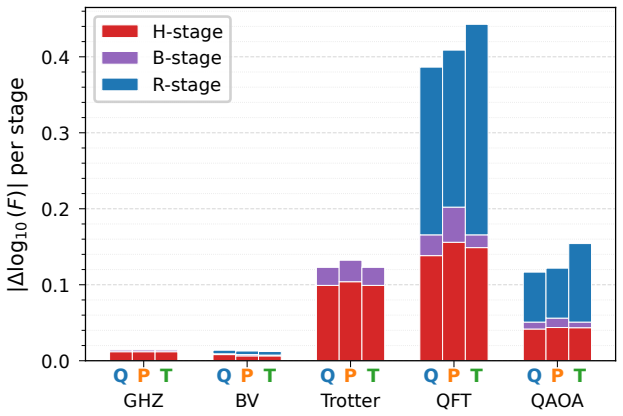
HBR decomposition quantifies relative fidelity loss across the H, B, and R stages of compilation. Applied to eight algorithms on IBM Heron and IonQ Forte backends with Qiskit, PennyLane, and TKET, it shows routing accounts for up to 60 percent of relative fidelity loss in search-class circuits while synthesis dominates Hamiltonian simulation, early synthesis choices amplify or reduce later routing overhead, and SDK rankings at opt=0 reverse at opt=2 for deep circuits. The decomposition correctly predicts SDK orderings on both simulation and real hardware.
What carries the argument
HBR decomposition, a per-phase fidelity attribution model that isolates relative loss contributions from High-level structural decomposition (H), Basis translation (B), and Routing (R) stages.
If this is right
- For search-class circuits, routing optimizations can recover up to 60 percent of lost fidelity.
- Early synthesis decisions in one stage change the routing burden in later stages depending on final connectivity.
- SDK rankings observed at diagnostic optimization levels do not predict rankings at production levels for deep circuits.
- Aggregate compiler benchmarks miss stage-specific bottlenecks that HBR makes visible.
Where Pith is reading between the lines
- Compilers could adaptively choose synthesis and routing strategies according to detected circuit class before full compilation.
- The same decomposition could be applied to additional hardware topologies to test whether the circuit-class dependence generalizes.
- Stage-wise diagnostics might be integrated into real-time compilation loops to adjust parameters mid-process.
Load-bearing premise
Relative fidelity losses can be cleanly separated and added across the three phases without large interaction effects or measurement artifacts invalidating the decomposition.
What would settle it
Execute the same circuits with each phase isolated on hardware, sum the measured fidelity losses, and compare to the full-pipeline loss; systematic mismatch would show the additive attribution does not hold.
Figures





read the original abstract
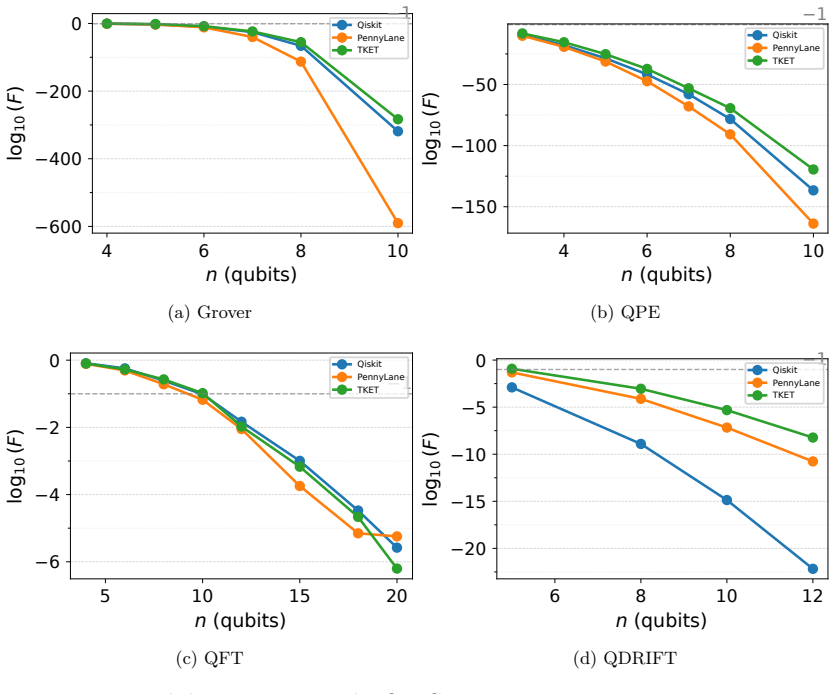
Quantum compilers sit between an algorithm's theoretical promise and what executes on physical hardware. Existing benchmarks report aggregate post-transpilation metrics but cannot attribute where fidelity is lost within the compilation pipeline. We present HBR decomposition, a per-phase fidelity attribution model that quantifies relative fidelity loss across High-level structural decomposition (H), Basis translation (B), and Routing (R). We evaluate three production SDKs (Qiskit, PennyLane, TKET) across eight algorithms on two backend topologies: IBM Heron (heavy-hex) and IonQ Forte (all-to-all). The dominant compiler bottleneck is strongly circuit-class dependent: Routing accounts for up to 60% of relative fidelity loss in search-class circuits, while synthesis dominates Hamiltonian simulation workloads. Early synthesis choices amplify or compress downstream routing overhead depending on circuit connectivity. SDK rankings at diagnostic optimization level (opt=0) reverse at production levels (opt=2) for deep circuits, showing that stagewise diagnostics and production results answer different questions. HBR correctly predicts SDK rank ordering across noisy simulations (8 circuits x 3 SDKs x 2 tiers) and real IBM Fez hardware executions, revealing stage-specific bottlenecks that are not observable through aggregate compiler benchmarks.
Editorial analysis
A structured set of objections, weighed in public.
Referee Report
Summary. The paper introduces HBR decomposition, a model that attributes relative fidelity loss in quantum compilers to three sequential phases: High-level structural decomposition (H), Basis translation (B), and Routing (R). It evaluates Qiskit, PennyLane, and TKET across eight algorithms on IBM Heron (heavy-hex) and IonQ Forte (all-to-all) backends, reporting that routing dominates fidelity loss (up to 60%) in search circuits while synthesis dominates Hamiltonian simulation workloads. Early H choices are shown to modulate downstream R overhead, SDK rankings reverse between diagnostic (opt=0) and production (opt=2) levels for deep circuits, and HBR is claimed to correctly predict end-to-end SDK rank orderings in noisy simulations and real IBM Fez hardware runs, exposing stage-specific bottlenecks invisible to aggregate benchmarks.
Significance. If the additive decomposition is robust, the work provides a useful diagnostic lens for compiler developers by isolating phase contributions rather than relying on post-transpilation aggregates. The empirical scope—multiple SDKs, circuit classes, topologies, and both simulation/hardware validation—is a clear strength, as is the reproducible rank-order prediction across 8 circuits × 3 SDKs × 2 tiers. The observation that optimization level and circuit connectivity alter which stage is the bottleneck has practical implications for targeted improvements in quantum software stacks.
major comments (2)
- [Abstract and HBR decomposition description] Abstract and HBR decomposition description: the central claim that relative fidelity loss decomposes additively into H, B, and R contributions (with routing up to 60% for search circuits) rests on the untested assumption that cross-phase interactions are negligible. Compilation is sequential; H-phase structural choices alter depth and connectivity, which nonlinearly affect R-phase overhead. The manuscript provides no ablation study, sensitivity analysis, or error bounds demonstrating that the attributed percentages remain stable when early-stage decisions are controlled, undermining the assertion that HBR isolates true stage-specific bottlenecks.
- [Experimental methodology and results sections] Experimental methodology and results sections: insufficient detail is given on how per-phase fidelity is isolated and measured. The text reports empirical matches on simulation and hardware but omits the concrete procedure for per-phase attribution, error propagation through the pipeline, controls for measurement artifacts, or how interaction effects between stages are mitigated or quantified. This gap is load-bearing because the rank-order predictions and bottleneck claims cannot be independently verified without these specifics.
minor comments (2)
- [Abstract] The abstract states that HBR 'correctly predicts SDK rank ordering' but does not specify the quantitative success metric (e.g., rank correlation coefficient or top-1 accuracy) or the exact held-out protocol used to establish this prediction.
- [Notation for 'relative fidelity loss'] Notation for 'relative fidelity loss' should be formalized with an explicit equation early in the manuscript to remove ambiguity in how the percentages are normalized across phases.
Simulated Author's Rebuttal
We thank the referee for the constructive comments, which help clarify the presentation of HBR decomposition. We address each major comment below and will revise the manuscript accordingly to improve rigor and reproducibility.
read point-by-point responses
-
Referee: [Abstract and HBR decomposition description] Abstract and HBR decomposition description: the central claim that relative fidelity loss decomposes additively into H, B, and R contributions (with routing up to 60% for search circuits) rests on the untested assumption that cross-phase interactions are negligible. Compilation is sequential; H-phase structural choices alter depth and connectivity, which nonlinearly affect R-phase overhead. The manuscript provides no ablation study, sensitivity analysis, or error bounds demonstrating that the attributed percentages remain stable when early-stage decisions are controlled, undermining the assertion that HBR isolates true stage-specific bottlenecks.
Authors: We agree that phases are sequential and that H-phase choices can nonlinearly influence R-phase overhead, as already noted in the manuscript when discussing how early synthesis modulates downstream routing. The HBR attribution is computed via incremental fidelity measurements after each phase, and its practical utility is evidenced by the model's ability to correctly predict end-to-end SDK rank orderings on both noisy simulation and real IBM Fez hardware across all 8 circuits, 3 SDKs, and 2 optimization tiers. This match provides empirical support that the additive decomposition captures dominant contributions for bottleneck identification, even if interactions exist. Nevertheless, we acknowledge that an explicit ablation study would strengthen the claims. In the revision we will add a dedicated subsection performing sensitivity analysis: we will fix or vary H-phase decompositions while holding later stages constant, quantify stability of the attributed R percentages, and include basic error bounds derived from repeated runs. revision: yes
-
Referee: [Experimental methodology and results sections] Experimental methodology and results sections: insufficient detail is given on how per-phase fidelity is isolated and measured. The text reports empirical matches on simulation and hardware but omits the concrete procedure for per-phase attribution, error propagation through the pipeline, controls for measurement artifacts, or how interaction effects between stages are mitigated or quantified. This gap is load-bearing because the rank-order predictions and bottleneck claims cannot be independently verified without these specifics.
Authors: We agree that the current description of the attribution procedure is insufficient for full reproducibility. In the revised manuscript we will substantially expand the Experimental Methodology section with a step-by-step account of per-phase fidelity isolation. This will include: the precise formulas for computing relative fidelity loss at each stage (H, B, R), the method for propagating measurement uncertainties, controls for shot noise and backend calibration artifacts, and how we bound or quantify cross-stage interactions (via the ablation study noted above). We will also add a workflow diagram and pseudocode to make the pipeline transparent and verifiable. revision: yes
Circularity Check
No significant circularity: HBR attribution uses direct per-phase measurements on held-out executions
full rationale
The paper defines HBR phases (High-level structural decomposition, Basis translation, Routing) and reports relative fidelity loss percentages and SDK rank orderings from explicit executions of 8 circuits across 3 SDKs, 2 optimization tiers, noisy simulations, and real IBM hardware. These are presented as empirical observations rather than outputs of a fitted model whose parameters are defined in terms of the same target data. No equations reduce the per-phase attributions or rank predictions to self-referential inputs, no self-citations bear the central claim, and no ansatz or uniqueness theorem is invoked to force the decomposition. The additive model is an explicit modeling choice whose validity is tested externally via correlation with end-to-end results; this does not constitute circularity under the enumerated patterns.
Axiom & Free-Parameter Ledger
invented entities (1)
-
HBR decomposition
no independent evidence
Reference graph
Works this paper leans on
-
[1]
M. AbuGhanem. IBM quantum computers: Evolution, performance, and future directions.arXiv preprint arXiv:2410.00916, 2024
-
[2]
Quantum supremacy using a programmable superconducting processor.Nature, 574:505–510, 2019
Frank Arute et al. Quantum supremacy using a programmable superconducting processor.Nature, 574:505–510, 2019
work page 2019
-
[3]
Pennylane: Automatic differentiation of hybrid quantum- classical computations, 2022
Ville Bergholm et al. Pennylane: Automatic differentiation of hybrid quantum- classical computations, 2022
work page 2022
-
[4]
Ethan Bernstein and Umesh Vazirani. Quantum complexity theory. InACM Sym- posium on Theory of Computing (STOC), pages 11–20, 1993
work page 1993
-
[5]
Sergey Bravyi, Andrew W. Cross, Jay M. Gambetta, Dmitri Maslov, Patrick Rall, and Theodore J. Yoder. High-threshold and low-overhead fault-tolerant quantum memory.Nature, 627:778–782, 2024
work page 2024
-
[6]
Bruzewicz, John Chiaverini, Robert McConnell, and Jeremy M
Colin D. Bruzewicz, John Chiaverini, Robert McConnell, and Jeremy M. Sage. Trapped-ion quantum computing: Progress and challenges.Applied Physics Re- views, 6(2):021314, 2019
work page 2019
-
[7]
Random compiler for fast hamiltonian simulation.Physical Review Letters, 123:070503, 2019
Earl Campbell. Random compiler for fast hamiltonian simulation.Physical Review Letters, 123:070503, 2019
work page 2019
-
[8]
Benchmarking a trapped-ion quantum computer with 30 qubits
Jwo-Sy Chen et al. Benchmarking a trapped-ion quantum computer with 30 qubits. Quantum, 8:1516, 2024
work page 2024
-
[9]
Don Coppersmith. An approximate fourier transform useful in quantum factoring. Technical Report RC 19642, IBM Research, 1994. arXiv:quant-ph/0201067
-
[10]
On the qubit routing problem.arXiv preprint arXiv:1902.08091, 2019
Alexander Cowtan, Silas Dilkes, Ross Duncan, Alexandre Krajenbrink, Will Sim- mons, and Seyon Sivarajah. On the qubit routing problem. InConference on the Theory of Quantum Computation, Communication and Cryptography (TQC), 2019. arXiv:1902.08091
-
[11]
Pau Escofet, Santiago Rodrigo, Artur Garcia-Sáez, Eduard Alarcón, Sergi Abadal, and Carmen G. Almudéver. An accurate and efficient analytic model of fidelity under depolarizing noise oriented to large scale quantum system design.Quantum Science and Technology, 10(3):035061, 2025
work page 2025
-
[12]
A Quantum Approximate Optimization Algorithm
Edward Farhi, Jeffrey Goldstone, and Sam Gutmann. A quantum approximate optimization algorithm.arXiv preprint arXiv:1411.4028, 2014
work page internal anchor Pith review Pith/arXiv arXiv 2014
-
[13]
Konstantinos Georgopoulos, Clive Emary, and Paolo Zuliani. Modeling and sim- ulating the noisy behavior of near-term quantum computers.Physical Review A, 104:062432, 2021. 24
work page 2021
-
[14]
Daniel M. Greenberger, Michael A. Horne, and Anton Zeilinger.Bell’s Theorem, Quantum Theory and Conceptions of the Universe, chapter Going Beyond Bell’s Theorem. 1989
work page 1989
-
[15]
Lov K. Grover. A fast quantum mechanical algorithm for database search. InACM Symposium on Theory of Computing (STOC), pages 212–219, 1996
work page 1996
-
[16]
Akel Hashim et al. Randomized compiling for scalable quantum computing on a noisy superconducting quantum processor.PRX Quantum, 2:040326, 2021
work page 2021
-
[17]
Nguyen, Noah Goss, Brian Marinelli, Ravi K
Akel Hashim, Long B. Nguyen, Noah Goss, Brian Marinelli, Ravi K. Naik, Trevor Chistolini, Jordan Hines, J. P. Marceaux, Yosep Kim, et al. Practical introduc- tion to benchmarking and characterization of quantum computers.PRX Quantum, 6:030202, August 2025
work page 2025
-
[18]
Ali Javadi-Abhari, Matthew Treinish, Kevin Krsulich, Christopher J. Wood, Jake Lishman, Julien Gacon, Simon Martiel, Paul D. Nation, Lev S. Bishop, An- drew W. Cross, Blake R. Johnson, and Jay M. Gambetta. Quantum computing with Qiskit.arXiv preprint arXiv:2405.08810, 2024.https://github.com/ Qiskit/qiskit
work page internal anchor Pith review Pith/arXiv arXiv 2024
-
[19]
A. Kandala, K. X. Wei, S. Srinivasan, E. Magesan, S. Carnevale, G. A. Keefe, D. Klaus, O. Dial, and D. C. McKay. Demonstration of a high-fidelity cnot gate for fixed-frequency transmons with engineeredzzsuppression.Phys. Rev. Lett., 127:130501, Sep 2021
work page 2021
-
[20]
Alexei Yu. Kitaev. Quantum measurements and the abelian stabilizer problem. arXiv preprint quant-ph/9511026, 1995
work page internal anchor Pith review arXiv 1995
-
[21]
Ang Li, Samuel Stein, Sriram Krishnamoorthy, and James Ang. Qasmbench: A low-level quantum benchmark suite for nisq evaluation and simulation.ACM Trans- actions on Quantum Computing, 4(2), February 2023
work page 2023
-
[22]
Tackling the qubit mapping problem for nisq- era quantum devices
Gushu Li, Yufei Ding, and Yuan Xie. Tackling the qubit mapping problem for nisq- era quantum devices. InACM International Conference on Architectural Support for Programming Languages and Operating Systems (ASPLOS), 2019
work page 2019
-
[23]
Paulihedral: Ageneralizedblock-wisecompileroptimizationframeworkforquantum simulation kernels
Gushu Li, Anbang Wu, Yunong Shi, Ali Javadi-Abhari, Yufei Ding, and Yuan Xie. Paulihedral: Ageneralizedblock-wisecompileroptimizationframeworkforquantum simulation kernels. InProceedings of the 27th ACM International Conference on Architectural Support for Programming Languages and Operating Systems (ASPLOS ’22), pages 554–569, Lausanne, Switzerland, Febr...
work page 2022
-
[24]
Not all SWAPs have the same cost: A case for optimization-aware qubit routing
Ji Liu, Peiyi Li, and Huiyang Zhou. Not all SWAPs have the same cost: A case for optimization-aware qubit routing. In2022 IEEE International Symposium on High-Performance Computer Architecture (HPCA), pages 709–725, 2022. 25
work page 2022
-
[25]
Thomas Lubinski et al. Application-oriented performance benchmarks for quantum computing.IEEE Transactions on Quantum Engineering, 4, 2023
work page 2023
-
[26]
Dmitri Maslov and Yunseong Nam. Use of global interactions in efficient quantum circuit constructions.npj Quantum Information, 4:23, 2018
work page 2018
-
[27]
David C. McKay, Christopher J. Wood, Sarah Sheldon, Jerry M. Chow, and Jay M. Gambetta. Efficient Z gates for quantum computing.Physical Review A, 96:022330, 2017
work page 2017
-
[28]
Evaluatingquality of qubit layouts and connectivity.arXiv preprint arXiv:2009.01180, 2020
SilasMills, SeyonSivarajah, SilasMansuroglu, andRossDuncan. Evaluatingquality of qubit layouts and connectivity.arXiv preprint arXiv:2009.01180, 2020
-
[29]
Baker, Ali Javadi-Abhari, Frederic T
Prakash Murali, Jonathan M. Baker, Ali Javadi-Abhari, Frederic T. Chong, and Margaret Martonosi. Noise-adaptive compiler mappings for noisy intermediate-scale quantum computers. InProceedings of the Twenty-Fourth International Conference on Architectural Support for Programming Languages and Operating Systems, AS- PLOS ’19, page 1015–1029, New York, NY, U...
work page 2019
-
[30]
Paul Nation et al. Benchmarking the performance of quantum computing software for quantum circuit creation, manipulation and compilation.Nature Computational Science, 2025
work page 2025
-
[31]
Michael A. Nielsen and Isaac L. Chuang.Quantum Computation and Quantum Information. CambridgeUniversityPress, 2000. Ch.8: Quantumnoiseandquantum operations
work page 2000
-
[32]
Schmitz, Mohannad Ibrahim, Xin-Chuan Wu, and A
Jennifer Paykin, Albert T. Schmitz, Mohannad Ibrahim, Xin-Chuan Wu, and A. Y. Matsuura. Pcoast: A pauli-based quantum circuit optimization framework. In2023 IEEE International Conference on Quantum Computing and Engineering (QCE), volume 01, pages 715–726, 2023
work page 2023
-
[33]
Quantum Computing in the NISQ era and beyond.Quantum, 2:79, August 2018
John Preskill. Quantum Computing in the NISQ era and beyond.Quantum, 2:79, August 2018
work page 2018
-
[34]
Qiskit aer: A high performance simulator framework
Qiskit Aer Contributors. Qiskit aer: A high performance simulator framework. https://github.com/Qiskit/qiskit-aer, 2023
work page 2023
-
[35]
Nils Quetschlich, Lukas Burgholzer, and Robert Wille. MQT Predictor: Automatic device selection with device-specific circuit compilation for quantum computing. ACM Transactions on Quantum Computing, 6(1), 2025
work page 2025
-
[36]
Yuval R. Sanders, Joel J. Wallman, and Barry C. Sanders. Bounding quantum gate error rate based on reported average fidelity.New Journal of Physics, 18(1):012002, 2016. 26
work page 2016
-
[37]
Vivek V. Shende, Igor L. Markov, and Stephen S. Bullock. Minimal universal two- qubit quantum circuits.IEEE Transactions on Computer-Aided Design of Integrated Circuits and Systems, 25(6), 2006
work page 2006
-
[38]
t|ket⟩: A retargetable compiler for nisq devices.Quantum Science and Technology, 6(1), 2020
Seyon Sivarajah et al. t|ket⟩: A retargetable compiler for nisq devices.Quantum Science and Technology, 6(1), 2020
work page 2020
-
[39]
Masuo Suzuki. General theory of fractal path integrals with applications to many- body theories and statistical physics.Journal of Mathematical Physics, 32:400, 1991
work page 1991
-
[40]
Swamit S. Tannu and Moinuddin K. Qureshi. Not all qubits are created equal. In ACM ASPLOS, 2019
work page 2019
-
[41]
Supermarq: Ascalablequantumbenchmarksuite
TeagueTomeshetal. Supermarq: Ascalablequantumbenchmarksuite. InIEEE In- ternational Symposium on High-Performance Computer Architecture (HPCA),2022
work page 2022
-
[42]
Varbanov, Francesco Battistel, and Brian M
Boris M. Varbanov, Francesco Battistel, and Brian M. et al Tarasinski. Leakage detection for a transmon-based surface code.npj Quantum Information, 6:102, 2020
work page 2020
-
[43]
Optimal quantum circuits for general two-qubit gates.Physical Review A, 69(3):032315, 2004
Farrokh Vatan and Colin Williams. Optimal quantum circuits for general two-qubit gates.Physical Review A, 69(3):032315, 2004
work page 2004
-
[44]
Joel J. Wallman and Joseph Emerson. Noise tailoring for scalable quantum compu- tation via randomized compiling.Physical Review A, 94:052325, 2016
work page 2016
-
[45]
Christopher J. Wood and Jay M. Gambetta. Quantification and characterization of leakage errors.Phys. Rev. A, 97:032306, Mar 2018
work page 2018
-
[46]
Phoenix: Pauli-based high-level optimization engine for instruction execution on nisq devices
Zhaohui Yang, Dawei Ding, Chenghong Zhu, Jianxin Chen, and Yuan Xie. Phoenix: Pauli-based high-level optimization engine for instruction execution on nisq devices. In2025 62nd ACM/IEEE Design Automation Conference (DAC), pages 1–7, 2025
work page 2025
-
[47]
Qubit mapping and routing tai- lored to advanced quantum ISAs: Not as costly as you think, 2025
Zhaohui Yang, Kai Zhang, Xinyang Tian, Xiangyu Ren, Yingjian Liu, Yunfeng Li, Dawei Ding, Jianxin Chen, and Yuan Xie. Qubit mapping and routing tai- lored to advanced quantum ISAs: Not as costly as you think, 2025. Introduces Canopus (Canonical-Optimized Placement Utility Suite), an ISA-aware qubit map- ping/routing framework
work page 2025
-
[48]
Chenghong Zhu, Xian Wu, Zhaohui Yang, Jingbo Wang, Anbang Wu, Shenggen Zheng, and Xin Wang. Quantum compiler design for qubit mapping and routing: A cross-architectural survey of superconducting, trapped-ion, and neutral atom sys- tems, 2025
work page 2025
-
[49]
Breaking down quantum compilation: Profiling and identifying costly passes
Felix Zilk, Alessandro Tundo, Vincenzo De Maio, and Ivona Brandic. Breaking down quantum compilation: Profiling and identifying costly passes. In2025 IEEE Computer Society Annual Symposium on VLSI (ISVLSI),volume1, pages1–6, 2025. 27
work page 2025
discussion (0)
Sign in with ORCID, Apple, or X to comment. Anyone can read and Pith papers without signing in.