Recognition: 2 theorem links
· Lean TheoremInvestigating Pre-flare Signatures in Spectroscopic Observations of an X9-class Solar Flare
Pith reviewed 2026-05-11 03:22 UTC · model grok-4.3
The pith
Pre-flare oscillations and velocity trends point to gradual magnetic destabilization before an X9 solar flare
A machine-rendered reading of the paper's core claim, the machinery that carries it, and where it could break.
Core claim
Analysis of IRIS spectroscopic observations reveals two ranges of periodic oscillations (~7-10 min and ~18-21 min) during the pre-flare phase of an X9.0 flare, with enhancements near the polarity inversion line. A steady rise in Si IV line parameters begins three hours before the flare, transitioning to intense non-thermal velocities and blueshifts fifteen minutes before onset. These patterns are consistent with slow destabilization of the coronal magnetic field, possibly from gradual flux rope activation, followed by a rapid shift to intense reconnection.
What carries the argument
Wavelet and time-series analysis of non-thermal velocity, Doppler velocity, and intensity in the Si IV 1403 Å spectral line.
If this is right
- The pre-flare signatures include localized enhancements of oscillations near the polarity inversion line.
- Line parameters show a gradual increase over hours leading to abrupt changes minutes before the flare.
- The sequence supports a two-stage process: slow magnetic field destabilization then rapid reconnection.
Where Pith is reading between the lines
- If confirmed in more events, these patterns could serve as precursors for flare forecasting.
- The oscillations may relate to magnetohydrodynamic waves that build up energy in the corona.
- Similar analysis on other spectral lines could reveal how different atmospheric layers respond before flares.
Load-bearing premise
That the detected pre-flare oscillations and velocity increases are directly related to the flare's triggering mechanism rather than unrelated solar dynamics or observational biases.
What would settle it
Observation of identical oscillation periods and velocity trends in regions away from the active region or in non-flaring active regions would indicate the signatures are not unique to impending flares.
Figures


read the original abstract
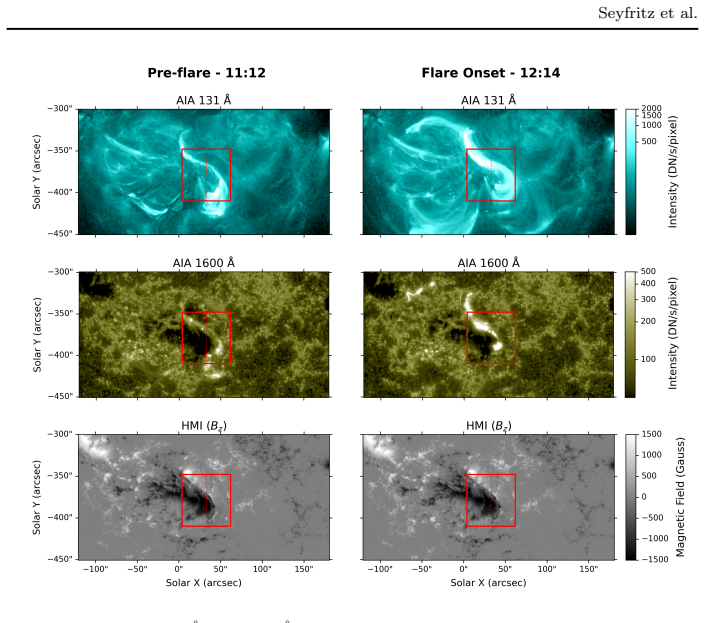
On October 3rd, 2024, the Sun emitted an X9.0-class flare from active region NOAA 13842. The event was recorded by multiple space-based instruments, beginning hours before the eruption, granting a unique opportunity to provide insight into the flare's pre-flare phase. In this study, we employ analysis of Interface Region Imaging Spectrograph (IRIS) spectroscopic data to investigate pre-flaring phenomena associated with this flare. We present time-series and wavelet analysis of non-thermal velocity, Doppler velocity, and line intensity quantities of the IRIS Si IV 1403 angstrom line. We find two ranges of periodic oscillations during the pre-flare phase: ~7-10 min and ~18-21 min oscillations, with local enhancements occurring near the polarity inversion line. We also find a steady rise in Si IV line parameters beginning 3 hours before the flare in the same region, transitioning into strong non-thermal velocities and blueshifts ~15 minutes before onset. These findings are consistent with a slow destabilization of the coronal magnetic field, possibly driven by the gradual activation of a flux rope, followed by a rapid shift to intense reconnection activity leading to flare onset.
Editorial analysis
A structured set of objections, weighed in public.
Referee Report
Summary. The manuscript analyzes IRIS spectroscopic observations of the Si IV 1403 Å line in NOAA AR 13842 prior to the 3 October 2024 X9.0 flare. Time-series and wavelet analysis of non-thermal velocity, Doppler velocity, and intensity reveal 7–10 min and 18–21 min periodicities with local enhancements near the polarity inversion line, plus a gradual rise in these quantities beginning ~3 h before onset that transitions to strong blueshifts and non-thermal velocities ~15 min prior. These signatures are interpreted as evidence for slow coronal magnetic destabilization, possibly driven by gradual flux-rope activation, followed by rapid reconnection.
Significance. If the reported periodicities and velocity trends can be shown to be flare-precursor-specific rather than typical active-region variability, the work would supply useful high-resolution spectroscopic constraints on flare-initiation models. The use of IRIS data on a well-observed X-class event is a clear observational strength; however, the absence of quantitative error bars, spatial-mask definitions, and control comparisons limits the immediate impact.
major comments (2)
- [Abstract] Abstract (and presumably the Discussion section): the claim that the 7–10 min and 18–21 min oscillations plus the 3-hour gradual rise are 'consistent with a slow destabilization of the coronal magnetic field, possibly driven by the gradual activation of a flux rope' rests on an untested assumption of pre-flare specificity. No control analysis (identical wavelet and time-series processing on the same AR hours earlier, on adjacent non-PIL pixels, or on a non-flaring reference interval) is described, leaving open the possibility that the reported periods and trends reflect background active-region variability or post-hoc region selection.
- [Methods] Methods/Results (wavelet analysis of Si IV non-thermal velocity, Doppler shift, and intensity): no error bars, confidence levels, or tests against red-noise null hypotheses are reported for the detected periods. Without these, it is impossible to assess whether the 7–10 min and 18–21 min signals exceed the background power spectrum at a statistically meaningful level.
minor comments (2)
- The abstract states 'local enhancements occurring near the polarity inversion line' but does not specify the exact spatial masks, pixel selection criteria, or area sizes used; these details are needed for reproducibility.
- Consider adding a brief comparison to prior IRIS studies of pre-flare oscillations (e.g., in other X-class events) to place the reported periods in context.
Simulated Author's Rebuttal
We thank the referee for their constructive and detailed review. The comments highlight important areas for strengthening the statistical rigor and specificity of our pre-flare analysis. We have revised the manuscript to incorporate control comparisons and formal statistical testing of the periodicities. Our point-by-point responses follow.
read point-by-point responses
-
Referee: [Abstract] Abstract (and presumably the Discussion section): the claim that the 7–10 min and 18–21 min oscillations plus the 3-hour gradual rise are 'consistent with a slow destabilization of the coronal magnetic field, possibly driven by the gradual activation of a flux rope' rests on an untested assumption of pre-flare specificity. No control analysis (identical wavelet and time-series processing on the same AR hours earlier, on adjacent non-PIL pixels, or on a non-flaring reference interval) is described, leaving open the possibility that the reported periods and trends reflect background active-region variability or post-hoc region selection.
Authors: We agree that demonstrating pre-flare specificity requires explicit controls. In the revised manuscript we have added two control analyses using identical processing: (i) the same active region during a non-flaring interval several hours earlier, and (ii) adjacent non-PIL pixels during the pre-flare window. These show that both the 7–10 min and 18–21 min periodicities and the gradual rise in Si IV parameters are significantly stronger near the PIL and in the hours immediately preceding flare onset than in the controls. The Abstract and Discussion have been updated to present these results and to qualify the interpretation of slow magnetic destabilization. revision: yes
-
Referee: [Methods] Methods/Results (wavelet analysis of Si IV non-thermal velocity, Doppler shift, and intensity): no error bars, confidence levels, or tests against red-noise null hypotheses are reported for the detected periods. Without these, it is impossible to assess whether the 7–10 min and 18–21 min signals exceed the background power spectrum at a statistically meaningful level.
Authors: We thank the referee for this observation. The revised manuscript now includes quantitative error bars on all time-series of non-thermal velocity, Doppler velocity, and intensity. We have re-computed the wavelet spectra following the Torrence & Compo (1998) procedure, which incorporates red-noise background estimation and 95 % confidence contours. The 7–10 min and 18–21 min periods are shown to lie above the red-noise threshold in the pre-flare PIL region. The Methods section has been expanded to describe the error propagation and statistical testing, and the Results section now reports the confidence levels explicitly. revision: yes
Circularity Check
No circularity: purely observational analysis with direct measurements
full rationale
The paper conducts time-series and wavelet analysis directly on IRIS Si IV 1403 Å spectroscopic observations of non-thermal velocity, Doppler shift, and intensity. Reported periods (~7-10 min, ~18-21 min) and trends (3-hour rise, 15-min pre-onset blueshifts) are extracted quantities from the data itself, not outputs of any model equations, fitted parameters, or derivations that reduce back to author-defined inputs. The consistency interpretation with flux-rope destabilization is explicitly framed as an interpretive statement rather than a quantitative prediction. No self-citations, uniqueness theorems, or ansatzes are invoked as load-bearing steps for the central results. The work remains self-contained as an observational report against external solar flare datasets.
Axiom & Free-Parameter Ledger
Lean theorems connected to this paper
-
IndisputableMonolith/Foundation/ArithmeticFromLogic.leanLogicNat recovery; 8-tick period forcing unclearWe find two ranges of periodic oscillations during the pre-flare phase: ~7-10 min and ~18-21 min oscillations... wavelet analysis... Savitzky-Golay filter... global wavelet spectrum
-
IndisputableMonolith/Foundation/ArrowOfTime.leanBerry-phase monotonicity; Z-complexity arrow unclearThese findings are consistent with a slow destabilization of the coronal magnetic field, possibly driven by the gradual activation of a flux rope
Reference graph
Works this paper leans on
-
[1]
Effects on a structured, active region, multi-threaded coronal loop
Coronal energy release by MHD avalanches. Effects on a structured, active region, multi-threaded coronal loop. , keywords =. doi:10.1051/0004-6361/202346689 , archivePrefix =. 2306.06047 , primaryClass =
-
[2]
Solar Atmospheric Heating Due to Small-scale Events in an Emerging Flux Region. , keywords =. doi:10.3847/1538-4357/acfd2b , archivePrefix =. 2309.06452 , primaryClass =
-
[3]
A magnetic avalanche as the central engine powering a solar flare. arXiv e-prints , keywords =. doi:10.48550/arXiv.2503.12235 , archivePrefix =. 2503.12235 , primaryClass =
-
[4]
EUV line emission from a multi-threaded coronal loop
Coronal energy release by MHD avalanches: II. EUV line emission from a multi-threaded coronal loop. , keywords =. doi:10.1051/0004-6361/202450644 , archivePrefix =. 2406.11701 , primaryClass =
-
[5]
Observations and Modelling of the Pre-flare Period of the 29 March 2014 X1 Flare. , keywords =. doi:10.1007/s11207-017-1064-9 , archivePrefix =. 1701.06457 , primaryClass =
-
[6]
Localizing short-period pulsations in hard X-rays and gamma-rays during an X9.0 flare , volume=
Li, Dong , year=. Localizing short-period pulsations in hard X-rays and gamma-rays during an X9.0 flare , volume=. doi:10.1051/0004-6361/202453613 , journal=
-
[7]
Multiwavelength Observations of the Precursors Before the Eruptive X4.9 Limb Solar Flare on 25 February, 2014: Current Sheet, Eruptive Filament, Flare and Eruption Onset in the Frame of the Tether-Cutting Magnetic Reconnection Scenario. arXiv e-prints , keywords =. doi:10.48550/arXiv.2504.15097 , archivePrefix =. 2504.15097 , primaryClass =
-
[8]
Fan, Yuhong and Kazachenko, Maria D. and Afanasyev, Andrey N. and Fisher, George H. , title =. 2024 , month =. doi:10.3847/1538-4357/ad7f53 , url =
-
[9]
N. L. S. Jeffrey and L. Fletcher and N. Labrosse and P. J. A. Simões , title =. Science Advances , volume =. 2018 , doi =. https://www.science.org/doi/pdf/10.1126/sciadv.aav2794 , abstract =
-
[10]
Monthly Notices of the Royal Astronomical Society , volume =
French, Ryan J and Yu, Sijie and Chen, Bin and Shen, Chengcai and Matthews, Sarah A , title =. Monthly Notices of the Royal Astronomical Society , volume =. 2024 , month =. doi:10.1093/mnras/stae430 , url =
-
[11]
French, Ryan J. and Hayes, Laura A. and Kazachenko, Maria D. and Reeves, Katharine K. and Shen, Chengcai and Lörinčík, Juraj , title =. The Astrophysical Journal , abstract =. 2024 , month =. doi:10.3847/1538-4357/ad8ed1 , url =
-
[12]
Dominique, M. and Zhukov, A. N. and Dolla, L. and Inglis, A. and Lapenta, G. , title =. Solar Physics , volume =. 2018 , doi =
work page 2018
-
[13]
Exploring impulsive solar magnetic energy release and particle acceleration with focused hard X-ray imaging spectroscopy , author=. 2017 , eprint=
work page 2017
-
[14]
Finding the Critical Decay Index in Solar Prominence Eruptions. , keywords =. doi:10.3847/1538-4357/ab4793 , archivePrefix =. 1909.10442 , primaryClass =
-
[15]
Christopher Torrence and Gilbert P. Compo. A Practical Guide to Wavelet Analysis. Bulletin of the American Meteorological Society. 1998. doi:10.1175/1520-0477(1998)079<0061:APGTWA>2.0.CO;2
-
[16]
Janvier, M. and Aulanier, G. and Bommier, V. and Schmieder, B. and Démoulin, P. and Pariat, E. , year=. ELECTRIC CURRENTS IN FLARE RIBBONS: OBSERVATIONS AND THREE-DIMENSIONAL STANDARD MODEL , volume=. The Astrophysical Journal , publisher=. doi:10.1088/0004-637x/788/1/60 , number=
-
[17]
The Location of Non-thermal Velocity in the Early Phases of Large Flares Revealing Pre-eruption Flux Ropes. , keywords =. doi:10.1088/0004-637X/774/2/122 , adsurl =
-
[18]
Srivastava, Abhishek Kumar and Shetye, Juie and Murawski, Krzysztof and Doyle, John Gerard and Stangalini, Marco and Scullion, Eamon and Ray, Tom and Wójcik, Dariusz Patryk and Dwivedi, Bhola N. , title =. Scientific Reports , year =. doi:10.1038/srep43147 , url =
-
[19]
Flare Loop Radiative Hydrodynamics. VI. Chromospheric Evaporation due to Heating by Nonthermal Electrons. , year = 1985, month = feb, volume =. doi:10.1086/162902 , adsurl =
-
[20]
Multi-episode Chromospheric Evaporation Observed in a Solar Flare. , keywords =. doi:10.3847/1538-4357/aab15a , archivePrefix =. 1801.04370 , primaryClass =
-
[21]
Kerr, Graham S. , TITLE=. Frontiers in Astronomy and Space Sciences , VOLUME=. 2023 , URL=. doi:10.3389/fspas.2022.1060862 , ISSN=
-
[22]
Multiwavelength Studies of MHD Waves in the Solar Chromosphere. An Overview of Recent Results. Ssr , keywords =. doi:10.1007/s11214-015-0141-3 , archivePrefix =. 1503.01769 , primaryClass =
-
[23]
An Introduction with Problems and Solutions (2nd edition)
Physics of the Solar Corona. An Introduction with Problems and Solutions (2nd edition). doi:10.1007/3-540-30766-4 , adsurl =
-
[24]
Li, Y. and Sun, X. and Ding, M. D. and Qiu, J. and Priest, E. R. , title =. The Astrophysical Journal , volume =. 2017 , doi =
work page 2017
-
[25]
De Pontieu, B. and Title, A. M. and Lemen, J. R. and Kushner, G. D. and Akin, D. J. and Allard, B. and Berger, T. and Boerner, P. and Cheung, M. and Chou, C. and others , title =. Solar Physics , volume =. 2014 , doi =
work page 2014
-
[26]
Lemen, J. R. and Title, A. M. and Akin, D. J. and Boerner, P. F. and Chou, C. and Drake, J. F. and Duncan, D. W. and Edwards, C. G. and Friedlaender, F. M. and Heyman, G. F. and others , title =. Solar Physics , volume =. 2012 , doi =
work page 2012
-
[27]
Observational aspects of sunspot oscillations. Philosophical Transactions of the Royal Society of London Series A , year = 2006, month = feb, volume =. doi:10.1098/rsta.2005.1701 , adsurl =
-
[28]
Schou, J. and Scherrer, P. H. and Bush, R. I. and Wachter, R. and Couvidat, S. and Rabello-Soares, M. C. and Bogart, R. S. and Hoeksema, J. T. and Liu, Y. and Duvall, T. L. and others , title =. Solar Physics , volume =. 2012 , doi =
work page 2012
-
[29]
Garcia, H. A. , title =. Solar Physics , volume =. 1994 , doi =
work page 1994
-
[30]
Analytical Chemistry , volume=
Smoothing and differentiation of data by simplified least squares procedures , author=. Analytical Chemistry , volume=. 1964 , publisher=
work page 1964
-
[31]
Initial Calibration of the Atmospheric Imaging Assembly (AIA) on the Solar Dynamics Observatory (SDO). , keywords =. doi:10.1007/s11207-011-9804-8 , adsurl =
- [32]
-
[33]
Onset of the Magnetic Explosion in Solar Flares and Coronal Mass Ejections. , keywords =. doi:10.1086/320559 , adsurl =
-
[34]
Magnetic Flux Cancellation as the Trigger Mechanism of Solar Coronal Jets. , keywords =. doi:10.3847/1538-4357/ab2fe3 , archivePrefix =. 1906.06452 , primaryClass =
-
[35]
Velocity Characteristics of Evaporated Plasma Using Hinode/EUV Imaging Spectrometer. , keywords =. doi:10.1088/0004-637X/699/2/968 , archivePrefix =. 0905.1669 , primaryClass =
-
[36]
Properties of a Solar Flare Kernel Observed by Hinode and SDO. , keywords =. doi:10.1088/0004-637X/766/2/127 , archivePrefix =. 1212.4388 , primaryClass =
-
[37]
Quasi-Periodic Pulsations in Solar Flares. Ssr , keywords =. doi:10.1007/s11214-009-9536-3 , adsurl =
-
[38]
A Database of Flare Ribbon Properties from the Solar Dynamics Observatory. I. Reconnection Flux. , archivePrefix = "arXiv", eprint =. doi:10.3847/1538-4357/aa7ed6 , adsurl =
-
[39]
NASA Special Publication , year = 1964, volume = 50, pages =
A Process for Flares. NASA Special Publication , year = 1964, volume = 50, pages =
work page 1964
-
[40]
Nat , year = 1966, month = aug, volume =
Model of the High-Energy Phase of Solar Flares. Nat , year = 1966, month = aug, volume =. doi:10.1038/211695a0 , adsurl =
-
[41]
Theoretical Model of Flares and Prominences. I: Evaporating Flare Model. Sol Phys , keywords =. doi:10.1007/BF00153671 , adsurl =
-
[42]
Magnetic reconnection in the corona and the loop prominence phenomenon. Sol Phys , keywords =. doi:10.1007/BF00206193 , adsurl =
-
[43]
The Atmospheric Response to Large Electron Beam Fluxes in Solar Flares III: Comprehensive Modeling of the Brightest Observed Near-Ultraviolet Continuum Source in an X9 Solar Flare. arXiv e-prints , keywords =. doi:10.48550/arXiv.2511.11915 , archivePrefix =. 2511.11915 , primaryClass =
-
[44]
Dual Origins of Rapid Flare Ribbon Downflows in an X9-class Solar Flare. , keywords =. doi:10.3847/1538-4357/ae21b5 , archivePrefix =. 2511.13862 , primaryClass =
-
[45]
The magnetic nature of solar flares. Aapr , year = 2002, month = jan, volume =. doi:10.1007/s001590100013 , adsurl =
-
[46]
An Observational Overview of Solar Flares. Ssr , archivePrefix = "arXiv", eprint =. doi:10.1007/s11214-010-9701-8 , adsurl =
-
[47]
SDO/AIA response to coronal hole, quiet Sun, active region, and flare plasma , DOI= "10.1051/0004-6361/201014872", url= "https://doi.org/10.1051/0004-6361/201014872", journal =
-
[48]
Living Reviews in Solar Physics , keywords =
Flare Observations. Living Reviews in Solar Physics , keywords =. doi:10.12942/lrsp-2008-1 , adsurl =
-
[49]
, archivePrefix = "arXiv", eprint =
Implications of X-ray Observations for Electron Acceleration and Propagation in Solar Flares. , archivePrefix = "arXiv", eprint =. doi:10.1007/s11214-010-9680-9 , adsurl =
-
[50]
High-resolution observations of flare precursors in the low solar atmosphere. Nature Astronomy , keywords =. doi:10.1038/s41550-017-0085 , archivePrefix =. 1703.09866 , primaryClass =
-
[51]
Pre-flare Activity and Magnetic Reconnection during the Evolutionary Stages of Energy Release in a Solar Eruptive Flare. , keywords =. doi:10.1088/0004-637X/743/2/195 , archivePrefix =. 1109.3415 , primaryClass =
-
[52]
Joint High Temperature Observation of a Small C6.5 Solar Flare With Iris/Eis/Aia. , keywords =. doi:10.1088/0004-637X/803/2/84 , adsurl =
-
[53]
Impulsive Phase Flare Energy Transport by Large-Scale Alfv \'e n Waves and the Electron Acceleration Problem. , keywords =. doi:10.1086/527044 , archivePrefix =. 0712.3452 , primaryClass =
-
[54]
Relationship Between Hard and Soft X-ray Emission Components of a Solar Flare. , keywords =. doi:10.1088/0004-637X/728/1/4 , archivePrefix =. 1012.4346 , primaryClass =
-
[55]
and Roumeliotis, George , pages=
Moore, Ronald L. and Roumeliotis, George , pages=. Triggering of eruptive flares: Destabilization of the preflare magnetic field configuration , DOI=. Lecture Notes in Physics Eruptive Solar Flares ,year=
-
[56]
Li, Ting and Yang, Kai and Hou, Yijun and Zhang, Jun , year=. SLIPPING MAGNETIC RECONNECTION OF FLUX-ROPE STRUCTURES AS A PRECURSOR TO AN ERUPTIVE X-CLASS SOLAR FLARE , volume=. The Astrophysical Journal , publisher=. doi:10.3847/0004-637x/830/2/152 , number=
-
[57]
Plasma Physics and Controlled Fusion , archivePrefix = "arXiv", eprint =
Oscillatory processes in solar flares. Plasma Physics and Controlled Fusion , archivePrefix = "arXiv", eprint =. doi:10.1088/0741-3335/52/12/124009 , adsurl =
-
[58]
Hayes, Laura A. and Inglis, Andrew R. and Christe, Steven and Dennis, Brian and Gallagher, Peter T. , title =. 2020 , month =. doi:10.3847/1538-4357/ab8d40 , url =
-
[59]
Quasi-Periodic Pulsations in Solar and Stellar Flares: A Review of Underpinning Physical Mechanisms and Their Predicted Observational Signatures. , keywords =. doi:10.1007/s11214-021-00840-9 , adsurl =
-
[60]
The Solar Dynamics Observatory (SDO). , keywords =. doi:10.1007/s11207-011-9841-3 , adsurl =
-
[61]
Relationship between wave processes in sunspots and quasi-periodic pulsations in active region flares , DOI= "10.1051/0004-6361/200912132", url= "https://doi.org/10.1051/0004-6361/200912132", journal =
-
[62]
Very Long-period Pulsations before the Onset of Solar Flares. , keywords =. doi:10.3847/1538-4357/833/2/206 , archivePrefix =. 1610.09291 , primaryClass =
-
[63]
Preflare very long-periodic pulsations observed in Hα emission before the onset of a solar flare⋆ , DOI= "10.1051/0004-6361/202038398", url= "https://doi.org/10.1051/0004-6361/202038398", journal =
-
[64]
Decaying and decayless transverse oscillations of a coronal loop. , keywords =. doi:10.1051/0004-6361/201220676 , adsurl =
-
[65]
Systematic non-thermal velocity increase preceding soft X-ray flare onset. arXiv e-prints , keywords =. doi:10.48550/arXiv.2506.15921 , archivePrefix =. 2506.15921 , primaryClass =
-
[66]
X-ray precursors to flares and filament eruptions. , keywords =. doi:10.1051/0004-6361:20077771 , adsurl =
-
[67]
Particle heating and acceleration by reconnecting and nonreconnecting current sheets , DOI= "10.1051/0004-6361/202141361", url= "https://doi.org/10.1051/0004-6361/202141361", journal =
-
[68]
The EUV Imaging Spectrometer for Hinode. , keywords =. doi:10.1007/s01007-007-0293-1 , adsurl =
-
[69]
Long-period oscillations in the lower solar atmosphere prior to flare events , DOI= "10.1051/0004-6361/202348606", url= "https://doi.org/10.1051/0004-6361/202348606", journal =
-
[70]
The Astrophysical Journal , volume =
Matsumoto, Keitarou and Inoue, Satoshi and Hayashi, Keiji and Liu, Nian and Wang, Ying and Lee, Jeongwoo and Jing, Ju and Wang, Haimin , title =. The Astrophysical Journal , volume =. 2025 , doi =
work page 2025
-
[71]
Large-scale Coronal Dimming Foreshadowing a Solar Eruption on 2011 October 1. , keywords =. doi:10.3847/1538-4357/ad1603 , adsurl =
-
[72]
The role of filament activation in a solar eruption , DOI= "10.1051/0004-6361/201116895", url= "https://doi.org/10.1051/0004-6361/201116895", journal =
-
[73]
Kontar, E. P. and Hannah, I. G. and Bian, N. H. , title =. 2011 , month =. doi:10.1088/2041-8205/730/2/L22 , url =
-
[74]
Harra, L. K. and Williams, D. R. and Wallace, A. J. and Magara, T. and Hara, H. and Tsuneta, S. and Sterling, A. C. and Doschek, G. A. , title =. 2009 , month =. doi:10.1088/0004-637X/691/2/L99 , url =
-
[75]
Pre-Flare Flows in the Corona. , keywords =. doi:10.1007/s11207-010-9661-x , adsurl =
-
[76]
Stores, Morgan and Jeffrey, Natasha L. S. and Kontar, Eduard P. , title =. 2021 , month =. doi:10.3847/1538-4357/ac2c65 , url =
-
[77]
Publications of the Astronomical Society of Japan , volume =
Imada, Shinsuke and Bamba, Yumi and Kusano, Kanya , title =. Publications of the Astronomical Society of Japan , volume =. 2014 , month =. doi:10.1093/pasj/psu092 , url =
-
[78]
Bamba, Yumi and Lee, Kyoung-Sun and Imada, Shinsuke and Kusano, Kanya , title =. 2017 , month =. doi:10.3847/1538-4357/aa6dfe , url =
-
[79]
and Dominguez, Santiago Vargas and Kosovichev, Alexander G
Sadykov, Viacheslav M. and Dominguez, Santiago Vargas and Kosovichev, Alexander G. and Sharykin, Ivan N. and Struminsky, Alexei B. and Zimovets, Ivan , title =. 2015 , month =. doi:10.1088/0004-637X/805/2/167 , url =
-
[80]
Pulsating X-ray Precursors of a Powerful Solar Flare: Evidence of Quasi-Periodic Reconnection Leading to a Flux-Rope Eruption. Cosmic Research , keywords =. doi:10.1134/S0010952525601343 , adsurl =
discussion (0)
Sign in with ORCID, Apple, or X to comment. Anyone can read and Pith papers without signing in.