Recognition: no theorem link
Constraining the Galactic bar using the M92 stellar stream
Pith reviewed 2026-05-11 03:31 UTC · model grok-4.3
The pith
The M92 stellar stream constrains the Milky Way bar's pattern speed to 29.1 km s^{-1} kpc^{-1}.
A machine-rendered reading of the paper's core claim, the machinery that carries it, and where it could break.
Core claim
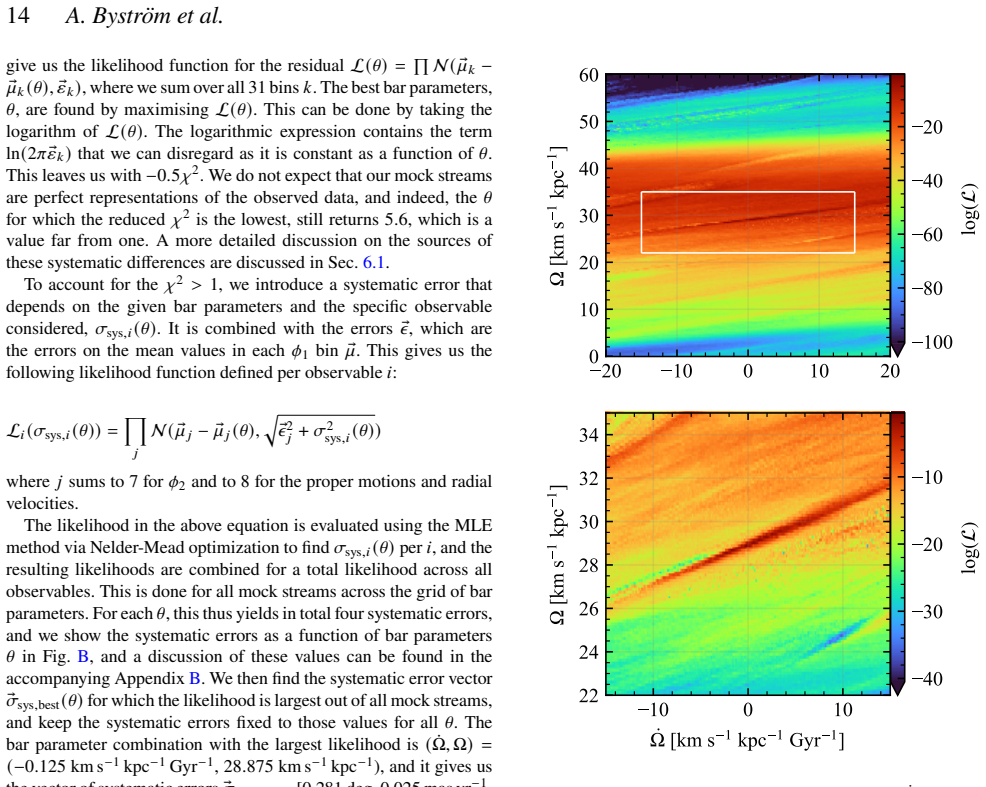
The M92 stream's observed spatial and kinematic properties are best matched by mock streams evolved in a Milky Way potential with a bar pattern speed of Ω = 29.1^{+0.7}_{-0.4} km s^{-1} kpc^{-1} and a time derivative Ω̇ = 0.7^{+3.5}_{-2.3} km s^{-1} kpc^{-1} Gyr^{-1}. This inference is obtained through probabilistic comparison of the stream data to simulations in different barred models, establishing stellar streams as viable probes for bar properties.
What carries the argument
Probabilistic matching of observed M92 stream members to mock streams simulated in barred galactic potentials with varying pattern speeds.
Load-bearing premise
The mock streams accurately represent the real M92 stream's evolution under the influence of the galactic bar's time-dependent potential.
What would settle it
If additional observations reveal that the stream's velocity gradients or spatial extent deviate significantly from those predicted by the best-fit bar model, the estimated pattern speed would be invalidated.
Figures




read the original abstract
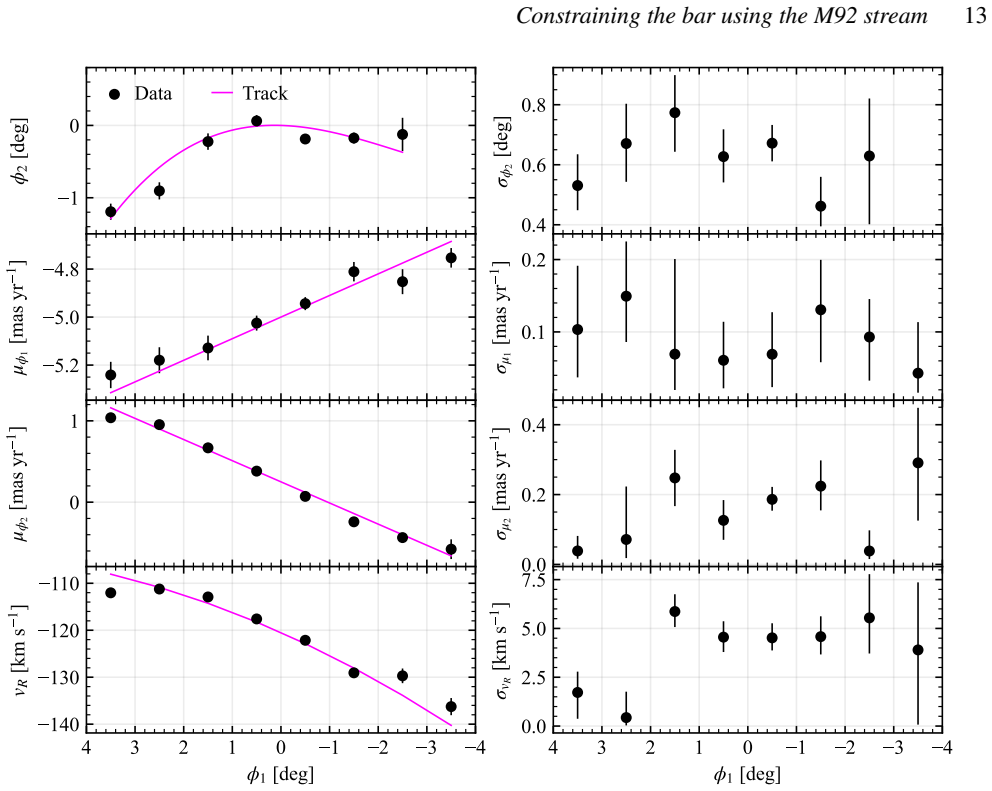
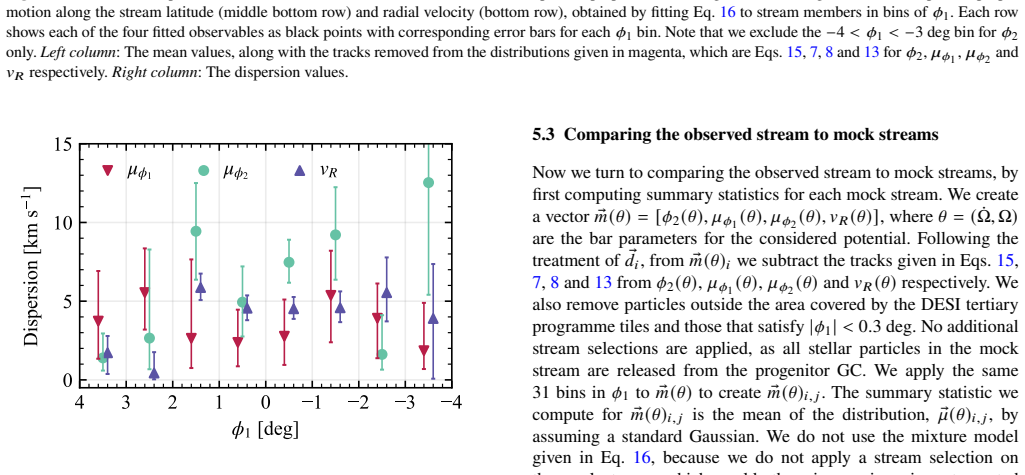
Stellar streams are excellent probes of the gravitational potential in which they evolve. In the Milky Way (MW), globular cluster (GC) streams are routinely used to infer properties about time-dependent perturbations of the underlying potential. This implies that streams with Galactocentric radii small enough to be perturbed by the MW bar should offer constraints on it, such as its pattern speed, which currently has a wide range of values reported in the literature and is important when studying stellar kinematics. The GC M92 has a small pericentre and should be affected by the bar. It has a diffuse stellar stream, but confirming stream members has previously been hindered by a lack of spectroscopic data. In this paper, we use Dark Energy Spectroscopic Instrument (DESI) observations together with photometric and astrometric data to obtain spectroscopic members of the M92 stream for the first time. We identify a clear spatial distribution and gradients in distance moduli, proper motions, and radial velocities that confirm the stream's existence. We compare the observed stream to mock streams generated in different barred potentials and estimate the MW bar's pattern speed $\Omega = 29.1^{+0.7}_{-0.4}$ km s$^{-1}$ kpc$^{-1}$ and $\dot \Omega = 0.7^{+3.5}_{-2.3}$ km s$^{-1}$ kpc$^{-1}$ Gyr$^{-1}$. This is the first time a stellar stream is used to probabilistically infer these bar properties, and it opens up an exciting realm of inner Galactic potential characterisation using stellar streams.
Editorial analysis
A structured set of objections, weighed in public.
Referee Report
Summary. The paper reports the first spectroscopic confirmation of the M92 globular cluster stellar stream using DESI observations combined with photometric and astrometric data. It identifies a clear spatial distribution along with gradients in distance moduli, proper motions, and radial velocities. By generating and comparing mock streams evolved in different barred Galactic potentials to the observed data, the authors derive constraints on the Milky Way bar pattern speed of Ω = 29.1^{+0.7}_{-0.4} km s^{-1} kpc^{-1} and its derivative dot{Ω} = 0.7^{+3.5}_{-2.3} km s^{-1} kpc^{-1} Gyr^{-1}, presenting this as the first probabilistic inference of these bar properties from a stellar stream.
Significance. If the modeling assumptions hold, this work provides a novel and potentially powerful method for constraining the time-dependent inner Milky Way potential using stellar streams, which could help reconcile the wide range of bar pattern speed values reported in the literature from other techniques. The approach is extensible to other inner-Galaxy streams and represents a clear methodological advance, with the narrow uncertainty on Ω being a notable outcome of the probabilistic comparison.
major comments (2)
- [Mock stream generation and fitting] Mock stream generation (methods section): the inference of Ω and dot{Ω} is obtained by fitting mock streams evolved in barred potentials where bar shape, mass, orientation, and functional form are held fixed from literature values while only Ω and dot{Ω} are varied. No sensitivity tests or variations of these fixed parameters are shown; a mismatch between the assumed bar model and reality could systematically bias the recovered Ω value and its quoted 1σ interval, which is load-bearing for the central claim.
- [Data selection] Data selection and member identification (results section): the criteria used to select DESI spectroscopic members, including any cuts on radial velocity, proper motion, or metallicity, and quantitative estimates of contamination or completeness, are not presented in sufficient detail to assess whether the reported gradients could be affected by selection effects or interlopers.
minor comments (3)
- [Abstract] The abstract states that mock streams were generated in 'different barred potentials' but does not specify the number of models, the exact parameter variations, or the bar potential functional form employed.
- [Notation] Notation for the pattern speed derivative is inconsistent between the abstract (dot{Ω}) and the reported value; a uniform symbol should be used throughout.
- [Methods] The paper would benefit from an explicit statement of the assumed bar mass and orientation values taken from the literature in the mock generation.
Simulated Author's Rebuttal
We thank the referee for their constructive comments and positive assessment of the significance of our work. We address each major comment below and are prepared to revise the manuscript accordingly.
read point-by-point responses
-
Referee: [Mock stream generation and fitting] Mock stream generation (methods section): the inference of Ω and dot{Ω} is obtained by fitting mock streams evolved in barred potentials where bar shape, mass, orientation, and functional form are held fixed from literature values while only Ω and dot{Ω} are varied. No sensitivity tests or variations of these fixed parameters are shown; a mismatch between the assumed bar model and reality could systematically bias the recovered Ω value and its quoted 1σ interval, which is load-bearing for the central claim.
Authors: We thank the referee for this important observation. Our analysis deliberately fixed the bar shape, mass, orientation, and functional form to standard literature values in order to isolate the constraints on pattern speed Ω and its time derivative, which are the quantities of primary interest for probing the time-dependent inner potential. We agree, however, that the absence of sensitivity tests leaves open the possibility of systematic bias in the reported Ω interval if the adopted bar model differs from reality. In the revised manuscript we will add an appendix (or expanded methods subsection) presenting results from additional mock-stream runs in which bar mass and shape are varied within published ranges; we will quantify the resulting shifts in the recovered Ω posterior and discuss the robustness of our central value. revision: yes
-
Referee: [Data selection] Data selection and member identification (results section): the criteria used to select DESI spectroscopic members, including any cuts on radial velocity, proper motion, or metallicity, and quantitative estimates of contamination or completeness, are not presented in sufficient detail to assess whether the reported gradients could be affected by selection effects or interlopers.
Authors: We agree that the current description of the spectroscopic member selection is insufficient for full reproducibility and for evaluating possible selection biases. In the revised results section we will provide the precise numerical cuts applied to the DESI data (radial velocity, proper-motion, metallicity, and any additional quality or photometric criteria), together with quantitative estimates of contamination (e.g., expected field-star or interloper fractions derived from control fields or statistical modeling) and completeness (e.g., recovery rates from injected mock members). These additions will allow readers to assess whether the reported spatial and kinematic gradients are robust against selection effects. revision: yes
Circularity Check
No significant circularity; inference is data-driven fitting of bar parameters
full rationale
The derivation proceeds by identifying M92 stream members via DESI spectroscopy plus photometry/astrometry, then generating mock streams in barred potentials and performing probabilistic comparison to constrain Ω and dotΩ. This is a standard parameter inference step whose output values are not equivalent to the inputs by construction; the mocks are forward models, not tautological rearrangements of the data. No load-bearing self-citations, uniqueness theorems, or ansatzes imported from prior author work are invoked to force the result. The central claim remains an empirical constraint whose validity rests on the fidelity of the mock generation rather than definitional equivalence.
Axiom & Free-Parameter Ledger
free parameters (2)
- bar pattern speed Ω
- bar pattern speed derivative dot{Ω}
axioms (2)
- domain assumption The gravitational potential can be decomposed into a time-dependent barred component plus a static axisymmetric background.
- domain assumption Identified spectroscopic members accurately trace the true stream orbit without significant contamination.
Reference graph
Works this paper leans on
-
[1]
BV Photometry of RR Lyrae Variables in the Globular Cluster M92. , keywords =. doi:10.1086/132956 , adsurl =
-
[2]
Gaia EDR3 view on galactic globular clusters. , keywords =. doi:10.1093/mnras/stab1475 , archivePrefix =. 2102.09568 , primaryClass =
-
[3]
Astropy: A community Python package for astronomy. , keywords =. doi:10.1051/0004-6361/201322068 , archivePrefix =. 1307.6212 , primaryClass =
-
[4]
The Astronomical Journal , author =
The Astropy Project: Building an Open-science Project and Status of the v2.0 Core Package. , keywords =. doi:10.3847/1538-3881/aabc4f , archivePrefix =. 1801.02634 , primaryClass =
-
[5]
The Astropy Project: Sustaining and Growing a Community-oriented Open-source Project and the Latest Major Release (v5.0) of the Core Package. , keywords =. doi:10.3847/1538-4357/ac7c74 , archivePrefix =. 2206.14220 , primaryClass =
work page internal anchor Pith review Pith/arXiv arXiv doi:10.3847/1538-4357/ac7c74
-
[6]
Charles R. Harris and K. Jarrod Millman and St. Array programming with. 2020 , month = sep, journal =. doi:10.1038/s41586-020-2649-2 , publisher =
-
[7]
Adrian M. Price-Whelan , title =. doi:10.21105/joss.00388 , url =
-
[8]
Adrian Price-Whelan and Brigitta Sipőcz and Daniel Lenz and Johnny Greco and Nathaniel Starkman and Dan Foreman-Mackey and P. L. Lim and Semyeong Oh and Sergey Koposov and Syrtis Major , title =. doi:10.5281/zenodo.4159870 , url =
-
[9]
Eric Jones and Travis Oliphant and Pearu Peterson and others , title =
-
[10]
Virtanen, Pauli and Gommers, Ralf and Oliphant, Travis E. and Haberland, Matt and Reddy, Tyler and Cournapeau, David and Burovski, Evgeni and Peterson, Pearu and Weckesser, Warren and Bright, Jonathan and. Nature Methods , year =
-
[11]
C., Varoquaux G., 2011, @doi [Computing in Science Engineering] 10.1109/MCSE.2011.37 , 13, 22
The NumPy Array: A Structure for Efficient Numerical Computation. Computing in Science and Engineering , keywords =. doi:10.1109/MCSE.2011.37 , archivePrefix =. 1102.1523 , primaryClass =
-
[12]
D., 2007, @doi [Computing in Science Engineering] 10.1109/MCSE.2007.55 , 9, 90
Matplotlib: A 2D Graphics Environment. Computing in Science and Engineering , keywords =. doi:10.1109/MCSE.2007.55 , adsurl =
-
[13]
Constraining the Milky Way Potential with a Six-Dimensional Phase-Space Map of the GD-1 Stellar Stream. , keywords =. doi:10.1088/0004-637X/712/1/260 , archivePrefix =. 0907.1085 , primaryClass =
-
[14]
Broken into Pieces: ATLAS and Aliqa Uma as One Single Stream. , keywords =. doi:10.3847/1538-4357/abeb18 , archivePrefix =. 2006.10763 , primaryClass =
-
[15]
The Astrophysical Journal , volume=
The field of streams: Sagittarius and its siblings , author=. The Astrophysical Journal , volume=. 2006 , publisher=
work page 2006
-
[16]
Martin and Nick Kaiser and Klaus Hodapp and Kenneth C
Nina Hernitschek and Branimir Sesar and Hans-Walter Rix and Vasily Belokurov and David Martinez-Delgado and Nicolas F. Martin and Nick Kaiser and Klaus Hodapp and Kenneth C. Chambers and Richard Wainscoat and Eugene Magnier and Rolf-Peter Kudritzki and Nigel Metcalfe and Peter W. Draper , title =. 2017 , month =. doi:10.3847/1538-4357/aa960c , url =
-
[17]
Charting the Galactic Acceleration Field. I. A Search for Stellar Streams with Gaia DR2 and EDR3 with Follow-up from ESPaDOnS and UVES. , keywords =. doi:10.3847/1538-4357/abfcc2 , archivePrefix =. 2012.05245 , primaryClass =
-
[18]
A deeper look at the GD1 stream: density variations and wiggles. , keywords =. doi:10.1093/mnras/sty677 , archivePrefix =. 1801.08948 , primaryClass =
-
[19]
S ^ 5 : The Orbital and Chemical Properties of One Dozen Stellar Streams. , keywords =. doi:10.3847/1538-4357/ac46d3 , archivePrefix =. 2110.06950 , primaryClass =
-
[20]
Exploring the interaction between the MW and LMC with a large sample of blue horizontal branch stars from the DESI survey. , keywords =. doi:10.1093/mnras/staf1219 , archivePrefix =. 2410.09149 , primaryClass =
-
[21]
The Hidden Past of M92: Detection and Characterization of a Newly Formed 17 Long Stellar Stream Using the Canada-France Imaging Survey. , keywords =. doi:10.3847/1538-4357/abb6f7 , archivePrefix =. 2009.04487 , primaryClass =
-
[22]
Mean proper motions, space orbits, and velocity dispersion profiles of Galactic globular clusters derived from Gaia DR2 data. , keywords =. doi:10.1093/mnras/sty2997 , archivePrefix =. 1811.01507 , primaryClass =
-
[23]
Intrinsic iron spread and a new metallicity scale for globular clusters. , keywords =. doi:10.1051/0004-6361/200913003 , archivePrefix =. 0910.0675 , primaryClass =
-
[24]
The eye of Gaia on globular clusters structure: tidal tails. , keywords =. doi:10.1093/mnras/staa1209 , archivePrefix =. 2004.13754 , primaryClass =
-
[25]
Testing kinematic distances under a realistic Galactic potential: Investigating systematic errors in the kinematic distance method arising from a non-axisymmetric potential. , keywords =. doi:10.1051/0004-6361/202450000 , archivePrefix =. 2403.18000 , primaryClass =
-
[26]
2019, MNRAS, 482, 1525, doi: 10.1093/mnras/sty2672
AGAMA: action-based galaxy modelling architecture. , keywords =. doi:10.1093/mnras/sty2672 , archivePrefix =. 1802.08239 , primaryClass =
-
[27]
2017, MNRAS, 465, 1621, doi: 10.1093/mnras/stw2819
Dynamical modelling of the galactic bulge and bar: the Milky Way's pattern speed, stellar and dark matter mass distribution. , keywords =. doi:10.1093/mnras/stw2819 , archivePrefix =. 1608.07954 , primaryClass =
-
[28]
2022b, MNRAS, 514, L1, doi: 10.1093/mnrasl/slac046
The stellar mass distribution of the Milky Way's bar: an analytical model. , keywords =. doi:10.1093/mnrasl/slac046 , archivePrefix =. 2204.13114 , primaryClass =
-
[29]
Rotation Curve of the Milky Way from Classical Cepheids. , keywords =. doi:10.3847/2041-8213/aaf73f , archivePrefix =. 1810.02131 , primaryClass =
-
[30]
The Circular Velocity Curve of the Milky Way from 5 to 25 kpc. , keywords =. doi:10.3847/1538-4357/aaf648 , archivePrefix =. 1810.09466 , primaryClass =
-
[31]
Weighing the Galactic disk using phase-space spirals. III. Probing distant regions of the disk using the Gaia EDR3 proper motion sample. , keywords =. doi:10.1051/0004-6361/202142819 , archivePrefix =. 2111.13707 , primaryClass =
-
[32]
2013, ApJ, 779, 115, doi: 10.1088/0004-637X/779/2/115 Chanam´ e, J., Kleyna, J., & van der Marel, R
A Direct Dynamical Measurement of the Milky Way's Disk Surface Density Profile, Disk Scale Length, and Dark Matter Profile at 4 kpc < -0.5ex R < -0.5ex 9 kpc. , keywords =. doi:10.1088/0004-637X/779/2/115 , archivePrefix =. 1309.0809 , primaryClass =
-
[33]
Milky Way dynamics in light of Gaia. , keywords =. doi:10.1016/j.newar.2024.101721 , archivePrefix =. 2501.04075 , primaryClass =
-
[34]
Improved Particle Spray Algorithm for Modeling Globular Cluster Streams. , keywords =. doi:10.3847/1538-4365/ad9904 , archivePrefix =. 2408.01496 , primaryClass =
-
[35]
Monthly Notices of the Royal Astronomical Society , author =
A catalogue of masses, structural parameters, and velocity dispersion profiles of 112 Milky Way globular clusters. , keywords =. doi:10.1093/mnras/sty1057 , archivePrefix =. 1804.08359 , primaryClass =
-
[36]
S ^ 5 : Probing the Milky Way and Magellanic Clouds potentials with the 6D map of the Orphan-Chenab stream. , keywords =. doi:10.1093/mnras/stad551 , archivePrefix =. 2211.04495 , primaryClass =
-
[37]
dynesty: a dynamic nested sampling package for estimating Bayesian posteriors and evidences
DYNESTY: a dynamic nested sampling package for estimating Bayesian posteriors and evidences. , keywords =. doi:10.1093/mnras/staa278 , archivePrefix =. 1904.02180 , primaryClass =
-
[38]
doi:10.5281/zenodo.12537467 , version =
joshspeagle/dynesty: v2.1.4. doi:10.5281/zenodo.12537467 , version =
-
[39]
Nested Sampling. Bayesian Inference and Maximum Entropy Methods in Science and Engineering: 24th International Workshop on Bayesian Inference and Maximum Entropy Methods in Science and Engineering , year = 2004, editor =. doi:10.1063/1.1835238 , adsurl =
-
[40]
Nested sampling for general. Bayesian Analysis , author =. 2006 , note =. doi:10.1214/06-BA127 , abstract =
-
[41]
Dynamic nested sampling: an improved algorithm for parameter estimation and evidence calculation , volume =. Statistics and Computing , author =. 2019 , pages =. doi:10.1007/s11222-018-9844-0 , abstract =
-
[42]
ESCARGOT: Mapping Vertical Phase Spiral Characteristics Throughout the Real and Simulated Milky Way. , keywords =. doi:10.3847/1538-4357/acf1fc , archivePrefix =. 2302.09086 , primaryClass =
-
[43]
Price-Whelan, Adrian and Souchereau, Harrison and Wagg, Tom and Sipőcz, Brigitta and Starkman, Nathaniel and Chen, Yingtian and Lilleengen, Sophia and. adrn/gala: v1.9.1 , url =. 2024 , doi =
work page 2024
-
[44]
The Southern clusters and overview
Homogeneous analysis of globular clusters from the APOGEE survey with the BACCHUS code - II. The Southern clusters and overview. , keywords =. doi:10.1093/mnras/stz3496 , archivePrefix =. 1912.04839 , primaryClass =
-
[45]
Was the progenitor of the Sagittarius stream a disc galaxy?. , keywords =. doi:10.1111/j.1745-3933.2010.00921.x , archivePrefix =. 1007.1485 , primaryClass =
-
[46]
Implementing the Nelder-Mead simplex algorithm with adaptive parameters , volume =
Gao, Fuchang and Han, Lixing , year =. Implementing the Nelder-Mead simplex algorithm with adaptive parameters , volume =. Computational Optimization and Applications , doi =
-
[47]
galstreams: A library of Milky Way stellar stream footprints and tracks. , keywords =. doi:10.1093/mnras/stad321 , archivePrefix =. 2204.10326 , primaryClass =
-
[48]
Stellar streams in the Gaia era. , keywords =. doi:10.1016/j.newar.2024.101713 , archivePrefix =. 2405.19410 , primaryClass =
-
[49]
Insights into Pre-enrichment of Star Clusters and Self-enrichment of Dwarf Galaxies from Their Intrinsic Metallicity Dispersions. , keywords =. doi:10.1088/0004-6256/144/6/183 , archivePrefix =. 1209.4648 , primaryClass =
-
[50]
Connecting the Milky Way potential profile to the orbital time-scales and spatial structure of the Sagittarius Stream. , keywords =. doi:10.1093/mnras/sty3428 , archivePrefix =. 1804.04995 , primaryClass =
-
[51]
Constraining the potential of the Milky Way using stellar streams and the Inverse Time Integration method. , keywords =. doi:10.1093/mnras/staf658 , archivePrefix =. 2412.15091 , primaryClass =
-
[52]
Galactic Accelerations from the GD-1 Stream Suggest a Tilted Dark Matter Halo. , keywords =. doi:10.3847/2041-8213/add0a9 , archivePrefix =. 2504.07187 , primaryClass =
-
[53]
The mechanics of tidal streams. , keywords =. doi:10.1111/j.1365-2966.2011.18270.x , archivePrefix =. 1011.3672 , primaryClass =
-
[54]
More on the structure of tidal tails , volume =. , author =. 2012 , note =. doi:10.1111/j.1365-2966.2011.20242.x , abstract =
-
[55]
On the structure of tidal tails , volume =. , author =. 2008 , pages =. doi:10.1111/j.1365-2966.2008.13323.x , abstract =
-
[56]
Gaps and length asymmetry in the stellar stream Palomar 5 as effects of Galactic bar rotation. Nature Astronomy , keywords =. doi:10.1038/s41550-017-0220-3 , archivePrefix =. 1703.04627 , primaryClass =
-
[57]
The case of the tidal stream of the Hyades
Impact of the Galactic bar on tidal streams within the Galactic disc. The case of the tidal stream of the Hyades. , keywords =. doi:10.1051/0004-6361/202346650 , archivePrefix =. 2309.05733 , primaryClass =
-
[58]
Spending Too Much Time at the Galactic Bar: Chaotic Fanning of the Ophiuchus Stream. , keywords =. doi:10.3847/0004-637X/824/2/104 , archivePrefix =. 1601.06790 , primaryClass =
-
[59]
Gaps in globular cluster streams: giant molecular clouds can cause them too. , keywords =. doi:10.1093/mnrasl/slw148 , archivePrefix =. 1606.02715 , primaryClass =
-
[60]
A sharper view of Pal 5's tails: discovery of stream perturbations with a novel non-parametric technique. , keywords =. doi:10.1093/mnras/stx1208 , archivePrefix =. 1609.01282 , primaryClass =
-
[61]
Effects of baryonic and dark matter substructure on the Pal 5 stream. , keywords =. doi:10.1093/mnras/stz142 , archivePrefix =. 1809.09640 , primaryClass =
-
[62]
The effect of the deforming dark matter haloes of the Milky Way and the Large Magellanic Cloud on the Orphan-Chenab stream. , keywords =. doi:10.1093/mnras/stac3108 , archivePrefix =. 2205.01688 , primaryClass =
-
[63]
LMC Calls, Milky Way Halo Answers: Disentangling the Effects of the MW LMC Interaction on Stellar Stream Populations. , keywords =. doi:10.3847/1538-4357/ad93a7 , archivePrefix =. 2410.02574 , primaryClass =
-
[64]
Dancing Streams In Merging Halos: Stellar Streams in a MW--LMC-like merger. arXiv e-prints , keywords =. doi:10.48550/arXiv.2505.14792 , archivePrefix =. 2505.14792 , primaryClass =
-
[65]
GD-1 and the Milky Way Starless Dark Matter Subhalos. , keywords =. doi:10.3847/1538-4357/adec91 , archivePrefix =. 2503.13290 , primaryClass =
-
[66]
The merger that led to the formation of the Milky Way's inner stellar halo and thick disk. , keywords =. doi:10.1038/s41586-018-0625-x , archivePrefix =. 1806.06038 , primaryClass =
-
[67]
A Comparative Study between M30 and M92: M92 is a Merger Remnant with a Large Helium Enhancement. , keywords =. doi:10.3847/1538-4357/ad12ca , archivePrefix =. 2312.02442 , primaryClass =
-
[68]
M92 (NGC 6341) Is a Metal-complex Globular Cluster with an Atypical Primordial Population. , keywords =. doi:10.3847/2041-8213/acd05a , archivePrefix =. 2305.02983 , primaryClass =
-
[69]
A new algorithm for detecting stellar streams
STREAMFINDER - I. A new algorithm for detecting stellar streams. , keywords =. doi:10.1093/mnras/sty912 , archivePrefix =. 1804.11338 , primaryClass =
-
[70]
A., Ramsay, G., Andronov, I., et al
Mass models of the Milky Way. , keywords =. doi:10.1046/j.1365-8711.1998.01282.x10.1111/j.1365-8711.1998.01282.x , archivePrefix =. astro-ph/9612059 , primaryClass =
work page doi:10.1046/j.1365-8711.1998.01282.x10.1111/j.1365-8711.1998.01282.x 1998
-
[71]
Disentangling the Galaxy's Gordian knot: evidence from APOGEE Gaia for a knotted and slower bar in the Milky Way. , keywords =. doi:10.1093/mnras/staf348 , archivePrefix =. 2402.07986 , primaryClass =
-
[72]
Riding the kinematic waves in the Milky Way disk with Gaia. , keywords =. doi:10.1051/0004-6361/201833494 , archivePrefix =. 1805.09790 , primaryClass =
-
[73]
Shepherding tidal debris with the Galactic bar: the Ophiuchus stream. , keywords =. doi:10.1093/mnras/stw1006 , archivePrefix =. 1512.04536 , primaryClass =
-
[74]
Flipping of the Tidal Tails of the Ophiuchus Stream due to the Decelerating Galactic Bar. , keywords =. doi:10.3847/1538-4357/adc57c , archivePrefix =. 2503.19221 , primaryClass =
-
[75]
A Larger Extent for the Ophiuchus Stream. , keywords =. doi:10.3847/1538-3881/ab8cbf , archivePrefix =. 2004.14350 , primaryClass =
-
[76]
The X-shaped Bulge of the Milky Way Revealed by WISE. , keywords =. doi:10.3847/0004-6256/152/1/14 , archivePrefix =. 1603.00026 , primaryClass =
-
[77]
The structure of the Milky Way's bar outside the bulge. , keywords =. doi:10.1093/mnras/stv745 , archivePrefix =. 1504.01401 , primaryClass =
-
[78]
Morphology, Near-Infrared Luminosity, and Mass of the Galactic Bulge from COBE DIRBE Observations. , keywords =. doi:10.1086/175734 , adsurl =
-
[79]
Dynamical streams in the local stellar halo. , keywords =. doi:10.1093/mnras/staf965 , archivePrefix =. 2503.02926 , primaryClass =
-
[80]
Stellar halo substructure generated by bar resonances. , keywords =. doi:10.1093/mnras/stad2136 , archivePrefix =. 2303.00008 , primaryClass =
discussion (0)
Sign in with ORCID, Apple, or X to comment. Anyone can read and Pith papers without signing in.