Recognition: 2 theorem links
· Lean TheoremPrimitive Sequences for Probability Measures on Compact Intervals
Pith reviewed 2026-05-11 03:25 UTC · model grok-4.3
The pith
The mapping from probability measures on compact intervals to their primitive sequences is a homeomorphism.
A machine-rendered reading of the paper's core claim, the machinery that carries it, and where it could break.
Core claim
We construct primitive sequences by repeated antidifferentiation of the CDF of X evaluated at the upper endpoint b; these sequences are identified with factorially rescaled moment sequences of b-X; the map between measures and sequences is a homeomorphism; admissible sequences are characterized; and sharp bounds are obtained on functionals for measures with fixed initial terms.
What carries the argument
The primitive sequence, obtained by iterated antidifferentiation of the CDF and evaluation at the fixed upper endpoint b, which functions as a complete and topologically faithful representation equivalent to a rescaled moment sequence of the reflected variable.
If this is right
- Every probability measure on [a, b] corresponds to a unique primitive sequence and vice versa under the homeomorphism.
- A sequence is admissible precisely when it satisfies the conditions derived from classical moment theory applied to the reflected variable.
- All measures sharing the first m primitive terms lie in a set whose two chosen functionals attain sharp bounds that can be computed explicitly from those terms.
- Qualitative distribution properties such as support width, skewness, or modality are encoded transparently in the decay or sign pattern of the sequence terms.
Where Pith is reading between the lines
- Truncation of primitive sequences could supply a new method for constructing approximating distributions that respect the homeomorphism.
- The link to moment sequences may allow transfer of existing moment inequalities or quadrature rules directly into statements about primitive-sequence-constrained measures.
- Because the construction uses only antiderivatives and endpoint evaluation, it may adapt naturally to numerical or functional-analytic settings where CDFs are available only in discretized form.
Load-bearing premise
The random variable must be supported on a compact interval so that the iterated antiderivatives remain well-defined and evaluation at the fixed endpoint produces a complete sequence representation.
What would settle it
Two distinct probability measures on the same compact interval that produce identical primitive sequences would disprove the injectivity (and thus the homeomorphism) of the map.
Figures
read the original abstract
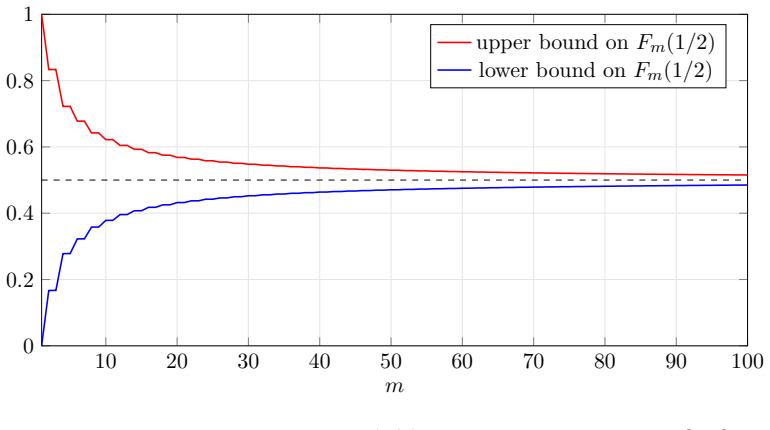
We introduce a sequence representation of a random variable $X$ supported on a compact interval $[a,b]$, which we call a primitive sequence. We construct this sequence by repeatedly antidifferentiating the associated cumulative distribution function of $X$ and evaluating the antiderivatives at the endpoint $b$. We show that the primitive sequence of $X$ can be identified as a factorially rescaled moment sequence of the reflected random variable $b-X$. Through this identification, we show that the primitive sequence transparently captures qualitative features of the distribution of $X$. We then connect primitive sequences directly to classical moment theory and exploit this connection to characterize admissible primitive sequences and to show that under natural topologies, the map from probability measures to primitive sequences is a homeomorphism. We end by examining the set of probability measures whose first $m$ primitive sequence terms are fixed, and thereby obtaining sharp upper and lower bounds on two functionals of those measures.
Editorial analysis
A structured set of objections, weighed in public.
Referee Report
Summary. The manuscript introduces primitive sequences for a random variable X supported on a compact interval [a,b], constructed by repeated antidifferentiation of the CDF of X followed by evaluation at the endpoint b. It identifies the resulting sequence as the factorially rescaled moment sequence of the reflected variable b-X via iterated integral representations. The paper then uses this link to classical Hausdorff moment theory to characterize admissible primitive sequences, prove that the map from probability measures (under the weak topology) to primitive sequences (under the product topology) is a homeomorphism, and obtain sharp upper and lower bounds on two functionals over the set of measures with the first m primitive terms fixed.
Significance. If the central identifications and applications hold, the work supplies a transparent integral-based sequence representation that directly encodes distribution features on bounded intervals and inherits the full power of the classical Hausdorff moment problem without introducing new parameters or ad-hoc constructions. The homeomorphism and extremal bounds follow from standard facts (moment map continuity and discrete extremal measures), but the explicit antiderivative construction may prove useful for qualitative analysis or numerical work. Credit is due for the clean Fubini-based identification and for routing all claims through established theory rather than novel axioms.
major comments (1)
- The identification of the primitive sequence with rescaled moments (via repeated integration against the CDF) is load-bearing for the homeomorphism and characterization claims; the manuscript should include an explicit inductive formula relating the k-th primitive term to (1/k!) E[(b-X)^k] together with a self-contained verification that the iterated antiderivatives remain well-defined on the compact interval.
minor comments (3)
- The abstract refers to 'two functionals' without naming them; the introduction or the section on fixed initial terms should state explicitly what these functionals are (e.g., mean, variance, or other moments) so that the sharpness claim is immediately intelligible.
- Notation for the primitive sequence should be introduced once and used consistently; a brief table or displayed equation listing the first three or four terms for a concrete example (uniform or Beta) would help readers verify the construction.
- The topology section should cite a standard reference for the fact that the moment map is a homeomorphism onto the admissible Hausdorff sequences (e.g., a textbook treatment of the moment problem) rather than treating it as immediate.
Simulated Author's Rebuttal
We thank the referee for the careful reading, positive assessment, and constructive suggestion. We address the major comment below.
read point-by-point responses
-
Referee: The identification of the primitive sequence with rescaled moments (via repeated integration against the CDF) is load-bearing for the homeomorphism and characterization claims; the manuscript should include an explicit inductive formula relating the k-th primitive term to (1/k!) E[(b-X)^k] together with a self-contained verification that the iterated antiderivatives remain well-defined on the compact interval.
Authors: We agree that an explicit inductive formula and a self-contained verification would strengthen the presentation. While the manuscript already derives the identification via iterated integral representations and Fubini, we will add a dedicated lemma in the revised version that states the inductive relation p_k = (1/k!) E[(b-X)^k] and proves it by induction on k, starting from the base case k=0 (where p_0 = 1) and using the integral representation of each antiderivative. The proof will explicitly invoke Fubini's theorem to interchange the order of integration. We will also include a short paragraph verifying that each iterated antiderivative is well-defined and continuous on the compact interval [a,b], since the CDF is bounded and measurable and all integrals are taken over a finite-length interval. revision: yes
Circularity Check
No significant circularity identified
full rationale
The paper constructs the primitive sequence explicitly by iterated antidifferentiation of the CDF followed by evaluation at the fixed endpoint b. The claimed identification with factorially rescaled moments of b-X is obtained by direct repeated application of the integral representation of moments (via Fubini or integration by parts), which is a standard calculation on compact intervals and does not presuppose the final result. The homeomorphism is then deduced from the classical theorem that the Hausdorff moment map is a homeomorphism from Prob([a,b]) (weak topology) to admissible moment sequences (product topology). Admissibility is characterized by the classical positive-semidefiniteness conditions on the shifted Hankel matrices, and the extremal bounds for fixed initial terms are the standard values attained by discrete measures with at most m+1 atoms. No step reduces by definition or by self-citation to its own inputs; all load-bearing facts are external classical results.
Axiom & Free-Parameter Ledger
axioms (2)
- standard math Cumulative distribution functions are non-decreasing, right-continuous, with F(a)=0 and F(b)=1.
- standard math Iterated antiderivatives of integrable functions on compact intervals exist and can be evaluated at the endpoint.
invented entities (1)
-
primitive sequence
no independent evidence
Lean theorems connected to this paper
-
IndisputableMonolith/Cost/FunctionalEquation.leanwashburn_uniqueness_aczel unclearWe show that the primitive sequence of X can be identified as a factorially rescaled moment sequence of the reflected random variable b−X. ... admissible primitive sequences ... Hausdorff criterion
Reference graph
Works this paper leans on
-
[1]
, year = 1965, month = jun, publisher =
Abramowitz, Milton and Stegun, Irene A. , year = 1965, month = jun, publisher =. Handbook of
work page 1965
- [2]
-
[3]
and Sheu, Chyong-Hwa , year = 1991, month = sep, journal =
Barron, Andrew R. and Sheu, Chyong-Hwa , year = 1991, month = sep, journal =. Approximation of. doi:10.1214/aos/1176348252 , urldate =
-
[4]
Journal of Financial Economics , volume =
Optimal Rules for Ordering Uncertain Prospects , author =. Journal of Financial Economics , volume =. doi:10.1016/0304-405X(75)90025-2 , urldate =
- [5]
-
[6]
Cauchy, Augustin-Louis , year = 2009, series =. R\'esum\'e Des Le cons Donn\'ees \`a l'\'ecole Polytechnique Sur Le Calcul Infinit\'esimal , booktitle =. doi:10.1017/CBO9780511702624.003 , urldate =
-
[7]
, year = 2003, month = feb, journal =
Cheng, Yu and Pai, Jeffrey S. , year = 2003, month = feb, journal =. On the. doi:10.1016/S0167-6687(02)00193-2 , urldate =
-
[8]
Proceedings of the USSR Academy of Sciences , volume =
Estimation of Unknown Probability Density Based on Observations , author =. Proceedings of the USSR Academy of Sciences , volume =
-
[9]
Chernoff, Herman and Gastwirth, Joseph L. and Jr, M. V. Johns , year = 1967, month = feb, journal =. Asymptotic. doi:10.1214/aoms/1177699058 , urldate =
-
[10]
Houston Journal of Mathematics , volume =
Recursiveness, Positivity and Truncated Moment Problems , author =. Houston Journal of Mathematics , volume =
-
[11]
Journal of Mathematical Analysis and Applications , volume =
Gibbs Phenomena for Some Classical Orthogonal Polynomials , author =. Journal of Mathematical Analysis and Applications , volume =. doi:10.1016/j.jmaa.2021.125574 , urldate =
-
[12]
Dudley, R. M. , year = 2002, series =. Real. doi:10.1017/CBO9780511755347 , urldate =
- [13]
-
[14]
Efromovich, Sam , year = 1999, series =. Nonparametric. doi:10.1007/b97679 , urldate =
-
[15]
Farid, F. O. and Lancaster, P. , year = 1991, month = jan, journal =. Spectral Properties of Diagonally Dominant Infinite Matrices. doi:10.1016/0024-3795(91)90003-F , urldate =
-
[16]
Feller, William , year = 1991, series =. An
work page 1991
-
[17]
Feller, William , year = 1968, publisher =. An
work page 1968
-
[18]
Fishburn, Peter C. , year = 1977, journal =. Mean-. 1807225 , eprinttype =
work page 1977
-
[19]
Fournier, Nicolas and Guillin, Arnaud , year = 2015, month = aug, journal =. On the Rate of Convergence in. doi:10.1007/s00440-014-0583-7 , urldate =
-
[20]
Gautschi, Walter , year = 1983, month = jul, journal =. The Condition of. doi:10.1016/0024-3795(83)80020-2 , urldate =
-
[21]
Goberna, Miguel A. and L. Linear
-
[22]
Hall, Peter and Presnell, Brett , year = 1999, journal =. Density. doi:10.2307/1390636 , urldate =. 1390636 , eprinttype =
-
[23]
doi:10.1007/BF01378337 , urldate =
Hausdorff, Felix , year = 1921, month = mar, journal =. doi:10.1007/BF01378337 , urldate =
-
[24]
Inglese, Gabriele , year = 2003, month = may, journal =. Fourier--. doi:10.1016/S0377-0427(02)00819-1 , urldate =
- [25]
-
[26]
Krein, M. G. and Nudel'man, A. A. , year = 1977, publisher =. The
work page 1977
-
[27]
Lalancette, Micha. A. doi:10.48550/arXiv.2509.26635 , urldate =. arXiv , keywords =:2509.26635 , primaryclass =
-
[28]
Letac, Gerard and Mora, Marianne , year = 1990, month = mar, journal =. Natural. doi:10.1214/aos/1176347491 , urldate =
-
[29]
Muldowney, Pat and Ostaszewski, Krzysztof and Wojdowski, Wojciech , year = 2012, month = nov, journal =. The. doi:10.2478/v10127-012-0025-9 , urldate =
-
[30]
Journal of Rajasthan Academy of Physical Sciences , volume =
On the Stop-Loss Transform Properties and Ordering , author =. Journal of Rajasthan Academy of Physical Sciences , volume =
-
[31]
Dissertations Mathematicae (Rozprawy Matematyczne) , volume =
Order Relations in the Set of Probability Distribution Functions and Their Applications in Queueing Theory , author =. Dissertations Mathematicae (Rozprawy Matematyczne) , volume =
- [32]
- [33]
-
[34]
Schm. The. doi:10.1007/978-3-319-64546-9 , urldate =
-
[35]
M.: Distances of probability measures and random variables
Schwartz, Stuart C. , year = 1967, month = aug, journal =. Estimation of. doi:10.1214/aoms/1177698795 , urldate =
-
[36]
Shohat, J. A. and Tamarkin, J. D. , year = 2014, publisher =. The
work page 2014
-
[37]
Bulletin des Sciences Math\'ematiques , volume =
Formules de Cubature Mecanique a Coefficients Non Negatifs , author =. Bulletin des Sciences Math\'ematiques , volume =
-
[38]
Asymptotic. doi:10.1017/CBO9780511802256 , urldate =
-
[39]
Villani, C. Optimal. doi:10.1007/978-3-540-71050-9 , urldate =
-
[40]
Wendel, J. G. , year = 1948, month = nov, journal =. Note on the. doi:10.2307/2304460 , urldate =
-
[41]
Winkler, Gerhard , year = 1988, journal =. Extreme. 3689944 , eprinttype =
work page 1988
- [42]
discussion (0)
Sign in with ORCID, Apple, or X to comment. Anyone can read and Pith papers without signing in.