Recognition: no theorem link
An electron injector for the Electron-Ion Collider based on proton-driven plasma wakefield acceleration
Pith reviewed 2026-05-11 03:11 UTC · model grok-4.3
The pith
A proton-driven plasma wakefield scheme using RHIC protons can inject polarized electrons into the Electron-Ion Collider while meeting its design goals for polarization and luminosity.
A machine-rendered reading of the paper's core claim, the machinery that carries it, and where it could break.
Core claim
The central claim of the paper is that an initial study shows the design parameters of the EIC are within reach when accelerating the electron bunches in the proton-driven plasma wake, achieving an average polarization of approximately 70% and a luminosity of 10^34 cm^{-2}s^{-1}.
What carries the argument
The proton-driven plasma wakefield acceleration mechanism, in which high-energy proton bunches create wakefields in a plasma that trap and accelerate electron bunches to high energies while preserving their polarization.
If this is right
- The EIC can be supplied with electron bunches at the required energy and quality using this injector.
- Beam polarization of about 70% can be maintained through the acceleration process.
- The scheme can deliver the target luminosity of 10^34 cm^{-2}s^{-1} for the collider.
- Existing RHIC proton bunches can be repurposed to drive the plasma wakes without new major proton sources.
Where Pith is reading between the lines
- If the scheme works as estimated, it could allow the EIC to be built with a shorter or less expensive electron linac.
- This application demonstrates how plasma wakefield acceleration might integrate with existing high-energy proton facilities for electron beam production.
- Further optimization of the plasma cell and bunch parameters could improve the delivered luminosity or polarization beyond the initial estimates.
Load-bearing premise
The proton bunches from RHIC can create a plasma wake that accelerates the electrons to the needed energy and quality while keeping polarization high and allowing the target luminosity to be reached.
What would settle it
A full simulation or experimental demonstration that either achieves or fails to achieve electron acceleration to EIC energies with preserved polarization and emittance consistent with 10^34 luminosity.
Figures
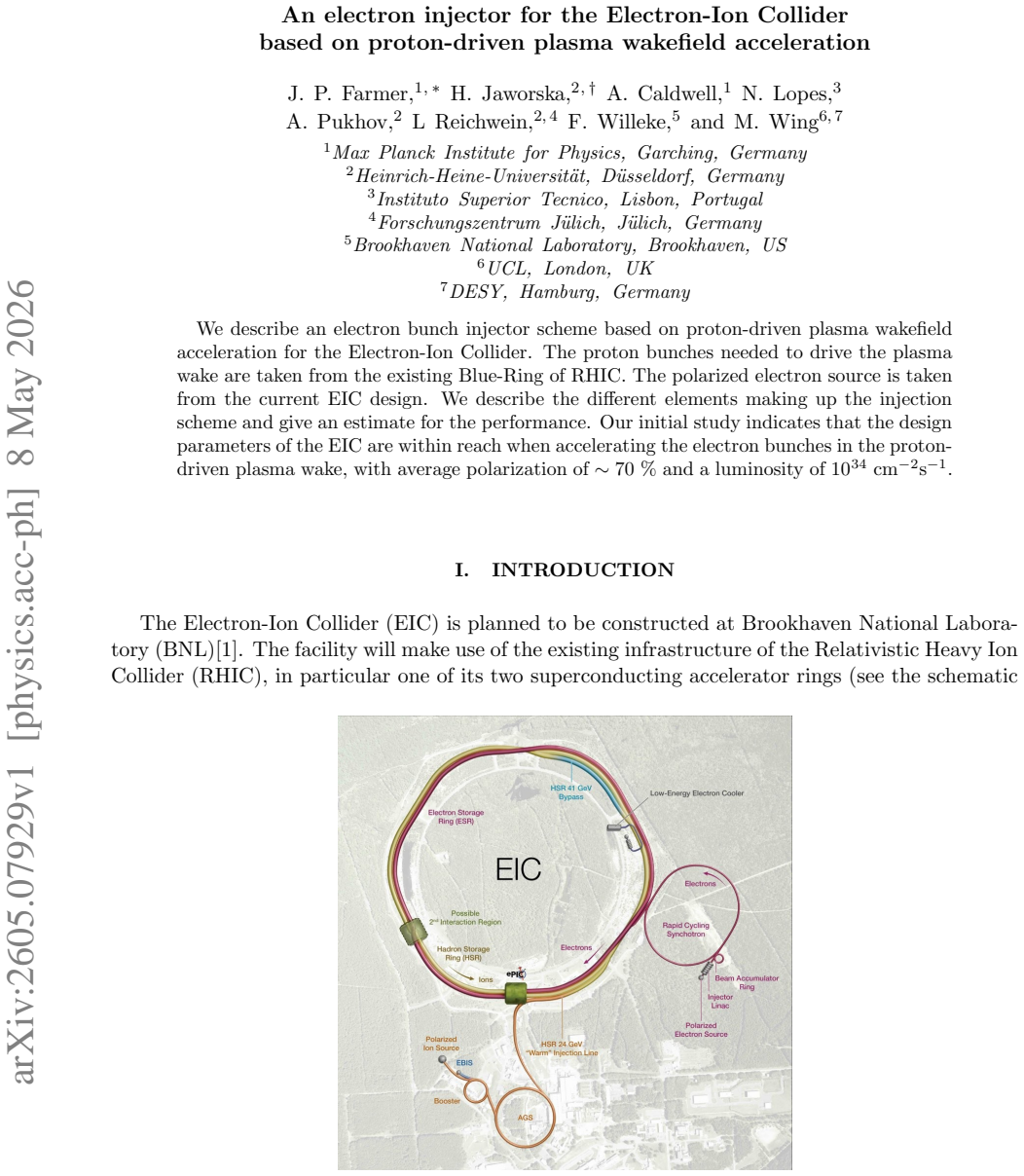


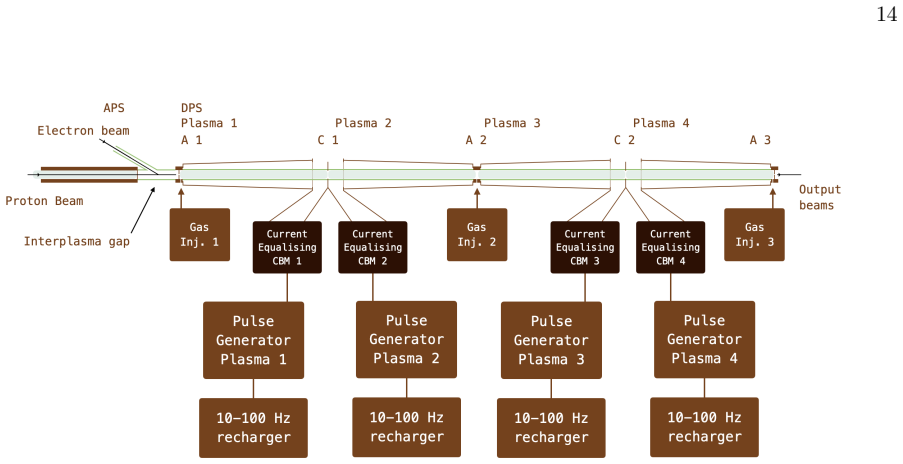

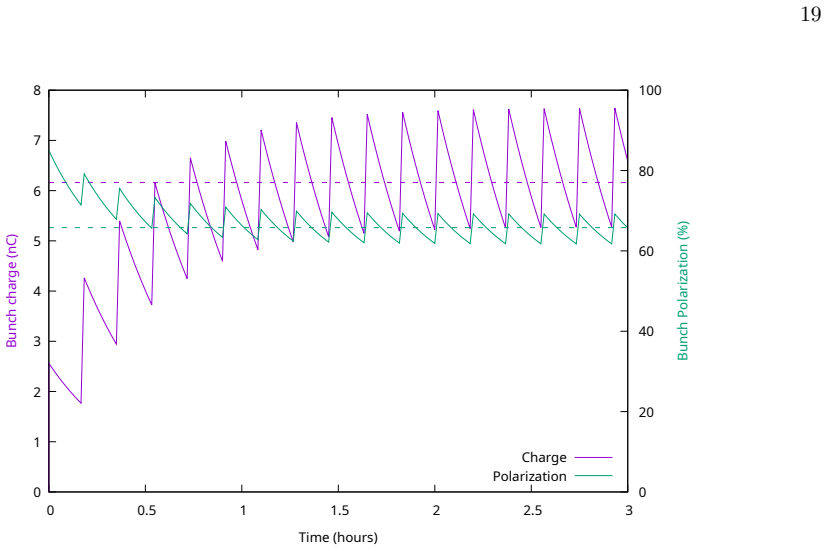
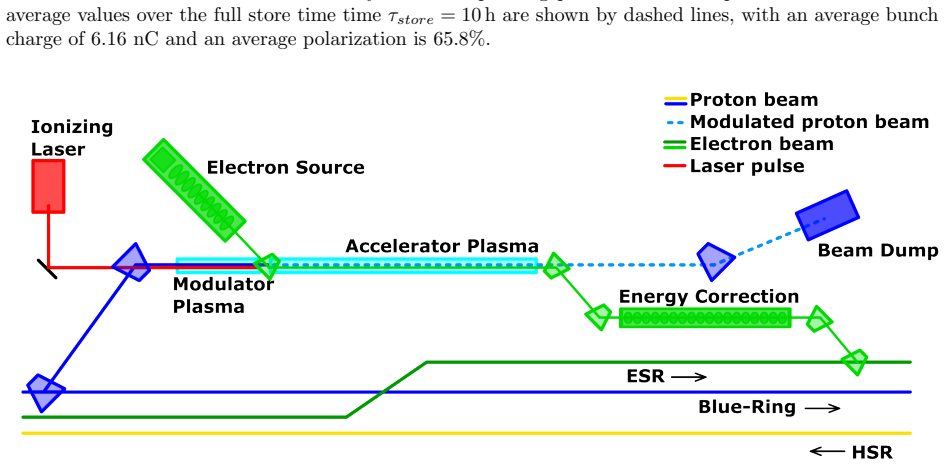
read the original abstract
We describe an electron bunch injector scheme based on proton-driven plasma wakefield acceleration for the Electron-Ion Collider. The proton bunches needed to drive the plasma wake are taken from the existing Blue-Ring of RHIC. The polarized electron source is taken from the current EIC design. We describe the different elements making up the injection scheme and give an estimate for the performance. Our initial study indicates that the design parameters of the EIC are within reach when accelerating the electron bunches in the proton-driven plasma wake, with average polarization of ~70% and a luminosity of 1e34 cm$^{-2}$s$^{-1}$.
Editorial analysis
A structured set of objections, weighed in public.
Referee Report
Summary. The manuscript proposes an electron injector scheme for the Electron-Ion Collider (EIC) based on proton-driven plasma wakefield acceleration (PWFA). Proton bunches extracted from the existing RHIC Blue Ring are used to drive the plasma wake, which accelerates polarized electron bunches taken from the current EIC polarized source. The paper outlines the main elements of the scheme and provides initial performance estimates indicating that EIC design parameters can be reached, with average electron polarization of ~70% and luminosity of 10^{34} cm^{-2}s^{-1}.
Significance. If the performance estimates can be validated through detailed modeling, the scheme would offer a novel approach to EIC injection by repurposing RHIC proton bunches for PWFA, potentially enabling compact acceleration while preserving polarization and achieving target luminosity. This could reduce infrastructure needs for the EIC and demonstrate practical integration of plasma acceleration in collider contexts, though the preliminary nature limits immediate impact.
major comments (3)
- [estimates section / abstract] The central performance claim (abstract and the estimates section) that EIC parameters are within reach with ~70% polarization and 10^{34} cm^{-2}s^{-1} luminosity rests on the unverified assumption that RHIC proton bunches can drive a suitable wake with adequate amplitude, transformer ratio, and beam loading. No analytic scaling, dephasing length calculation, or plasma density matching analysis is provided to secure the final electron energy, charge, and emittance; this is load-bearing for the claim.
- [scheme description] No quantitative treatment is given for polarization preservation during PWFA acceleration (including potential depolarization from plasma fields or emittance growth), which is required to support the ~70% average polarization figure. This omission affects the viability assessment for the polarized EIC beams.
- [performance estimates] The implicit assumption that RHIC proton bunch length, energy spread, and intensity allow stable wake excitation without detailed simulation of beam quality degradation or luminosity reach is not supported by any calculation or reference to prior PWFA studies with similar drivers.
minor comments (2)
- [abstract] The abstract states performance claims without any mention of the key assumptions or limitations of the initial study; adding a qualifying phrase would improve clarity.
- [scheme description] Notation for beam parameters (e.g., charge, emittance) should be defined consistently when first introduced in the scheme description.
Simulated Author's Rebuttal
We thank the referee for the detailed and constructive comments on our manuscript proposing a proton-driven PWFA electron injector for the EIC. We address each major comment below and have updated the manuscript to incorporate additional analysis and clarifications where feasible.
read point-by-point responses
-
Referee: [estimates section / abstract] The central performance claim (abstract and the estimates section) that EIC parameters are within reach with ~70% polarization and 10^{34} cm^{-2}s^{-1} luminosity rests on the unverified assumption that RHIC proton bunches can drive a suitable wake with adequate amplitude, transformer ratio, and beam loading. No analytic scaling, dephasing length calculation, or plasma density matching analysis is provided to secure the final electron energy, charge, and emittance; this is load-bearing for the claim.
Authors: We agree that additional supporting analysis is needed to substantiate the performance estimates. In the revised version, we have added analytic expressions for the wakefield amplitude and transformer ratio using standard PWFA scaling laws, along with an estimate of the dephasing length and a plasma density optimization to achieve the required electron energy. References to established PWFA theory are included. Full 3D simulations of beam loading and emittance are noted as necessary future work but beyond the scope of this conceptual proposal. revision: partial
-
Referee: [scheme description] No quantitative treatment is given for polarization preservation during PWFA acceleration (including potential depolarization from plasma fields or emittance growth), which is required to support the ~70% average polarization figure. This omission affects the viability assessment for the polarized EIC beams.
Authors: We have revised the scheme description section to include a quantitative estimate of polarization preservation. Drawing from literature on polarized electron acceleration in plasma wakes, we estimate that depolarization due to plasma fields can be kept below 5% with appropriate bunch matching, leading to an average polarization of approximately 70% from the initial 80% source polarization. Emittance growth is addressed via adiabatic matching, with supporting references added. revision: yes
-
Referee: [performance estimates] The implicit assumption that RHIC proton bunch length, energy spread, and intensity allow stable wake excitation without detailed simulation of beam quality degradation or luminosity reach is not supported by any calculation or reference to prior PWFA studies with similar drivers.
Authors: The performance estimates are based on parameters from the RHIC Blue Ring and prior proton-driven PWFA experiments such as AWAKE, which used similar proton bunch intensities and lengths. We have added references to these studies and a brief calculation showing that the energy spread and bunch length are compatible with stable wake excitation for the proposed plasma density. Detailed simulations of beam quality are acknowledged as important and planned for follow-up work; the luminosity is calculated using standard EIC formulas with the assumed beam parameters. revision: partial
Circularity Check
No significant circularity; performance estimates are forward projections
full rationale
The manuscript presents a conceptual injector scheme and initial performance estimates (polarization ~70%, luminosity 1e34 cm^{-2}s^{-1}) based on combining existing RHIC proton bunches with a polarized electron source and plasma wakefield acceleration. No load-bearing derivations, equations, or self-citations are shown that reduce by construction to the inputs themselves. The claims are explicitly labeled as an 'initial study' and 'estimate,' not as a closed-form derivation or fitted prediction. External benchmarks (RHIC parameters, EIC design) are invoked without self-referential fitting or uniqueness theorems imported from the authors' prior work. This is a standard non-circular proposal paper.
Axiom & Free-Parameter Ledger
axioms (1)
- domain assumption Proton bunches from the RHIC Blue Ring can be used to drive plasma wakes for electron acceleration
Reference graph
Works this paper leans on
-
[1]
F. Willeke and J. Beebe-Wang,Electron Ion Collider Conceptual Design Report 2021, Tech. Rep. (Brookhaven National Laboratory (BNL), Upton, NY, United States; Thomas Jefferson National Ac- celerator Facility (TJNAF), Newport News, VA, United States, United States, 2021)
work page 2021
-
[2]
E. Gschwendtner, K. Lotov, P. Muggli, M. Wing,et al.(AWAKE Collaboration), The AWAKE Run 2 programme and beyond, Symmetry14, 1680 (2022)
work page 2022
-
[3]
V. N. Litvinenko, N. Bachhawat, J. C. Brutus, L. Cultrera, K. Decker, M. Gaowei, P. Inacker, Y. Jing, J. Ma, K. P. Mondal, G. Narayan, I. Pinayev, F. Severino, K. Shih, J. Skaritka, L. Smart, Y. Than, J. Walsh, E. Wang, G. Wang, and D. Weiss, Towards advanced polarized electron sources, Nature Physics22, 325–330 (2026)
work page 2026
-
[4]
T. Tajima and J. M. Dawson, Laser electron accelerator, Phys. Rev. Lett.43, 267 (1979)
work page 1979
-
[5]
P. Chen, J. M. Dawson, R. W. Huff, and T. Katsouleas, Acceleration of electrons by the interaction of a bunched electron beam with a plasma, Phys. Rev. Lett.54, 693 (1985)
work page 1985
-
[6]
I. Blumenfeldet al., Energy doubling of 42 GeV electrons in a metre-scale plasma wakefield accelerator, Nature445, 741 (2007)
work page 2007
-
[7]
A. J. Gonsalveset al., Petawatt Laser Guiding and Electron Beam Acceleration to 8 GeV in a Laser- Heated Capillary Discharge Waveguide, Phys. Rev. Lett.122, 084801 (2019)
work page 2019
-
[8]
F. Albert, M. E. Couprie, A. Debus, M. C. Downer, J. Faure, A. Flacco, L. A. Gizzi, T. Grismayer, A. Huebl, C. Joshi, M. Labat, W. P. Leemans, A. R. Maier, S. P. D. Mangles, P. Mason, F. Mathieu, P. Muggli, M. Nishiuchi, J. Osterhoff, P. P. Rajeev, U. Schramm, J. Schreiber, A. G. R. Thomas, J.-L. Vay, M. Vranic, and K. Zeil, 2020 roadmap on plasma acceler...
work page 2020
-
[9]
A. Caldwell, K. Lotov, A. Pukhov, and F. Simon, Proton Driven Plasma Wakefield Acceleration, Nature Phys.5, 363 (2009), arXiv:0807.4599 [physics.acc-ph]
- [10]
-
[11]
F. Willeke,Study of a Fixed Field Accelerator as a Driver for Proton Driven Plasma Wakefield Accel- eration, Tech. Rep. (Brookhaven National Lab, 2026)
work page 2026
- [12]
-
[13]
R. Assmannet al.(AWAKE Collaboration), Proton-driven plasma wakefield acceleration: a path to the future of high-energy particle physics, Plasma Phys. Control. Fusion56, 084013 (2014), arXiv:1401.4823 [physics.acc-ph]
-
[14]
Caldwellet al., Path to AWAKE: Evolution of the concept, Nucl
A. Caldwellet al., Path to AWAKE: Evolution of the concept, Nucl. Instrum. Meth. A829, 3 (2016), arXiv:1511.09032 [physics.plasm-ph]
-
[15]
P. Muggliet al.(AWAKE Collaboration), AWAKE readiness for the study of the seeded self-modulation of a 400 GeV proton bunch, Plasma Phys. Control. Fusion60, 014046 (2017), arXiv:1708.01087 [physics.plasm-ph]
-
[16]
L. Verraet al.(AWAKE Collaboration), Controlled Growth of the Self-Modulation of a Relativistic Proton Bunch in Plasma, Phys. Rev. Lett.129, 024802 (2022), arXiv:2203.13752 [physics.plasm-ph]
-
[17]
E. Adliet al.(AWAKE Collaboration), Acceleration of electrons in the plasma wakefield of a proton bunch, Nature561, 363 (2018), arXiv:1808.09759
-
[18]
F. Batschet al.(AWAKE Collaboration), Transition between Instability and Seeded Self-Modulation of a Relativistic Particle Bunch in Plasma, Phys. Rev. Lett.126, 164802 (2021), arXiv:2012.09676 [physics.plasm-ph]
-
[19]
K. V. Lotov, Controlled self-modulation of high energy beams in a plasma, Phys. Plasmas18, 024501 (2011)
work page 2011
- [20]
-
[21]
T. Katsouleas, S. Wilks, P. Chen, J. M. Dawson, and J. J. Su, Beam Loading in Plasma Accelerators, Part. Accel.22, 81 (1987)
work page 1987
-
[22]
R. Keinigs and M. E. Jones, Two-dimensional dynamics of the plasma wakefield accelerator, Phys. Fluids30, 252 (1987)
work page 1987
-
[23]
K. V. Lotov, Fine wakefield structure in the blowout regime of plasma wakefield accelerators, Phys. 22 Rev. ST Accel. Beams6, 061301 (2003). [24]Seehttps: // lcode. infofor code description and manual
work page 2003
-
[24]
K. V. Lotov and P. V. Tuev, Plasma wakefield acceleration beyond the dephasing limit with 400 GeV proton driver, Plasma Phys. Controlled Fusion63, 125027 (2021)
work page 2021
-
[25]
H. Jaworskaet al., A full-energy electron injector for the EIC based on proton-driven plasma-wakefield acceleration, inProceedings of the 17th International Particle Accelerator Conf. (IPAC’26), TUP3043, in preparation
-
[26]
J. B. Rosenzweig, G. Andonian, M. Ferrario, P. Muggli, O. Williams, V. Yakimenko, and K. Xuan, Plasma wakefields in the quasi-nonlinear regime, AIP Conference Proceedings1299, 500 (2010), https://aip.scitation.org/doi/pdf/10.1063/1.3520373
-
[27]
van der Meer,Improving the power efficiency of the plasma wakefield accelerator, Tech
S. van der Meer,Improving the power efficiency of the plasma wakefield accelerator, Tech. Rep. (CERN, Geneva, 1985)
work page 1985
-
[28]
C. A. Lindstrømet al., Energy-Spread Preservation and High Efficiency in a Plasma-Wakefield Accel- erator, Phys. Rev. Lett.126, 014801 (2021)
work page 2021
-
[29]
L. Reichwein, Z. Gong, C. Zheng, L. L. Ji, A. Pukhov, and M. B¨ uscher, Plasma acceleration of polarized particle beams, Reports on Progress in Physics88, 117001 (2025)
work page 2025
-
[30]
Y. Wu, L. Ji, X. Geng, Q. Yu, N. Wang, B. Feng, Z. Guo, W. Wang, C. Qin, X. Yan, L. Zhang, J. Thomas, A. H¨ utzen, M. B¨ uscher, T. P. Rakitzis, A. Pukhov, B. Shen, and R. Li, Polarized electron- beam acceleration driven by vortex laser pulses, New Journal of Physics21, 073052 (2019)
work page 2019
-
[31]
Y. Wu, L. Ji, X. Geng, Q. Yu, N. Wang, B. Feng, Z. Guo, W. Wang, C. Qin, X. Yan, L. Zhang, J. Thomas, A. H¨ utzen, A. Pukhov, M. B¨ uscher, B. Shen, and R. Li, Polarized electron acceleration in beam-driven plasma wakefield based on density down-ramp injection, Phys. Rev. E100, 043202 (2019)
work page 2019
-
[32]
J. Vieira, C.-K. Huang, W. B. Mori, and L. O. Silva, Polarized beam conditioning in plasma based acceleration, Phys. Rev. ST Accel. Beams14, 071303 (2011)
work page 2011
-
[33]
Plyushchevet al., A rubidium vapor source for a plasma source for AWAKE, J
G. Plyushchevet al., A rubidium vapor source for a plasma source for AWAKE, J. Phys. D: Appl. Phys.51, 025203 (2018)
work page 2018
-
[34]
B. Buttensch¨ onet al., A high power, high density helicon discharge for the plasma wakefield accelerator experiment AWAKE, Plasma Phys. Control. Fusion60, 075005 (2018)
work page 2018
-
[35]
M. Granetznyet al., Exploration of helicon plasmas for wakefield accelerators at the Madison AWAKE Prototype, Physics of Plasmas32, 093507 (2025)
work page 2025
-
[36]
N. C. Lopes, C. Cobo, J. B. Ben Chen, P. B. Jury, L. C. Kennedy, A. Vanstone, and Z. Najmudin, A metre-scale plasma discharge for plasma wakefield acceleration, Plasma Phys. Control. Fusion68, 045046 (2026)
work page 2026
-
[37]
N. E. Torrado, N. C. Lopes, J. F. A. Silva, C. Amoedo, and A. Sublet, Double pulse generator for unipolar discharges in long plasma tubes for the awake experiment, IEEE Trans. Plasma Sci.51, 3619 (2023)
work page 2023
-
[38]
N. E. Torrado, C. Amoedo, A. Sublet, M. Taborelli, S. F. Pinto, J. F. Silva, and N. Lopes, Double pulse generator for awake scalable discharge plasma source, J. Phys.: Conf. Ser.3124, 012021 (2025)
work page 2025
- [39]
- [40]
-
[41]
Nosochkovet al., Dynamic aperture of the EIC electron storage ring, JACoWIPAC2024, MOPC82 (2024)
Y. Nosochkovet al., Dynamic aperture of the EIC electron storage ring, JACoWIPAC2024, MOPC82 (2024)
work page 2024
discussion (0)
Sign in with ORCID, Apple, or X to comment. Anyone can read and Pith papers without signing in.