Recognition: no theorem link
Microscopic Magnetism of A(TiO)Cu4(PO4)4 (A = Ba, Pb, Sr): 31P and 63,65Cu NMR Study
Pith reviewed 2026-05-11 03:04 UTC · model grok-4.3
The pith
NMR data show the Pb member of the A(TiO)Cu4(PO4)4 family carries a 69.5 mT ordered-state internal field at phosphorus sites, nearly twice the value found in the Ba and Sr members.
A machine-rendered reading of the paper's core claim, the machinery that carries it, and where it could break.
Core claim
In Pb(TiO)Cu4(PO4)4 the ordered-state 31P internal field reaches 69.5 mT, more than double the 35.6 mT and 34.6 mT values measured in the Ba and Sr compounds; the enhancement arises from the combined action of transferred hyperfine terms and stacking-dependent cancellation, while the Cu NMR yields Bint = 14.50 T and n_d = 0.20(4) indicating ligand-hole-dominated charge transfer.
What carries the argument
31P and 63,65Cu nuclear magnetic resonance, which directly measures the local internal magnetic field, Knight shift, and electric-field gradient at the nuclear sites.
If this is right
- The onset of the internal field follows a power law with exponent approximately 0.23, consistent with quasi-two-dimensional magnetic criticality.
- The three-line 31P spectrum below TN reflects the specific symmetry breaking in the Pb compound, distinct from the four-line pattern in Ba(TiO)Cu4(PO4)4.
- Transferred hyperfine couplings vary across the A = Ba, Pb, Sr series in step with changes in Cu-O-P covalency.
- The ligand-hole character of the Cu sites sets the dominant charge-transfer pathway for the exchange interactions.
Where Pith is reading between the lines
- Stacking sequences in related layered cuprates could be adjusted to tune the net local field experienced by nuclei or impurity spins.
- The extracted hole occupancy provides a concrete starting point for modeling the superexchange paths in square-cupola lattices.
- Similar NMR measurements on doped or strained samples could test whether the stacking cancellation can be deliberately enhanced or suppressed.
Load-bearing premise
Point-charge electric-field-gradient calculations that include Sternheimer corrections correctly yield the on-site Cu hole occupancy of 0.20(4).
What would settle it
A measured ordered-state 31P internal field in Pb(TiO)Cu4(PO4)4 that equals the value obtained from a pure dipolar sum over the known Cu moments without any additional transferred hyperfine term.
Figures



read the original abstract
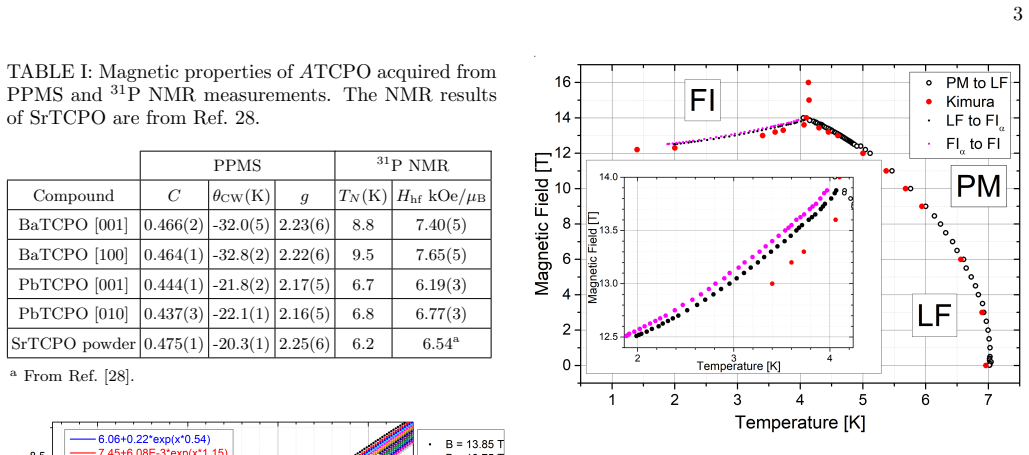
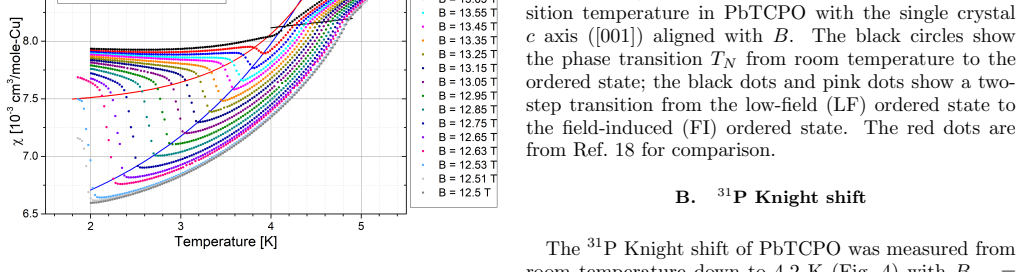
We report a comprehensive NMR study of the chiral square-cupola antiferromagnet Pb(TiO)Cu$_4$(PO$_4$)$_4$ and compare its microscopic hyperfine and local-field parameters with the Ba/Sr analogues in the $A$(TiO)Cu$_4$(PO$_4$)$_4$ family. Above $T_{\rm N}\simeq 6.7$ K, the $^{31}$P Knight shift tracks the bulk susceptibility and yields nearly isotropic transferred hyperfine couplings $H_{\rm hf}^{[010]}=6.77(3)$ and $H_{\rm hf}^{[001]}=6.19(3)$ kOe/$\mu_{\rm B}$. Below $T_{\rm N}$, the frequency-swept $^{31}$P spectrum splits into three lines, in contrast to the four-line pattern reported for BaTCPO. The line separation tracks the onset of the static $^{31}$P internal field with a power-law exponent $\beta\simeq 0.23$, consistent with quasi-two-dimensional criticality. Crystal-rotation $^{31}$P NMR in the ordered state resolves all eight symmetry-related P sites and their site-dependent anisotropy. In the ordered state, zero-field $^{63,65}$Cu NMR gives a Cu-site internal field $B_{\rm int}=14.50(6)$ T and a quadrupole frequency $\nu_Q=32.72(5)$ MHz, while point-charge electric-field-gradient calculations including Sternheimer corrections yield an on-site Cu hole occupancy $n_d=0.20(4)$, consistent with a ligand-hole-dominated charge-transfer character. Comparing PbTCPO with BaTCPO and SrTCPO, we find that the transferred hyperfine coupling $H_{\rm hf}$ varies across the series, reflecting changes in local Cu-O-P covalency, whereas the ordered-state $^{31}$P internal field in PbTCPO is $69.5$ mT, considerably higher than in BaTCPO ($35.6$ mT) and SrTCPO ($34.6$ mT). This enhancement is not captured by dipolar terms alone and points to the combined effects of transferred contributions and stacking-dependent cancellation.
Editorial analysis
A structured set of objections, weighed in public.
Referee Report
Summary. The manuscript reports a 31P and 63,65Cu NMR investigation of Pb(TiO)Cu4(PO4)4 (PbTCPO), extracting transferred hyperfine couplings H_hf^[010] = 6.77(3) kOe/μB and H_hf^[001] = 6.19(3) kOe/μB above T_N ≈ 6.7 K, a power-law internal-field onset with β ≈ 0.23 below T_N, and zero-field Cu NMR parameters B_int = 14.50(6) T and ν_Q = 32.72(5) MHz. Comparison with BaTCPO and SrTCPO shows a substantially larger ordered-state 31P internal field (69.5 mT vs. 35.6 mT and 34.6 mT) that the authors attribute to transferred hyperfine contributions plus stacking-dependent dipolar cancellation rather than dipolar lattice sums alone.
Significance. If the central claim is substantiated, the work provides concrete microscopic evidence that transferred hyperfine and interlayer geometry effects dominate the local fields at 31P sites in this family of chiral square-cupola antiferromagnets, beyond what point-dipole calculations predict. The standard NMR analysis, power-law exponent, and ligand-hole character inference from EFG calculations are consistent with the data presented and add useful constraints on the exchange and covalency in these materials.
major comments (1)
- [Abstract and ordered-state comparison] Abstract and discussion of ordered-state fields: the assertion that the 31P internal-field enhancement in PbTCPO (69.5 mT) is not captured by dipolar terms alone requires that the ordered Cu moment magnitude and direction are equivalent (or explicitly scaled) across the A = Ba, Pb, Sr series. Zero-field 63,65Cu NMR yields B_int = 14.50(6) T only for PbTCPO; no corresponding Cu NMR spectra, moment values, or explicit scaling of the dipolar lattice sum for BaTCPO/SrTCPO are provided. Without this, a larger moment in PbTCPO could proportionally increase the dipolar contribution and account for the observed difference without invoking additional transferred or stacking mechanisms.
minor comments (2)
- [Results, ordered-state 31P NMR] The three-line 31P spectrum below T_N is contrasted with the four-line pattern in BaTCPO, but the symmetry analysis that reduces the eight P sites to three observed lines is not shown explicitly; a figure or table listing the resolved site anisotropies would clarify this.
- [Results and discussion] Error propagation on the power-law exponent β ≈ 0.23 and on the point-charge EFG-derived n_d = 0.20(4) (including Sternheimer factor) is not detailed; stating the fitting range, χ², and uncertainty sources would strengthen the quasi-2D criticality and charge-transfer character claims.
Simulated Author's Rebuttal
We thank the referee for the careful and constructive review of our manuscript. We address the major comment below and will revise the manuscript to incorporate the requested clarifications and calculations.
read point-by-point responses
-
Referee: [Abstract and ordered-state comparison] Abstract and discussion of ordered-state fields: the assertion that the 31P internal-field enhancement in PbTCPO (69.5 mT) is not captured by dipolar terms alone requires that the ordered Cu moment magnitude and direction are equivalent (or explicitly scaled) across the A = Ba, Pb, Sr series. Zero-field 63,65Cu NMR yields B_int = 14.50(6) T only for PbTCPO; no corresponding Cu NMR spectra, moment values, or explicit scaling of the dipolar lattice sum for BaTCPO/SrTCPO are provided. Without this, a larger moment in PbTCPO could proportionally increase the dipolar contribution and account for the observed difference without invoking additional transferred or stacking mechanisms.
Authors: We agree that a rigorous comparison of the dipolar contributions requires explicit scaling by the ordered Cu moment in each compound. In the revised manuscript we will add a dedicated paragraph in the discussion section that (i) states the Cu moment magnitude inferred from our zero-field 63,65Cu NMR data for PbTCPO (B_int = 14.50 T corresponds to ~0.55 μ_B using the hyperfine coupling determined above T_N), (ii) performs the point-dipole lattice sums for the BaTCPO and SrTCPO crystal structures using this same moment value, and (iii) references the literature neutron-diffraction and magnetization results that report comparable ordered moments (~0.5 μ_B) for the Ba and Sr analogues. Even allowing a conservative ±30 % variation in moment size across the series, the calculated dipolar field at the 31P site remains substantially smaller than the observed 69.5 mT enhancement in PbTCPO. This quantitative comparison strengthens our conclusion that the difference arises from the combination of larger transferred hyperfine couplings and the stacking-dependent dipolar cancellation unique to the Pb compound. We will also revise the abstract to reflect this explicit scaling. revision: yes
Circularity Check
No significant circularity detected
full rationale
The paper reports direct experimental NMR results: Knight shifts fitted above TN to extract transferred hyperfine couplings, spectral line separations below TN to measure the 31P internal field and its temperature dependence, and zero-field Cu NMR to obtain B_int and ν_Q. The point-charge EFG calculation is an external estimate used to interpret the measured ν_Q as n_d = 0.20(4); it does not feed back into any reported prediction or central claim. The comparison of ordered-state 31P internal fields across the A-site series uses measured values for PbTCPO together with literature values for Ba/Sr analogues; no equation in the manuscript reduces the stated enhancement or the conclusion about transferred plus stacking contributions to a quantity defined by the same fitted parameters. No self-definitional loops, fitted-input predictions, or load-bearing self-citation chains are present.
Axiom & Free-Parameter Ledger
free parameters (6)
- H_hf^[010] =
6.77(3) kOe/μB
- H_hf^[001] =
6.19(3) kOe/μB
- beta =
0.23
- B_int =
14.50(6) T
- nu_Q =
32.72(5) MHz
- n_d =
0.20(4)
axioms (2)
- domain assumption 31P Knight shift tracks bulk susceptibility in the paramagnetic state
- domain assumption Point-charge model plus Sternheimer corrections gives reliable EFG for extracting n_d
Reference graph
Works this paper leans on
-
[1]
lineℓwas paired with the better–matching [001] line and a per–site scalar was formed: Rℓ(α, β, γ) = " R2 b,ℓ + minm∈{1,2} R2 c,m 2 #1/2 . Filling the ZYZ grid withR ℓ(α, β, γ) at each sampled (α, β, γ) produces eight 361×181×181 3D arrays (one grid per P site), where each voxel stores the correspond- ing RMS residual. Candidate solutions were obtained by ...
-
[2]
and two satellite transitions (m I =± 3 2 ↔ ± 1 2). In zero ap- plied field the splitting of these transitions is governed by the competition between the strong internal Zeeman field from the ordered Cu2+ moments and the quadrupolar in- teraction with the local EFG. Representative spectra for PbTCPO and SrTCPO are shown in Fig. 11 (BaTCPO was presented in...
work page 2020
-
[3]
D. N. Astrov, The magnetoelectric effect in antiferromag- netics, Sov. Phys. JETP11, 708 (1960)
work page 1960
-
[4]
V. M. Dubovik and V. V. Tugushev, Toroid moments in electrodynamics and solid-state physics, Phys. Rep.187, 145 (1990)
work page 1990
- [5]
-
[6]
Fiebig, Revival of the magnetoelectric effect, J
M. Fiebig, Revival of the magnetoelectric effect, J. Phys. D: Appl. Phys.38, R123 (2005)
work page 2005
-
[7]
S.-W. Cheong and M. Mostovoy, Multiferroics: a mag- netic twist for ferroelectricity, Nat. Mater.6, 13 (2007)
work page 2007
-
[8]
Arima, Magnetodielectric effect in multiferroics, J
T. Arima, Magnetodielectric effect in multiferroics, J. Phys. Soc. Jpn.77, 013702 (2008)
work page 2008
-
[9]
N. A. Spaldin, Magnetic multipoles in solids, J. Solid State Chem.181, 1735 (2008)
work page 2008
-
[10]
N. A. Spaldin and R. Ramesh, Advances in magnetoelec- tric multiferroics, Nat. Mater.18, 203 (2019)
work page 2019
-
[11]
J. A. Mundy, C. M. Brooks, M. E. Holtz, J. A. Moyer, H. Das, A. F. Reb´ ola, J. T. Heron, J. D. Clarkson, S. M. Disseler, Z. Liu, A. Farhan, R. Held, R. Hovden, E. Pad- gett, Q. Mao, H. Paik, R. Misra, L. F. Kourkoutis, D. A. Muller, C. J. Fennie, P. Schiffer, E. Arenholz, D. G. Schlom, and D. C. Ralph, Atomically engineered ferroic layers yield a room-te...
work page 2016
- [12]
- [13]
-
[14]
Y. Kato, K. Kimura, A. Miyake, M. Tokunaga, A. Mat- suo, K. Kindo, M. Akaki, M. Hagiwara, S. Kimura, T. Kimura, and Y. Motome, Magnetoelectric behav- ior from cluster multipoles in square cupolas: Study of Sr(TiO)Cu 4(PO4)4 in comparison with Ba and Pb isostructurals, Phys. Rev. B99, 024415 (2019)
work page 2019
- [15]
-
[16]
K. Kimura, P. Babkevich, M. Sera, M. Toyoda, K. Ya- mauchi, G. S. Tucker, J. Martius, T. Fennell, P. Manuel, D. D. Khalyavin, R. D. Johnson, T. Nakano, Y. Nozue, H. M. Rønnow, and T. Kimura, Magnetodielectric detec- tion of magnetic quadrupole order in Ba(TiO)Cu4(PO4)4 with Cu 4O12 square cupolas, Nat. Commun.7, 13039 (2016)
work page 2016
- [17]
- [18]
- [19]
- [20]
- [21]
- [22]
-
[23]
R. R¨ asta, I. Heinmaa, K. Kimura, T. Kimura, and R. Stern, Magnetic order and spin dynamics in 13 the square-cupola antiferromagnet Ba(TiO)Cu 4(PO4)4, Phys. Rev. B101, 054417 (2020)
work page 2020
-
[24]
P. W. Selwood,Magnetochemistry(Interscience, New York, 1956)
work page 1956
-
[25]
G. A. Bain and J. F. Berry, Diamagnetic corrections and pascal’s constants, J. Chem. Educ.85, 532 (2008)
work page 2008
-
[26]
B. Bleaney and K. D. Bowers, Anomalous paramag- netism of copper acetate, Proc. R. Soc. London, Ser. A 214, 451 (1952)
work page 1952
-
[27]
E. Spodine, R. Richter, A. Vega, E. M. Araya, and M. T. Garland, Synthesis and characterization of cop- per(ii) phosphates with layered and three-dimensional structures, Inorg. Chim. Acta342, 53 (2003)
work page 2003
-
[28]
A. M. F. Phillips, H. Suo, M. D. C. G. da Silva, A. J. L. Pombeiro, and W.-H. Sun, Recent developments in vanadium-catalyzed olefin coordination polymeriza- tion, Coord. Chem. Rev.416, 213332 (2020)
work page 2020
-
[29]
A. Abragam and B. Bleaney,Electron Paramagnetic Res- onance of Transition Ions(Clarendon Press, Oxford, 1970)
work page 1970
-
[30]
S. S. Islam, K. M. Ranjith, M. Baenitz, Y. Skourski, A. A. Tsirlin, and R. Nath, Frustration of square cupola in Sr(TiO)Cu4(PO4)4, Phys. Rev. B97, 174432 (2018)
work page 2018
-
[31]
J. R. Singer, Nuclear magnetic relaxation in paramag- netic crystals, Phys. Rev.104, 929 (1956)
work page 1956
-
[32]
R. Nath, Y. Furukawa, F. Borsa, E. E. Kaul, M. Baenitz, C. Geibel, and D. C. Johnston, Magnetism of the spin- 1/2 Heisenberg antiferromagnetsA 2CuP2O7 (A= Li, Na) with a weak exchange anisotropy, Phys. Rev. B80, 214430 (2009)
work page 2009
-
[33]
S. Stoll and A. Schweiger, Easyspin, a comprehensive software package for spectral simulation and analysis in EPR, J. Magn. Reson.178, 42 (2006)
work page 2006
-
[34]
Moriya, Nuclear magnetic relaxation in antiferromag- netics, Prog
T. Moriya, Nuclear magnetic relaxation in antiferromag- netics, Prog. Theor. Phys.16, 23 (1956)
work page 1956
- [35]
-
[36]
Abragam,The Principles of Nuclear Magnetism(Ox- ford University Press, Oxford, 1961)
A. Abragam,The Principles of Nuclear Magnetism(Ox- ford University Press, Oxford, 1961)
work page 1961
-
[37]
Mehring,Principles of High Resolution NMR in Solids(Springer-Verlag, Berlin, 1983)
M. Mehring,Principles of High Resolution NMR in Solids(Springer-Verlag, Berlin, 1983)
work page 1983
-
[38]
T. Shimizu, H. Yasuoka, T. Tsuda, K. Koga, and Y. Ueda, Cu NMR and NQR in high-T c oxides YBa2Cu3Ox (6.0<x<6.98) and related material CuO, Bull. Magn. Reson.12, 39 (1990)
work page 1990
-
[39]
R. M. Sternheimer, On nuclear quadrupole moments, Phys. Rev.80, 102 (1950)
work page 1950
-
[40]
R. M. Sternheimer, Shielding and antishielding of nuclear quadrupole moments, Phys. Rev. B10, 3027 (1974)
work page 1974
-
[41]
R. R¨ asta, I. Heinmaa, J. Link, Y. Kousaka, T. Kimura, Y. Ihara, K. Kimura, and R. Stern, Data for: Microscopic magnetism ofA(TiO)Cu 4(PO4)4 (A= Ba, Pb, Sr): 31P and 63,65Cu NMR, Zenodo (2026), dataset
work page 2026
discussion (0)
Sign in with ORCID, Apple, or X to comment. Anyone can read and Pith papers without signing in.