Recognition: no theorem link
Mutual Linearity in Nonequilibrium Langevin Dynamics
Pith reviewed 2026-05-11 02:55 UTC · model grok-4.3
The pith
In nonequilibrium overdamped Langevin dynamics, locally perturbing one dynamical parameter linearly relates stationary densities at any two positions.
A machine-rendered reading of the paper's core claim, the machinery that carries it, and where it could break.
Core claim
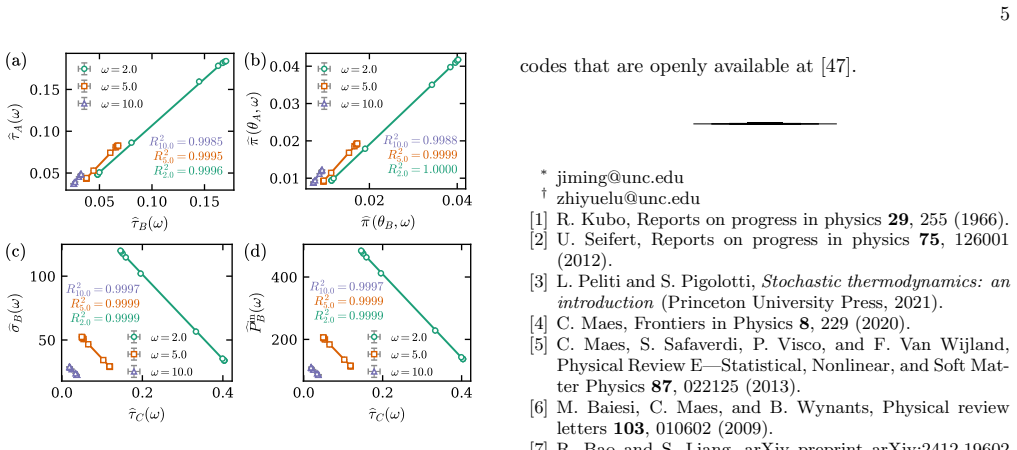
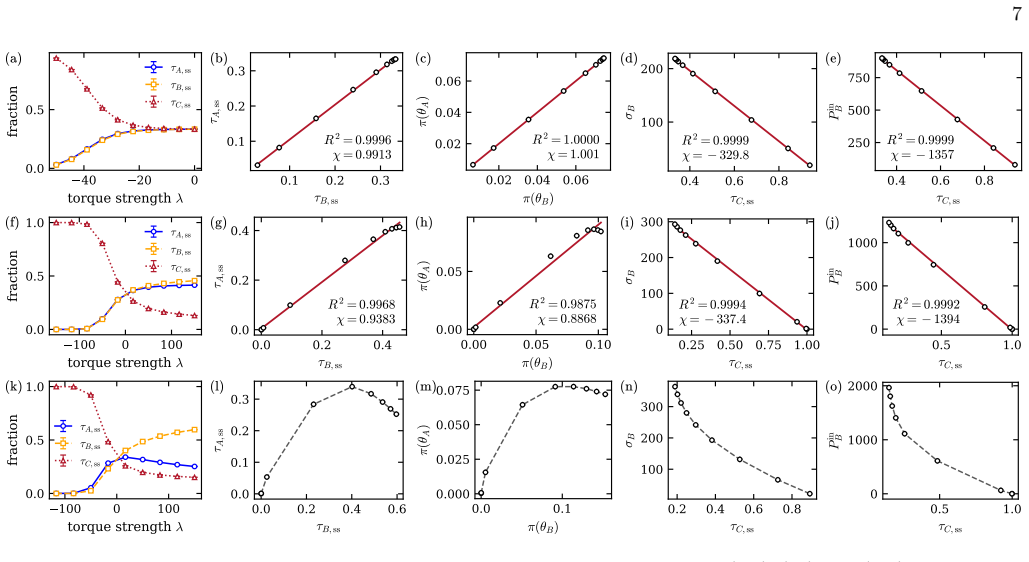
When a dynamical parameter is locally perturbed at a single position in nonequilibrium overdamped Langevin systems, the stationary densities at any two positions are linearly related. This leads to mutual linearity among different stationary state-current observables. The theory extends the mutual linearity to non-stationary relaxation processes in the Laplace domain, revealing that it originates from the same one-dimensional response structure as in discrete systems, and demonstrates robustness under finite-width perturbations with an application to the F1-ATPase rotary motor model.
What carries the argument
The mutual linearity relation, which states that stationary densities at distinct positions remain proportional under a localized parameter perturbation and thereby connects multiple current observables through the underlying one-dimensional response structure.
If this is right
- The framework supplies a direct rule for controlling and designing nonequilibrium responses in continuous systems.
- Mutual linearity connects any pair of stationary state-current observables without additional calculation.
- The linear relation extends from stationary states to relaxation processes when examined in the Laplace domain.
- The relation remains valid for perturbations that have finite but still localized width.
- The same linearity appears in the F1-ATPase rotary motor model and can be used to predict its response.
Where Pith is reading between the lines
- If the relation is general, it may let researchers predict responses in complex continuous systems by measuring densities or currents at only two locations rather than solving the full equation everywhere.
- The one-dimensional structure identified here could be checked for signatures in higher-dimensional or multi-particle nonequilibrium models.
- Because the linearity survives finite-width perturbations, it may apply to experimental setups where perfect point perturbations are impossible.
Load-bearing premise
The dynamics must be overdamped Langevin with a unique stationary state, and any perturbation must be applied locally at one position.
What would settle it
Solve the Fokker-Planck equation for a one-dimensional overdamped Langevin system, apply a local perturbation of varying strength at position x, and test whether the ratio of stationary densities at positions y and z stays exactly constant.
Figures

read the original abstract
Understanding how nonequilibrium systems respond to perturbations is a central challenge in physics. In this work, we establish mutual linearity in nonequilibrium overdamped Langevin systems. This theory provides a framework for controlling and designing nonequilibrium responses in continuous systems. When a dynamical parameter is locally perturbed at a single position, the stationary densities at any two positions are linearly related. It further leads to mutual linearity among different stationary state-current observables. We also extend the mutual linearity to non-stationary relaxation processes in the Laplace domain. Our theory reveals that mutual linearity in both discrete and continuous systems originates from the same one-dimensional response structure. We further show that mutual linearity is robust under finite-width perturbations. As an application, we demonstrate the mutual linearity and its finite-width robustness in the F$_1$-ATPase rotary motor model.
Editorial analysis
A structured set of objections, weighed in public.
Referee Report
Summary. The manuscript establishes mutual linearity in nonequilibrium overdamped Langevin dynamics. When a dynamical parameter is locally perturbed at a single position, the stationary densities at any two positions are linearly related; this follows from integrating the first-order stationary Fokker-Planck equation (constant current J) under a localized drift perturbation. The result extends to mutual linearity among different stationary state-current observables, to non-stationary relaxation processes in the Laplace domain, and remains valid for finite-width perturbations by continuity. The same one-dimensional response structure is shown to underlie mutual linearity in both discrete and continuous systems. The theory is illustrated by a direct numerical check in the F1-ATPase rotary motor model.
Significance. If the central derivation holds, the work supplies a simple, algebraically explicit framework for controlling and designing nonequilibrium responses in continuous systems. The unification of discrete and continuous cases through the shared one-dimensional structure, the parameter-free character obtained by direct integration of the Fokker-Planck ODE, and the explicit robustness proof for finite-width perturbations are notable strengths. The numerical demonstration on the biologically relevant F1-ATPase model adds practical value and falsifiability.
minor comments (2)
- [Abstract] The abstract states the main results but does not indicate the explicit integration step that yields the linear relation; a single sentence referencing the constant-current Fokker-Planck structure would improve immediate clarity.
- [Application section] In the F1-ATPase application, the specific dynamical parameter that is perturbed and the precise definition of the state-current observables should be stated explicitly in the text (rather than only in a figure caption) to make the numerical check fully reproducible from the manuscript alone.
Simulated Author's Rebuttal
We thank the referee for their positive assessment of our manuscript and for recommending acceptance. We are pleased that the referee recognized the value of the one-dimensional response structure underlying mutual linearity, its extension to discrete and continuous systems, the robustness to finite-width perturbations, and the numerical illustration with the F1-ATPase model.
Circularity Check
No circularity: derivation is direct integration of 1D stationary Fokker-Planck under localized perturbation
full rationale
The paper derives mutual linearity by integrating the first-order ODE obtained from the stationary Fokker-Planck equation (constant probability current J) when the drift perturbation is confined to a single point or finite interval. This algebraic step produces an explicit linear relation between stationary densities at arbitrary positions without invoking fitted parameters, self-definitions, or prior results from the same authors. The extension to Laplace-domain relaxation and finite-width cases follows by continuity of the integrating factor. The F1-ATPase example is a numerical verification of the same 1D construction. No load-bearing step reduces to a tautology or self-citation chain; the result is a straightforward consequence of the 1D continuity equation and is self-contained against external benchmarks.
Axiom & Free-Parameter Ledger
axioms (2)
- domain assumption The system obeys overdamped Langevin dynamics
- domain assumption A stationary state exists
Reference graph
Works this paper leans on
-
[1]
Kubo, Reports on progress in physics29, 255 (1966)
R. Kubo, Reports on progress in physics29, 255 (1966)
work page 1966
-
[2]
Seifert, Reports on progress in physics75, 126001 (2012)
U. Seifert, Reports on progress in physics75, 126001 (2012)
work page 2012
-
[3]
L. Peliti and S. Pigolotti,Stochastic thermodynamics: an introduction(Princeton University Press, 2021)
work page 2021
- [4]
-
[5]
C. Maes, S. Safaverdi, P. Visco, and F. Van Wijland, Physical Review E—Statistical, Nonlinear, and Soft Mat- ter Physics87, 022125 (2013)
work page 2013
- [6]
-
[7]
Nonlinear response identities and bounds for nonequilibrium steady states,
R. Bao and S. Liang, arXiv preprint arXiv:2412.19602 (2024)
-
[8]
T. Aslyamov, K. Ptaszy´ nski, and M. Esposito, Physical Review Letters134, 157101 (2025)
work page 2025
-
[9]
K. Ptaszy´ nski, T. Aslyamov, and M. Esposito, Physical Review E113, 024131 (2026)
work page 2026
-
[11]
Dynamical Fluctuation-Response Relations
T. Aslyamov and M. Esposito, arXiv preprint arXiv:2604.24626 (2026)
work page internal anchor Pith review Pith/arXiv arXiv 2026
-
[12]
J. Zheng and Z. Lu, arXiv preprint arXiv:2509.19606 (2025)
work page internal anchor Pith review Pith/arXiv arXiv 2025
- [13]
- [14]
-
[15]
Thermodynamic and kinetic bounds for finite-frequency fluctuation-response,
J. Zheng and Z. Lu, arXiv preprint arXiv:2602.18631 (2026)
-
[16]
E. Kwon, H.-M. Chun, H. Park, and J. S. Lee, Physical Review Letters135, 097101 (2025)
work page 2025
-
[17]
A. Dechant, arXiv preprint arXiv:2510.15228 (2025)
-
[18]
A. Dechant and S.-i. Sasa, Proceedings of the National Academy of Sciences117, 6430 (2020)
work page 2020
- [19]
-
[20]
Spectral Fluctuation-Dissipation-Response Inequalities
J. Gu, arXiv preprint arXiv:2604.20362 (2026)
work page internal anchor Pith review Pith/arXiv arXiv 2026
-
[21]
T. Aslyamov, K. Ptaszy´ nski, and M. Esposito, Physical Review Letters136, 067102 (2026)
work page 2026
- [22]
-
[23]
S. Dal Cengio, D. Levis, and I. Pagonabarraga, Physical review letters123, 238003 (2019)
work page 2019
-
[24]
L. K. Davis, K. Proesmans, and ´E. Fodor, Physical Re- view X14, 011012 (2024)
work page 2024
-
[25]
T. H. Ueon, J. P. Patterson, and J. R. Green, Proceedings of the National Academy of Sciences123, e2531136123 (2026)
work page 2026
- [26]
-
[27]
Y. Tu, T. S. Shimizu, and H. C. Berg, Proceedings of the National Academy of Sciences105, 14855 (2008)
work page 2008
-
[28]
H. H. Mattingly and Y. Tu, Nature Physics , 1 (2026)
work page 2026
-
[29]
P. E. Harunari, S. Dal Cengio, V. Lecomte, and M. Po- lettini, Physical Review Letters133, 047401 (2024)
work page 2024
- [30]
- [31]
-
[32]
Mutual Linearity in and out of Stationarity for Markov Jump Processes: A Trajectory-Based Approach
J. Zheng and Z. Lu, arXiv preprint arXiv:2604.06162 (2026)
work page internal anchor Pith review Pith/arXiv arXiv 2026
-
[33]
F. Khodabandehlou, C. Maes, and K. Netoˇ cn` y, Journal of Physics A: Mathematical and Theoretical58, 155002 (2025)
work page 2025
-
[34]
S. Dal Cengio, P. E. Harunari, V. Lecomte, and M. Po- lettini, SciPost Physics19, 111 (2025)
work page 2025
- [35]
-
[36]
H. Turlier, D. A. Fedosov, B. Audoly, T. Auth, N. S. Gov, C. Sykes, J.-F. Joanny, G. Gompper, and T. Betz, Nature physics12, 513 (2016)
work page 2016
- [37]
- [38]
-
[39]
J. Gieseler, J. R. Gomez-Solano, A. Magazz` u, I. P´ erez Castillo, L. P´ erez Garc´ ıa, M. Gironella-Torrent, X. Viader-Godoy, F. Ritort, G. Pesce, A. V. Arzola, et al., Advances in Optics and Photonics13, 74 (2021)
work page 2021
-
[40]
C. Gonzalez-Ballestero, M. Aspelmeyer, L. Novotny, R. Quidant, and O. Romero-Isart, Science374, eabg3027 (2021)
work page 2021
-
[41]
D. Hempston, J. Vovrosh, M. Toroˇ s, G. Winstone, M. Rashid, and H. Ulbricht, Applied Physics Letters111 (2017)
work page 2017
-
[42]
See Supplemental Material at [URL] for more details
-
[43]
A. W. Lau and T. C. Lubensky, Physical Review E—Statistical, Nonlinear, and Soft Matter Physics76, 011123 (2007)
work page 2007
-
[44]
P. Reimann, C. Van den Broeck, H. Linke, P. H¨ anggi, J. Rubi, and A. P´ erez-Madrid, Physical review letters 87, 010602 (2001)
work page 2001
- [45]
-
[46]
T. Mishima, D. Gupta, Y. Nakayama, W. C. Wareham, T. Ohyama, D. A. Sivak, and S. Toyabe, Physical Review Letters135, 148402 (2025)
work page 2025
-
[47]
Zheng, (2026), https://github.com/Axeho2/Mutual- Linearity-in-Nonequilibrium-Langevin-Dynamics
J. Zheng, (2026), https://github.com/Axeho2/Mutual- Linearity-in-Nonequilibrium-Langevin-Dynamics
work page 2026
-
[48]
V. Blickle, T. Speck, C. Lutz, U. Seifert, and C. Bechinger, Physical review letters98, 210601 (2007)
work page 2007
-
[49]
V. Blickle, T. Speck, U. Seifert, and C. Bechinger, Phys- ical Review E—Statistical, Nonlinear, and Soft Matter Physics75, 060101 (2007)
work page 2007
-
[50]
J. R. Gomez-Solano, A. Petrosyan, S. Ciliberto, R. Chetrite, and K. Gawedzki, Physical review letters 103, 040601 (2009)
work page 2009
-
[51]
V. Blickle, J. Mehl, and C. Bechinger, Physical Review E—Statistical, Nonlinear, and Soft Matter Physics79, 060104 (2009)
work page 2009
- [52]
-
[53]
M. Gavrilov and J. Bechhoefer, Philosophical Transac- tions of the Royal Society A: Mathematical, Physical and Engineering Sciences375(2017)
work page 2017
- [54]
-
[55]
J. A. Albay, G. Paneru, H. K. Pak, and Y. Jun, Optics express26, 29906 (2018)
work page 2018
-
[56]
J. E. Curtis, B. A. Koss, and D. G. Grier, Optics com- munications207, 169 (2002)
work page 2002
-
[57]
D. G. Grier and Y. Roichman, Applied optics45, 880 (2006)
work page 2006
-
[58]
Y. Roichman, V. Wong, and D. G. Grier, Physical Review E—Statistical, Nonlinear, and Soft Matter Physics75, 011407 (2007)
work page 2007
-
[59]
Mutual Linearity in Nonequilibrium Langevin Dynamics
S. Thapa, D. Zaretzky, R. Vatash, G. Gradziuk, C. Broedersz, Y. Shokef, and Y. Roichman, SciPost Physics17, 096 (2024). END MA TTER Detailed steady-state simulations.— In the main text, we showed a representative steady-state mutual-linearity test using the local entropy-production observableσ B. Here we provide the complete set of steady-state sim- ulati...
work page 2024
-
[60]
A. W. Lau and T. C. Lubensky, State-dependent diffusion: Thermodynamic consistency and its path integral formulation, Physical Review E—Statistical, Nonlinear, and Soft Matter Physics76, 011123 (2007)
work page 2007
- [61]
discussion (0)
Sign in with ORCID, Apple, or X to comment. Anyone can read and Pith papers without signing in.