Recognition: 2 theorem links
· Lean TheoremMutual Linearity in and out of Stationarity for Markov Jump Processes: A Trajectory-Based Approach
Pith reviewed 2026-05-10 18:20 UTC · model grok-4.3
The pith
Trajectory-based derivation extends mutual linearity to non-stationary relaxation in Markov jump processes.
A machine-rendered reading of the paper's core claim, the machinery that carries it, and where it could break.
Core claim
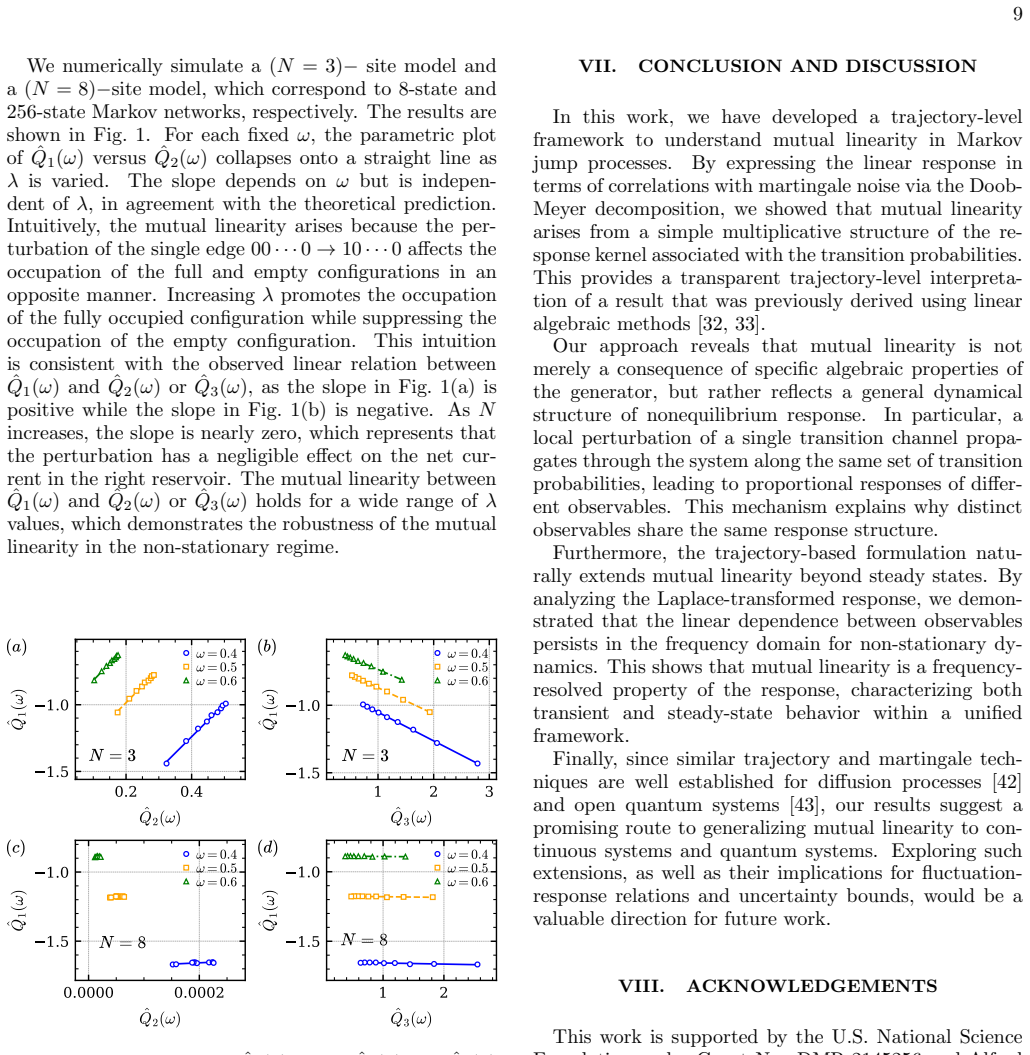
By applying trajectory-level linear response theory to a Markov jump process whose single-edge transition rate is perturbed, the authors derive that the resulting changes in any two observables remain linearly dependent throughout the non-stationary relaxation phase, for both state observables and counting observables.
What carries the argument
trajectory-level linear response theory, which expresses the first-order change in an observable expectation as an average over perturbed trajectories
If this is right
- Mutual linearity applies directly to non-stationary relaxation for state observables.
- The same linear dependence holds for counting observables during relaxation.
- The trajectory formulation identifies the path-level origin of the mutual linearity relation.
- The method opens a route to the same relation in diffusion processes and open quantum systems.
Where Pith is reading between the lines
- The result suggests checking whether similar linear relations appear in experimental time-series data from chemical reaction networks that have not yet reached steady state.
- It may link to other nonequilibrium response identities that are currently stated only for stationary conditions.
- Simple two- or three-state jump models could be simulated to quantify how quickly the linear dependence emerges after a rate perturbation.
Load-bearing premise
The derivation assumes trajectory-level linear response theory remains valid when applied to the non-stationary relaxation dynamics of Markov jump processes.
What would settle it
A numerical simulation of a small Markov jump network in which the linear dependence between two observables is measured during the transient after a single-edge rate perturbation and found to deviate systematically from the predicted relation while still holding in the long-time limit.
Figures
read the original abstract
Nonequilibrium response theory is a fundamental framework for understanding how physical systems respond to perturbations. Recently, a mutual linearity has been discovered for Markov jump processes using linear algebra analysis. This mutual linearity states that two observables are linearly dependent on each other in the long-time limit when the transition rate of a single edge is altered. It has also been extended to non-stationary cases for current observables. In this work, we provide a trajectory-based derivation of mutual linearity utilizing the trajectory-level linear response theory. The trajectory approach allows us to generalize the mutual linearity to non-stationary relaxation dynamics for state observables and counting observables. Our results shed light on the fundamental response properties far from equilibrium and the trajectory-level origin of mutual linearity. Our trajectory-based approach makes it possible to generalize the mutual linearity to a broader class of systems, including diffusion processes and open quantum systems.
Editorial analysis
A structured set of objections, weighed in public.
Referee Report
Summary. The manuscript presents a trajectory-based derivation of mutual linearity for Markov jump processes, extending a prior linear-algebra result to non-stationary relaxation dynamics. Using trajectory-level linear response theory, it claims to establish that two observables remain linearly dependent when a single edge rate is perturbed, now holding for both state observables and counting observables during relaxation from arbitrary initial conditions. The approach is positioned as enabling future generalizations to diffusion processes and open quantum systems.
Significance. If the central derivation is rigorous and the non-stationary extension holds without hidden restrictions, the work supplies a trajectory-level origin for mutual linearity and broadens its scope beyond the long-time stationary limit. This could unify response properties across nonequilibrium Markovian systems and provide a template for similar relations in continuous-state or quantum settings.
major comments (2)
- [Abstract and trajectory-response derivation] The non-stationary extension for state observables (Abstract and the section deriving the trajectory response) invokes trajectory-level linear response without stating the precise initial probability vector or the instant at which the rate perturbation is applied. Standard trajectory response formulas acquire transient corrections when the system starts far from stationarity; the manuscript must specify whether the perturbation occurs at t=0 from an arbitrary p(0) or after equilibration, and whether any additional averaging or long-time limit is taken to recover exact mutual linearity.
- [Extension to counting observables] The claim that the same mutual-linearity relation holds for counting observables in the non-stationary regime (the paragraph extending prior work) should be accompanied by an explicit check that the integrated current response does not pick up initial-condition-dependent terms that would violate linearity. If the derivation relies on the same trajectory formula used for state observables, the paper must demonstrate why the counting case is free of the transient issues that could affect state observables.
minor comments (2)
- [Notation] Notation for the perturbed rate matrix and the trajectory weight should be introduced once and used consistently; currently the abstract and main text alternate between different symbols for the same object.
- [Introduction] The manuscript would benefit from a short table or diagram contrasting the stationary linear-algebra result with the new trajectory result, highlighting which assumptions are relaxed.
Simulated Author's Rebuttal
We thank the referee for the careful reading and constructive criticism. The comments correctly identify places where the original manuscript was insufficiently explicit about initial conditions and the handling of transients for counting observables. We have revised the manuscript to address both points directly, adding the requested specifications and an explicit verification that no initial-condition-dependent terms violate the linearity for counting observables.
read point-by-point responses
-
Referee: [Abstract and trajectory-response derivation] The non-stationary extension for state observables (Abstract and the section deriving the trajectory response) invokes trajectory-level linear response without stating the precise initial probability vector or the instant at which the rate perturbation is applied. Standard trajectory response formulas acquire transient corrections when the system starts far from stationarity; the manuscript must specify whether the perturbation occurs at t=0 from an arbitrary p(0) or after equilibration, and whether any additional averaging or long-time limit is taken to recover exact mutual linearity.
Authors: We agree that the original text did not state these details with sufficient precision. In the revised manuscript we now explicitly specify that the single-edge rate perturbation is applied at t=0 to a system prepared in an arbitrary initial distribution p(0). The trajectory-level linear response is used at finite times without any long-time limit or additional ensemble averaging. The mutual linearity follows directly from the structure of the first-order response for a single perturbed edge; the transient corrections that appear in the individual response functions are identical (up to the observable) for the two observables under consideration and therefore cancel in the linear dependence relation. A new clarifying paragraph has been inserted in the derivation section. revision: yes
-
Referee: [Extension to counting observables] The claim that the same mutual-linearity relation holds for counting observables in the non-stationary regime (the paragraph extending prior work) should be accompanied by an explicit check that the integrated current response does not pick up initial-condition-dependent terms that would violate linearity. If the derivation relies on the same trajectory formula used for state observables, the paper must demonstrate why the counting case is free of the transient issues that could affect state observables.
Authors: We thank the referee for this observation. The integrated counting observable is constructed from the same trajectory response formula, but the initial-distribution contributions appear only in the unperturbed part of the current and therefore drop out of the first-order response. Consequently they cannot break the linear relation between the two counting observables. To make this transparent we have added an explicit appendix calculation that isolates the initial-condition term and shows it cancels identically in the mutual-linearity identity. This demonstration is independent of the particular form of p(0) and confirms that no additional transient corrections arise for the counting case. revision: yes
Circularity Check
Independent trajectory derivation; prior linear-algebra result cited but not load-bearing
full rationale
The paper cites a prior linear-algebra discovery of mutual linearity but then supplies a distinct trajectory-based derivation that invokes trajectory-level linear response theory to extend the relation to non-stationary relaxation for both state and counting observables. No equation or claim reduces by construction to the cited result or to a fitted parameter; the derivation chain stands on its own trajectory formalism. The single self-citation is therefore minor and non-load-bearing, consistent with normal scholarly practice when an independent route is presented.
Axiom & Free-Parameter Ledger
axioms (1)
- domain assumption Markov jump processes obey standard stochastic trajectory dynamics under rate changes
Lean theorems connected to this paper
-
IndisputableMonolith/Cost/FunctionalEquation.leanwashburn_uniqueness_aczel unclear?
unclearRelation between the paper passage and the cited Recognition theorem.
d⟨Q(τ)⟩/dr_ij = ∫ dt (1/r_ij) ⟨Q(τ) dε_ij(t)⟩; response function R_rij(τ,t) = p_j(t) ∑_l c_l ∫ ds [P(l,s|i)-P(l,s|j)]
-
IndisputableMonolith/Foundation/RealityFromDistinction.leanreality_from_one_distinction unclear?
unclearRelation between the paper passage and the cited Recognition theorem.
lim τ→∞ d⟨Q_m(τ)⟩/dr_ij = π_j τ ∑_l c_l^{(m)} (Z_li - Z_lj) + O(1); ratio χ independent of r_ij
What do these tags mean?
- matches
- The paper's claim is directly supported by a theorem in the formal canon.
- supports
- The theorem supports part of the paper's argument, but the paper may add assumptions or extra steps.
- extends
- The paper goes beyond the formal theorem; the theorem is a base layer rather than the whole result.
- uses
- The paper appears to rely on the theorem as machinery.
- contradicts
- The paper's claim conflicts with a theorem or certificate in the canon.
- unclear
- Pith found a possible connection, but the passage is too broad, indirect, or ambiguous to say the theorem truly supports the claim.
Forward citations
Cited by 2 Pith papers
-
Graph theoretic derivation of mutual linearity for transient probabilities and hitting time distributions in Markov networks
Graph theory yields explicit combinatorial formulas showing mutual linearity for transient occupation probabilities and hitting time distributions in Markov networks.
-
Mutual Linearity in Nonequilibrium Langevin Dynamics
Local perturbations in nonequilibrium Langevin dynamics induce linear relations between stationary densities and currents at different positions due to an underlying one-dimensional response structure.
Reference graph
Works this paper leans on
-
[1]
Mora, Physical limit to concentration sensing amid spurious ligands, Physical review letters115, 038102 (2015)
T. Mora, Physical limit to concentration sensing amid spurious ligands, Physical review letters115, 038102 (2015). 10
2015
-
[2]
Bialek and S
W. Bialek and S. Setayeshgar, Physical limits to biochem- ical signaling, Proceedings of the National Academy of Sciences102, 10040 (2005)
2005
-
[3]
Hartich, A
D. Hartich, A. C. Barato, and U. Seifert, Sensory capac- ity: An information theoretical measure of the perfor- mance of a sensor, Physical Review E93, 022116 (2016)
2016
-
[4]
B. Wark, B. N. Lundstrom, and A. Fairhall, Sensory adaptation, Current opinion in neurobiology17, 423 (2007)
2007
-
[5]
G. Lan, P. Sartori, S. Neumann, V. Sourjik, and Y. Tu, The energy–speed–accuracy trade-off in sensory adapta- tion, Nature physics8, 422 (2012)
2012
-
[6]
Conti and T
D. Conti and T. Mora, Nonequilibrium dynamics of adap- tation in sensory systems, Physical Review E106, 054404 (2022)
2022
-
[7]
C. S. Pittendrigh, On temperature independence in the clock system controlling emergence time in drosophila, Proceedings of the National Academy of Sciences40, 1018 (1954)
1954
-
[8]
C. H. Johnson and M. J. Rust,Circadian rhythms in bacteria and microbiomes, Vol. 409 (Springer, 2021)
2021
-
[9]
J. B. Hogenesch and H. R. Ueda, Understanding systems- level properties: timely stories from the study of clocks, Nature Reviews Genetics12, 407 (2011)
2011
-
[10]
Ay and D
N. Ay and D. C. Krakauer, Geometric robustness theory and biological networks, Theory in biosciences125, 93 (2007)
2007
- [11]
-
[12]
Maes, Response theory: a trajectory-based approach, Frontiers in Physics8, 229 (2020)
C. Maes, Response theory: a trajectory-based approach, Frontiers in Physics8, 229 (2020)
2020
-
[13]
C. Maes, S. Safaverdi, P. Visco, and F. Van Wijland, Fluctuation-response relations for nonequilibrium diffu- sions with memory, Physical Review E—Statistical, Non- linear, and Soft Matter Physics87, 022125 (2013)
2013
-
[14]
Baiesi, C
M. Baiesi, C. Maes, and B. Wynants, Fluctuations and response of nonequilibrium states, Physical review letters 103, 010602 (2009)
2009
-
[15]
Baiesi and C
M. Baiesi and C. Maes, An update on the nonequilib- rium linear response, New Journal of Physics15, 013004 (2013)
2013
-
[16]
Seifert and T
U. Seifert and T. Speck, Fluctuation-dissipation theorem in nonequilibrium steady states, EPL (Europhysics Let- ters)89, 10007 (2010)
2010
-
[17]
Pagare, Z
A. Pagare, Z. Zhang, J. Zheng, and Z. Lu, Stochastic distinguishability of markovian trajectories, The Journal of Chemical Physics160(2024)
2024
-
[18]
J. Zheng and Z. Lu, Nonequilibrium macroscopic re- sponse relations for counting statistics, arXiv preprint arXiv:2511.02041 (2025)
-
[19]
Dechant and S.-i
A. Dechant and S.-i. Sasa, Fluctuation–response in- equality out of equilibrium, Proceedings of the National Academy of Sciences117, 6430 (2020)
2020
-
[20]
J. Zheng and Z. Lu, Nonlinear response relations and fluctuation-response inequalities for nonequilibrium stochastic systems, arXiv preprint arXiv:2509.19606 (2025)
work page internal anchor Pith review Pith/arXiv arXiv 2025
-
[21]
Zheng and Z
J. Zheng and Z. Lu, Universal response inequalities be- yond steady states via trajectory information geometry, Physical Review E112, L012103 (2025)
2025
-
[22]
Zheng and Z
J. Zheng and Z. Lu, Unified linear fluctuation-response theory arbitrarily far from equilibrium, Physical Review E112, 064103 (2025)
2025
-
[23]
J. Zheng and Z. Lu, Thermodynamic and kinetic bounds for finite-frequency fluctuation-response, arXiv preprint arXiv:2602.18631 (2026)
-
[24]
Kwon, H.-M
E. Kwon, H.-M. Chun, H. Park, and J. S. Lee, Fluctuation-response inequalities for kinetic and entropic perturbations, Physical Review Letters135, 097101 (2025)
2025
-
[25]
J. S. Lee, J.-M. Park, and H. Park, Universal form of ther- modynamic uncertainty relation for langevin dynamics, Physical Review E104, L052102 (2021)
2021
-
[26]
A. Dechant, Finite-frequency fluctuation-response in- equality, arXiv preprint arXiv:2510.15228 (2025)
-
[27]
Hasegawa and T
Y. Hasegawa and T. Van Vu, Uncertainty relations in stochastic processes: An information inequality ap- proach, Physical Review E99, 062126 (2019)
2019
-
[28]
Van Vu, Fundamental bounds on precision and re- sponse for quantum trajectory observables, PRX Quan- tum6, 010343 (2025)
T. Van Vu, Fundamental bounds on precision and re- sponse for quantum trajectory observables, PRX Quan- tum6, 010343 (2025)
2025
-
[29]
Aslyamov, K
T. Aslyamov, K. Ptaszy´ nski, and M. Esposito, Nonequi- librium fluctuation-response relations: From identities to bounds, Physical Review Letters134, 157101 (2025)
2025
-
[30]
Aslyamov, K
T. Aslyamov, K. Ptaszy´ nski, and M. Esposito, Macro- scopic fluctuation-response theory and its use for gene regulatory networks, Physical Review Letters136, 067102 (2026)
2026
-
[31]
Ptaszy´ nski, T
K. Ptaszy´ nski, T. Aslyamov, and M. Esposito, Nonequi- librium fluctuation-response relations for state-current correlations, Physical Review E113, 024131 (2026)
2026
-
[32]
P. E. Harunari, S. Dal Cengio, V. Lecomte, and M. Polet- tini, Mutual linearity of nonequilibrium network currents, Physical Review Letters133, 047401 (2024)
2024
-
[33]
Bebon and T
R. Bebon and T. Speck, Mutual linearity is a generic property of steady-state markov networks, Physical Re- view Letters136, 137401 (2026)
2026
-
[34]
Chun and J
H.-M. Chun and J. M. Horowitz, Trade-offs between number fluctuations and response in nonequilibrium chemical reaction networks, The Journal of Chemical Physics158(2023)
2023
-
[35]
Fernandes Martins and J
G. Fernandes Martins and J. M. Horowitz, Topologically constrained fluctuations and thermodynamics regulate nonequilibrium response, Physical Review E108, 044113 (2023)
2023
-
[36]
J. A. Owen, T. R. Gingrich, and J. M. Horowitz, Univer- sal thermodynamic bounds on nonequilibrium response with biochemical applications, Physical Review X10, 011066 (2020)
2020
-
[37]
Aslyamov and M
T. Aslyamov and M. Esposito, General theory of static response for markov jump processes, Physical Review Letters133, 107103 (2024)
2024
-
[38]
Meyer, A decomposition theorem for supermartin- gales, Illinois Journal of Mathematics6, 193 (1962)
P.-A. Meyer, A decomposition theorem for supermartin- gales, Illinois Journal of Mathematics6, 193 (1962)
1962
-
[39]
L. T. Stutzer, C. Dieball, and A. Godec, Stochastic calculus for pathwise observables of markov-jump pro- cesses: Unification of diffusion and jump dynamics, arXiv preprint arXiv:2508.04647 (2025)
work page internal anchor Pith review Pith/arXiv arXiv 2025
-
[40]
Peliti and S
L. Peliti and S. Pigolotti,Stochastic thermodynamics: an introduction(Princeton University Press, 2021)
2021
-
[41]
D. T. Gillespie, Exact stochastic simulation of coupled chemical reactions, The journal of physical chemistry81, 2340 (1977)
1977
-
[42]
Dieball and A
C. Dieball and A. Godec, Direct route to thermodynamic uncertainty relations and their saturation, Physical Re- view Letters130, 087101 (2023). 11
2023
-
[43]
Kwon and J
E. Kwon and J. S. Lee, A unified framework for classi- cal and quantum uncertainty relations using stochastic representations, Communications Physics8, 444 (2025)
2025
-
[44]
Zheng, (2026), https://github.com/Axeho2/Mutual- Linearity-in-and-out-of-Stationarity-for-Markov-Jump- Processes-A-Trajectory-Based-Approach
J. Zheng, (2026), https://github.com/Axeho2/Mutual- Linearity-in-and-out-of-Stationarity-for-Markov-Jump- Processes-A-Trajectory-Based-Approach
2026
discussion (0)
Sign in with ORCID, Apple, or X to comment. Anyone can read and Pith papers without signing in.