Recognition: 2 theorem links
· Lean TheoremReducibility of native weighted graphs on Rydberg Arrays
Pith reviewed 2026-05-11 03:19 UTC · model grok-4.3
The pith
Classical kernelisation leaves dense native unit-disk graphs for Rydberg processors with finite irreducible kernels.
A machine-rendered reading of the paper's core claim, the machinery that carries it, and where it could break.
Core claim
State-of-the-art kernelisation applied to random unit-disk graphs of the MIS and MWIS problems reduces many small or sparse instances to empty, but dense instances retain finite irreducible kernels; weights raise reducibility while longer interaction ranges lower it, and the kernels that survive would demand substantial embedding overheads on quantum hardware, making direct execution of the native graph the lower-cost option.
What carries the argument
Kernelisation techniques that repeatedly apply reduction rules to simplify graph instances of the maximum independent set problem before any solver is called.
If this is right
- Near-term quantum optimisation benchmarks should focus on dense native unit-disk instances that survive classical reduction.
- Direct execution of the original graph is cheaper than first reducing and then embedding when kernels remain.
- Weighted versions of the problem become easier for classical preprocessing than unweighted ones.
- Longer-range Rydberg interactions produce graphs that are harder to reduce classically.
Where Pith is reading between the lines
- Hybrid classical-quantum workflows could run reductions first and hand only the irreducible core to the quantum device.
- The same pattern may appear in other hardware-native graphs beyond Rydberg arrays, such as those with fixed-range couplings.
- Quantum advantage claims for optimisation may need to be tested specifically on instances whose kernels cannot be made trivial.
Load-bearing premise
Random unit-disk graphs of chosen size and density accurately represent the interaction graphs that can be realized on current Rydberg atom arrays.
What would settle it
A concrete dense random unit-disk graph instance that kernelisation reduces all the way to the empty graph, or a reduced kernel whose non-native embedding on Rydberg hardware uses fewer total atoms and gates than the original native instance.
Figures


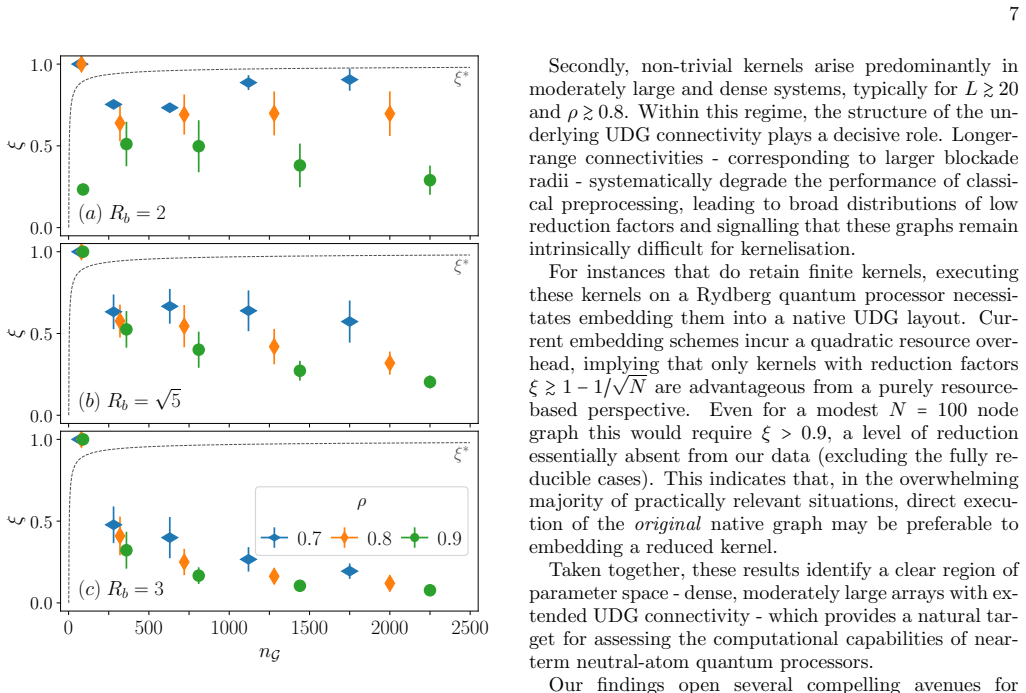
read the original abstract
We investigate the classical reducibility of random unit-disk graph (UDG) instances of the maximum independent set (MIS) and maximum weighted independent set (MWIS) problems, which can be natively realised in Rydberg atom quantum processors. Using state-of-the-art kernelisation techniques, we systematically probe how far classical preprocessing can simplify such native optimisation problems of varying size and connectivity. While many small or sparse instances can be fully reduced, dense graphs often retain finite irreducible kernels even after extensive reductions. Introducing vertex weights tends to increase reducibility, whereas extending the interaction range in the underlying UDG connectivity suppresses the reduction efficiency. By exploring where classical reductions cease to be effective, we aim to delineate the regime of problem instances that remain computationally demanding - those most relevant for testing and benchmarking near-term quantum optimisation hardware. We find that for the remaining finite kernels, quantum execution would require non-native embeddings with substantial resource overheads, suggesting that directly running native instances may be more practical than embedding a reduced kernel.
Editorial analysis
A structured set of objections, weighed in public.
Referee Report
Summary. The paper investigates the classical reducibility of random unit-disk graph (UDG) instances for the maximum independent set (MIS) and maximum weighted independent set (MWIS) problems, which are native to Rydberg atom quantum processors. Using state-of-the-art kernelisation techniques, it systematically probes instances of varying size and connectivity. The authors report that many small or sparse instances can be fully reduced, while dense graphs often retain finite irreducible kernels. Vertex weights tend to increase reducibility, whereas longer interaction ranges suppress reduction efficiency. They conclude that for remaining finite kernels, quantum execution would require non-native embeddings with substantial resource overheads, suggesting that directly running native instances may be more practical than embedding a reduced kernel.
Significance. If the central empirical trends hold and the random UDG model is representative, this work helps delineate regimes of problem instances that remain computationally demanding after classical preprocessing, which is relevant for benchmarking near-term quantum optimization hardware. The systematic variation of parameters (size, density, weights, range) and reporting of clear trends provide useful empirical data on the limits of kernelisation for these native graphs. The study does not include machine-checked proofs or open code, but its computational approach could support reproducibility if methods and instances are fully detailed.
major comments (2)
- [Graph generation and methods] The strongest claim—that remaining finite kernels would require non-native embeddings with substantial overheads, making direct native execution preferable—depends on random UDGs being representative of native Rydberg interaction graphs. Native graphs arise from fixed or programmable 2D atom positions (typically lattices), inducing UDGs with strict planarity, bounded degree sequences, and spatial edge correlations. Random UDGs lack these constraints and can produce topologically different instances. This assumption is load-bearing for the practical implications but is not tested via comparison to lattice-based or hardware-realizable graphs.
- [Results and conclusions] The conclusion on embedding overheads for finite kernels is stated qualitatively without quantitative estimates. No specific kernel sizes, reduction ratios, or references to embedding costs (e.g., for the reported dense-graph kernels) are provided to support that the overheads are 'substantial' relative to direct native execution. This weakens the suggestion that direct native instances are more practical.
minor comments (1)
- [Abstract and methods] The abstract and methods refer to 'state-of-the-art kernelisation techniques' without naming the specific algorithms or implementations used. Including these details (or pseudocode) would improve clarity and reproducibility.
Simulated Author's Rebuttal
We thank the referee for their constructive comments, which highlight important aspects of scope and evidence strength in our work on the classical reducibility of unit-disk graphs. We address each major comment below, indicating where revisions will be incorporated.
read point-by-point responses
-
Referee: [Graph generation and methods] The strongest claim—that remaining finite kernels would require non-native embeddings with substantial overheads, making direct native execution preferable—depends on random UDGs being representative of native Rydberg interaction graphs. Native graphs arise from fixed or programmable 2D atom positions (typically lattices), inducing UDGs with strict planarity, bounded degree sequences, and spatial edge correlations. Random UDGs lack these constraints and can produce topologically different instances. This assumption is load-bearing for the practical implications but is not tested via comparison to lattice-based or hardware-realizable graphs.
Authors: We agree that random unit-disk graphs do not incorporate the additional structural constraints present in lattice-based Rydberg arrays, such as planarity, bounded degree sequences, and spatial edge correlations. Our use of random UDGs follows established modeling practices in the Rydberg optimization literature to isolate the effects of size, density, and weights on reducibility. We acknowledge that this choice limits direct extrapolation to hardware instances. In the revised manuscript, we will add a discussion paragraph clarifying this distinction, noting that the reported trends (e.g., the suppressing effect of density and interaction range) are expected to be relevant but that targeted comparisons to lattice graphs remain an important direction for future work. This revision clarifies the scope without altering the core empirical results. revision: partial
-
Referee: [Results and conclusions] The conclusion on embedding overheads for finite kernels is stated qualitatively without quantitative estimates. No specific kernel sizes, reduction ratios, or references to embedding costs (e.g., for the reported dense-graph kernels) are provided to support that the overheads are 'substantial' relative to direct native execution. This weakens the suggestion that direct native instances are more practical.
Authors: We accept that the claim regarding embedding overheads is currently qualitative and would be strengthened by quantitative support. While the manuscript reports the retention of finite irreducible kernels for dense graphs, specific kernel sizes, reduction ratios, and explicit comparisons to embedding costs are not detailed in the conclusions. In the revised version, we will include quantitative data drawn from our experiments (such as average irreducible kernel sizes and reduction ratios for dense instances) together with references to typical minor-embedding overhead factors in Rydberg hardware. This will allow a more concrete assessment of whether direct native execution is preferable for the remaining kernels. revision: yes
Circularity Check
No significant circularity in empirical computational study
full rationale
The paper is an empirical investigation that generates random unit-disk graphs, applies standard kernelisation algorithms for MIS/MWIS, and reports observed reduction outcomes. No derivation chain exists that reduces a claimed result to its own inputs by construction, no parameters are fitted and then relabeled as predictions, and no load-bearing premises rest on self-citations. The central findings on kernel sizes and embedding overheads are direct computational outputs rather than tautological restatements of the input model or prior author work.
Axiom & Free-Parameter Ledger
axioms (1)
- domain assumption Random unit-disk graphs accurately model the connectivity realizable in Rydberg atom arrays
Lean theorems connected to this paper
-
IndisputableMonolith/Foundation/RealityFromDistinction.leanreality_from_one_distinction unclear?
unclearRelation between the paper passage and the cited Recognition theorem.
We find that for the remaining finite kernels, quantum execution would require non-native embeddings with substantial resource overheads
What do these tags mean?
- matches
- The paper's claim is directly supported by a theorem in the formal canon.
- supports
- The theorem supports part of the paper's argument, but the paper may add assumptions or extra steps.
- extends
- The paper goes beyond the formal theorem; the theorem is a base layer rather than the whole result.
- uses
- The paper appears to rely on the theorem as machinery.
- contradicts
- The paper's claim conflicts with a theorem or certificate in the canon.
- unclear
- Pith found a possible connection, but the passage is too broad, indirect, or ambiguous to say the theorem truly supports the claim.
Reference graph
Works this paper leans on
-
[1]
Reduction Philosophy Given a graphG=(V, E)with vertex weightsw∶V→ R≥0, a reduction rule identifies a set of vertices whose membership in an optimal solution is fully determined by its local structure. Removing these vertices and ad- justing the objective value (in the weighted case) yields a smaller problem instanceG ′=(V ′, E′), termed the kernel. Applyi...
-
[2]
A complete list and details can be found in Table 1 of [100]
Examples of Fundamental Reduction Rules In the following we give a brief description of a subset of reduction rules used inLearnAndReduce. A complete list and details can be found in Table 1 of [100]. a. Isolated Vertex.If a vertexvhas a open neigh- bourhood (simply called the neighbourhood)N(v)={u∣ (v, u)∈E}=∅, thenvmust belong to every MIS/MWIS solution...
-
[3]
Learned Reduction: KaMIS’sLearnAndReduce Although many reduction rules are inexpensive, sev- eral of the most powerful ones - such as advanced neighbourhood-dominance checks, generalised twin rules, or deep folding cascades - can be costly to evaluate. TheLearnAndReduceframework [74] incorporates ma- chine learning to accelerate these expensive reductions...
-
[4]
2 (c) shows the same analysis for the largest studied array ofL=50
Fig. 2 (c) shows the same analysis for the largest studied array ofL=50. The vast majority of graphs did yield a finite kernel with e.g. the largest mean reduction factor forρ=0.9 (atR b = √
-
[5]
dropping by a factor of 3 from ¯ξ∼0.35 (L=20) down to ¯ξ∼0.12 forL=50. The remaining connectivities are showing even smaller reductions, and we again find very similar behaviour for the different fillingsρin the array. Even forR b = √ 8 andρ<1 did we find graphs which are not fully reducible, where arrays with a larger defect density appear to be harder f...
-
[6]
was deemed ‘hard’ (i.e. had a finite kernel), here we see that cer- tain weighted instances are solved to optimality (empty kernel). Furthermore, Fig. 3 (b) shows that we find larger mean reduction factors compared to the MIS case. This behaviour is consistent with the interpretation that 6 0.7 0.8 0.9 1.0 ρ 1 √ 2 2 √ 5 √ 8 3 Rb (a) 1 √ 2 2 √ 5 √ 8 3 Rb 0...
work page 2000
-
[7]
V. T. Paschos,Applications of combinatorial optimiza- tion, Vol. 3 (John Wiley & Sons, 2014)
work page 2014
-
[8]
R. M. Karp, Reducibility among combinatorial prob- lems, inComplexity of Computer Computations: Pro- ceedings of a symposium on the Complexity of Computer Computations, edited by R. E. Miller, J. W. Thatcher, and J. D. Bohlinger (Springer US, Boston, MA, 1972) pp. 85–103
work page 1972
-
[9]
C. H. Papadimitriou and K. Steiglitz,Combinatorial op- timization: algorithms and complexity(Courier Corpo- ration, 1998)
work page 1998
-
[10]
B. Korte and J. Vygen, Combinatorial optimization: Theory and algorithms (Springer Berlin Heidelberg, Berlin, Heidelberg, 2018)
work page 2018
-
[11]
Quantum Computation by Adiabatic Evolution
E. Farhi, J. Goldstone, S. Gutmann, and M. Sipser, Quantum computation by adiabatic evolution (2000), arXiv:quant-ph/0001106 [quant-ph]
work page Pith review arXiv 2000
-
[12]
E. Farhi, J. Goldstone, S. Gutmann, J. Lapan, A. Lundgren, and D. Preda, A quantum adiabatic evolution algorithm applied to random instances of an np-complete problem, Science292, 472 (2001), https://www.science.org/doi/pdf/10.1126/science.1057726
- [13]
-
[14]
T. Kadowaki and H. Nishimori, Quantum annealing in the transverse ising model, Phys. Rev. E58, 5355 (1998)
work page 1998
- [15]
- [16]
- [17]
- [18]
-
[19]
N. Astrakhantsev, G. Mazzola, I. Tavernelli, and G. Carleo, Phenomenological theory of variational quan- tum ground-state preparation, Phys. Rev. Res.5, 033225 (2023)
work page 2023
-
[20]
A. Peruzzo, J. McClean, P. Shadbolt, M.-H. Yung, X.-Q. Zhou, P. J. Love, A. Aspuru-Guzik, and J. L. O’Brien, A variational eigenvalue solver on a photonic quantum processor, Nature Communications5, 4213 (2014)
work page 2014
-
[21]
A. Kandala, A. Mezzacapo, K. Temme, M. Takita, M. Brink, J. M. Chow, and J. M. Gambetta, Hardware- efficient variational quantum eigensolver for small molecules and quantum magnets, Nature549, 242 (2017)
work page 2017
- [22]
- [23]
-
[24]
A Quantum Approximate Optimization Algorithm
E. Farhi, J. Goldstone, and S. Gutmann, A quan- tum approximate optimization algorithm (2014), arXiv:1411.4028 [quant-ph]
work page internal anchor Pith review Pith/arXiv arXiv 2014
- [25]
-
[26]
J. Wurtz and P. Love, Maxcut quantum approximate optimization algorithm performance guarantees forp> 1, Phys. Rev. A103, 042612 (2021)
work page 2021
- [27]
- [28]
-
[29]
Lucas, Ising formulations of many np problems, Fron- tiers in physics2, 5 (2014)
A. Lucas, Ising formulations of many np problems, Fron- tiers in physics2, 5 (2014)
work page 2014
- [30]
-
[31]
L. F. P´ erez Armas, S. Creemers, and S. Deleplanque, Solving the resource constrained project scheduling problem with quantum annealing, Scientific Reports14, 16784 (2024)
work page 2024
-
[32]
M. W. Johnson, M. H. S. Amin, S. Gildert, T. Lant- ing, F. Hamze, N. Dickson, R. Harris, A. J. Berkley, J. Johansson, P. Bunyk, E. M. Chapple, C. Enderud, J. P. Hilton, K. Karimi, E. Ladizinsky, N. Ladizinsky, T. Oh, I. Perminov, C. Rich, M. C. Thom, E. Tolka- cheva, C. J. S. Truncik, S. Uchaikin, J. Wang, B. Wil- son, and G. Rose, Quantum annealing with ...
work page 2011
-
[33]
D. De Santis, S. Tirone, S. Marmi, and V. Giovan- netti, Optimized QUBO formulation methods for quan- tum computing, Quantum Science and Technology11, 015056 (2026)
work page 2026
-
[34]
A. D. King, A. Nocera, M. M. Rams, J. Dziarmaga, R. Wiersema, W. Bernoudy, J. Raymond, N. Kaushal, N. Heinsdorf, R. Harris, K. Boothby, F. Altomare, M. Asad, A. J. Berkley, M. Boschnak, K. Chern, H. Christiani, S. Cibere, J. Connor, M. H. Dehn, R. Deshpande, S. Ejtemaee, P. Farre, K. Hamer, E. Hoskinson, S. Huang, M. W. Johnson, S. Kortas, E. Ladizinsky, ...
-
[35]
A. Zaribafiyan, D. J. J. Marchand, and S. S. Changiz Rezaei, Systematic and deterministic graph mi- nor embedding for cartesian products of graphs, Quan- tum Information Processing16, 136 (2017)
work page 2017
-
[36]
E. Pelofske, Comparing three generations of D-Wave quantum annealers for minor embedded combinatorial optimization problems, Quantum Science and Technol- ogy10, 025025 (2025)
work page 2025
-
[37]
Choi, Minor-embedding in adiabatic quantum com- putation: I
V. Choi, Minor-embedding in adiabatic quantum com- putation: I. the parameter setting problem, Quantum Information Processing7, 193 (2008)
work page 2008
-
[38]
Choi, Minor-embedding in adiabatic quantum com- putation: Ii
V. Choi, Minor-embedding in adiabatic quantum com- putation: Ii. minor-universal graph design, Quantum Information Processing10, 343 (2011)
work page 2011
-
[39]
P. Date, R. Patton, C. Schuman, and T. Potok, Effi- ciently embedding QUBO problems on adiabatic quan- tum computers, Quantum Information Processing18, 117 (2019)
work page 2019
-
[40]
A. Ceselli and M. Premoli, On good encodings for quan- tum annealer and digital optimization solvers, Scientific Reports13, 5628 (2023)
work page 2023
- [41]
-
[42]
F. A. Quinton, P. A. S. Myhr, M. Barani, P. Crespo del Granado, and H. Zhang, Quantum annealing applica- tions, challenges and limitations for optimisation prob- lems compared to classical solvers, Scientific Reports15, 12733 (2025)
work page 2025
-
[43]
L. Henriet, L. Beguin, A. Signoles, T. Lahaye, A. Browaeys, G.-O. Reymond, and C. Jurczak, Quan- tum computing with neutral atoms, Quantum4, 327 (2020)
work page 2020
-
[44]
M. Morgado and S. Whitlock, Quantum simulation and computing with rydberg-interacting qubits, AVS Quan- tum Science3, 10.1116/5.0036562 (2021)
-
[45]
D. Bluvstein, H. Levine, G. Semeghini, T. T. Wang, S. Ebadi, M. Kalinowski, A. Keesling, N. Maskara, H. Pichler, M. Greiner, V. Vuleti` c, and M. D. Lukin, A quantum processor based on coherent transport of entangled atom arrays, Nature604, 451 (2022)
work page 2022
-
[46]
S. J. Evered, D. Bluvstein, M. Kalinowski, S. Ebadi, T. Manovitz, H. Zhou, S. H. Li, A. A. Geim, T. T. Wang, N. Maskara, H. Levine, G. Semeghini, M. Greiner, V. Vuleti´ c, and M. D. Lukin, High-fidelity parallel entangling gates on a neutral-atom quantum computer, Nature622, 268 (2023)
work page 2023
-
[47]
D. Bluvstein, S. J. Evered, A. A. Geim, S. H. Li, H. Zhou, T. Manovitz, S. Ebadi, M. Cain, M. Kalinowski, D. Hangleiter, J. P. Bonilla Ataides, N. Maskara, I. Cong, X. Gao, P. Sales Ro- driguez, T. Karolyshyn, G. Semeghini, M. J. Gullans, M. Greiner, V. Vuleti´ c, and M. D. Lukin, Logical quan- tum processor based on reconfigurable atom arrays, Na- ture62...
work page 2024
- [48]
-
[49]
N.-C. Chiu, E. C. Trapp, J. Guo, M. H. Abobeih, L. M. Stewart, S. Hollerith, P. Stroganov, M. Kalinowski, A. A. Geim, S. J. Evered, S. H. Li, L. M. Peters, D. Blu- vstein, T. T. Wang, M. Greiner, V. Vuleti´ c, and M. D. Lukin, Continuous operation of a coherent 3,000-qubit system (2025), arXiv:2506.20660 [quant-ph]
-
[50]
A. G. de Oliveira, E. Diamond-Hitchcock, D. M. Walker, M. T. Wells-Pestell, G. Pelegr´ ı, C. J. Picken, G. P. A. Malcolm, A. J. Daley, J. Bass, and J. D. Pritchard, Demonstration of weighted-graph optimization on a rydberg-atom array using local light shifts, PRX Quan- tum6, 010301 (2025)
work page 2025
-
[51]
M. D. Lukin, M. Fleischhauer, R. Cote, L. M. Duan, D. Jaksch, J. I. Cirac, and P. Zoller, Dipole Block- ade and Quantum Information Processing in Mesoscopic Atomic Ensembles, Phys. Rev. Lett.87, 037901 (2001)
work page 2001
- [52]
-
[53]
M. Saffman, T. G. Walker, and K. Mølmer, Quantum information with Rydberg atoms, Rev. Mod. Phys.82, 2313 (2010)
work page 2010
-
[54]
H. Pichler, S.-T. Wang, L. Zhou, S. Choi, and M. D. Lukin, Quantum Optimization for Maximum Indepen- dent Set Using Rydberg Atom Arrays, 1808.10816 [quant-ph] (2018)
-
[55]
H. Pichler, S.-T. Wang, L. Zhou, S. Choi, and M. D. Lukin, Computational complexity of the Rydberg block- ade in two dimensions, 1809.04954 [quant-ph] (2018)
-
[56]
S. Ebadi, A. Keesling, M. Cain, T. T. Wang, H. Levine, D. Bluvstein, G. Semeghini, A. Omran, J.-G. Liu, R. Samajdar, X.-Z. Luo, B. Nash, X. Gao, B. Barak, E. Farhi, S. Sachdev, N. Gemelke, L. Zhou, S. Choi, H. Pichler, S.-T. Wang, M. Greiner, V. Vuleti` c, and M. D. Lukin, Quantum Optimization of Maximum Inde- pendent Set using Rydberg Atom Arrays, Scienc...
work page 2022
-
[57]
K. Kim, M. Kim, J. Park, A. Byun, and J. Ahn, Quan- tum computing dataset of maximum independent set problem on king lattice of over hundred Rydberg atoms, Scientific Data11, 111 (2024)
work page 2024
-
[58]
K. Goswami, R. Mukherjee, H. Ott, and P. Schmelcher, Solving optimization problems with local light-shift en- coding on Rydberg quantum annealers, Phys. Rev. Res. 6, 023031 (2024)
work page 2024
- [59]
-
[60]
M. Kim, K. Kim, J. Hwang, E.-G. Moon, and J. Ahn, Rydberg quantum wires for maximum independent set problems, Nature Phys.18, 755 (2022)
work page 2022
-
[61]
A. Byun, M. Kim, and J. Ahn, Finding the maximum in- dependent sets of platonic graphs using rydberg atoms, PRX Quantum3, 030305 (2022)
work page 2022
-
[62]
C. Dalyac, L.-P. Henry, M. Kim, J. Ahn, and L. Hen- riet, Exploring the impact of graph locality for the resolution of mis with neutral atom devices (2023), arXiv:2306.13373 [quant-ph]
-
[63]
A. Byun, J. Jung, K. Kim, M. Kim, S. Jeong, H. Jeong, and J. Ahn, Rydberg-atom graphs for quadratic un- constrained binary optimization problems, Advanced Quantum Technologies7, 2300398 (2024)
work page 2024
-
[64]
A. Byun, S. Jeong, and J. Ahn, Programming higher- 10 order interactions of rydberg atoms, Physical Review A 110, 042612 (2024)
work page 2024
- [65]
-
[66]
M. Lanthaler, K. Ender, C. Dlaska, and W. Lech- ner, Quantum optimization with globally driven neutral atom arrays (2024), arXiv:2410.03902 [quant-ph]
-
[67]
M.-T. Nguyen, J.-G. Liu, J. Wurtz, M. D. Lukin, S.- T. Wang, and H. Pichler, Quantum optimization with arbitrary connectivity using Rydberg atom arrays, PRX Quantum4, 010316 (2023)
work page 2023
-
[68]
L. Bombieri, Z. Zeng, R. Tricarico, R. Lin, S. Notar- nicola, M. Cain, M. D. Lukin, and H. Pichler, Quan- tum Adiabatic Optimization with Rydberg Arrays: Lo- calization Phenomena and Encoding Strategies, PRX Quantum6, 020306 (2025)
work page 2025
-
[69]
W. Lechner, P. Hauke, and P. Zoller, A quantum anneal- ing architecture with all-to-all connectivity from local interactions, Science Advances1, e1500838 (2015)
work page 2015
-
[70]
M. Lanthaler, C. Dlaska, K. Ender, and W. Lech- ner, Rydberg-Blockade-Based Parity Quantum Opti- mization, Phys. Rev. Lett.130, 220601 (2023)
work page 2023
-
[71]
S. Stastny, H. P. B¨ uchler, and N. Lang, Functional com- pleteness of planar rydberg blockade structures, Phys. Rev. B108, 085138 (2023)
work page 2023
-
[72]
J. Park, S. Jeong, M. Kim, K. Kim, A. Byun, L. Vig- noli, L.-P. Henry, L. Henriet, and J. Ahn, Rydberg-atom experiment for the integer factorization problem, Phys. Rev. Res.6, 023241 (2024)
work page 2024
-
[73]
M. J. A. Schuetz, R. S. Andrist, G. Salton, R. Yalovet- zky, R. Raymond, Y. Sun, A. Acharya, S. Chakrabarti, M. Pistoia, and H. G. Katzgraber, Quantum Compila- tion Toolkit for Rydberg Atom Arrays with Implications for Problem Hardness and Quantum Speedups (2025), arXiv:2412.14976 [quant-ph]
-
[74]
R. S. Andrist, M. J. Schuetz, P. Minssen, R. Yalovet- zky, S. Chakrabarti, D. Herman, N. Kumar, G. Salton, R. Shaydulin, Y. Sun,et al., Hardness of the maximum- independent-set problem on unit-disk graphs and prospects for quantum speedups, Physical Review Re- search5, 043277 (2023)
work page 2023
-
[75]
M. J. A. Schuetz, R. Yalovetzky, R. S. Andrist, G. Salton, Y. Sun, R. Raymond, S. Chakrabarti, A. Acharya, R. Shaydulin, M. Pistoia, and H. G. Katz- graber, qReduMIS: A Quantum-Informed Reduction Algorithm for the Maximum Independent Set Problem (2025), arXiv:2503.12551 [quant-ph]
-
[76]
F. Barahona, On the computational complexity of ising spin glass models, Journal of Physics A: Mathematical and General15, 3241 (1982)
work page 1982
-
[77]
S. Lamm, P. Sanders, C. Schulz, D. Strash, and R. F. Werneck, Finding near-optimal independent sets at scale, Journal of Heuristics23, 207 (2017)
work page 2017
-
[78]
D. Hespe, C. Schulz, and D. Strash, Scalable kernel- ization for maximum independent sets, ACM J. Exp. Algorithmics24, 10.1145/3355502 (2019)
-
[79]
S. Lamm, C. Schulz, D. Strash, R. Williger, and H. Zhang, Exactly Solving the Maximum Weight Inde- pendent Set Problem on Large Real-World Graphs, in 2019 Proceedings of the Meeting on Algorithm Engineer- ing and Experiments (ALENEX)(2019) pp. 144–158, https://epubs.siam.org/doi/pdf/10.1137/1.9781611975499.12
-
[80]
E. Großmann, K. Langedal, and C. Schulz, Accelerat- ing reductions using graph neural networks and a new concurrent local search for the maximum weight inde- pendent set problem, arXiv preprint arXiv:2412.14198 (2024)
discussion (0)
Sign in with ORCID, Apple, or X to comment. Anyone can read and Pith papers without signing in.