Recognition: 2 theorem links
· Lean TheoremTesting the BH^* Model: a UV-to-Optical Spectral Fitting of The Cliff
Pith reviewed 2026-05-11 03:07 UTC · model grok-4.3
The pith
A multi-component spectral fit to The Cliff naturally produces a solution matching the black hole star model.
A machine-rendered reading of the paper's core claim, the machinery that carries it, and where it could break.
Core claim
A Bagpipes fit that allows stellar, nebular, AGN, and blackbody components to the UV-to-optical spectrum of The Cliff naturally yields a BH*-like solution, with the host inferred as low-mass (log Mstar/Msun ~7.7), metal-poor, dust-attenuated (AV ~0.5 mag), and already assembled log Mstar/Msun ~7 about 200 Myr before z=3.55, while the blackbody accounts for the optical continuum.
What carries the argument
Bagpipes spectral fitting code configured with stellar, nebular, AGN, and blackbody emission components.
If this is right
- The host galaxy mass can range from log Mstar/Msun 7.7 to 8.1 depending on the dust attenuation law chosen.
- The black hole to stellar mass ratio exceeds expectations from standard scaling relations, suggesting either non-coeval growth or revised BH property estimates.
- Modest AGN UV leakage is permitted but remains weakly constrained, allowing both AGN+host and host-dominated UV scenarios.
- The star formation history is relatively smooth with early mass assembly.
Where Pith is reading between the lines
- Applying the same multi-component fitting to other little red dots could test whether the BH* solution is common rather than unique to The Cliff.
- The tension with BH-host scaling relations may point to rapid black hole growth phases in early galaxies that standard relations do not capture.
- Improved constraints on the dust attenuation law would tighten the allowed range of host masses and attenuations.
Load-bearing premise
The Bagpipes components map directly to the physical elements of the BH* model without major degeneracies or missing physics.
What would settle it
High-resolution spectroscopy or resolved imaging showing no 5000 K blackbody continuum or a host mass and attenuation inconsistent with the fit would falsify the BH*-like interpretation.
Figures


read the original abstract
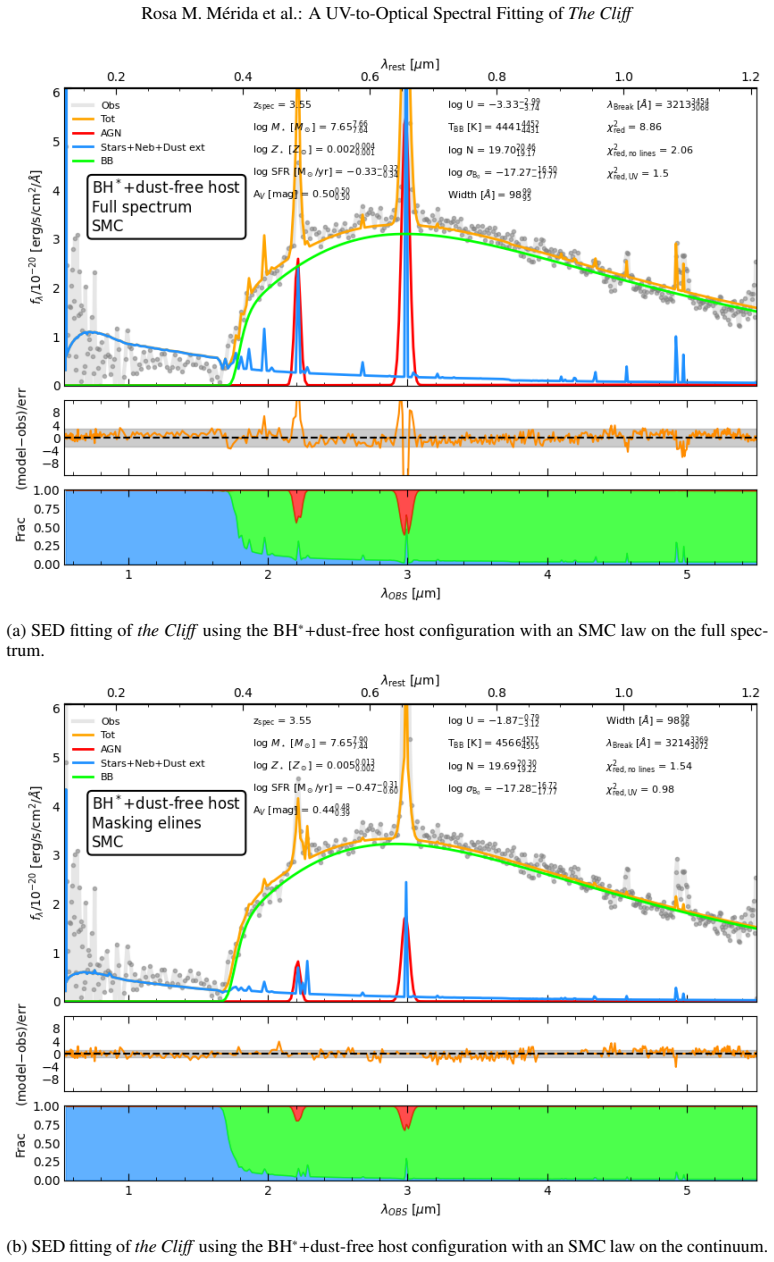
In the black hole star (BH*) model, the characteristic "V"-shaped SED of LRDs is produced by an accreting BH embedded in a dense neutral-gas envelope with a near-unity covering factor. This envelope reprocesses radiation and emits as a ~5,000K blackbody, producing the optical continuum. Meanwhile, the UV is powered by a low-mass, dust-free, metal-poor host. The BH* scenario is promising, but it has yet to undergo detailed testing; conducting a self-consistent UV-to-optical spectral-fitting analysis of LRDs would provide a robust assessment of the model. In this work, we test the BH* scenario by fitting the full JWST/NIRSpec PRISM spectrum of The Cliff ($z_{spec}=3.55$), an LRD that played a pivotal role in the development of this model. A Bagpipes fit that allows stellar, nebular, AGN, and blackbody components naturally yields a BH*-like solution for The Cliff, even with broad priors. Our method allows us to characterize its host, despite remaining unresolved in JWST imaging. From the continuum, we infer the host to be low-mass (log $M_\star/M_\odot$~7.7), star-forming, metal-poor, affected by non-negligible dust attenuation ($A_V$~0.5 mag) acting on both stellar and nebular components. Larger $M_\star$ (up to log $M_\star/M_\odot$~8.1) and attenuations (up to $A_V$~1 mag) are obtained depending on the assumed dust attenuation law. Modest AGN UV leakage is consistently allowed by the code, but remains weak and not robustly constrained, with both AGN+host and host-dominated UV scenarios yielding equivalent fits. The star formation history of the host is relatively smooth, with the galaxy already assembling log $M_\star/M_\odot$~7 about 200 Myr before $z_{spec}=3.55$. The BH-to-$M_\star$ ratio exceeds the values expected from BH-host scaling relations, especially at recent times. This tension may indicate either inaccurate estimates of the BH properties or non-coeval BH-host evolution.
Editorial analysis
A structured set of objections, weighed in public.
Referee Report
Summary. The paper tests the BH* model for little red dots by fitting the full JWST/NIRSpec PRISM spectrum of The Cliff (z=3.55) with Bagpipes, allowing stellar, nebular, AGN, and blackbody components under broad priors. It reports that this decomposition naturally yields a BH*-like solution, with the host inferred as low-mass (log M⋆/M⊙ ≈ 7.7), star-forming, metal-poor, and moderately dust-attenuated (AV ≈ 0.5 mag), plus a smooth star-formation history and high BH-to-M⋆ ratio; results vary with dust law and AGN leakage remains weakly constrained.
Significance. If the result holds, the work supplies a useful self-consistent test of the BH* scenario by showing that an established public code with broad priors can recover the expected low-mass host properties for an LRD without strong model-imposed priors. The approach of letting the data drive the solution is a clear strength. Significance is reduced, however, by the reported sensitivity to dust-attenuation law and the lack of tight constraints on AGN UV leakage, both of which affect whether the inferred host truly matches the BH* requirements.
major comments (3)
- [Abstract] Abstract and Results: the reported shifts with dust law (log M⋆ up to 8.1, AV up to 1 mag) directly affect whether the host remains low-mass and metal-poor in the sense demanded by the BH* model; a quantitative table comparing best-fit parameters and χ² across the tested attenuation laws is needed to establish robustness.
- [Results] Results: the finding that AGN+host and host-dominated UV solutions give statistically equivalent fits shows the data do not enforce the near-unity covering factor required by BH*; the posterior for AGN UV leakage (and its degeneracy with the blackbody term) must be presented explicitly.
- [Discussion] Discussion: the assumption that the independent Bagpipes blackbody component maps directly to the reprocessing envelope of the BH* model is load-bearing for the central claim, yet no test of alternative decompositions (e.g., removing the blackbody or linking its normalization to the AGN term) is reported to rule out degeneracies.
minor comments (2)
- [Methods] The star-formation history and metallicity priors should be stated explicitly in the Methods section, as they influence the inferred assembly time of log M⋆ ≈ 7.
- [Figure 1] Figure showing the best-fit decomposition would be clearer if the individual stellar, nebular, AGN, and blackbody contributions were over-plotted separately.
Simulated Author's Rebuttal
We thank the referee for their constructive and detailed comments, which have prompted us to strengthen the presentation of our results and address key aspects of robustness and model assumptions. We have revised the manuscript to incorporate additional tables, figures, and tests as detailed below.
read point-by-point responses
-
Referee: [Abstract] Abstract and Results: the reported shifts with dust law (log M⋆ up to 8.1, AV up to 1 mag) directly affect whether the host remains low-mass and metal-poor in the sense demanded by the BH* model; a quantitative table comparing best-fit parameters and χ² across the tested attenuation laws is needed to establish robustness.
Authors: We agree that explicitly quantifying the variations across dust laws is necessary for assessing robustness. In the revised manuscript we have added Table 2, which tabulates the best-fit log M⋆, A_V, metallicity, SFR, and reduced χ² for each attenuation law tested (Calzetti, SMC, and two others). The table shows that the host remains low-mass (log M⋆ ≤ 8.1) and metal-poor ([Z/H] < −0.5) in all cases, while A_V ranges from 0.5 to 1.0 mag; χ² values differ by less than 10 percent, confirming that the data do not strongly discriminate among the laws. These results are now cross-referenced in the abstract and Section 3. revision: yes
-
Referee: [Results] Results: the finding that AGN+host and host-dominated UV solutions give statistically equivalent fits shows the data do not enforce the near-unity covering factor required by BH*; the posterior for AGN UV leakage (and its degeneracy with the blackbody term) must be presented explicitly.
Authors: We accept that the posterior on AGN UV leakage must be shown explicitly. We have added Figure 5, which displays the one- and two-dimensional posteriors for the AGN UV leakage fraction together with its correlation against blackbody normalization. The figure confirms that host-dominated and modest-leakage solutions are statistically equivalent, with the leakage posterior allowing values from 0 to ~0.4 but peaking near 0.2. We have updated the text in Section 3.2 to note that the current data do not tightly enforce the near-unity covering factor assumed in the BH* model and discuss this as a limitation of the PRISM spectrum. revision: yes
-
Referee: [Discussion] Discussion: the assumption that the independent Bagpipes blackbody component maps directly to the reprocessing envelope of the BH* model is load-bearing for the central claim, yet no test of alternative decompositions (e.g., removing the blackbody or linking its normalization to the AGN term) is reported to rule out degeneracies.
Authors: This is a fair point on the mapping between the fitted blackbody and the BH* reprocessing envelope. In the revised Section 4.3 we now report two additional tests: (1) a fit excluding the blackbody component entirely, which increases χ² by ~65 for the same number of degrees of freedom, and (2) a run in which blackbody normalization is tied to AGN bolometric luminosity via a fixed reprocessing efficiency, yielding host parameters consistent with the fiducial free-blackbody solution within 1σ. These tests support the necessity of the blackbody term and indicate that its inclusion does not introduce uncontrolled degeneracies that alter the inferred low-mass, metal-poor host. The discussion has been expanded to include these results and the associated caveats. revision: yes
Circularity Check
No circularity: data-driven Bagpipes fit yields solution independently
full rationale
The paper's central result is obtained by running an established public Bayesian fitting code (Bagpipes) on observed JWST/NIRSpec PRISM spectra with explicitly broad priors on four independent components (stellar, nebular, AGN, blackbody). The BH*-like decomposition emerges as the maximum-likelihood solution to the data rather than being imposed by any equation, fitted parameter renamed as prediction, or self-citation chain. No load-bearing step reduces to a prior result by the same authors; the physical mapping of components to the BH* envelope is presented as an interpretive comparison after the fit, not as a definitional identity. Dust-law variations are explored as sensitivity tests, not hidden constraints. The derivation is therefore self-contained against external spectral data.
Axiom & Free-Parameter Ledger
free parameters (4)
- Host stellar mass =
log M_star/M_sun ~7.7 (up to 8.1)
- Dust attenuation A_V =
~0.5 mag (up to 1 mag)
- Host metallicity =
metal-poor
- AGN UV leakage =
modest, not robustly determined
axioms (1)
- domain assumption The Bagpipes spectral synthesis code provides an accurate decomposition of the observed spectrum into stellar, nebular, AGN, and blackbody components that can be physically interpreted in the context of the BH* model.
Lean theorems connected to this paper
-
IndisputableMonolith/Cost/FunctionalEquation.leanwashburn_uniqueness_aczel unclearA Bagpipes fit that allows stellar, nebular, AGN, and blackbody components naturally yields a BH*-like solution... blackbody temperature varies between 4,441 and 4,566 K
-
IndisputableMonolith/Foundation/AlphaCoordinateFixation.leanalpha_pin_under_high_calibration unclearWe used the continuity mode... priors... log A_BB=[−25,−16], T=[1000,7000] K
Reference graph
Works this paper leans on
-
[1]
Akins, H. B., Casey, C. M., Berg, D. A., et al. 2025b, ApJ, 980, L29 Ananna , T. T., Bogdán, Á., Kovács, O. E., Natarajan, P., & Hickox, R. C. 2024, ApJ, 969, L18
work page 2024
-
[2]
Asada, Y ., Inayoshi, K., Fei, Q., Fujimoto, S., & Willott, C. 2026, arXiv e-prints, arXiv:2601.10573
work page internal anchor Pith review arXiv 2026
-
[3]
Baggen, J. F. W., Scoggins, M. T., van Dokkum, P., et al. 2026, arXiv e-prints, arXiv:2602.02702
work page internal anchor Pith review arXiv 2026
-
[4]
Baggen, J. F. W., van Dokkum, P., Labbé, I., et al. 2023, ApJ, 955, L12
work page 2023
-
[5]
Baldwin, J. A. 1977, ApJ, 214, 679
work page 1977
-
[6]
Barro, G., Perez-Gonzalez, P. G., Kocevski, D., et al. 2025, arXiv e-prints, arXiv:2512.15853
-
[7]
Barro, G., Pérez-González, P. G., Kocevski, D. D., et al. 2024, ApJ, 963, 128
work page 2024
-
[8]
Billand, J.-B., Elbaz, D., Gentile, F., et al. 2026, A&A, 706, A29
work page 2026
-
[9]
Brammer, G. & Valentino, F. 2025, The DAWN JWST Archive: Compilation of Public NIRSpec Spectra
work page 2025
- [10]
-
[11]
Carnall, A. C., McLure, R. J., Dunlop, J. S., & Davé, R. 2018, MNRAS, 480, 4379
work page 2018
-
[12]
Casey, C. M., Akins, H. B., Finkelstein, S. L., et al. 2025, ApJ, 990, L61
work page 2025
- [13]
- [14]
-
[15]
Cloonan, A. P., Whitaker, K. E., Manning, S. M., et al. 2026, arXiv e-prints, arXiv:2603.24700 de Graaff, A., Brammer, G., Weibel, A., et al. 2025a, A&A, 697, A189 de Graaff, A., Hviding, R. E., Naidu, R. P., et al. 2025b, arXiv e-prints, arXiv:2511.21820, submitted to MNRAS de Graaff, A., Rix, H.-W., Naidu, R. P., et al. 2025c, A&A, 701, A168 D’Eugenio, ...
-
[16]
J., Chatzikos, M., Guzmán, F., et al
Ferland, G. J., Chatzikos, M., Guzmán, F., et al. 2017, Rev. Mexicana Astron. Astrofis., 53, 385
work page 2017
- [17]
-
[18]
Furtak, L. J., Secunda, A. R., Greene, J. E., et al. 2025, A&A, 698, A227
work page 2025
-
[19]
Gordon, K. D., Clayton, G. C., Misselt, K. A., Landolt, A. U., & Wolff, M. J. 2003, ApJ, 594, 279
work page 2003
-
[20]
Greene, J. E. & Ho, L. C. 2005, ApJ, 630, 122
work page 2005
-
[21]
Greene, J. E., Labbe, I., Goulding, A. D., et al. 2024, ApJ, 964, 39
work page 2024
-
[22]
A., Pacucci, F., & Kocevski, D
Guia, C. A., Pacucci, F., & Kocevski, D. D. 2024, Research Notes of the Ameri- can Astronomical Society, 8, 207
work page 2024
-
[23]
Hviding, R. E., de Graaff, A., Miller, T. B., et al. 2025, A&A, 702, A57
work page 2025
- [24]
- [25]
- [26]
-
[27]
The Emergence of Little Red Dots from Binary Massive Black Holes
Inayoshi, K., Shangguan, J., Chen, X., Ho, L. C., & Haiman, Z. 2025, arXiv e-prints, arXiv:2505.05322, submitted to ApJ
work page internal anchor Pith review Pith/arXiv arXiv 2025
-
[28]
Jakobsen, P., Ferruit, P., Alves de Oliveira, C., et al. 2022, A&A, 661, A80
work page 2022
-
[29]
Ji, X., D’Eugenio, F., Juodžbalis, I., et al. 2026, MNRAS, 545, staf2235
work page 2026
-
[30]
Ji, X., Maiolino, R., Übler, H., et al. 2025, MNRAS, 544, 3900
work page 2025
-
[31]
C., Übler, H., Maiolino, R., et al
Jones, G. C., Übler, H., Maiolino, R., et al. 2026, MNRAS, 546, stag115 Juodžbalis, I., Ji, X., Maiolino, R., et al. 2024, MNRAS, 535, 853 Juodžbalis, I., Marconcini, C., D’Eugenio, F., et al. 2025, arXiv e-prints, arXiv:2508.21748
-
[32]
Kennicutt, Jr., R. C. 1998, ARA&A, 36, 189
work page 1998
-
[33]
Kido, D., Ioka, K., Hotokezaka, K., Inayoshi, K., & Irwin, C. M. 2025, MNRAS, 544, 3407
work page 2025
-
[34]
Kocevski, D. D., Finkelstein, S. L., Barro, G., et al. 2025, ApJ, 986, 126
work page 2025
- [35]
-
[36]
GLIMPSED: Direct evidence for a fast AGN-driven outflow from a z=6.64 Little Red Dot host galaxy
Korber, D., Marques-Chaves, R., Schaerer, D., et al. 2026, arXiv e-prints, arXiv:2604.08687
work page internal anchor Pith review Pith/arXiv arXiv 2026
-
[37]
Labbe, I., Greene, J. E., Bezanson, R., et al. 2025, ApJ, 978, 92
work page 2025
-
[38]
Labbe, I., Greene, J. E., Matthee, J., et al. 2024, arXiv e-prints, arXiv:2412.04557, submitted to ApJ Labbé, I., van Dokkum, P., Nelson, E., et al. 2023, Nature, 616, 266
-
[39]
Leja, J., Carnall, A. C., Johnson, B. D., Conroy, C., & Speagle, J. S. 2019, ApJ, 876, 3
work page 2019
-
[40]
Li, W., Inayoshi, K., Onoue, M., & Toyouchi, D. 2023, ApJ, 950, 85
work page 2023
- [41]
-
[42]
Lupi, A., Trinca, A., V olonteri, M., Dotti, M., & Mazzucchelli, C. 2024, A&A, 689, A128
work page 2024
- [43]
- [44]
-
[45]
Madau, P. & Maiolino, R. 2026, arXiv e-prints, arXiv:2602.22386
-
[46]
2024, A&A, 691, A145 Matthee , J., Naidu, R
Maiolino, R., Scholtz, J., Curtis-Lake, E., et al. 2024, A&A, 691, A145 Matthee , J., Naidu, R. P., Brammer, G., et al. 2024, ApJ, 963, 129
work page 2024
-
[47]
Matthee, J., Naidu, R. P., Kotiwale, G., et al. 2025, ApJ, 988, 246 Mérida, R. M., Gaspar, G., Asada, Y ., et al. 2026a, A&A, 707, A212 Mérida, R. M., Gaspar, G., Sawicki, M., et al. 2025, A&A, 698, A317 Mérida, R. M., Pérez-González, P. G., Sánchez-Blázquez, P., et al. 2023, ApJ, 950, 125 Mérida, R. M., Sawicki, M., Iyer, K. G., et al. 2026b, A&A, 707, A5
work page 2025
-
[48]
P., Matthee, J., Katz, H., et al
Naidu, R. P., Matthee, J., Katz, H., et al. 2025, arXiv e-prints, arXiv:2503.16596, submitted
- [49]
-
[50]
Perger, K., Fogasy, J., Frey, S., & Gabányi, K. É. 2025, A&A, 693, L2
work page 2025
-
[51]
Pizzati, E., Hennawi, J. F., Schaye, J., et al. 2025, MNRAS, 539, 2910
work page 2025
-
[52]
Quadri, G., Trinca, A., Lupi, A., Colpi, M., & V olonteri, M. 2025, A&A, 704, A248
work page 2025
-
[53]
Reines, A. E. & V olonteri, M. 2015, ApJ, 813, 82
work page 2015
- [54]
- [55]
-
[56]
Scholtz, J., D’Eugenio, F., Maiolino, R., et al. 2026, arXiv e-prints, arXiv:2603.22277
-
[57]
Setton, D. J., Greene, J. E., Spilker, J. S., et al. 2025, ApJ, 991, L10
work page 2025
-
[58]
F., Faucher-Giguère, C.-A., et al
Shen, X., Hopkins, P. F., Faucher-Giguère, C.-A., et al. 2020, MNRAS, 495, 3252
work page 2020
-
[59]
Sun, W. Q., Naidu, R. P., Matthee, J., et al. 2026, arXiv e-prints, arXiv:2601.20929, submitted to the Open Journal of Astrophysics
- [60]
-
[61]
Taylor, A. J., Kokorev, V ., Kocevski, D. D., et al. 2025, ApJ, 989, L7
work page 2025
- [62]
-
[63]
2024, arXiv e-prints, arXiv:2412.14248, submitted to A&A
Trinca, A., Valiante, R., Schneider, R., et al. 2024, arXiv e-prints, arXiv:2412.14248, submitted to A&A
-
[64]
Umeda, H., Inayoshi, K., Harikane, Y ., & Murase, K. 2026, ApJ, 999, 183
work page 2026
- [65]
-
[66]
Zhang, Z., Jiang, L., Liu, W., & Ho, L. C. 2025, ApJ, 985, 119
work page 2025
- [67]
-
[68]
Zubovas, K. & King, A. 2021, MNRAS, 501, 4289 Article number, page 12 Rosa M. Mérida et al.: A UV-to-Optical Spectral Fitting ofThe Cliff Appendix A: The effect of the absorption component Figure A.1 shows a fit toThe Cliffusing the BH ∗+dust-free host configuration while masking the emission lines and not including the gas absorption component (see Sect....
work page 2021
discussion (0)
Sign in with ORCID, Apple, or X to comment. Anyone can read and Pith papers without signing in.