Recognition: no theorem link
Allocation of Dynamic Operating Envelopes in Radial Distribution Networks
Pith reviewed 2026-05-11 02:44 UTC · model grok-4.3
The pith
Power flow model choice, binding constraints, and import/export direction substantially alter dynamic operating envelope sizes and shapes in radial networks.
A machine-rendered reading of the paper's core claim, the machinery that carries it, and where it could break.
Core claim
Dynamic operating envelopes change significantly depending on whether a nonlinear or linear power flow model is employed, whether thermal or voltage constraints become binding, and whether the envelope is computed for import or export conditions. The LACE algorithm supplies a transparent and scalable procedure for allocating these envelopes, demonstrated on multiple test feeders including a realistic low-voltage network with Belgian real-world data.
What carries the argument
The LACE algorithm for dynamic operating envelope allocation, which computes transparent capacity limits while respecting chosen power flow models and binding network constraints.
If this is right
- Distribution system operators can select power flow models and constraints to achieve more efficient network capacity use.
- LACE enables envelope calculation on larger networks where existing methods become intractable.
- The algorithm can operate in tandem with other optimization engines for combined planning and control tasks.
- Stakeholders obtain clearer understanding of how modeling choices translate into import versus export limits.
Where Pith is reading between the lines
- The same sensitivity analysis could be repeated on meshed or medium-voltage networks to check whether the reported effects persist.
- Coupling LACE with real-time measurement feedback might allow envelopes to adapt faster to changing load and generation.
- Benchmarking LACE against other published DOE methods on identical feeders would quantify relative transparency and speed.
Load-bearing premise
That findings obtained on the chosen test feeders and Belgian real-world data will generalize to other networks and to live operational use.
What would settle it
A side-by-side run on an unseen larger feeder showing that LACE either loses computational scalability or produces envelope values that match those of black-box solvers with no transparency gain.
Figures



read the original abstract
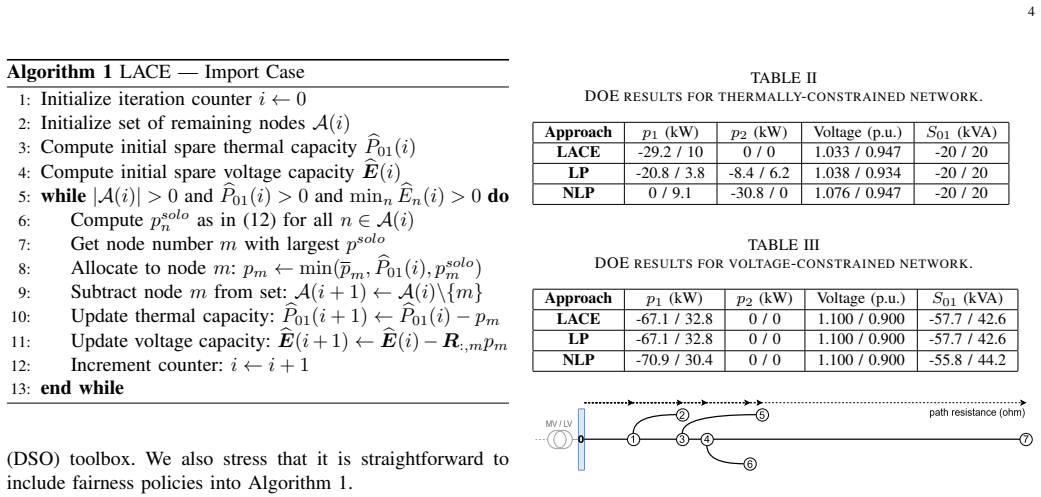
This paper provides an in-depth analysis on how different aspects of the dynamic operating envelope (DOE) formulation impact the computation and allocation of network capacity. We show that the envelopes are significantly affected by the power flow model (non-linear or linear), binding network constraint (thermal or voltage) and by the calculation case (import or export envelope). We also propose a novel DOE algorithm (LACE) that presents transparent and scalable computation that is useful for larger networks or to act in tandem with other optimization engines. We run numerical simulations with different test feeders, including a realistic low-voltage feeder with real-world data from Belgium. This paper provides crucial insights and tools to distribution system operators (DSOs), stakeholders and academics alike to make sure DOE calculation achieves desirable and efficient outcome.
Editorial analysis
A structured set of objections, weighed in public.
Referee Report
Summary. The manuscript examines how power flow model selection (nonlinear versus linear), binding network constraints (thermal versus voltage), and operating cases (import versus export) influence the computation and allocation of dynamic operating envelopes (DOEs) in radial distribution networks. It introduces the LACE algorithm as a novel method for DOE allocation, asserting that it offers transparent and scalable computation suitable for larger networks or integration with other optimization engines. The claims are supported by numerical simulations on standard test feeders and a realistic Belgian low-voltage feeder using real-world data.
Significance. If the central claims hold, the analysis would provide DSOs with actionable insights into how modeling choices affect network capacity allocation, potentially improving efficiency in DER integration. The LACE proposal, combined with the use of real Belgian data, represents a practical contribution that could support operational tools. Strengths include the simulation-based validation across multiple feeders and cases; however, the significance is reduced by the lack of quantitative benchmarks for the scalability assertions.
major comments (2)
- [§4 and LACE algorithm section] §4 (Numerical Results) and the LACE algorithm description: the claim of 'scalable computation' useful for larger networks rests on simulations limited to standard test feeders and one Belgian LV network, with no asymptotic complexity analysis (e.g., scaling with number of nodes or constraints), runtime profiles, or benchmarks on feeders exceeding ~200 nodes. This directly undermines the assertion that LACE can act in tandem with other engines for operational use.
- [Abstract and §3] Abstract and §3 (DOE Formulation): the statement that envelopes are 'significantly affected' by power flow model, binding constraint, and calculation case is presented without accompanying quantitative metrics such as percentage differences in allocated capacity, error bounds relative to nonlinear solutions, or statistical significance tests across the reported cases.
minor comments (2)
- [§2] The notation distinguishing import and export envelopes in the problem formulation could be made more explicit to improve readability for readers unfamiliar with DOE concepts.
- [§4] Figure captions in the results section would benefit from including the specific test feeder and case (import/export) for each subplot to aid quick interpretation.
Simulated Author's Rebuttal
We thank the referee for the constructive and detailed feedback on our manuscript. We have carefully reviewed each major comment and provide point-by-point responses below, outlining the revisions we plan to make to address the concerns raised.
read point-by-point responses
-
Referee: [§4 and LACE algorithm section] §4 (Numerical Results) and the LACE algorithm description: the claim of 'scalable computation' useful for larger networks rests on simulations limited to standard test feeders and one Belgian LV network, with no asymptotic complexity analysis (e.g., scaling with number of nodes or constraints), runtime profiles, or benchmarks on feeders exceeding ~200 nodes. This directly undermines the assertion that LACE can act in tandem with other engines for operational use.
Authors: We appreciate the referee highlighting the importance of stronger evidence for the scalability claims. Our simulations on standard test feeders and the realistic Belgian LV feeder with real-world data demonstrate practical performance, and the LACE algorithm is formulated as a linear program, which inherently supports polynomial scaling with network size. To strengthen this, we will add an asymptotic complexity analysis, runtime profiles for the tested cases, and a discussion of how the algorithm's transparency enables integration with other optimization engines in operational settings. revision: yes
-
Referee: [Abstract and §3] Abstract and §3 (DOE Formulation): the statement that envelopes are 'significantly affected' by power flow model, binding constraint, and calculation case is presented without accompanying quantitative metrics such as percentage differences in allocated capacity, error bounds relative to nonlinear solutions, or statistical significance tests across the reported cases.
Authors: We agree that the claim would be better supported by explicit quantitative metrics. In the revised manuscript, we will incorporate tables and/or figures providing percentage differences in allocated capacities, error bounds relative to the nonlinear solutions, and relevant comparisons across the model types, constraint types, and import/export cases examined in our numerical results. revision: yes
Circularity Check
No significant circularity; claims rest on simulations and algorithm description
full rationale
The paper analyzes DOE impacts via power flow models and binding constraints, then proposes the LACE algorithm with validation on standard test feeders and one Belgian LV network. No self-definitional equations, fitted parameters renamed as predictions, or load-bearing self-citations appear in the provided claims or abstract. The derivation chain consists of numerical experiments and algorithmic proposal rather than reductions to inputs by construction. Scalability assertions are supported only by limited cases (a potential evidence weakness) but do not constitute circularity per the enumerated patterns.
Axiom & Free-Parameter Ledger
Reference graph
Works this paper leans on
-
[1]
Renewable Integration Study: Stage1 report. 2020
work page 2020
-
[2]
Fairness in dynamic operating envelope: Objective functions. 2023
work page 2023
-
[3]
Future grid for distributed energy. 2020
work page 2020
-
[4]
AusNet Services. Model standing offer for basic connection services: Basic micro Embedded Generation (EG) – inverter energy system. 2019
work page 2019
-
[5]
Ben-Tal, Aharon and Nemirovski, Arkadi and El Ghaoui, Laurent. Robust Optimization. 2021
work page 2021
-
[6]
Schedule of electricity network charges 2020/21
Evoenergy. Schedule of electricity network charges 2020/21. 2020
work page 2020
-
[7]
Molzahn, Daniel K. and Hiskens, Ian A. , title =. Foundations and Trends in Electric Energy Systems , volume =. 2019 , issn =
work page 2019
-
[8]
GNU Linear Programming Kit: Reference Manual
Andrew Makhorin. GNU Linear Programming Kit: Reference Manual. 2020
work page 2020
-
[9]
NREL. On the path to sunshot: Emerging issues and challenges in integrating solar with the distribution system. 2016
work page 2016
-
[10]
Andreas T. Procopiou and Michael Z. Liu and William Nacmanson and Luis F. Ochoa. Advanced planning of PV -rich distribution networks - deliverable 4: Non-traditional solutions. 2020
work page 2020
-
[11]
Renewable integration study stage 1 appendix A: High penetrations of distributed solar PV
AEMO. Renewable integration study stage 1 appendix A: High penetrations of distributed solar PV. 2020
work page 2020
- [12]
-
[13]
Fairness in Dynamic Operating Envelope: Objective Functions
Project EDGE. Fairness in Dynamic Operating Envelope: Objective Functions. 2023
work page 2023
-
[14]
Accelerating the Implementation of Operating Envelopes Across Australia – Milestone 4: Final Report
Arthur Gonçalves Givisiez and Luis Ochoa. Accelerating the Implementation of Operating Envelopes Across Australia – Milestone 4: Final Report. 2024
work page 2024
-
[15]
Victorian Distribution Network Service Provider (DNSP) basic micro EG connections power quality response mode settings. 2019
work page 2019
- [16]
-
[17]
K. Baker and A. Bernstein and E. Dall’Anese and C. Zhao , journal=PWRS, title=. 2018 , volume=
work page 2018
-
[18]
Optimal sizing of capacitors placed on a radial distribution system , year=
M. Optimal sizing of capacitors placed on a radial distribution system , year=
-
[19]
M. E. Network reconfiguration in distribution systems for loss reduction and load balancing , year=
-
[20]
Liu, Bin and Braslavsky, Julio H. , journal=. Sensitivity and Robustness Issues of Operating Envelopes in Unbalanced Distribution Networks , year=
-
[21]
Liu, Bin and Braslavsky, Julio H. , journal=PWRS, title=. 2024 , volume=
work page 2024
-
[22]
Local and Distributed Voltage Control Algorithms in Distribution Networks , year=
G. Local and Distributed Voltage Control Algorithms in Distribution Networks , year=
-
[23]
de Carvalho, Wilhiam C. and Ratnam, Elizabeth L. and Blackhall, Lachlan and Meier, Alexandra von , journal=PWRS, title=. 2023 , volume=
work page 2023
-
[24]
Wilhiam de Carvalho and Ahmad Attarha and Hemanshu R. Pota , title=. 2024 , journal=
work page 2024
-
[25]
P. A. N. Three-phase power flow calculations using the current injection method , year=
-
[26]
Efficient Control of Energy Storage for Increasing the
S. Efficient Control of Energy Storage for Increasing the. 2018 , volume=
work page 2018
-
[27]
M. U. Arbitrage With Power Factor Correction Using Energy Storage , year=
-
[28]
Jahangiri, Pedram and Aliprantis, Dionysios C. , journal= PWRS, title=. 2013 , volume=
work page 2013
-
[29]
Decentralized Stochastic Control of Distributed Energy Resources , year=
W. Decentralized Stochastic Control of Distributed Energy Resources , year=
-
[30]
Review of control strategies for voltage regulation of the smart distribution network with high penetration of renewable distributed generation , journal =. 2016 , author =
work page 2016
-
[31]
and Blackhall, Lachlan , journal=PWRS, title=
Mediwaththe, Chathurika P. and Blackhall, Lachlan , journal=PWRS, title=. 2021 , volume=
work page 2021
-
[32]
Grid and Market Services From the Edge: Using Operating Envelopes to Unlock Network-Aware Bottom-Up Flexibility , year=
- [33]
-
[34]
D. K. A survey of distributed optimization and control algorithms for electric power systems , year=
-
[35]
Network-wide Constraints: What is better for network-safe coordination of
Nodal Operating Envelopes vs. Network-wide Constraints: What is better for network-safe coordination of
-
[36]
Ensuring Distribution Network Integrity Using Dynamic Operating Limits for Prosumers , year=
-
[37]
K. E. Distributed and Decentralized Voltage Control of Smart Distribution Networks: Models, Methods, and Future Research , year=
-
[38]
A. T. Adaptive Decentralized Control of Residential Storage in. 2019 , volume=
work page 2019
-
[39]
Iromi Ranaweera and Ole-Morten Midtgård and Magnus Korpås , journal=RE, title=. 2017 , volume=
work page 2017
-
[40]
Elizabeth L. Ratnam and Steven R. Weller and Christopher M. Kellett. Scheduling residential battery storage with solar PV : Assessing the benefits of net metering. 2015
work page 2015
-
[41]
Elizabeth L. Ratnam and Steven R. Weller and Christopher M. Kellett. Central versus localized optimization-based approaches to power management in distribution networks with residential battery storage. 2016
work page 2016
-
[42]
Elizabeth L. Ratnam and Steven R. Weller. Receding horizon optimization-based approaches to managing supply voltages and power flows in a distribution grid with battery storage co-located with solar PV. 2018
work page 2018
-
[43]
Michael D. Sankur and Roel Dobbe and Emma Stewart and Duncan S. Callaway and Daniel B. Arnold , journal=ArXiv, title=. 2016 , volume = "1606.04492v1", pages=
-
[44]
Sankur and Roel Dobbe and Alexandra von Meier and Emma M
Michael D. Sankur and Roel Dobbe and Alexandra von Meier and Emma M. Stewart and Daniel B. Arnold , journal=. Optimal Voltage Phasor Regulation for Switching Actions in Unbalanced Distribution Systems , year=
-
[45]
A. Singhal and V. Ajjarapu and J. Fuller and J. Hansen , journal=TSG, title=. 2019 , volume=
work page 2019
-
[46]
Local Voltage Control Strategies for
J. Local Voltage Control Strategies for. 2014 , volume=
work page 2014
-
[47]
and Brady, Kyle and Moffat, Keith and Swartz, Jaimie , TITLE =
von Meier, Alexandra and Ratnam, Elizabeth L. and Brady, Kyle and Moffat, Keith and Swartz, Jaimie , TITLE =. Energies , VOLUME =. 2020 , NUMBER =
work page 2020
-
[48]
Y. Coordinated Control of Distributed Energy-Storage Systems for Voltage Regulation in Distribution Networks , year=
-
[49]
Residential Demand Side Management Under High Penetration of Rooftop Photovoltaic Units , year=
E. Residential Demand Side Management Under High Penetration of Rooftop Photovoltaic Units , year=
-
[50]
M. Distributed Control of Battery Energy Storage Systems for Voltage Regulation in Distribution Networks With High. 2018 , volume=
work page 2018
-
[51]
D. B. Optimal dispatch of reactive power for voltage regulation and balancing in unbalanced distribution systems , year=
-
[52]
2019 IEEE Milan PowerTech , title=
S. 2019 IEEE Milan PowerTech , title=. 2019 , pages=
work page 2019
-
[53]
Stefano. An Industry Perspective on. IFAC Proc. Volumes , note =. 2012 , pages =
work page 2012
-
[54]
Evaluation of multiple inverter volt-
S. Evaluation of multiple inverter volt-. 2015 , pages=
work page 2015
-
[55]
W. C. Over-voltage Disconnection of. IFAC-PapersOnLine , volume =. 2020 , note =
work page 2020
-
[56]
Allocation of Dynamic Operating Envelopes in Radial Distribution Networks , note =
W. Allocation of Dynamic Operating Envelopes in Radial Distribution Networks , note =
-
[57]
Dugan, Roger C. and McDermott, Thomas E. , booktitle=. An open source platform for collaborating on smart grid research , year=
-
[58]
2017 IEEE Power Energy Society General Meeting , title=
J. 2017 IEEE Power Energy Society General Meeting , title=. 2017 , pages=
work page 2017
-
[59]
W. H. 2001 IEEE Power Engineering Society Winter Meeting. Conference Proceedings , title=. 2001 , pages=
work page 2001
-
[60]
Klonari, Vasiliki and Vallée, François and Durieux, Olgan and De Grève, Zacharie and Lobry, Jacques , booktitle=. Probabilistic modeling of short term fluctuations of photovoltaic power injection for the evaluation of overvoltage risk in low voltage grids , year=
- [61]
- [62]
-
[63]
Russell, James Stanley and Scott, Paul and Iria, José , booktitle=. Robust Operating Envelopes with Phase Unbalance Constraints in Unbalanced Three-Phase Networks , year=
-
[64]
Schoene, Jens and others , booktitle=PESGM2017, title=. 2017 , volume=
work page 2017
-
[65]
Shaw, Marnie and Sturmberg, Bjorn and Guo, Lin and Gao, Xinyu and Ratnam, Elizabeth and Blackhall, Lachlan , title =. Proc. of the Tenth ACM Inter. Conf. on Future Energy Systems , year =
-
[66]
J. W. 2011 IEEE/PES Power Systems Conference and Exposition , title=. 2011 , pages=
work page 2011
-
[67]
Demand-side Volt/Var/Watt regulation for effective voltage control in distribution grids , year=
Spanias, Chrysovalantis and Aristidou, Petros and Michaelides, Michalis , booktitle=. Demand-side Volt/Var/Watt regulation for effective voltage control in distribution grids , year=
-
[68]
2021 IEEE Madrid PowerTech , title=
J. 2021 IEEE Madrid PowerTech , title=. 2021 , pages=
work page 2021
- [69]
- [70]
-
[71]
The IEEE Website. 2008
work page 2008
-
[72]
Oren Patashnik. ing. 1988
work page 1988
- [73]
-
[74]
Tame the BeaST --- The B to X of
Nicolas Markey. Tame the BeaST --- The B to X of. 2005
work page 2005
- [75]
-
[76]
Robin Fairbairns. The FAQ. 2008
work page 2008
- [77]
-
[78]
Nelson H. F. Beebe. User Group Bibliography Archive. 2008
work page 2008
-
[79]
Patrick W. Daly. The natbib.sty package. 2007
work page 2007
- [80]
discussion (0)
Sign in with ORCID, Apple, or X to comment. Anyone can read and Pith papers without signing in.