Recognition: 2 theorem links
· Lean TheoremBayesian Sensitivity of Causal Inference Estimators under Evidence-Based Priors
Pith reviewed 2026-05-11 02:59 UTC · model grok-4.3
The pith
Causal inference sensitivity analysis should average over evidence-based priors instead of using worst-case assumption changes.
A machine-rendered reading of the paper's core claim, the machinery that carries it, and where it could break.
Core claim
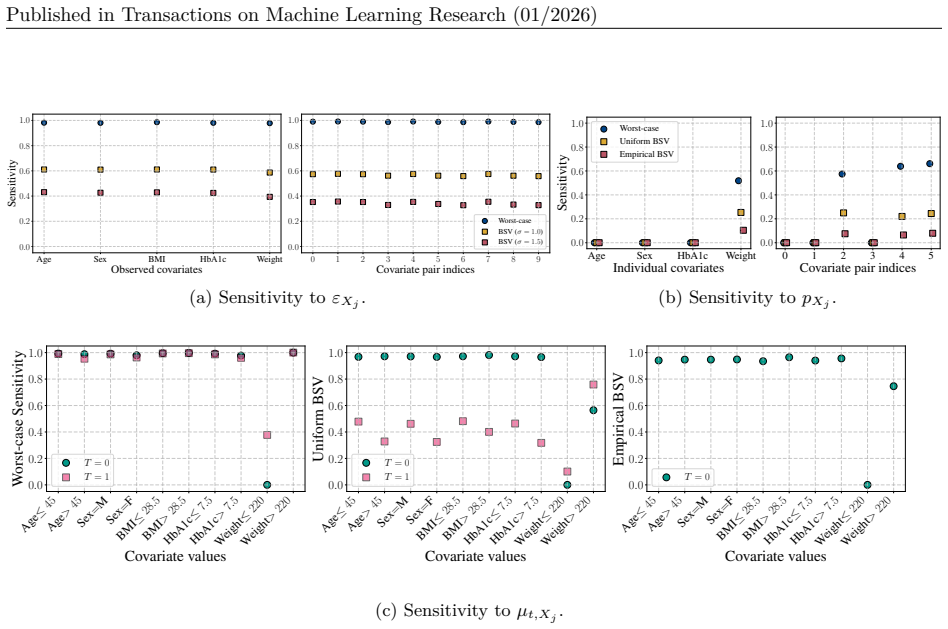
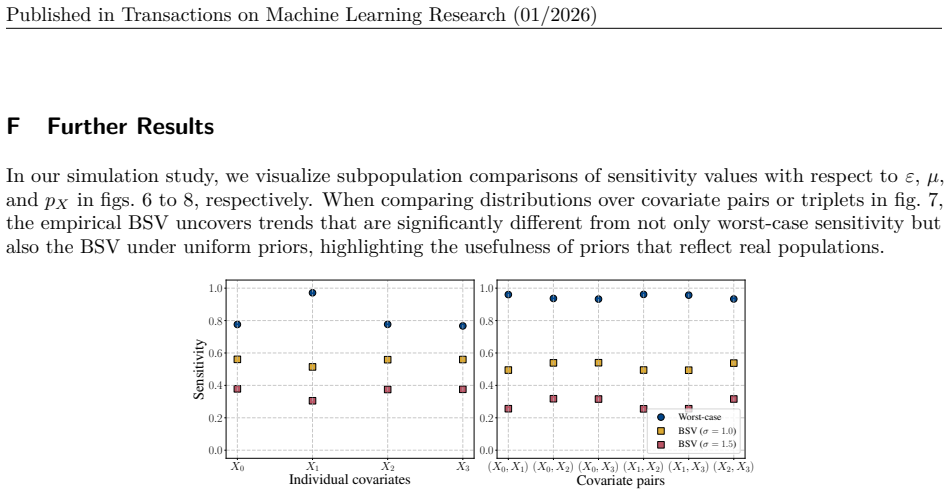
The central claim is that replacing worst-case criteria with the Bayesian Sensitivity Value, defined as the expected sensitivity under evidence-based priors and estimated by Monte Carlo, yields sensitivity assessments that remain informative and consistent with domain knowledge for common causal assumptions.
What carries the argument
Bayesian Sensitivity Value (BSV), which computes the average sensitivity of a causal estimate across distributions of assumption violations drawn from real-world evidence priors.
If this is right
- Worst-case sensitivity conclusions frequently rely on implausible changes to the data-generating process.
- Monte Carlo approximations make the expected sensitivity computable for standard assumptions such as unconfoundedness and positivity.
- In the diabetes treatment example the BSV produces robustness conclusions aligned with prior knowledge rather than pessimistic extremes.
- The same evidence-prior approach extends directly to sensitivity analysis of other untestable assumptions in observational studies.
Where Pith is reading between the lines
- Adopting evidence-based priors for sensitivity could reduce overly conservative policy conclusions drawn from observational health data.
- Similar averaging over empirically grounded distributions might improve robustness checks in related areas such as missing-data analysis or model comparison.
- When evidence for priors is sparse the BSV could be iteratively updated as new data sources become available.
Load-bearing premise
Priors constructed from real-world evidence accurately represent the plausible range of assumption violations without introducing bias.
What would settle it
A controlled simulation in which the true data-generating process is known and the realized sensitivity of estimates is compared against the BSV predicted from the evidence-based prior.
Figures




read the original abstract
Causal inference, especially in observational studies, relies on untestable assumptions about the true data-generating process. Sensitivity analysis helps us determine how robust our conclusions are when we alter these underlying assumptions. Existing frameworks for sensitivity analysis are concerned with worst-case changes in assumptions. In this work, we argue that using such pessimistic criteria can often become uninformative or lead to conclusions contradicting our prior knowledge about the world. To demonstrate this claim, we generalize the recent s-value framework (Gupta & Rothenh\"ausler, 2023) to estimate the sensitivity of three different common assumptions in causal inference. Empirically, we find that, indeed, worst-case conclusions about sensitivity can rely on unrealistic changes in the data-generating process. To overcome this, we extend the s-value framework with a new sensitivity analysis criterion: Bayesian Sensitivity Value (BSV), which computes the expected sensitivity of an estimate to assumption violations under priors constructed from real-world evidence. We use Monte Carlo approximations to estimate this quantity and illustrate its applicability in an observational study on the effect of diabetes treatments on weight loss.
Editorial analysis
A structured set of objections, weighed in public.
Referee Report
Summary. The paper extends the s-value framework for sensitivity analysis in causal inference to three common untestable assumptions. It argues that worst-case s-values often rely on unrealistic changes in the data-generating process, as shown in an observational diabetes study. To address this, it introduces the Bayesian Sensitivity Value (BSV), defined as the expected sensitivity of a causal estimate to assumption violations under priors constructed from real-world evidence, with Monte Carlo approximation used for computation.
Significance. If the evidence-based prior construction can be made transparent and the Monte Carlo estimator validated, BSV would provide a useful middle ground between fully worst-case and fully Bayesian sensitivity analysis, incorporating domain knowledge to avoid pessimistic conclusions while remaining falsifiable. The generalization to multiple assumptions and the concrete empirical illustration are positive features.
major comments (3)
- The abstract and main text provide no explicit mathematical definition, derivation, or formula for the BSV (the quantity whose expectation is taken over the evidence-based priors). Without this, it is impossible to verify that the Monte Carlo approximation targets the claimed object or that the three target assumptions are parameterized independently of the observed data.
- The empirical illustration reports only Monte Carlo point estimates for BSV without convergence diagnostics, error bounds, or a direct quantitative comparison to the corresponding worst-case s-values on the same diabetes dataset. This leaves the central claim—that BSV yields more informative conclusions—unsupported by the reported results.
- The construction of the evidence-based priors is load-bearing for the claimed advantage over worst-case analysis, yet the manuscript supplies no protocol for evidence selection, functional-form choices, or hyperparameter elicitation. Any unexamined modeling decisions in this step can re-introduce the very dependence on unrealistic scenarios that BSV is intended to avoid.
minor comments (2)
- The abstract refers to 'three different common assumptions' but never names them; this should be stated explicitly in the introduction or methods.
- The reference 'Rothenhäuser' appears with an encoding artifact; correct to 'Rothenhäusler'.
Simulated Author's Rebuttal
Thank you for the constructive feedback on our manuscript. We have carefully considered each of the major comments and provide point-by-point responses below. Where appropriate, we indicate that revisions will be incorporated in the next version of the paper.
read point-by-point responses
-
Referee: The abstract and main text provide no explicit mathematical definition, derivation, or formula for the BSV (the quantity whose expectation is taken over the evidence-based priors). Without this, it is impossible to verify that the Monte Carlo approximation targets the claimed object or that the three target assumptions are parameterized independently of the observed data.
Authors: We thank the referee for pointing this out. While the BSV is introduced conceptually in the abstract and described in the main text as the expected sensitivity under evidence-based priors with Monte Carlo approximation, we agree that an explicit mathematical definition and derivation are necessary for verification. In the revised manuscript, we will include a formal definition of the BSV, including the expectation over the prior, the parameterization of the three assumptions, and a derivation showing independence from observed data where applicable. This will allow readers to confirm that the Monte Carlo targets the intended quantity. revision: yes
-
Referee: The empirical illustration reports only Monte Carlo point estimates for BSV without convergence diagnostics, error bounds, or a direct quantitative comparison to the corresponding worst-case s-values on the same diabetes dataset. This leaves the central claim—that BSV yields more informative conclusions—unsupported by the reported results.
Authors: The referee correctly identifies that the empirical section currently presents only point estimates from the Monte Carlo procedure without accompanying diagnostics or comparisons. To support the claim that BSV provides more informative conclusions than worst-case s-values, we will add in the revision: (i) convergence diagnostics such as trace plots or effective sample sizes, (ii) error bounds or standard errors for the BSV estimates, and (iii) a direct quantitative comparison table or figure contrasting BSV and s-values for the diabetes treatment effect analysis. These additions will substantiate the central claim with the reported results. revision: yes
-
Referee: The construction of the evidence-based priors is load-bearing for the claimed advantage over worst-case analysis, yet the manuscript supplies no protocol for evidence selection, functional-form choices, or hyperparameter elicitation. Any unexamined modeling decisions in this step can re-introduce the very dependence on unrealistic scenarios that BSV is intended to avoid.
Authors: We acknowledge the importance of transparency in constructing the evidence-based priors, as this is central to the BSV's advantage. The current manuscript outlines the use of real-world evidence for the diabetes study but does not detail a full protocol. In the revision, we will expand the methods section with a clear protocol for evidence selection (e.g., criteria for including studies or data sources), choices of functional forms for the priors, and the elicitation process for hyperparameters, drawing from domain literature. This will mitigate concerns about re-introducing unrealistic assumptions and enhance the reproducibility of the approach. revision: yes
Circularity Check
No significant circularity; BSV defined independently via external priors
full rationale
The paper extends the s-value framework by defining BSV as an expectation of sensitivity under priors constructed from real-world evidence, approximated via Monte Carlo. This construction is presented as drawing on external evidence rather than being fitted to or derived from the target observational data or the sensitivity estimates themselves. No equation reduces the BSV output to a self-referential fit, renamed known result, or load-bearing self-citation chain; the central claim remains self-contained against the provided benchmarks of worst-case analysis.
Axiom & Free-Parameter Ledger
free parameters (1)
- Parameters of the evidence-based priors
axioms (2)
- domain assumption Causal inference assumptions can be violated in ways quantifiable by sensitivity parameters
- domain assumption Evidence-based priors can be reliably constructed from external data or literature
invented entities (1)
-
Bayesian Sensitivity Value (BSV)
no independent evidence
Lean theorems connected to this paper
-
IndisputableMonolith/Cost/FunctionalEquation.leanwashburn_uniqueness_aczel unclear?
unclearRelation between the paper passage and the cited Recognition theorem.
We generalize the s-value framework ... Bayesian Sensitivity Value (BSV) ... priors constructed from real-world evidence. We use Monte Carlo approximations...
-
IndisputableMonolith/Foundation/RealityFromDistinction.leanreality_from_one_distinction unclear?
unclearRelation between the paper passage and the cited Recognition theorem.
worst-case sensitivity ... sup {exp(−D(a∥â)) | τ(a)≤δ}
What do these tags mean?
- matches
- The paper's claim is directly supported by a theorem in the formal canon.
- supports
- The theorem supports part of the paper's argument, but the paper may add assumptions or extra steps.
- extends
- The paper goes beyond the formal theorem; the theorem is a base layer rather than the whole result.
- uses
- The paper appears to rely on the theorem as machinery.
- contradicts
- The paper's claim conflicts with a theorem or certificate in the canon.
- unclear
- Pith found a possible connection, but the passage is too broad, indirect, or ambiguous to say the theorem truly supports the claim.
Reference graph
Works this paper leans on
-
[1]
Controlled clinical trials , volume=
Measurement of health status: ascertaining the minimal clinically important difference , author=. Controlled clinical trials , volume=. 1989 , publisher=
work page 1989
-
[2]
Minimum clinically important difference in medical studies , author=. Biometrics , volume=. 2015 , publisher=
work page 2015
-
[3]
Environmental Modelling & Software , volume=
An annotated timeline of sensitivity analysis , author=. Environmental Modelling & Software , volume=. 2024 , publisher=
work page 2024
-
[4]
Environmental Modelling & Software , volume=
The future of sensitivity analysis: an essential discipline for systems modeling and policy support , author=. Environmental Modelling & Software , volume=. 2021 , publisher=
work page 2021
-
[5]
National Health and Nutrition Examination Survey Data , year =
-
[6]
Philosophical Transactions of the Royal Society A , volume=
Bayesian causal inference: a critical review , author=. Philosophical Transactions of the Royal Society A , volume=. 2023 , publisher=
work page 2023
-
[7]
Journal of the American Statistical Association , year=
Flexible sensitivity analysis for observational studies without observable implications , author=. Journal of the American Statistical Association , year=
-
[8]
Journal of the American Statistical Association , volume=
A distributional approach for causal inference using propensity scores , author=. Journal of the American Statistical Association , volume=. 2006 , publisher=
work page 2006
-
[9]
Operations Research Letters , volume=
Mirror descent and nonlinear projected subgradient methods for convex optimization , author=. Operations Research Letters , volume=. 2003 , publisher=
work page 2003
- [10]
- [11]
-
[12]
Diabetes, Obesity and Metabolism , volume=
Effect of weight reduction on glycated haemoglobin in weight loss trials in patients with type 2 diabetes , author=. Diabetes, Obesity and Metabolism , volume=. 2017 , publisher=
work page 2017
-
[13]
Advances in neural information processing systems , volume=
Sense and sensitivity analysis: Simple post-hoc analysis of bias due to unobserved confounding , author=. Advances in neural information processing systems , volume=
-
[14]
Advances in Neural Information Processing Systems , volume=
The fragility of fairness: Causal sensitivity analysis for fair machine learning , author=. Advances in Neural Information Processing Systems , volume=
-
[15]
Journal of the Royal Statistical Society Series B: Statistical Methodology , volume=
Making sense of sensitivity: Extending omitted variable bias , author=. Journal of the Royal Statistical Society Series B: Statistical Methodology , volume=. 2020 , publisher=
work page 2020
-
[16]
Annals of internal medicine , volume=
Limitations and misinterpretations of E-values for sensitivity analyses of observational studies , author=. Annals of internal medicine , volume=. 2019 , publisher=
work page 2019
-
[17]
The American Statistician , volume=
Sensitivity analyses of clinical trial designs: selecting scenarios and summarizing operating characteristics , author=. The American Statistician , volume=. 2024 , publisher=
work page 2024
-
[18]
The American journal of clinical nutrition , volume=
Best (but oft-forgotten) practices: sensitivity analyses in randomized controlled trials , author=. The American journal of clinical nutrition , volume=. 2016 , publisher=
work page 2016
-
[19]
Wiley Interdisciplinary Reviews: Data Mining and Knowledge Discovery , volume=
Subgroup discovery , author=. Wiley Interdisciplinary Reviews: Data Mining and Knowledge Discovery , volume=. 2015 , publisher=
work page 2015
-
[20]
Data Mining and Knowledge Discovery , volume=
Robust subgroup discovery: Discovering subgroup lists using mdl , author=. Data Mining and Knowledge Discovery , volume=. 2022 , publisher=
work page 2022
-
[21]
arXiv preprint arXiv:2305.18793 , year=
A first course in causal inference , author=. arXiv preprint arXiv:2305.18793 , year=
-
[22]
External validity and transportability: a formal approach , author=. JSM Proceedings , pages=
- [23]
-
[24]
Distributed optimization and statistical learning via the alternating direction method of multipliers , author=. Foundations and Trends. 2011 , publisher=
work page 2011
-
[25]
Probabilistic and causal inference: the works of judea pearl , pages=
On Pearl’s hierarchy and the foundations of causal inference , author=. Probabilistic and causal inference: the works of judea pearl , pages=
-
[26]
Journal of the Royal Statistical Society Series B: Statistical Methodology , volume=
The normal law under linear restrictions: simulation and estimation via minimax tilting , author=. Journal of the Royal Statistical Society Series B: Statistical Methodology , volume=. 2017 , publisher=
work page 2017
-
[27]
Statistics in medicine , volume=
Bayesian sensitivity analysis for unmeasured confounding in observational studies , author=. Statistics in medicine , volume=. 2007 , publisher=
work page 2007
-
[29]
Advances in Neural Information Processing Systems , volume=
The s-value: evaluating stability with respect to distributional shifts , author=. Advances in Neural Information Processing Systems , volume=
-
[30]
The Thirty-eighth Annual Conference on Neural Information Processing Systems , year=
End-To-End Causal Effect Estimation from Unstructured Natural Language Data , author=. The Thirty-eighth Annual Conference on Neural Information Processing Systems , year=
-
[31]
Diabetes, Obesity and Metabolism , volume=
Efficacy and safety of tirzepatide in people with type 2 diabetes by baseline body mass index: An exploratory subgroup analysis of SURPASS-AP-Combo , author=. Diabetes, Obesity and Metabolism , volume=. 2024 , publisher=
work page 2024
-
[32]
UCI Machine Learning Repository , volume=
Diabetes 130-US hospitals for years 1999-2008 , author=. UCI Machine Learning Repository , volume=
work page 1999
- [33]
-
[34]
Obesity Research & Clinical Practice , volume=
Clinical characteristics affecting weight loss in an East Asian population receiving semaglutide: A STEP 6 subgroup analysis , author=. Obesity Research & Clinical Practice , volume=. 2024 , publisher=
work page 2024
-
[36]
Long-term weight loss effects of semaglutide in obesity without diabetes in the SELECT trial , author=. Nature medicine , volume=. 2024 , publisher=
work page 2024
-
[37]
Body weight reduction in women treated with tirzepatide by reproductive stage: a post hoc analysis from the SURMOUNT program , author=. Obesity , volume=. 2025 , publisher=
work page 2025
-
[38]
The 22nd international conference on artificial intelligence and statistics , pages=
Interval estimation of individual-level causal effects under unobserved confounding , author=. The 22nd international conference on artificial intelligence and statistics , pages=. 2019 , organization=
work page 2019
-
[39]
Journal of the Royal Statistical Society: Series B (Methodological) , volume=
Assessing sensitivity to an unobserved binary covariate in an observational study with binary outcome , author=. Journal of the Royal Statistical Society: Series B (Methodological) , volume=. 1983 , publisher=
work page 1983
-
[40]
Annals of internal medicine , volume=
Sensitivity analysis in observational research: introducing the E-value , author=. Annals of internal medicine , volume=. 2017 , publisher=
work page 2017
-
[41]
Sensitivity analysis for certain permutation inferences in matched observational studies , author=. Biometrika , volume=. 1987 , publisher=
work page 1987
-
[42]
Causal inference in statistics, social, and biomedical sciences , author=. 2015 , publisher=
work page 2015
-
[43]
The central role of the propensity score in observational studies for causal effects , author=. Biometrika , volume=. 1983 , publisher=
work page 1983
- [44]
-
[45]
Journal of the Royal Statistical Society Series B: Statistical Methodology , volume=
Sensitivity analysis for inverse probability weighting estimators via the percentile bootstrap , author=. Journal of the Royal Statistical Society Series B: Statistical Methodology , volume=. 2019 , publisher=
work page 2019
-
[46]
Doubly robust estimation in missing data and causal inference models , author=. Biometrics , volume=. 2005 , publisher=
work page 2005
-
[47]
Environmental modelling & software , volume=
Why so many published sensitivity analyses are false: A systematic review of sensitivity analysis practices , author=. Environmental modelling & software , volume=. 2019 , publisher=
work page 2019
-
[48]
Journal of the American statistical Association , volume=
Statistics and causal inference , author=. Journal of the American statistical Association , volume=. 1986 , publisher=
work page 1986
-
[49]
Journal of educational Statistics , volume=
Assignment to treatment group on the basis of a covariate , author=. Journal of educational Statistics , volume=. 1977 , publisher=
work page 1977
-
[50]
The Annals of statistics , pages=
Bayesian inference for causal effects: The role of randomization , author=. The Annals of statistics , pages=. 1978 , publisher=
work page 1978
-
[51]
Journal of the American statistical Association , volume=
A generalization of sampling without replacement from a finite universe , author=. Journal of the American statistical Association , volume=. 1952 , publisher=
work page 1952
-
[52]
Journal of the American statistical Association , volume=
Model-based direct adjustment , author=. Journal of the American statistical Association , volume=. 1987 , publisher=
work page 1987
- [53]
- [54]
-
[55]
Proceedings of the international AAAI conference on web and social media , volume=
The pushshift reddit dataset , author=. Proceedings of the international AAAI conference on web and social media , volume=
-
[56]
Doubly robust estimation in missing data and causal inference models
Heejung Bang and James M Robins. Doubly robust estimation in missing data and causal inference models. Biometrics, 61 0 (4): 0 962--973, 2005
work page 2005
-
[57]
On pearl’s hierarchy and the foundations of causal inference
Elias Bareinboim, Juan D Correa, Duligur Ibeling, and Thomas Icard. On pearl’s hierarchy and the foundations of causal inference. In Probabilistic and causal inference: the works of judea pearl, pp.\ 507--556. 2022
work page 2022
-
[58]
Jason Baumgartner, Savvas Zannettou, Brian Keegan, Megan Squire, and Jeremy Blackburn. The pushshift reddit dataset. In Proceedings of the international AAAI conference on web and social media, volume 14, pp.\ 830--839, 2020
work page 2020
-
[59]
Mirror descent and nonlinear projected subgradient methods for convex optimization
Amir Beck and Marc Teboulle. Mirror descent and nonlinear projected subgradient methods for convex optimization. Operations Research Letters, 31 0 (3): 0 167--175, 2003
work page 2003
-
[60]
Stephen Boyd, Neal Parikh, Eric Chu, Borja Peleato, Jonathan Eckstein, et al. Distributed optimization and statistical learning via the alternating direction method of multipliers. Foundations and Trends in Machine learning , 3 0 (1): 0 1--122, 2011
work page 2011
-
[61]
Stephen P Boyd and Lieven Vandenberghe. Convex optimization. Cambridge university press, 2004
work page 2004
-
[62]
Diabetes health indicators dataset, 2023
CDC. Diabetes health indicators dataset, 2023. URL http://archive.ics.uci.edu/dataset/891/cdc+diabetes+health+indicators
work page 2023
-
[63]
Making sense of sensitivity: Extending omitted variable bias
Carlos Cinelli and Chad Hazlett. Making sense of sensitivity: Extending omitted variable bias. Journal of the Royal Statistical Society Series B: Statistical Methodology, 82 0 (1): 0 39--67, 2020
work page 2020
-
[64]
Diabetes 130-us hospitals for years 1999-2008
John Clore, Krzysztof Cios, Jon DeShazo, and Beata Strack. Diabetes 130-us hospitals for years 1999-2008. UCI Machine Learning Repository, 10: 0 C5230J, 2014
work page 1999
-
[65]
Statistical inference under constrained selection bias
Santiago Cortes-Gomez, Mateo Dulce, Carlos Patino, and Bryan Wilder. Statistical inference under constrained selection bias. arXiv preprint arXiv:2306.03302, 2023
-
[66]
Best (but oft-forgotten) practices: sensitivity analyses in randomized controlled trials
Russell J de Souza, Rebecca B Eisen, Stefan Perera, Bianca Bantoto, Monica Bawor, Brittany B Dennis, Zainab Samaan, and Lehana Thabane. Best (but oft-forgotten) practices: sensitivity analyses in randomized controlled trials. The American journal of clinical nutrition, 103 0 (1): 0 5--17, 2016
work page 2016
-
[67]
End-to-end causal effect estimation from unstructured natural language data
Nikita Dhawan, Leonardo Cotta, Karen Ullrich, Rahul Krishnan, and Chris J Maddison. End-to-end causal effect estimation from unstructured natural language data. In The Thirty-eighth Annual Conference on Neural Information Processing Systems, 2024
work page 2024
-
[68]
The fragility of fairness: Causal sensitivity analysis for fair machine learning
Jake Fawkes, Nic Fishman, Mel Andrews, and Zachary Lipton. The fragility of fairness: Causal sensitivity analysis for fair machine learning. Advances in Neural Information Processing Systems, 37: 0 137105--137134, 2024
work page 2024
-
[69]
Flexible sensitivity analysis for observational studies without observable implications
AlexanderM Franks, Alexander D’Amour, and Avi Feller. Flexible sensitivity analysis for observational studies without observable implications. Journal of the American Statistical Association, 2020
work page 2020
-
[70]
Markov chain Monte Carlo in practice
Walter R Gilks, Sylvia Richardson, and David Spiegelhalter. Markov chain Monte Carlo in practice. CRC press, 1995
work page 1995
-
[71]
Anders Gummesson, Elisabeth Nyman, Mikael Knutsson, and Martin Karpefors. Effect of weight reduction on glycated haemoglobin in weight loss trials in patients with type 2 diabetes. Diabetes, Obesity and Metabolism, 19 0 (9): 0 1295--1305, 2017
work page 2017
-
[72]
The s-value: evaluating stability with respect to distributional shifts
Suyash Gupta and Dominik Rothenh \"a usler. The s-value: evaluating stability with respect to distributional shifts. Advances in Neural Information Processing Systems, 36: 0 72058--72070, 2023
work page 2023
-
[73]
Larry Han, Andrea Arf \`e , and Lorenzo Trippa. Sensitivity analyses of clinical trial designs: selecting scenarios and summarizing operating characteristics. The American Statistician, 78 0 (1): 0 76--87, 2024
work page 2024
-
[74]
Minimum clinically important difference in medical studies
AS Hedayat, Junhui Wang, and Tu Xu. Minimum clinically important difference in medical studies. Biometrics, 71 0 (1): 0 33--41, 2015
work page 2015
-
[75]
Statistics and causal inference
Paul W Holland. Statistics and causal inference. Journal of the American statistical Association, 81 0 (396): 0 945--960, 1986
work page 1986
-
[76]
A generalization of sampling without replacement from a finite universe
Daniel G Horvitz and Donovan J Thompson. A generalization of sampling without replacement from a finite universe. Journal of the American statistical Association, 47 0 (260): 0 663--685, 1952
work page 1952
-
[77]
Causal inference in statistics, social, and biomedical sciences
Guido W Imbens and Donald B Rubin. Causal inference in statistics, social, and biomedical sciences. Cambridge university press, 2015
work page 2015
-
[78]
Limitations and misinterpretations of e-values for sensitivity analyses of observational studies
John PA Ioannidis, Yuan Jin Tan, and Manuel R Blum. Limitations and misinterpretations of e-values for sensitivity analyses of observational studies. Annals of internal medicine, 170 0 (2): 0 108--111, 2019
work page 2019
-
[79]
Measurement of health status: ascertaining the minimal clinically important difference
Roman Jaeschke, Joel Singer, and Gordon H Guyatt. Measurement of health status: ascertaining the minimal clinically important difference. Controlled clinical trials, 10 0 (4): 0 407--415, 1989
work page 1989
-
[80]
Takashi Kadowaki, Sang Yeoup Lee, Wataru Ogawa, Tomoyuki Nishida, Maria Overvad, Kazuyuki Tobe, Toshimasa Yamauchi, Soo Lim, et al. Clinical characteristics affecting weight loss in an east asian population receiving semaglutide: A step 6 subgroup analysis. Obesity Research & Clinical Practice, 18 0 (6): 0 457--464, 2024
work page 2024
-
[81]
Bayesian causal inference: a critical review
Fan Li, Peng Ding, and Fabrizia Mealli. Bayesian causal inference: a critical review. Philosophical Transactions of the Royal Society A, 381 0 (2247): 0 20220153, 2023
work page 2023
-
[82]
Sizhu Lu and Peng Ding. Flexible sensitivity analysis for causal inference in observational studies subject to unmeasured confounding. arXiv preprint arXiv:2305.17643, 2023
discussion (0)
Sign in with ORCID, Apple, or X to comment. Anyone can read and Pith papers without signing in.