Recognition: no theorem link
Weak Order on the MacNeille Completion of Bruhat Order
Pith reviewed 2026-05-11 02:14 UTC · model grok-4.3
The pith
The 0-Hecke monoid acts on the MacNeille completion of the Bruhat order to define a weak order whose pop-stack operator reaches the bottom in at most h-1 steps.
A machine-rendered reading of the paper's core claim, the machinery that carries it, and where it could break.
Core claim
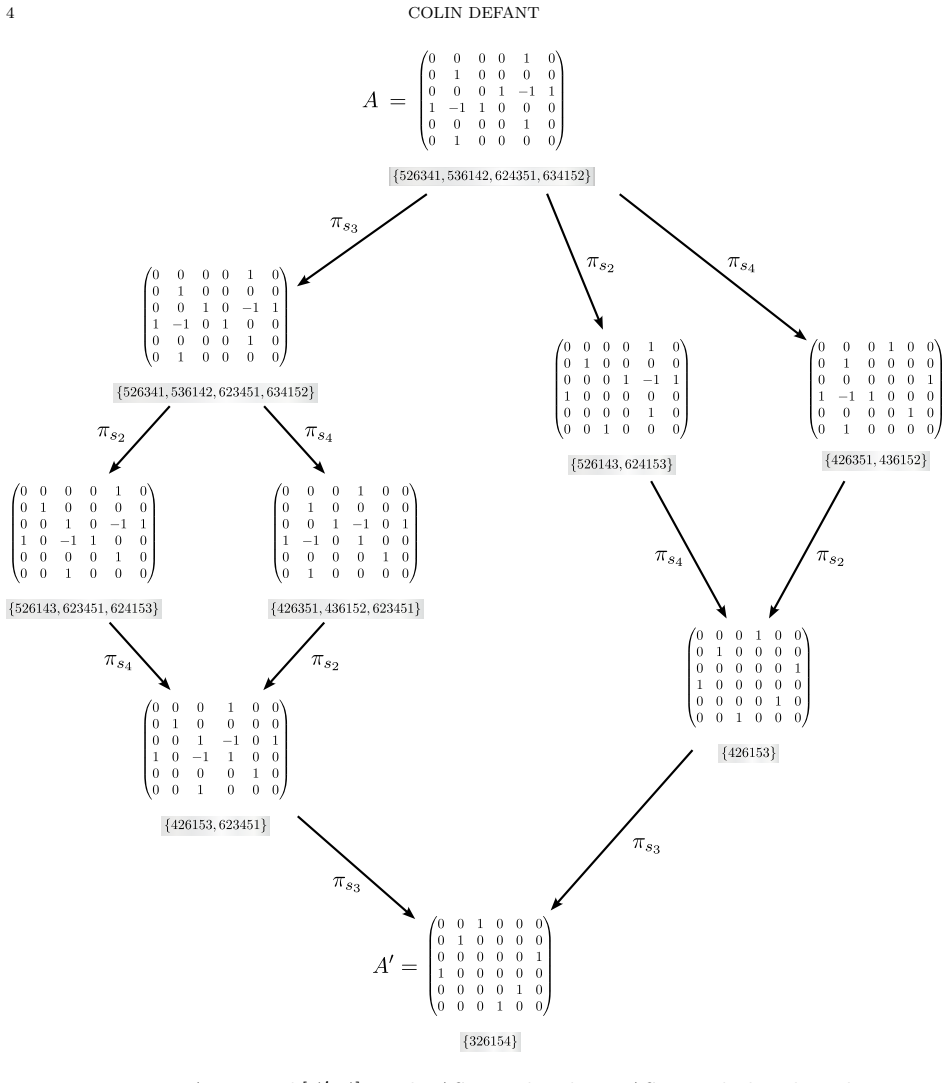
The 0-Hecke monoid of type W acts on the MacNeille completion Mac(W) of the Bruhat order on W. This action respects the lattice operations and therefore induces a well-defined weak order together with descent sets on Mac(W). When W is finite and irreducible the associated MacNeille pop-stack operator reaches the bottom element after at most h-1 steps, h being the Coxeter number of W. Specializing to type A recovers the Hamaker-Reiner structures on alternating sign matrices, proves the Escobar-Klein-Weigandt conjecture on Cohen-Macaulay ASM varieties, and supplies a counterexample to the Hamaker-Reiner conjecture on the poset topology of ASM intervals.
What carries the argument
The action of the 0-Hecke monoid of type W on Mac(W), which extends the usual weak-order action while remaining compatible with the meet and join operations of the MacNeille completion lattice.
If this is right
- Unions of Knutson-Miller subword complexes are vertex-decomposable.
- The Escobar-Klein-Weigandt conjecture holds: the relevant ASM varieties are Cohen-Macaulay.
- A counterexample exists to the Hamaker-Reiner conjecture on the topology of intervals in the ASM weak order.
- The maximum number of MacNeille pop-stack iterations is bounded by h-1 for every finite irreducible Coxeter group.
Where Pith is reading between the lines
- The construction supplies a uniform combinatorial model for weak-order phenomena that applies to every Coxeter type rather than only type A.
- The bound involving the Coxeter number suggests that the height of the new dynamics is governed by the same invariant that controls the length of reduced words and the degrees of the coinvariant algebra.
- The vertex-decomposability result may be used to compute the homotopy type of the relevant subword complexes by induction on the number of complexes in the union.
Load-bearing premise
The 0-Hecke monoid action on the MacNeille completion must be well-defined and must preserve the lattice operations so that the induced weak order relations remain consistent.
What would settle it
An explicit element of Mac(W) for some finite irreducible Coxeter group W that requires more than h-1 iterations of the MacNeille pop-stack operator to reach the bottom element.
Figures
read the original abstract
Let $\mathrm{Mac}(W)$ be the MacNeille completion of the Bruhat order of a Coxeter group $W$. We introduce an action of the $0$-Hecke monoid of type $W$ on $\mathrm{Mac}(W)$, which allows us to define a weak order and a descent set statistic on $\mathrm{Mac}(W)$. When $W$ is of type $A$, we recover constructions of Hamaker and Reiner, which were originally formulated in terms of monotone triangles and alternating sign matrices. Using this action, we prove that certain unions of Knutson--Miller subword complexes are vertex-decomposable. By specializing to type $A$, we prove a conjecture of Escobar, Klein, and Weigandt regarding Cohen--Macaulay ASM varieties. Along the way, we also exhibit a counterexample to a conjecture of Hamaker and Reiner regarding the poset topology of intervals in the ASM weak order. Finally, when $W$ is finite and irreducible, we use our $0$-Hecke action to introduce a noninvertible dynamical system on $\mathrm{Mac}(W)$ that we call the MacNeille pop-stack operator, and we prove that the maximum number of iterations of this operator needed to reach the bottom state is $h-1$, where $h$ is the Coxeter number of $W$. This article is meant to serve as a case study in using large language models to automate the workflow of mathematical research. The proof of the conjecture of Escobar--Klein--Weigandt and the disproof of the conjecture of Hamaker--Reiner were obtained autonomously by ChatGPT 5.4 Pro. Other aspects of the paper were obtained mostly by the author, but ChatGPT expedited the process. We provide a detailed account of this interaction, and we speculate on what allowed the model to be successful.
Editorial analysis
A structured set of objections, weighed in public.
Referee Report
Summary. The manuscript defines Mac(W) as the MacNeille completion of the Bruhat order on a Coxeter group W. It introduces an action of the 0-Hecke monoid of type W on Mac(W) to extend the weak order and descent set statistic. For type A this recovers prior constructions on alternating sign matrices and monotone triangles. The action is used to prove that certain unions of Knutson-Miller subword complexes are vertex-decomposable, to establish a conjecture of Escobar-Klein-Weigandt on the Cohen-Macaulay property of ASM varieties, and to exhibit a counterexample to a conjecture of Hamaker-Reiner on the topology of intervals in the ASM weak order. For finite irreducible W the paper defines the MacNeille pop-stack operator via the action and proves that its iteration count to the bottom element is at most the Coxeter number h-1. The work is presented as a case study in LLM-assisted mathematical research, with the conjecture proof and counterexample generated autonomously by ChatGPT 5.4 Pro.
Significance. If the 0-Hecke action is shown to be a well-defined monoid homomorphism on the full lattice Mac(W) and the key derivations are independently verified, the results would supply new combinatorial machinery for studying completions of Bruhat order, resolve an open question on ASM varieties, and introduce a dynamical system whose period is controlled by the Coxeter number. The counterexample and vertex-decomposability statements would also contribute concrete advances in poset topology and subword complex theory.
major comments (2)
- [section defining the 0-Hecke action] The section introducing the 0-Hecke monoid action on Mac(W): the manuscript must explicitly verify that the generators satisfy T_s^2 = T_s and the braid relations when applied to meets and joins that are added by the MacNeille completion and are absent from the original Bruhat poset. Without this verification the descent sets are not unambiguously defined and the subsequent dynamical system is not guaranteed to be well-defined.
- [final section on the pop-stack operator] The proof that the MacNeille pop-stack operator reaches the bottom in at most h-1 steps (final section): this bound is load-bearing for the main dynamical claim and rests on the lattice compatibility of the action; an explicit check for a small irreducible group (e.g., type A_2 or B_2) together with the general argument would be required to confirm that no extra relations arise on the added elements.
minor comments (2)
- [abstract and type-A specialization paragraph] The abstract states that the type-A case recovers Hamaker-Reiner constructions; a short explicit dictionary between the new descent sets and the classical ones on ASMs would improve readability.
- [final discussion section] The account of LLM interaction is presented as a case study; adding the precise prompts that produced the conjecture proof and counterexample would allow readers to assess reproducibility.
Simulated Author's Rebuttal
We thank the referee for their careful and constructive review of our manuscript. The comments identify important points that require clarification and additional verification to ensure the 0-Hecke action and the associated dynamical system are rigorously well-defined on the MacNeille completion. We address each major comment point by point below and will revise the manuscript accordingly.
read point-by-point responses
-
Referee: [section defining the 0-Hecke action] The section introducing the 0-Hecke monoid action on Mac(W): the manuscript must explicitly verify that the generators satisfy T_s^2 = T_s and the braid relations when applied to meets and joins that are added by the MacNeille completion and are absent from the original Bruhat poset. Without this verification the descent sets are not unambiguously defined and the subsequent dynamical system is not guaranteed to be well-defined.
Authors: We agree that an explicit verification of the monoid relations on the added lattice elements is necessary for a complete proof. The manuscript defines the action on the Bruhat poset W and extends it to Mac(W) by requiring that the action preserve meets and joins, but we did not include a separate lemma confirming that T_s^2 = T_s and the braid relations continue to hold after this extension. In the revised version we will insert a short subsection that proves these relations hold on the full lattice by using the universal property of the MacNeille completion together with the fact that the original action on W is order-preserving and satisfies the relations. This will unambiguously define the descent sets and the dynamical system. revision: yes
-
Referee: [final section on the pop-stack operator] The proof that the MacNeille pop-stack operator reaches the bottom in at most h-1 steps (final section): this bound is load-bearing for the main dynamical claim and rests on the lattice compatibility of the action; an explicit check for a small irreducible group (e.g., type A_2 or B_2) together with the general argument would be required to confirm that no extra relations arise on the added elements.
Authors: We accept that an explicit verification for small-rank cases would strengthen the argument and rule out unforeseen relations on the added elements. The general proof in the manuscript relies on the lattice compatibility established earlier, but we will augment the final section with direct computations for the irreducible groups of types A_2 and B_2. These calculations will confirm that the pop-stack operator reaches the bottom element in at most h-1 steps on the full MacNeille lattice and that no additional relations appear. The explicit checks will be presented as supporting evidence for the general bound. revision: yes
Circularity Check
No significant circularity; constructions are self-contained via explicit definitions and standard prior results
full rationale
The paper defines the 0-Hecke monoid action on Mac(W) explicitly to ensure it is a monoid homomorphism compatible with meets and joins in the MacNeille completion, then uses this to define weak order, descent sets, and the pop-stack operator. These steps rely on the standard definitions of MacNeille completion and 0-Hecke monoids from external literature, with the compatibility verified directly rather than assumed or fitted. The bound of h-1 iterations follows from the Coxeter number and the action's properties without reducing to self-citation chains or renaming inputs as outputs. The proofs of the cited conjectures are derived within this framework as independent consequences, with no load-bearing step collapsing to a prior result by the same authors or by construction.
Axiom & Free-Parameter Ledger
axioms (2)
- standard math The MacNeille completion of any poset is a complete lattice containing the original poset as a subposet.
- domain assumption The 0-Hecke monoid of type W acts on the Bruhat order in a manner compatible with the lattice operations of the MacNeille completion.
invented entities (1)
-
MacNeille pop-stack operator
no independent evidence
Reference graph
Works this paper leans on
-
[1]
I. Axelrod-Freed, H. Hao, M. Kendall, P. Klein, and Y. Luo. Some algebraic properties of ASM varieties. arXiv:2505.10480
-
[2]
A. Bj\"orner and F. Brenti. Combinatorics of Coxeter groups, vol. 231 of Graduate Texts in Mathematics. Springer, 2005
work page 2005
-
[3]
N. Bergeron and C. Ceballos. A Hopf algebra of subword complexes. Adv. Math., 305 (2017), 1163--1201
work page 2017
-
[4]
A. Claesson and B.\'A. Gu mundsson. Enumerating permutations sortable by k passes through a pop-stack. Adv. Appl. Math., 108 (2019), 79--96
work page 2019
-
[5]
A. Claesson, B. \'A. Gu mundsson, and J. Pantone. Counting pop-stacked permutations in polynomial time. Exp. Math., 32 (2023), 97--104
work page 2023
-
[6]
C. Defant. Meeting covered elements in -Tamari lattices.\ Adv.\ Appl.\ Math., 134 (2022)
work page 2022
-
[7]
C. Defant. Pop-stack-sorting for Coxeter groups. Comb. Theory, 1 (2022)
work page 2022
-
[8]
M. Elder and Y. K. Goh. k -pop stack sortable permutations and 2-avoidance. Electron. J. Combin., 28 (2021)
work page 2021
-
[9]
Algebra and geometry of ASM weak order.arXiv preprint arXiv:2502.19266,
L. Escobar, P. Klein, and A. Weigandt. Algebra and geometry of ASM weak order. arXiv:2502.19266
-
[10]
L. Escobar and K. M\'esz\'aros. Subword complexes via triangulations of root polytopes. Algebr. Comb., 1 (2018), 395--414
work page 2018
-
[11]
W. Fulton. Flags, Schubert polynomials, degeneracy loci, and determinantal formulas. Duke Math. J., 65 (1992), 381--420
work page 1992
-
[12]
Z. Hamaker and V. Reiner. Weak order and descents for monotone triangles. European J. Combin., 86 (2020)
work page 2020
-
[13]
A. Knutson and E. Miller. Subword complexes in Coxeter groups. Adv. Math., 184 (2004), 161--176
work page 2004
-
[14]
A. Knutson and E. Miller. Gr\"obner geometry of Schubert polynomials. Ann. of Math., 161 (2005), 1245--1318
work page 2005
-
[15]
V. Pilaud and C. Stump. Brick polytopes of spherical subword complexes and generalized associahedra. Adv. Math., 276 (2015), 1--61
work page 2015
- [16]
- [17]
discussion (0)
Sign in with ORCID, Apple, or X to comment. Anyone can read and Pith papers without signing in.