Recognition: 2 theorem links
· Lean TheoremHot biexcitons driven by extreme optical confinement
Pith reviewed 2026-05-11 02:29 UTC · model grok-4.3
The pith
Extreme optical confinement lets hot excitons in bilayer WS2 form four-body biexcitons that keep valley polarization at room temperature.
A machine-rendered reading of the paper's core claim, the machinery that carries it, and where it could break.
Core claim
The central discovery is the observation of four-body hot biexcitons in an energetically unfavorable bilayer of tungsten disulfide, made possible by extreme optical confinement from a non-radiative bound state in the continuum inside a photonic crystal defect cavity. The confined photons efficiently excite two-body hot excitons situated slightly above the indirect bandgap, allowing them to form higher-order four-body complexes. These hot biexcitons exhibit substantial valley polarization and coherence at room temperature, attributed to the topological nature of the bound states and the associated confinement carrying orbital angular momentum.
What carries the argument
The non-radiative bound state in the continuum inside a photonic crystal defect cavity, which creates quasi-three-dimensional open confinement for photons and concentrates them to drive many-body exciton interactions.
If this is right
- Room-temperature biexcitons become observable in otherwise unfavorable material configurations.
- The same confinement approach could enable still-higher-order states such as triexcitons.
- Many-body phenomena including Bose-Einstein condensation in 2D materials could be accessed through similar open photonic traps.
- Valley coherence in multi-particle complexes can persist at room temperature when driven by topologically protected light confinement.
Where Pith is reading between the lines
- Similar cavity designs might allow selective population of specific multi-exciton states by tuning the confinement volume.
- The method could be tested in other transition-metal dichalcogenide bilayers to check how material band structure affects the efficiency of hot-biexciton formation.
- If the orbital angular momentum component is essential, rotating the polarization of the driving light might modulate the observed coherence.
Load-bearing premise
The assumption that the special light trapping from the bound state in the continuum is what causes the hot excitons to form biexcitons and that the polarization comes from the topology of that trap rather than other experimental effects.
What would settle it
If the biexciton formation rate or valley polarization remains unchanged when the cavity is detuned away from the bound-state resonance while keeping total photon intensity the same, the attribution to the topological confinement would be falsified.
Figures


read the original abstract
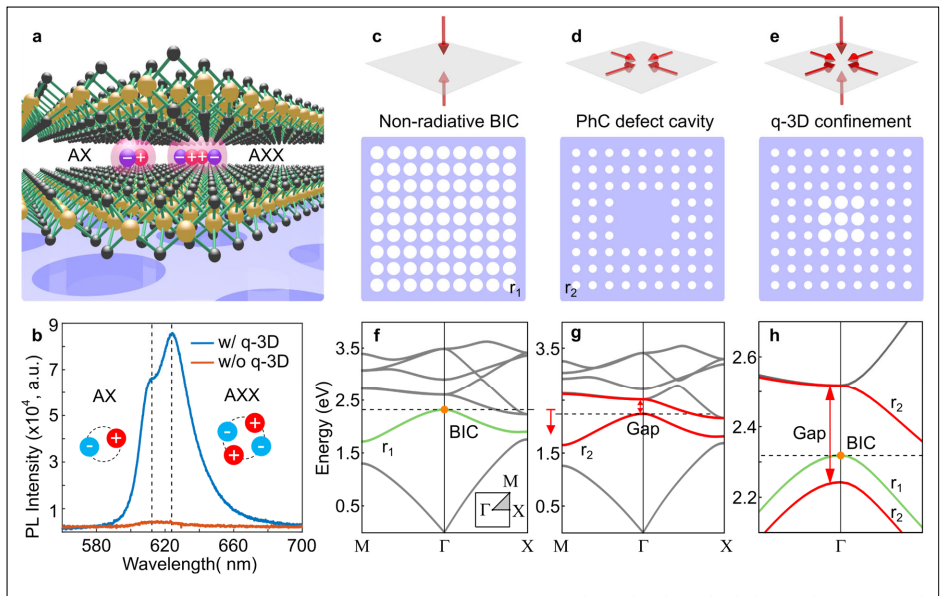
A powerful means to understanding condensed matter that possesses a multi-constituent, non-isolated, and complex nature, with a preeminent example being two-dimensional (2D) materials, is studying many-body interactions. However, experimentally observing high-order many-body interactions is a daunting task due to its heavy reliance on the abundance of low-order complexes. Here, we report the observation of four-body hot biexcitons in an energetically unfavorable bilayer of tungsten disulfide (WS2) through creating extreme optical confinement. Specifically, we integrate a non-radiative bound state in the continuum (BIC) into a photonic crystal (PhC) defect cavity, forming a quasi-three-dimensional (q-3D) but open confinement for photons at the driving frequency. The extremely confined photons in both reciprocal and physical spaces then excite inherently unproductive two-body hot excitons situated slightly above the indirect bandgap so efficiently that they form overwhelmed higher-order four-body hot biexcitons. Distinctively, these hot biexcitons exhibit substantial valley polarization and coherence at room temperature, which we attribute to the topological nature of BICs and the associated q-3D confinement with an orbital angular momentum. Besides achieving room-temperature biexcitons, the q-3D confinement could be valuable for higher-order interactions, such as triexcitons, and many other many-body phenomena, including Bose-Einstein condensation.
Editorial analysis
A structured set of objections, weighed in public.
Referee Report
Summary. The manuscript reports the observation of four-body hot biexcitons in an energetically unfavorable bilayer of WS2 achieved by integrating a non-radiative bound state in the continuum (BIC) into a photonic crystal defect cavity. This creates quasi-3D open confinement that efficiently excites unproductive two-body hot excitons above the indirect bandgap, leading to higher-order biexciton formation. The resulting hot biexcitons are claimed to exhibit substantial valley polarization and coherence at room temperature, attributed specifically to the topological properties of the BIC and the associated orbital angular momentum in the q-3D confinement. The work suggests broader utility for higher-order many-body interactions such as triexcitons and Bose-Einstein condensation.
Significance. If the central observations and the causal attribution to BIC topology hold after controls and data presentation, the result would advance the use of topological photonics to stabilize room-temperature many-body excitonic states in 2D materials. The q-3D confinement approach via non-radiative BICs offers a potentially generalizable route beyond conventional cavity enhancement, with implications for valleytronics and higher-order complexes. The absence of isolating controls for the topological mechanism currently limits the strength of the novelty claim.
major comments (2)
- [Abstract and Discussion] Abstract and Discussion: The attribution that 'these hot biexcitons exhibit substantial valley polarization and coherence at room temperature, which we attribute to the topological nature of BICs and the associated q-3D confinement with an orbital angular momentum' is load-bearing for the paper's novelty but is not supported by isolating controls. No comparative data (e.g., identical confinement strength in a topologically trivial cavity lacking the BIC polarization vortex or OAM) are presented to exclude alternatives such as local strain from the PhC defect, generic cavity-induced symmetry breaking, or residual driving-polarization effects.
- [Results] Results section: The central experimental claim of efficient excitation of unproductive two-body hot excitons into four-body hot biexcitons via the non-radiative BIC requires quantitative support. Spectra, power-dependent measurements, excitation-efficiency comparisons, and error analysis demonstrating the four-body nature and the role of extreme confinement must be shown explicitly; the abstract supplies none of these.
minor comments (3)
- Clarify the precise definition and quantitative characterization of 'q-3D' confinement (e.g., mode volume, quality factor, and how the open nature differs from closed 3D cavities) with supporting simulations or measurements.
- Add references to prior work on BICs in 2D-material cavities and room-temperature biexcitons in TMDs to better contextualize the advance.
- Ensure all figures include scale bars, error bars, and raw data where polarization/coherence values are reported.
Simulated Author's Rebuttal
We thank the referee for their thorough review and valuable comments on our manuscript. We address each major comment below with point-by-point responses and indicate revisions where appropriate. We believe the core observations are robust but acknowledge areas where clarification or additional context can strengthen the presentation.
read point-by-point responses
-
Referee: [Abstract and Discussion] Abstract and Discussion: The attribution that 'these hot biexcitons exhibit substantial valley polarization and coherence at room temperature, which we attribute to the topological nature of BICs and the associated q-3D confinement with an orbital angular momentum' is load-bearing for the paper's novelty but is not supported by isolating controls. No comparative data (e.g., identical confinement strength in a topologically trivial cavity lacking the BIC polarization vortex or OAM) are presented to exclude alternatives such as local strain from the PhC defect, generic cavity-induced symmetry breaking, or residual driving-polarization effects.
Authors: We agree that isolating controls using a topologically trivial cavity with matched confinement strength would provide more direct evidence for the specific role of BIC topology and OAM. The current work focuses on the BIC-enabled q-3D confinement as the enabling platform, with supporting theoretical analysis of the polarization vortex and its impact on valley selection rules. Alternative mechanisms such as strain or generic symmetry breaking are discussed in the manuscript and supplementary information, where we show that the observed polarization depends on the cavity's topological features rather than defect-induced strain alone. We will revise the abstract and discussion sections to more explicitly qualify the attribution, emphasize the supporting modeling, and note the absence of direct trivial-cavity controls as a limitation for future work. revision: partial
-
Referee: [Results] Results section: The central experimental claim of efficient excitation of unproductive two-body hot excitons into four-body hot biexcitons via the non-radiative BIC requires quantitative support. Spectra, power-dependent measurements, excitation-efficiency comparisons, and error analysis demonstrating the four-body nature and the role of extreme confinement must be shown explicitly; the abstract supplies none of these.
Authors: The results section, figures, and supplementary materials already present the requested quantitative elements: power-dependent PL spectra showing the biexciton emergence, superlinear power scaling consistent with four-body processes, excitation efficiency comparisons between the BIC cavity and bare bilayer, and associated error analysis. The abstract, being a concise summary, omits these details. We will revise the abstract to incorporate key quantitative indicators (e.g., power-law exponents and confinement-enhanced rates) while ensuring all supporting data are explicitly cross-referenced in the main text for clarity. revision: yes
- Direct experimental isolating controls with topologically trivial cavities of matched confinement strength, which would require fabrication and characterization of additional devices.
Circularity Check
No circularity: experimental observation with interpretive attribution
full rationale
The paper reports an experimental observation of four-body hot biexcitons in WS2 enabled by q-3D confinement from a non-radiative BIC in a PhC defect cavity. The central claims rest on measured valley polarization and coherence at room temperature, with attribution to BIC topology and OAM stated as an interpretation rather than derived from equations. No mathematical derivations, fitted parameters, self-definitional loops, or load-bearing self-citations appear in the provided text or abstract. The result is grounded in physical measurements and external cavity design principles, remaining self-contained without reduction to its own inputs.
Axiom & Free-Parameter Ledger
axioms (2)
- domain assumption Established framework of excitons, hot excitons, and biexcitons in transition metal dichalcogenides
- domain assumption Topological properties of bound states in the continuum confer orbital angular momentum and valley selectivity
Lean theorems connected to this paper
-
IndisputableMonolith/Foundation/AlexanderDuality.leanalexander_duality_circle_linking unclear?
unclearRelation between the paper passage and the cited Recognition theorem.
we attribute to the topological nature of BICs and the associated q-3D confinement with an orbital angular momentum
What do these tags mean?
- matches
- The paper's claim is directly supported by a theorem in the formal canon.
- supports
- The theorem supports part of the paper's argument, but the paper may add assumptions or extra steps.
- extends
- The paper goes beyond the formal theorem; the theorem is a base layer rather than the whole result.
- uses
- The paper appears to rely on the theorem as machinery.
- contradicts
- The paper's claim conflicts with a theorem or certificate in the canon.
- unclear
- Pith found a possible connection, but the passage is too broad, indirect, or ambiguous to say the theorem truly supports the claim.
Reference graph
Works this paper leans on
-
[1]
Although the detailed microscopic mechanism remains beyond the scope of the present work, this topology-mediated excitation may contribute to the enhanced valley polarization and coherence observed in AX and AXX emissions discussed below. 7 Achieving AXXs and experimental verification After establishing q-3D confinement and the topological property associ...
-
[2]
Peak 1 corresponds to neutral AX emission based on its wavelength
and 623 nm (Peak 2), with the overall emission intensity strongly enhanced, consistent with pump-assisted excitation enhancement via the q-3D design. Peak 1 corresponds to neutral AX emission based on its wavelength. To determine the origin of Peak 2, we perform pump-density-dependent PL measurements. As shown in Fig. 3c, Peak 2 near 623 nm shows a nonlin...
-
[3]
Wang, G. et al. Colloquium: Excitons in atomically thin transition metal dichalcogenides. Rev. Mod. Phys. 90, 021001 (2018)
work page 2018
-
[4]
Mak, K. F. & Shan, J. Photonics and optoelectronics of 2D semiconductor transition metal dichalcogenides. Nat. Photon. 10, 216–226 (2016)
work page 2016
-
[5]
Mak, K. F., Xiao, D. & Shan, J. Light–valley interactions in 2D semiconductors. Nat. Photon. 12, 451–460 (2018)
work page 2018
-
[6]
Xu, X., Yao, W., Xiao, D. & Heinz, T. F. Spin and pseudospins in layered transition metal dichalcogenides. Nat. Phys. 10, 343–350 (2014)
work page 2014
-
[7]
You, Y. et al. Observation of biexcitons in monolayer WSe2. Nat. Phys. 11, 477–481 (2015)
work page 2015
-
[8]
He, Z. et al. Biexciton formation in bilayer tungsten disulfide. ACS Nano 10, 2176–2183 (2016)
work page 2016
-
[9]
Moody, G., Schaibley, J. & Xu, X. Exciton dynamics in monolayer transition metal dichalcogenides. J. Opt. Soc. Am. B 33, C39–C49 (2016)
work page 2016
-
[10]
Yuan, L. & Huang, L. Exciton dynamics and annihilation in WS 2 2D semiconductors. Nanoscale 7, 7402– 7408 (2015)
work page 2015
-
[11]
Hao, K. et al. Neutral and charged inter-valley biexcitons in monolayer MoSe 2. Nat. Commun. 8, 15552 (2017)
work page 2017
-
[12]
Paradisanos, I. et al. Room temperature observation of biexcitons in exfoliated WS2 monolayers. Appl. Phys. Lett. 110, 193102 (2017)
work page 2017
- [13]
-
[14]
K., Lin, F.-C., Yeh, C.-H., Huang, J.-S
Nayak, P. K., Lin, F.-C., Yeh, C.-H., Huang, J.-S. & Chiu, P.-W. Robust room temperature valley polarization in monolayer and bilayer WS2. Nanoscale 8, 6035–6042 (2016)
work page 2016
-
[15]
Hsu, C. W. et al. Observation of trapped light within the radiation continuum. Nature 499, 188–191 (2013)
work page 2013
-
[16]
Zhen, B., Hsu, C. W., Lu, L., Stone, A. D. & Solja čić, M. Topological nature of optical bound states in the continuum. Phys. Rev. Lett. 113, 257401 (2014)
work page 2014
-
[17]
Hsu, C. W., Zhen, B., Stone, A. D., Joannopoulos, J. D. & Soljačić, M. Bound states in the continuum. Nat. Rev. Mater. 1, 16048 (2016)
work page 2016
-
[18]
Reciprocal quantum electrodynamics with bound states in the continuum
Lan, S. Reciprocal quantum electrodynamics with bound states in the continuum. Nanophotonics 15, e70108 (2026)
work page 2026
- [19]
-
[20]
Istrate, E. & Sargent, E. H. Photonic crystal heterostructures and interfaces. Rev. Mod. Phys. 78, 455–481 (2006)
work page 2006
-
[21]
Noda, S., Fujita, M. & Asano, T. Spontaneous-emission control by photonic crystals and nanocavities. Nat. Photon. 1, 449–458 (2007)
work page 2007
- [22]
-
[23]
Inhibited spontaneous emission in solid-state physics and electronics
Yablonovitch, E. Inhibited spontaneous emission in solid-state physics and electronics. Phys. Rev. Lett. 58, 2059–2062 (1987)
work page 2059
-
[24]
Liu, T. et al. Enhanced light-matter interaction in atomically thin MoS 2 coupled with 1D photonic crystal nanocavity. Opt. Express 25, 14691–14696 (2017)
work page 2017
- [25]
-
[26]
Kang, L., Wu, Y ., Ma, X., Lan, S. & Werner, D. H. High‐harmonic optical vortex generation from photonic bound states in the continuum. Adv. Opt. Mater. 10, 2101497 (2022)
work page 2022
-
[27]
Wang, B. et al. Generating optical vortex beams by momentum-space polarization vortices centred at bound states in the continuum. Nat. Photon. 14, 623–628 (2020)
work page 2020
-
[28]
Liu, W. et al. Circularly polarized states spawning from bound states in the continuum. Phys. Rev. Lett. 123, 116104 (2019)
work page 2019
-
[29]
Chen, Y . et al. Observation of intrinsic chiral bound states in the continuum. Nature 613, 474–478 (2023)
work page 2023
-
[30]
Gong, S.-H., Alpeggiani, F., Sciacca, B., Garnett, E. C. & Kuipers, L. Nanoscale chiral valley-photon interface through optical spin-orbit coupling. Science 359, 443–447 (2018)
work page 2018
-
[31]
Kesarwani, R. et al. Control of trion-to-exciton conversion in monolayer WS2 by orbital angular momentum of light. Sci. Adv. 8, eabm0100 (2022)
work page 2022
- [32]
-
[33]
Velický, M. et al. Mechanism of gold-assisted exfoliation of centimeter-sized transition-metal dichalcogenide monolayers. ACS Nano 12, 10463–10472 (2018)
work page 2018
-
[34]
Ma, X. et al. Coherent momentum control of forbidden excitons. Nat. Commun. 13, 6916 (2022)
work page 2022
- [35]
-
[36]
Jones, A. M. et al. Optical generation of excitonic valley coherence in monolayer WSe 2. Nat. Nanotechnol. 8, 634–638 (2013)
work page 2013
-
[37]
Minkov, M. et al. Inverse design of photonic crystals through automatic differentiation. ACS Photonics 7, 1729–1741 (2020). 14 Fig. 1: AXXs in atomic bilayers driven by q-3D confinement. a, Schematic of two-body hot exciton (AX) and four-body hot biexciton (AXX) in bilayer WS2 driven by q-3D confinement at the pumping wavelength. b, Room- temperature PL s...
work page 2020
discussion (0)
Sign in with ORCID, Apple, or X to comment. Anyone can read and Pith papers without signing in.