Recognition: no theorem link
The two-flavor Schwinger model at 50: Solving Coleman's puzzles
Pith reviewed 2026-05-11 02:23 UTC · model grok-4.3
The pith
In the two-flavor Schwinger model with equal fermion masses at theta equals pi, charge conjugation symmetry breaks spontaneously and confinement is absent for any gauge coupling.
A machine-rendered reading of the paper's core claim, the machinery that carries it, and where it could break.
Core claim
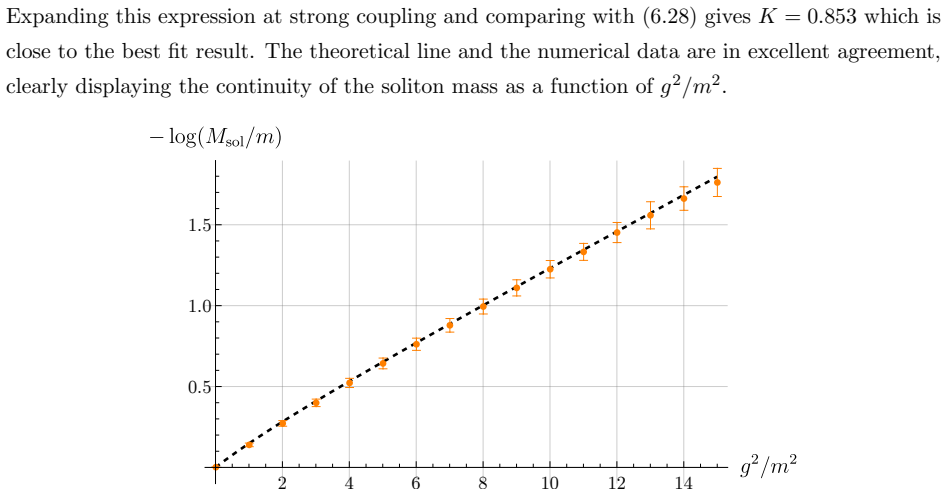
For equal fermion masses m at theta equals pi, the model exhibits spontaneous breaking of charge conjugation symmetry and absence of confinement for any value of the gauge coupling g. The mass gap behaves as m e to the minus 0.111 g squared over m squared in the strong-coupling regime m much less than g. This follows from two-loop renormalization group and integrability analysis, with lattice Hamiltonian results in agreement. The solution at theta equals zero involves a necessary level crossing between two isosinglet states, and isospin-breaking effects from unequal masses are estimated at strong coupling.
What carries the argument
Two-loop renormalization group flow combined with integrability methods to extract the leading strong-coupling asymptotics of the mass gap, verified by lattice Hamiltonian discretization.
If this is right
- The theory interpolates smoothly between weak and strong coupling without phase transitions at theta equals pi.
- Charged excitations remain deconfined at all couplings, allowing propagation without linear potentials.
- The mass gap suppression arises from non-perturbative dynamics fixed by the renormalization group coefficient.
- At theta equals zero the particle spectrum must contain a level crossing between two states of distinct discrete quantum numbers.
- Isospin violation induced by unequal masses stays quantifiable and remains under control at strong coupling.
Where Pith is reading between the lines
- The phase structure may inform analyses of theta-dependent deconfinement in related lower-dimensional models.
- Extending lattice runs to stronger couplings or finer spacings could test the stability of the 0.111 coefficient.
- The level-crossing mechanism at theta equals zero offers a template for studying discrete symmetry exchanges in other integrable systems.
Load-bearing premise
The two-loop renormalization group flow and integrability analysis capture the leading strong-coupling asymptotics without higher-order corrections or lattice artifacts altering the exponential form or the phase structure.
What would settle it
A high-precision lattice simulation at theta equals pi and m much less than g that finds either a mass gap deviating from the predicted exponential suppression or a linear confining potential between charges would falsify the central claim.
Figures






read the original abstract
In his 1976 paper "More about the massive Schwinger model", Coleman introduced $1+1$-dimensional Quantum Electrodynamics coupled to two charged massive fermions. By applying Abelian bosonization, he elucidated much of the physics of this two-flavor Schwinger model, but he listed three puzzles at the end of his paper. We present new analytical and numerical calculations to solve Coleman's three puzzles and thereby deepen our understanding of this model. These puzzles pertain to the theory with equal fermion masses at $\theta = 0$ and at $\theta = \pi$, as well as the size of isospin-breaking effects when the fermion masses are unequal. For the puzzle at $\theta = \pi$, the solution is related to the structure of the zero-temperature phase diagram arXiv:2305.04437: for equal fermion masses $m$, the model exhibits spontaneous breaking of charge conjugation symmetry and absence of confinement for any value of the gauge coupling $g$, so that there is a smooth interpolation from weak to strong coupling. Using two-loop Renormalization Group and integrability methods, we show that the mass gap behaves as $\sim m e^{-0.111 g^2/m^2}$ in the strong coupling regime $m\ll g$. Our numerical results using the lattice Hamiltonian are in good agreement with this behavior. For the puzzle at $\theta = 0$, the solution is related to a level crossing between two isosinglet particles with different discrete quantum numbers; we demonstrate the necessity of such a crossing by comparing integrability and weak coupling calculations, and we also exhibit the crossing numerically. Finally, we provide a new estimate for the size of isospin-breaking effects caused by different fermion masses at strong coupling.
Editorial analysis
A structured set of objections, weighed in public.
Referee Report
Summary. The paper resolves Coleman's three puzzles in the two-flavor Schwinger model. At θ=π with equal fermion masses m, it claims spontaneous breaking of charge conjugation symmetry and absence of confinement for any gauge coupling g, with the mass gap in the strong-coupling regime m ≪ g behaving as ∼ m exp(−0.111 g²/m²) from two-loop RG and integrability, confirmed by lattice Hamiltonian numerics. At θ=0 it demonstrates a level crossing between isosinglet particles with different discrete quantum numbers, and it provides a new estimate for isospin-breaking effects with unequal masses.
Significance. If the results hold, the work provides a comprehensive resolution of long-standing puzzles in the two-flavor Schwinger model, clarifying its phase structure across weak and strong coupling. The independent cross-validation between two-loop RG, integrability methods, and lattice Hamiltonian simulations is a clear strength, as is the parameter-free derivation of the leading exponential coefficient. This lends substantial credibility to the claims of C-symmetry breaking and deconfinement at θ=π for all g, with potential implications for related 1+1D gauge theories.
major comments (1)
- [two-loop RG and integrability derivation of the strong-coupling mass gap] In the two-loop RG and integrability derivation of the strong-coupling mass gap (the section presenting the beta-function analysis and the resulting exponent 0.111): the leading form ∼ m e^{-0.111 g²/m²} is obtained at two-loop order. The manuscript does not estimate the size of three-loop or higher contributions to the beta function or discuss whether they could alter the coefficient or functional form in the m/g → 0 limit. While the lattice data are stated to agree, they are necessarily at finite m/g; adding a concrete argument or scaling test for the robustness of the leading asymptotics would directly support the headline claim.
minor comments (3)
- [Abstract] Abstract: the coefficient 0.111 is quoted to three digits without indicating its origin from the two-loop coefficients or the numerical precision; a parenthetical note on its computation would improve clarity.
- [Lattice Hamiltonian numerics section] Lattice Hamiltonian numerics section: the mass-gap plots and fits should specify the exact range of m/g values, the fitting procedure used to extract the exponential, and any continuum extrapolation details to allow readers to assess agreement with the analytic form.
- [θ=0 level crossing discussion] Discussion of the θ=0 level crossing: the discrete quantum numbers of the two isosinglet particles should be tabulated or explicitly listed alongside the integrability and weak-coupling calculations for immediate reference.
Simulated Author's Rebuttal
We thank the referee for their thorough review and positive assessment of our work on resolving Coleman's puzzles in the two-flavor Schwinger model. We address the major comment below.
read point-by-point responses
-
Referee: In the two-loop RG and integrability derivation of the strong-coupling mass gap (the section presenting the beta-function analysis and the resulting exponent 0.111): the leading form ∼ m e^{-0.111 g²/m²} is obtained at two-loop order. The manuscript does not estimate the size of three-loop or higher contributions to the beta function or discuss whether they could alter the coefficient or functional form in the m/g → 0 limit. While the lattice data are stated to agree, they are necessarily at finite m/g; adding a concrete argument or scaling test for the robustness of the leading asymptotics would directly support the headline claim.
Authors: We agree that an explicit discussion of higher-order perturbative contributions would enhance the robustness of our claims. The two-loop beta function determines the leading term in the exponent for the mass gap as m/g → 0. Contributions from three-loop and higher orders in the beta function typically introduce subleading corrections, such as powers of (g²/m²) or additional logarithmic factors in the prefactor, without changing the leading exponential dependence or the coefficient at this order. The integrability analysis provides an independent, non-perturbative validation of the functional form. For the lattice results, which are at finite m/g, we will include in the revised manuscript a scaling plot of the ratio of the numerical mass gap to the predicted asymptotic form as a function of m/g. This will illustrate the convergence towards the expected behavior as the strong-coupling limit is approached. We will also add a short paragraph discussing the perturbative convergence based on the known properties of the renormalization group flow in this model. revision: yes
Circularity Check
Minor self-citation to prior phase diagram; central mass-gap derivation independent via standard two-loop RG
full rationale
The derivation of the mass-gap form ∼ m e^{-0.111 g²/m²} relies on standard two-loop RG flow equations whose beta-function coefficients are computed independently of the target result, combined with integrability methods; the lattice Hamiltonian numerics serve as an external confirmation rather than a fit. The reference to arXiv:2305.04437 for the zero-temperature phase diagram at θ=π constitutes a minor self-citation that supports the phase structure claim but is not load-bearing for the RG-derived asymptotics or the overall puzzle solutions, which retain independent analytic content. No self-definitional, fitted-prediction, or ansatz-smuggling reductions appear in the reported chain.
Axiom & Free-Parameter Ledger
axioms (2)
- standard math Abelian bosonization correctly maps the two-flavor Schwinger model to an equivalent bosonic theory whose spectrum and symmetries can be analyzed.
- domain assumption Two-loop renormalization group equations plus integrability methods give the leading exponential behavior of the mass gap in the strong-coupling regime.
Reference graph
Works this paper leans on
-
[1]
S. R. Coleman,More About the Massive Schwinger Model,Annals Phys.101(1976) 239
work page 1976
-
[2]
R. Dempsey, I. R. Klebanov, S. S. Pufu, B. T. Søgaard and B. Zan,Phase Diagram of the Two-Flavor Schwinger Model at Zero Temperature,Phys. Rev. Lett.132(2024) 031603 [2305.04437]
-
[3]
D. J. Gross and F. Wilczek,Ultraviolet Behavior of Nonabelian Gauge Theories,Phys. Rev. Lett.30(1973) 1343
work page 1973
-
[4]
H. D. Politzer,Reliable Perturbative Results for Strong Interactions?,Phys. Rev. Lett.30 (1973) 1346
work page 1973
-
[5]
K. G. Wilson,Confinement of Quarks,Phys. Rev. D10(1974) 2445
work page 1974
-
[6]
J. B. Kogut and L. Susskind,Hamiltonian Formulation of Wilson’s Lattice Gauge Theories, Phys. Rev. D11(1975) 395
work page 1975
-
[7]
Chenet al., Glueball spectrum and matrix elements on anisotropic lattices, Phys
Y. Chen et al.,Glueball spectrum and matrix elements on anisotropic lattices,Phys. Rev. D 73(2006) 014516 [hep-lat/0510074]
-
[8]
S. R. Coleman and E. J. Weinberg,Radiative Corrections as the Origin of Spontaneous Symmetry Breaking,Phys. Rev. D7(1973) 1888
work page 1973
-
[9]
A. M. Polyakov,Interaction of Goldstone Particles in Two-Dimensions. Applications to Ferromagnets and Massive Yang-Mills Fields,Phys. Lett. B59(1975) 79. 61
work page 1975
-
[10]
A. M. Polyakov and P. B. Wiegmann,Theory of Nonabelian Goldstone Bosons,Phys. Lett. B131(1983) 121
work page 1983
-
[11]
P. B. Wiegmann,On the Theory of Nonabelian Goldstone Bosons in Two-dimensions: Exact Solution of the O(3) NonlinearσModel,Phys. Lett. B141(1984) 217
work page 1984
-
[12]
P. Hasenfratz, M. Maggiore and F. Niedermayer,The Exact mass gap of the O(3) and O(4) nonlinear sigma models in d = 2,Phys. Lett. B245(1990) 522
work page 1990
- [13]
-
[14]
D. J. Amit, Y. Y. Goldschmidt and G. Grinstein,Renormalization Group Analysis of the Phase Transition in the 2D Coulomb Gas, Sine-Gordon Theory and xy Model,J. Phys. A 13(1980) 585
work page 1980
-
[15]
D. J. Gross and A. Neveu,Dynamical Symmetry Breaking in Asymptotically Free Field Theories,Phys. Rev. D10(1974) 3235
work page 1974
-
[16]
J. S. Schwinger,Gauge Invariance and Mass. 2.,Phys. Rev.128(1962) 2425
work page 1962
-
[17]
J. H. Lowenstein and J. A. Swieca,Quantum electrodynamics in two-dimensions,Annals Phys.68(1971) 172
work page 1971
-
[18]
S. R. Coleman, R. Jackiw and L. Susskind,Charge Shielding and Quark Confinement in the Massive Schwinger Model,Annals Phys.93(1975) 267
work page 1975
- [19]
- [20]
-
[21]
E. Arguello Cruz, G. Tarnopolsky and Y. Xin,Precision study of the massive Schwinger model near quantum criticality,Phys. Rev. D112(2025) 034023 [2412.01902]
- [22]
-
[23]
Infinite matrix product states for $(1+1)$-dimensional gauge theories
R. Dempsey, A.-M. E. Gl¨ uck, S. S. Pufu and B. T. Søgaard,Infinite matrix product states for (1 + 1)-dimensional gauge theories,JHEP03(2026) 181 [2508.16363]. 62
work page internal anchor Pith review Pith/arXiv arXiv 2026
-
[24]
S. R. Coleman,The Quantum Sine-Gordon Equation as the Massive Thirring Model,Phys. Rev. D11(1975) 2088
work page 1975
-
[25]
Mandelstam,Soliton Operators for the Quantized Sine-Gordon Equation,Phys
S. Mandelstam,Soliton Operators for the Quantized Sine-Gordon Equation,Phys. Rev. D 11(1975) 3026
work page 1975
- [26]
- [27]
- [28]
-
[29]
Y. Hosotani and R. Rodriguez,Bosonized massive N flavor Schwinger model,J. Phys. A31 (1998) 9925 [hep-th/9804205]
-
[30]
Hosotani,Antiferromagnetic S = 1/2 Heisenberg chain and the two flavor massless Schwinger model,Phys
Y. Hosotani,Antiferromagnetic S = 1/2 Heisenberg chain and the two flavor massless Schwinger model,Phys. Rev. B60(1999) 6198 [hep-th/9809066]
-
[31]
F. Berruto, G. Grignani, G. W. Semenoff and P. Sodano,On the correspondence between the strongly coupled two flavor lattice Schwinger model and the Heisenberg antiferromagnetic chain,Annals Phys.275(1999) 254 [hep-th/9901142]
-
[32]
Fractionalθangle, ’t Hooft anomaly, and quantum instantons in charge-qmulti-flavor Schwinger model,
T. Misumi, Y. Tanizaki and M. ¨Unsal,Fractionalθangle, ’t Hooft anomaly, and quantum instantons in charge-qmulti-flavor Schwinger model,JHEP07(2019) 018 [1905.05781]
-
[33]
Georgi,Automatic Fine-Tuning in the Two-Flavor Schwinger Model,Phys
H. Georgi,Automatic Fine-Tuning in the Two-Flavor Schwinger Model,Phys. Rev. Lett. 125(2020) 181601 [2007.15965]
-
[34]
H. Georgi,Mass perturbation theory in the 2-flavor Schwinger model with opposite masses with a review of the background,JHEP10(2022) 119 [2206.14691]
-
[35]
V. L. Berezinskii,Destruction of Long-range Order in One-dimensional and Two-dimensional Systems having a Continuous Symmetry Group I. Classical Systems,Sov. Phys. JETP32(1971) 493
work page 1971
-
[36]
J. M. Kosterlitz and D. J. Thouless,Ordering, metastability and phase transitions in two-dimensional systems,J. Phys. C6(1973) 1181
work page 1973
-
[37]
J. M. Kosterlitz,The critical properties of the two-dimensional xy model,J. Phys. C7 (1974) 1046. 63
work page 1974
-
[38]
J. V. Jose, L. P. Kadanoff, S. Kirkpatrick and D. R. Nelson,Renormalization, vortices, and symmetry breaking perturbations on the two-dimensional planar model,Phys. Rev. B16 (1977) 1217
work page 1977
- [39]
- [40]
- [41]
-
[42]
Witten,Nonabelian Bosonization in Two-Dimensions,Commun
E. Witten,Nonabelian Bosonization in Two-Dimensions,Commun. Math. Phys.92(1984) 455
work page 1984
-
[43]
Gepner,Nonabelian Bosonization and Multiflavor QED and QCD in Two-dimensions, Nucl
D. Gepner,Nonabelian Bosonization and Multiflavor QED and QCD in Two-dimensions, Nucl. Phys. B252(1985) 481
work page 1985
-
[44]
Affleck,On the Realization of Chiral Symmetry in (1+1)-dimensions,Nucl
I. Affleck,On the Realization of Chiral Symmetry in (1+1)-dimensions,Nucl. Phys. B265 (1986) 448
work page 1986
-
[45]
Creutz,CP violation in QCD,PoSConfinement2018(2018) 171 [1810.03543]
M. Creutz,CP violation in QCD,PoSConfinement2018(2018) 171 [1810.03543]
-
[46]
R. F. Dashen,Some features of chiral symmetry breaking,Phys. Rev. D3(1971) 1879
work page 1971
-
[47]
Creutz,Quark masses and chiral symmetry,Phys
M. Creutz,Quark masses and chiral symmetry,Phys. Rev. D52(1995) 2951 [hep-th/9505112]
- [48]
-
[49]
Creutz,Quark mass dependence of two-flavor QCD,Phys
M. Creutz,Quark mass dependence of two-flavor QCD,Phys. Rev. D83(2011) 016005 [1010.4467]
-
[50]
Theta, Time Reversal, and Temperature
D. Gaiotto, A. Kapustin, Z. Komargodski and N. Seiberg,Theta, Time Reversal, and Temperature,JHEP05(2017) 091 [1703.00501]
work page Pith review arXiv 2017
-
[51]
A. A. Belavin,Exact solution of the two-dimensional model with asymptotic freedom,Phys. Lett. B87(1979) 117
work page 1979
-
[52]
N. Andrei and J. H. Lowenstein,Diagonalization of the Chiral Invariant Gross-Neveu Hamiltonian,Phys. Rev. Lett.43(1979) 1698. 64
work page 1979
-
[53]
P. Forgacs, S. Naik and F. Niedermayer,The Exact mass gap of the chiral Gross-Neveu model,Phys. Lett. B283(1992) 282
work page 1992
-
[54]
D. Delphenich and J. Schechter,Multiflavor massive Schwinger model with nonAbelian bosonization,Int. J. Mod. Phys. A12(1997) 5305 [hep-th/9703120]
-
[55]
D. Albandea and P. Hern´ andez,Chiral and isospin breaking in the two-flavor Schwinger model,Phys. Rev. D111(2025) 074503 [2501.04674]
-
[56]
T. D. Lee and C.-N. Yang,Charge Conjugation, a New Quantum NumberG, and Selection Rules Concerning a Nucleon Anti-nucleon System,Nuovo Cim.10(1956) 749
work page 1956
-
[57]
C. C´ ordova, D. S. Freed, H. T. Lam and N. Seiberg,Anomalies in the Space of Coupling Constants and Their Dynamical Applications I,SciPost Phys.8(2020) 001 [1905.09315]
-
[58]
Z. Komargodski, A. Sharon, R. Thorngren and X. Zhou,Comments on Abelian Higgs Models and Persistent Order,SciPost Phys.6(2019) 003 [1705.04786]
-
[59]
T. Sulejmanpasic, D. G¨ oschl and C. Gattringer,First-Principles Simulations of 1+1D Quantum Field Theories atθ=πand Spin Chains,Phys. Rev. Lett.125(2020) 201602 [2007.06323]
-
[60]
R. D. Kenway and C. J. Hamer,More About the Lattice Schwinger Model,Nucl. Phys. B 139(1978) 85
work page 1978
-
[61]
Ziyatdinov,Asymptotic properties of mass spectrum in ’t Hooft’s model of mesons,Int
I. Ziyatdinov,Asymptotic properties of mass spectrum in ’t Hooft’s model of mesons,Int. J. Mod. Phys. A25(2010) 3899 [1003.4304]
-
[62]
Shifman,Advanced topics in quantum field theory.: A lecture course
M. Shifman,Advanced topics in quantum field theory.: A lecture course. Cambridge Univ. Press, Cambridge, UK, 2, 2012, 10.1017/9781108885911
-
[63]
Symmetries and strings of adjoint QCD2,
Z. Komargodski, K. Ohmori, K. Roumpedakis and S. Seifnashri,Symmetries and strings of adjoint QCD2,JHEP03(2021) 103 [2008.07567]
-
[64]
D. Kutasov and A. Schwimmer,Universality in two-dimensional gauge theory,Nucl. Phys. B442(1995) 447 [hep-th/9501024]
-
[65]
Weinberg,Pion scattering lengths,Phys
S. Weinberg,Pion scattering lengths,Phys. Rev. Lett.17(1966) 616
work page 1966
-
[66]
R. F. Dashen, B. Hasslacher and A. Neveu,Nonperturbative Methods and Extended Hadron Models in Field Theory 2. Two-Dimensional Models and Extended Hadrons,Phys. Rev. D 10(1974) 4130. 65
work page 1974
-
[67]
G. Delfino, G. Mussardo and P. Simonetti,Nonintegrable quantum field theories as perturbations of certain integrable models,Nucl. Phys. B473(1996) 469 [hep-th/9603011]
- [68]
-
[69]
P. J. Steinhardt,SU(2) Flavor Schwinger Model on the Lattice,Phys. Rev. D16(1977) 1782
work page 1977
- [70]
- [71]
-
[72]
R. Dempsey, I. R. Klebanov, S. S. Pufu and B. Zan,Discrete chiral symmetry and mass shift in the lattice Hamiltonian approach to the Schwinger model,Phys. Rev. Res.4(2022) 043133 [2206.05308]
-
[73]
Johnson,gamma(5) invariance,Phys
K. Johnson,gamma(5) invariance,Phys. Lett.5(1963) 253
work page 1963
-
[74]
V. Zauner-Stauber, L. Vanderstraeten, M. T. Fishman, F. Verstraete and J. Haegeman, Variational optimization algorithms for uniform matrix product states,Phys. Rev. B97 (2018) 045145 [1701.07035]
-
[75]
J. Haegeman, B. Pirvu, D. J. Weir, J. I. Cirac, T. J. Osborne, H. Verschelde et al., Variational matrix product ansatz for dispersion relations,Phys. Rev. B85(2012) 100408 [1103.2286]
-
[76]
H. Fukaya and T. Onogi,Lattice study of the massive Schwinger model with theta term under Luscher’s ’admissibility’ condition,Phys. Rev. D68(2003) 074503 [hep-lat/0305004]
-
[77]
J. Gasser and H. Leutwyler,Chiral Perturbation Theory to One Loop,Annals Phys.158 (1984) 142
work page 1984
- [78]
-
[79]
’t Hooft,A Two-Dimensional Model for Mesons,Nucl
G. ’t Hooft,A Two-Dimensional Model for Mesons,Nucl. Phys. B75(1974) 461. 66
work page 1974
-
[80]
Bergknoff,Physical Particles of the Massive Schwinger Model,Nucl
H. Bergknoff,Physical Particles of the Massive Schwinger Model,Nucl. Phys. B122(1977) 215
work page 1977
discussion (0)
Sign in with ORCID, Apple, or X to comment. Anyone can read and Pith papers without signing in.