Recognition: 2 theorem links
· Lean TheoremLight-driven octupolar inverse Faraday effect and multipolar order in Mott insulators
Pith reviewed 2026-05-11 02:17 UTC · model grok-4.3
The pith
Circularly polarized light creates a static effective field that couples directly to magnetic octupoles in driven Mott insulators.
A machine-rendered reading of the paper's core claim, the machinery that carries it, and where it could break.
Core claim
Using a Floquet Schrieffer-Wolff expansion of a driven Hubbard-Kanamori model for 4d²/5d² edge-sharing systems, the authors derive a low-energy multipolar Hamiltonian containing an effective static field linear in the magnetic octupole and a bond-dependent anisotropic exchange interaction. These two terms realize an octupolar inverse Faraday effect and reorganize the exchange landscape, producing a nonequilibrium multipolar phase space that includes antiferro-octupolar, ferro-octupolar, partially polarized ferro-quadrupolar, Ising octupolar, and multipolar liquid phases, plus reversible trigonal and tetragonal lattice distortions.
What carries the argument
Floquet Schrieffer-Wolff expansion of the driven Hubbard-Kanamori model, which isolates the two new light-induced terms in the effective low-energy multipolar Hamiltonian.
If this is right
- The octupolar inverse Faraday effect supplies a direct optical handle on hidden multipolar order without requiring equilibrium magnetic fields.
- The new bond-dependent exchange enlarges the parameter region for multipolar liquid states compared with equilibrium models.
- Optical tuning can switch the system among antiferro-octupolar, ferro-octupolar, and partially polarized ferro-quadrupolar phases.
- The induced multipolar order produces measurable reversible structural distortions that serve as fingerprints in time-resolved experiments.
Where Pith is reading between the lines
- If the light-induced octupolar field can be made strong enough, it might stabilize long-range octupolar order at higher temperatures than possible in equilibrium.
- The mechanism could be tested in other geometries or with different driving polarizations to map out how the multipolar phase diagram changes with light parameters.
- Detection of the predicted lattice distortions would also give an indirect route to confirm the presence of the octupolar order itself.
Load-bearing premise
The Floquet expansion remains valid and higher-order corrections stay small for the chosen driving frequency and strength in edge-sharing octahedral geometries.
What would settle it
Observation of light-induced trigonal or tetragonal lattice distortions whose magnitude and symmetry match the predicted octupolar or quadrupolar order parameters in pump-probe experiments on candidate 4d²/5d² materials.
Figures


read the original abstract
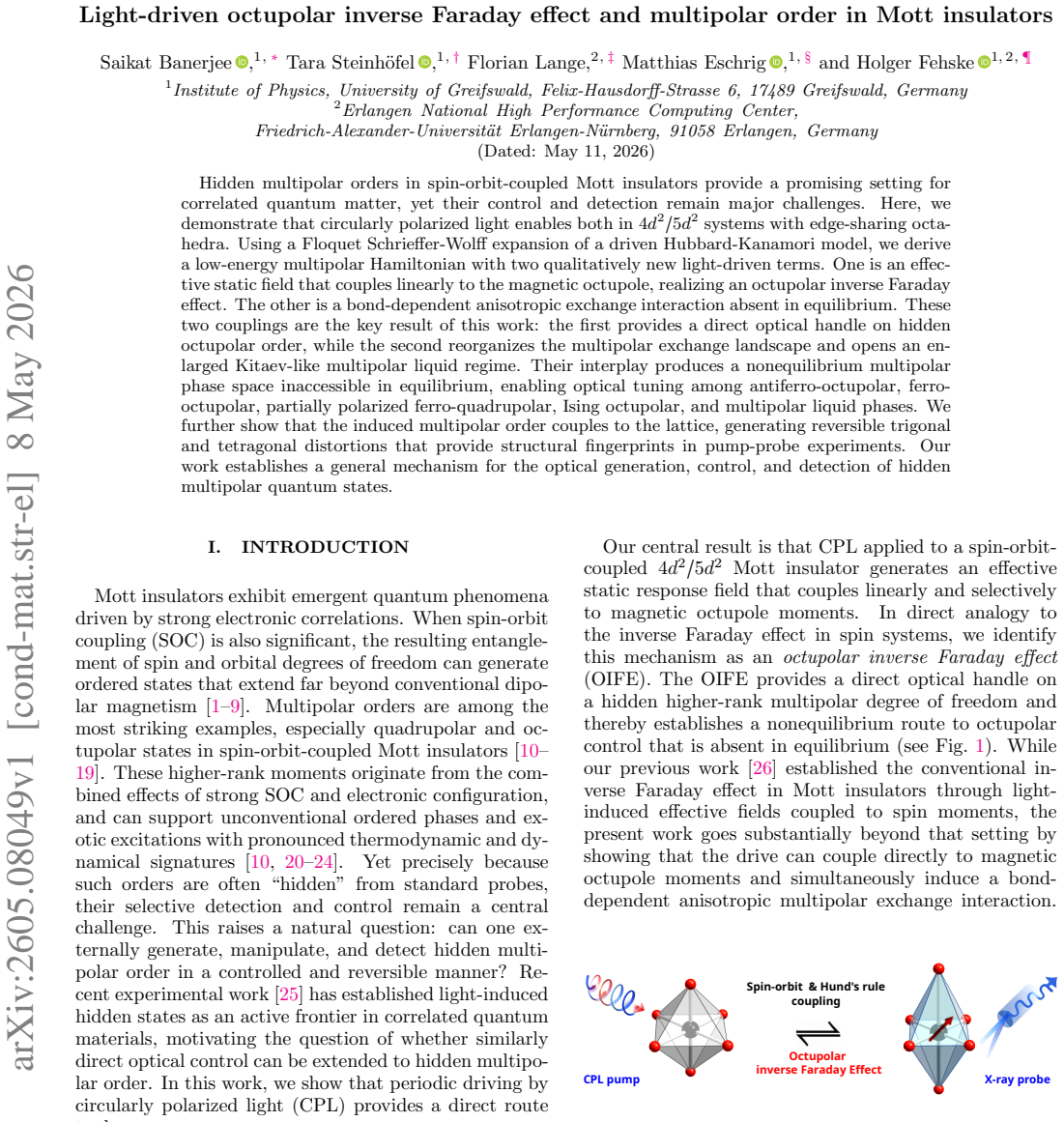
Hidden multipolar orders in spin-orbit-coupled Mott insulators provide a promising setting for correlated quantum matter, yet their control and detection remain major challenges. Here, we demonstrate that circularly polarized light enables both in $4d^2/5d^2$ systems with edge-sharing octahedra. Using a Floquet Schrieffer-Wolff expansion of a driven Hubbard-Kanamori model, we derive a low-energy multipolar Hamiltonian with two qualitatively new light-driven terms. One is an effective static field that couples linearly to the magnetic octupole, realizing an octupolar inverse Faraday effect. The other is a bond-dependent anisotropic exchange interaction absent in equilibrium. These two couplings are the key result of this work: the first provides a direct optical handle on hidden octupolar order, while the second reorganizes the multipolar exchange landscape and opens an enlarged Kitaev-like multipolar liquid regime. Their interplay produces a nonequilibrium multipolar phase space inaccessible in equilibrium, enabling optical tuning among antiferro-octupolar, ferro-octupolar, partially polarized ferro-quadrupolar, Ising octupolar, and multipolar liquid phases. We further show that the induced multipolar order couples to the lattice, generating reversible trigonal and tetragonal distortions that provide structural fingerprints in pump-probe experiments. Our work establishes a general mechanism for the optical generation, control, and detection of hidden multipolar quantum states.
Editorial analysis
A structured set of objections, weighed in public.
Referee Report
Summary. The manuscript uses a Floquet Schrieffer-Wolff expansion of a driven Hubbard-Kanamori model to derive a low-energy multipolar Hamiltonian for 4d²/5d² Mott insulators in edge-sharing octahedral geometry. It identifies two new light-induced terms—an effective static field linearly coupled to the magnetic octupole (realizing an octupolar inverse Faraday effect) and a bond-dependent anisotropic exchange interaction absent in equilibrium—and shows that their interplay enables optical tuning among antiferro-octupolar, ferro-octupolar, partially polarized ferro-quadrupolar, Ising octupolar, and multipolar liquid phases, with additional reversible lattice distortions providing structural fingerprints.
Significance. If the central derivation holds, the work is significant because it supplies a microscopic, light-driven mechanism for generating and detecting hidden multipolar orders that are difficult to access or control in equilibrium. The explicit derivation of the octupolar coupling and enlarged Kitaev-like regime from the driven microscopic model, rather than phenomenological fitting, provides falsifiable predictions for pump-probe experiments via lattice distortions. This opens a concrete route to nonequilibrium multipolar quantum matter in strongly spin-orbit-coupled systems.
major comments (2)
- [Floquet Schrieffer-Wolff derivation section] The Floquet Schrieffer-Wolff expansion (detailed in the section deriving the effective Hamiltonian) is presented without an explicit truncation-error bound or comparison to non-perturbative time-dependent calculations. Because the central claims—that the octupolar inverse Faraday term dominates and that the bond-dependent exchange enlarges the multipolar liquid regime—rest on the validity of this high-frequency expansion for realistic 4d/5d parameters, a quantitative assessment of O((t/ω)²) corrections is required.
- [Phase diagram and multipolar phases section] The phase-diagram results (showing the new nonequilibrium phases) are obtained from the effective model but lack benchmarks against exact diagonalization on small clusters or checks that higher-order Floquet processes do not alter the reported phase boundaries. This is load-bearing for the claim of an 'inaccessible in equilibrium' multipolar phase space.
minor comments (2)
- [Abstract] The abstract would benefit from a brief statement of the assumed frequency hierarchy (ω ≫ t, U) under which the expansion is controlled.
- [Model definition section] Notation for the local multipole operators (arising from the Kanamori + spin-orbit terms) should include an explicit cross-reference to standard definitions used for 4d²/5d² ions.
Simulated Author's Rebuttal
We thank the referee for their careful reading of the manuscript and for the positive assessment of its significance. We address each of the two major comments below.
read point-by-point responses
-
Referee: [Floquet Schrieffer-Wolff derivation section] The Floquet Schrieffer-Wolff expansion (detailed in the section deriving the effective Hamiltonian) is presented without an explicit truncation-error bound or comparison to non-perturbative time-dependent calculations. Because the central claims—that the octupolar inverse Faraday term dominates and that the bond-dependent exchange enlarges the multipolar liquid regime—rest on the validity of this high-frequency expansion for realistic 4d/5d parameters, a quantitative assessment of O((t/ω)²) corrections is required.
Authors: We agree that an explicit bound on truncation errors would strengthen the presentation. In the revised manuscript we will add a dedicated paragraph estimating the magnitude of O((t/ω)²) corrections for the laser frequencies and hopping amplitudes relevant to 4d²/5d² compounds (typically t/ω ≲ 0.1–0.2). These estimates follow directly from the next term in the Magnus expansion and confirm that the leading-order octupolar inverse Faraday term and the anisotropic exchange remain dominant. A full non-perturbative benchmark against time-dependent exact diagonalization or DMRG on the driven Hubbard-Kanamori model lies outside the scope of the present work, but the high-frequency regime we target is the same one in which the expansion has been validated in prior Floquet studies of spin-orbit-coupled systems. revision: partial
-
Referee: [Phase diagram and multipolar phases section] The phase-diagram results (showing the new nonequilibrium phases) are obtained from the effective model but lack benchmarks against exact diagonalization on small clusters or checks that higher-order Floquet processes do not alter the reported phase boundaries. This is load-bearing for the claim of an 'inaccessible in equilibrium' multipolar phase space.
Authors: The phase diagrams are obtained by exact diagonalization of the effective multipolar Hamiltonian on small clusters (up to 12 sites) supplemented by mean-field analysis for larger systems. In the revision we will include these finite-size data explicitly, together with a quantitative statement that the reported boundaries remain stable when the leading O((t/ω)²) corrections are added perturbatively to the effective model. Because the higher-order Floquet terms are parametrically small in the high-frequency limit used throughout the paper, they do not shift the phase boundaries outside the resolution of the plots. We will also add a brief discussion of the regime in which the effective-model description is expected to break down. revision: yes
Circularity Check
Derivation via Floquet Schrieffer-Wolff expansion is self-contained from microscopic model
full rationale
The central result is obtained by applying a standard perturbative Floquet Schrieffer-Wolff expansion to the time-periodic driven Hubbard-Kanamori Hamiltonian, yielding an effective low-energy multipolar model whose new terms (static octupole field and bond-dependent exchange) are generated by the expansion rather than presupposed. No quoted step reduces the claimed predictions to a fit, a self-definition, or a load-bearing self-citation whose validity is internal to the paper. The expansion is presented as an approximation whose validity is an external assumption, not a tautology. The derivation chain therefore remains independent of its target outputs.
Axiom & Free-Parameter Ledger
free parameters (1)
- light amplitude and frequency
axioms (2)
- domain assumption The driven Hubbard-Kanamori model accurately captures the low-energy physics of the 4d2/5d2 Mott insulators with edge-sharing octahedra.
- domain assumption Higher-order terms in the Floquet expansion can be neglected in the relevant driving regime.
Lean theorems connected to this paper
-
IndisputableMonolith/Foundation/RealityFromDistinction.leanreality_from_one_distinction unclear?
unclearRelation between the paper passage and the cited Recognition theorem.
Using a Floquet Schrieffer-Wolff expansion of a driven Hubbard-Kanamori model, we derive a low-energy multipolar Hamiltonian with two qualitatively new light-driven terms: an effective static field that couples linearly to the magnetic octupole... and a bond-dependent anisotropic exchange interaction
-
IndisputableMonolith/Cost/FunctionalEquation.leanwashburn_uniqueness_aczel unclear?
unclearRelation between the paper passage and the cited Recognition theorem.
Heff = J_eff(ζ) ∑ (σ̃^y_i σ̃^y_j − σ̃^x_i σ̃^x_j − σ̃^z_i σ̃^z_j) + Γ³(ζ) ∑ ... + h_m(ζ) ∑ σ̃^y_i
What do these tags mean?
- matches
- The paper's claim is directly supported by a theorem in the formal canon.
- supports
- The theorem supports part of the paper's argument, but the paper may add assumptions or extra steps.
- extends
- The paper goes beyond the formal theorem; the theorem is a base layer rather than the whole result.
- uses
- The paper appears to rely on the theorem as machinery.
- contradicts
- The paper's claim conflicts with a theorem or certificate in the canon.
- unclear
- Pith found a possible connection, but the passage is too broad, indirect, or ambiguous to say the theorem truly supports the claim.
Reference graph
Works this paper leans on
-
[1]
Fidelity map Next, we compute a related quantity, the fidelity map (FM). Given a quantum many-body system described by the HamiltonianH(λ), whereλis the driving parameter, the FM is defined as the overlap between ground states 10 at two different parameter points, Fij =∣⟨ϕgs(λi)∣ϕgs(λj)⟩∣,(17) for arbitraryλ i andλ j [67]. Unlike the FS, the two states en...
-
[2]
Finite-size scaling Because of the nearby competing phases visible in the multipolar SSF heat maps and FM profiles, we do not at- tempt a full universality classification of the phase transi- tions. Instead, we carry out the simplest finite-size anal- ysis of the tentative phase boundaries, without attempt- ing a complete scaling collapse, as shown in Fig...
-
[3]
Ferro-octupolar phase For sufficiently large positiveh m, the ground state re- alizes a uniform FO phase in which the octupolar com- ponent ˜σy is strongly polarized by the OIFE field. In ED, this regime is characterized by a large uniform ex- pectation value⟨˜σy⟩, a dominant Γ-point contribution to the octupolar structure factor, and strongly suppressed ...
-
[4]
Antiferro-octupolar phase We now turn to the opposite corner of theh m–Γ(3) plane and focus on the region near the origin. When both ∣hm∣and∣Γ(3)∣are much smaller thanJ eff, the physics is governed primarily by theJ eff exchange interaction, which stabilizes AFO order on the bipartite honeycomb lattice. At the origin,h m =Γ (3) =0, the Hamilto- nian maps ...
-
[5]
For Γ (3)=0, an intermediate regime appears in which 12 TABLE I
Partially polarized ferro-quadrupolar phase Ash m increases, the system does not evolve directly from the AFO phase to the fully polarized FO phase. For Γ (3)=0, an intermediate regime appears in which 12 TABLE I. Summary of the complementary numerical diagnostics used to identify the dominant regimes in Fig. 8. The labels summarize the most robust finite...
-
[6]
Ising octupolar phase Within ED, this regime is distinguished by a persis- tent uniform octupolar component but no comparably robust quadrupolar structure-factor signature. In partic- ular, the FM structure separates this region from both the PPFQ and ML regimes, while the dominant Γ-point response remains in the ferro-octupolar channel. We therefore refe...
-
[7]
Multipolar-liquid regime In the remaining part of theh m–Γ(3)phase diagram, our ED results show no clear signature of conventional long-range multipolar order. The FS maps remain com- paratively featureless, while neither the energy deriva- tives nor the low-energy gapE1−E0 exhibit a pronounced transition line or strong ordering tendency [cf. Figs. 5(j- l...
-
[8]
The variation of the different ex- change couplings as a function ofζis shown in Fig. 3 in the main text. For plotting, we restricted the summation to−5≤{n, l, m}≤5 in the above expressions. Appendix D: Multipolar exchange couplings in different geometry Throughout this work, we have studied a specificd 2 Mott insulator system under periodic driving, focu...
-
[9]
J. M. Coey,Magnetism and magnetic materials(Cam- bridge university press, 2010)
work page 2010
-
[10]
E. Morosan, D. Natelson, A. H. Nevidomskyy, and Q. Si, Strongly Correlated Materials, Adv. Mater.24, 4896 (2012)
work page 2012
-
[11]
R. Adler, C.-J. Kang, C.-H. Yee, and G. Kotliar, Cor- related materials design: prospects and challenges, Rep. Prog. Phys.82, 012504 (2018)
work page 2018
-
[12]
K. Buschow and F. M¨ uller,Physics of Magnetism and Magnetic Materials(Kluwer Academic/Plenum Publish- ers, New York, 2003)
work page 2003
- [13]
-
[15]
S. Banerjee, W. Zhu, and S.-Z. Lin, Electromagnetic sig- natures of a chiral quantum spin liquid, npj Quantum Mater.8, 63 (2023)
work page 2023
-
[16]
G. W. Fernando, S. Banerjee, and R. M. Geilhufe, Cor- related Electrons and Magnetism in Double Perovskites, Int. J. High Speed Electron. Syst.35, 2640002 (2026)
work page 2026
-
[17]
S. Banerjee and S.-Z. Lin, Emergent orbital magnetiza- tion in Kitaev quantum magnets, SciPost Phys.14, 127 (2023)
work page 2023
-
[18]
L. V. Pourovskii, D. Fiore Mosca, L. Celiberti, S. Khmelevskyi, A. Paramekanti, and C. Franchini, Hid- den orders in spin–orbit-entangled correlated insulators, Nat. Rev. Mater.10, 674 (2025)
work page 2025
-
[19]
L. V. Pourovskii and S. Khmelevskyi, Hidden order and multipolar exchange striction in a correlatedf-electron system, Proc. Natl. Acad. Sci. (U.S.A)118, e2025317118 (2021)
work page 2021
-
[20]
Y. Murakami, D. Goleˇ z, M. Eckstein, and P. Werner, Photoinduced nonequilibrium states in Mott insulators, Rev. Mod. Phys.97, 035001 (2025)
work page 2025
-
[21]
G. Chen and L. Balents, Spin-orbit coupling ind2 ordered double perovskites, Phys. Rev. B84, 094420 (2011)
work page 2011
-
[22]
A. S. Patri, A. Sakai, S. Lee, A. Paramekanti, S. Nakat- suji, and Y. B. Kim, Unveiling hidden multipolar orders with magnetostriction, Nat. Commun.10, 4092 (2019)
work page 2019
-
[23]
D. D. Maharaj, G. Sala, M. B. Stone, E. Kermarrec, C. Ritter, F. Fauth, C. A. Marjerrison, J. E. Greedan, A. Paramekanti, and B. D. Gaulin, Octupolar versus N´ eel Order in Cubic 5d2 Double Perovskites, Phys. Rev. Lett. 124, 087206 (2020)
work page 2020
-
[24]
L. V. Pourovskii, D. F. Mosca, and C. Franchini, Ferro- octupolar Order and Low-Energy Excitations ind 2 Dou- ble Perovskites of Osmium, Phys. Rev. Lett.127, 237201 (2021)
work page 2021
-
[25]
G. Khaliullin, D. Churchill, P. P. Stavropoulos, and H.- Y. Kee, Exchange interactions, Jahn-Teller coupling, and multipole orders in pseudospin one-half 5d 2 Mott insula- tors, Phys. Rev. Res.3, 033163 (2021)
work page 2021
- [26]
-
[27]
S. Banerjee, S. Humeniuk, A. R. Bishop, A. Saxena, and A. V. Balatsky, Multipolar multiferroics in 4d2/5d2 Mott insulators, Phys. Rev. B111, L201107 (2025)
work page 2025
- [28]
-
[29]
K. Hart, R. Sutcliffe, G. Refael, and A. Paramekanti, Phonon-Driven Multipolar Dynamics in a Spin-Orbit Coupled Mott Insulator, Phys. Rev. Lett.134, 246701 (2025)
work page 2025
-
[30]
A. Paramekanti, D. D. Maharaj, and B. D. Gaulin, Oc- tupolar order ind-orbital Mott insulators, Phys. Rev. B 101, 054439 (2020)
work page 2020
-
[31]
P. Zhao, J. Yang, and G. v. Chen, Multipolar ferroelec- tricity in the Mott regime, Phys. Rev. B111, 224416 (2025)
work page 2025
-
[32]
N. Iwahara, Z. Huang, I. Neefjes, and L. F. Chibotaru, Multipolar exchange interaction and complex order in insulating lanthanides, Phys. Rev. B105, 144401 (2022)
work page 2022
-
[33]
S. Fan, F. Jin, T. Kim, U. Kumar, Z. Zhang, V. Bhar- tiya, J. Li, B. Yalin, Y. Gu, M. Gu, W. Hu, C. Mazzoli, G. L. Carr, O. S. Bariˇ si´ c, A. S. Mishchenko, V. Bisogni, S. Singh, W. Wu, and J. Pelliciari, Excitations across the Equilibrium and Photoinduced “Hidden” States of Magnetoresistive Manganites, Phys. Rev. X16, 021018 (2026)
work page 2026
-
[34]
S. Banerjee, U. Kumar, and S.-Z. Lin, Inverse Faraday effect in Mott insulators, Phys. Rev. B105, L180414 (2022)
work page 2022
-
[35]
V. da Cruz Pinha Barbosa, D. D. Maharaj, Z. W. Cronkright, Y. Wang, R. Cong, E. Garcia, A. P. Reyes, J. Yan, C. Ritter, V. F. Mitrovi´ c, B. D. Gaulin, J. E. Greedan, and P. M. Woodward, Exploring the Links be- tween Structural Distortions, Orbital Ordering, and Mul- tipolar Magnetic Ordering in Double Perovskites Con- taining Re(VI) and Os(VII), Chem. Ma...
work page 2024
-
[36]
G. J. Nilsen, C. M. Thompson, C. Marjerisson, D. I. Badrtdinov, A. A. Tsirlin, and J. E. Greedan, Magnetic order and multipoles in the 5d 2 rhenium double per- ovskite Ba2YReO6, Phys. Rev. B103, 104430 (2021)
work page 2021
-
[37]
R. Caciuffo, J. A. Paix˜ ao, C. Detlefs, M. J. Longfield, P. Santini, N. Bernhoeft, J. Rebizant, and G. H. Lan- der, Multipolar ordering in NpO 2 below 25 K, J. Phys. Condens. Matter.15, S2287 (2003)
work page 2003
-
[38]
D. Hirai and Z. Hiroi, Successive symmetry breaking in aJ eff =3/2 quartet in the spin–orbit coupled insulator Ba2MgReO6, J. Phys. Soc. Jpn.88, 064712 (2019)
work page 2019
- [39]
-
[40]
D. Churchill and H.-Y. Kee, Competing multipolar or- ders in a face-centered cubic lattice: Application to the osmium double perovskites, Phys. Rev. B105, 014438 (2022)
work page 2022
- [41]
- [42]
-
[43]
A. Banerjee, J. Yan, J. Knolle, C. A. Bridges, M. B. Stone, M. D. Lumsden, D. G. Mandrus, D. A. Tennant, R. Moessner, and S. E. Nagler, Neutron scattering in the proximate quantum spin liquid RuCl3, Science356, 1055 (2017)
work page 2017
- [44]
-
[45]
K. F. Mucker, G. S. Smith, and Q. Johnson, The crystal structure of ReCl 5, Acta Crystallogr. B24, 874 (1968)
work page 1968
-
[46]
A. Vorobyova, A. Boltalin, D. Tsymbarenko, I. Mo- rozov, T. Vasilchikova, V. Gapontsev, K. Lyssenko, S. Demishev, A. Semeno, S. Streltsov, and O. Volkova, Anisotropy of exchange interactions in honeycomb lad- der compound ReCl 5, Mater. Chem. Phys.332, 130215 (2025)
work page 2025
-
[47]
Y. Song, W.-H. Dong, K.-R. Hao, S. Du, and L. Zhang, Designing topological and correlated 2D magnetic states via superatomic lattice constructions of zirconium dichlo- ride, Nano Res.16, 13509 (2023)
work page 2023
- [48]
-
[49]
Kusunose, Description of Multipole in f-Electron Sys- tems, J
H. Kusunose, Description of Multipole in f-Electron Sys- tems, J. Phys. Soc. Jpn.77, 064710 (2008)
work page 2008
-
[50]
H.-W. Ko and K.-J. Lee, Magnetic Octupole Hall Effect ind-Wave Altermagnets (2025), arXiv:2508.00794
- [51]
-
[52]
A. Weiße and H. Fehske, Exact diagonalization tech- niques, inComputational Many-Particle Physics, Lec- ture Notes in Physics, Vol. 739, edited by H. Fehske, R. Schneider, and A. Weiße (Springer, Berlin, Heidel- berg, 2008) pp. 529–544
work page 2008
-
[53]
S. R. White, Density matrix formulation for quantum renormalization groups, Phys. Rev. Lett.69, 2863 (1992)
work page 1992
-
[54]
Schollw¨ ock, The density-matrix renormalization group in the age of matrix product states, Ann
U. Schollw¨ ock, The density-matrix renormalization group in the age of matrix product states, Ann. Phys.326, 96 (2011)
work page 2011
-
[55]
A. Abragam and B. Bleaney,Electron paramagnetic res- onance of transition ions(Oxford : Clarendon press, 1970)
work page 1970
-
[56]
G. L. Stamokostas and G. A. Fiete, Mixing oft 2g-eg or- bitals in 4dand 5dtransition metal oxides, Phys. Rev. B 97, 085150 (2018)
work page 2018
-
[57]
R. Maezono and N. Nagaosa, Complex orbital state in manganites, Phys. Rev. B62, 11576 (2000)
work page 2000
-
[58]
J. van den Brink and D. Khomskii, Orbital ordering of complex orbitals in doped Mott insulators, Phys. Rev. B 63, 140416 (2001)
work page 2001
-
[59]
Y. Kuramoto, H. Kusunose, and A. Kiss, Multipole Or- ders and Fluctuations in Strongly Correlated Electron Systems, J. Phys. Soc. Jpn.78, 072001 (2009)
work page 2009
-
[60]
C. A. Marjerrison, C. M. Thompson, A. Z. Sharma, A. M. Hallas, M. N. Wilson, T. J. S. Munsie, R. Flacau, C. R. Wiebe, B. D. Gaulin, G. M. Luke, and J. E. Greedan, Magnetic ground states in the three Os6+ 5d2 double per- ovskites Ba2MOsO6 M=(Mg,Zn,Cd) from N´ eel order to its suppression, Phys. Rev. B94, 134429 (2016)
work page 2016
-
[61]
W. A. Harrison,Electronic structure and the properties of solids: the physics of the chemical bond(Dover Publi- cations, Mineola, NY, 1989)
work page 1989
-
[62]
A. Georges, L. d. Medici, and J. Mravlje, Strong Cor- relations from Hund’s Coupling, Annu. Rev. Condens. Matter Phys.4, 137 (2013)
work page 2013
-
[63]
Z. Nussinov and J. van den Brink, Compass models: The- ory and physical motivations, Rev. Mod. Phys.87, 1 (2015)
work page 2015
-
[64]
D. I. Khomskii,Transition Metal Compounds(Cam- bridge University Press, 2014)
work page 2014
-
[65]
D. A. Abanin, W. De Roeck, and F. m. c. Huveneers, Exponentially slow heating in periodically driven many- body systems, Phys. Rev. Lett.115, 256803 (2015)
work page 2015
-
[66]
A. V. Kimel, A. Kirilyuk, P. A. Usachev, R. V. Pisarev, A. M. Balbashov, and T. Rasing, Ultrafast non-thermal control of magnetization by instantaneous photomagnetic pulses, Nature435, 655 (2005)
work page 2005
-
[67]
A. de la Torre, D. M. Kennes, M. Claassen, S. Gerber, J. W. McIver, and M. A. Sentef, Colloquium: Nonther- mal pathways to ultrafast control in quantum materials, Rev. Mod. Phys.93, 041002 (2021)
work page 2021
-
[68]
D. Fiore Mosca, L. V. Pourovskii, and C. Franchini, Mod- eling magnetic multipolar phases in density functional theory, Phys. Rev. B106, 035127 (2022)
work page 2022
-
[69]
T. Yamakawa, T. Miyamoto, D. Sakai, and H. Okamoto, Dynamical aspects of excitonic Floquet states generated by a phase-locked mid-infrared pulse in a one-dimensional Mott insulator, New J. Phys.25, 093044 (2023)
work page 2023
-
[70]
A. Sriram and M. Claassen, Light-induced control of magnetic phases in Kitaev quantum magnets, Phys. Rev. Res.4, L032036 (2022)
work page 2022
-
[71]
P. Strobel and M. Daghofer, Comparing the influence of Floquet dynamics in various Kitaev-Heisenberg materi- als, Phys. Rev. B105, 085144 (2022)
work page 2022
-
[72]
N. Arakawa and K. Yonemitsu, Floquet engineering of Mott insulators with strong spin-orbit coupling, Phys. Rev. B103, L100408 (2021)
work page 2021
-
[73]
I. Rousochatzakis, N. B. Perkins, Q. Luo, and H.-Y. Kee, Beyond Kitaev physics in strong spin-orbit coupled mag- nets, Rep. Prog. Phys.87, 026502 (2024)
work page 2024
-
[74]
M. M¨ oller, P. A. Maksimov, S. Jiang, S. R. White, R. Va- lent´ ı, and A. L. Chernyshev, Rethinkingα-RuCl 3: Pa- rameters, models, and phase diagram, Phys. Rev. B112, 104403 (2025)
work page 2025
-
[75]
H.-K. Tang, M. A. Marashli, and W. C. Yu, Unveiling quantum phase transitions by fidelity mapping, Phys. Rev. B104, 075142 (2021)
work page 2021
-
[76]
X.-S. Yang and S. Deb, Cuckoo search: recent advances and applications, Neural Comput. Appl.24, 169 (2014)
work page 2014
- [77]
-
[78]
G. Sala, M. B. Stone, G. B. Hal´ asz, M. D. Lumsden, A. F. May, D. M. Pajerowski, S. Ohira-Kawamura, K. Kaneko, D. G. Mazzone, G. Simutis, J. Lass, Y. Kato, S.-H. Do, J. Y. Y. Lin, and A. D. Christianson, Field-tuned quantum renormalization of spin dynamics in the hon- eycomb lattice Heisenberg antiferromagnet YbCl3, Com- mun. Phys.6, 234 (2023)
work page 2023
-
[79]
J. D. Reger, J. A. Riera, and A. P. Young, Monte Carlo simulations of the spin-1/2 Heisenberg antiferromagnet in two dimensions, J. Phys. Condens. Matter1, 1855 (1989)
work page 1989
-
[80]
J. Richter, J. Schulenburg, and A. Honecker, Quan- 28 tum magnetism in two dimensions: From semi-classical n´ eel order to magnetic disorder, inQuantum Magnetism, edited by U. Schollw¨ ock, J. Richter, D. J. J. Farnell, and R. F. Bishop (Springer Berlin Heidelberg, Berlin, Heidel- berg”, 2004) pp. 85–153
work page 2004
-
[81]
M. Fishman, S. R. White, and E. M. Stoudenmire, The ITensor Software Library for Tensor Network Calcula- tions, SciPost Phys. Codebases , 4 (2022)
work page 2022
discussion (0)
Sign in with ORCID, Apple, or X to comment. Anyone can read and Pith papers without signing in.