Recognition: 2 theorem links
· Lean TheoremRapid phase ordering of Ising dynamics on mathbb Z²
Pith reviewed 2026-05-11 02:06 UTC · model grok-4.3
The pith
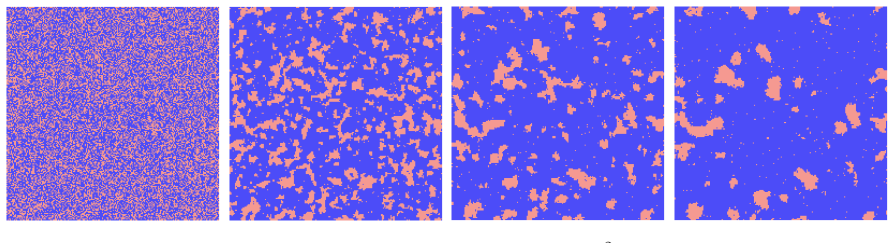
Ising Glauber dynamics on the plane converges rapidly to the plus phase from any sufficiently biased random initial configuration at low temperatures.
A machine-rendered reading of the paper's core claim, the machinery that carries it, and where it could break.
Core claim
There exists p0 less than 1 such that Ising Glauber dynamics initialized from i.i.d. spins equal to plus with probability p greater than p0, run at any inverse temperature beta greater than the critical beta_c, converges rapidly to the plus phase measure pi-plus on the infinite two-dimensional lattice.
What carries the argument
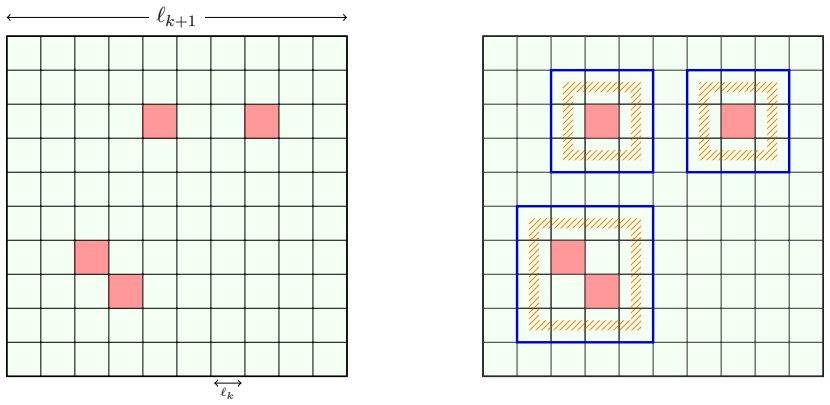
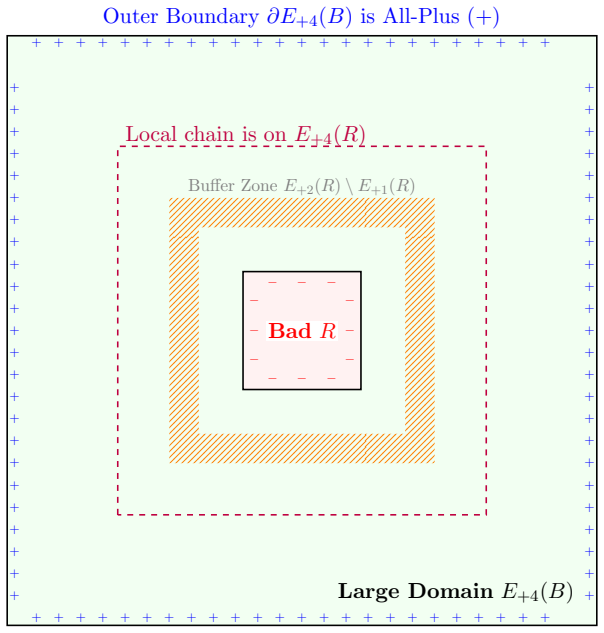
A spacetime multiscale coupling that converts a uniform-in-beta quasi-polynomial bound on the mixing time of Ising dynamics with plus boundary conditions into rapid phase ordering from biased initial configurations without boundaries.
If this is right
- The time until the system is locally close to the plus phase is finite and does not grow with distance from the initial time.
- Phase coexistence is avoided from any initialization with a fixed positive density of plus spins above the threshold.
- The same coupling argument applies verbatim in any dimension two or higher once the corresponding boundary mixing bound is available.
- Rapid ordering holds uniformly across the entire low-temperature regime rather than only at zero temperature.
Where Pith is reading between the lines
- The separation between boundary mixing and interior bias suggests that similar multiscale arguments could be tested on other models with strong spatial mixing under fixed boundary conditions.
- If quasi-polynomial mixing bounds with plus boundaries can be improved to polynomial, the phase-ordering time from biased starts would become polynomial as well.
- The result indicates that local observables such as the density of minus spins or the size of the largest minus cluster decay exponentially fast after a short transient.
Load-bearing premise
There exists a bound on the mixing time of the Ising dynamics with plus boundary conditions that is uniform over all low temperatures and at most quasi-polynomial in the system size.
What would settle it
Numerical simulation or rigorous construction showing that for some beta greater than beta_c and some p greater than p0 the probability of large minus-spin domains fails to decay to near zero within a time independent of window size.
Figures
read the original abstract
We consider the phase ordering problem for the low-temperature Ising dynamics initialized from a biased and disordered initialization. Work of Fontes, Schonmann, Sidoravicius (2002) showed that at zero-temperature, Ising Glauber dynamics on $\mathbb Z^d$ for $d\ge 2$ initialized from i.i.d. spins on each vertex that are $+1$ with sufficiently large probability, absorbs into the all-plus configuration quickly. We prove that analogous behavior holds throughout the low-temperature regime of the Ising model in two dimensions. Namely, there exists $p_0 <1$ such that Ising Glauber dynamics initialized from i.i.d. spins that are $+1$ with probability $p>p_0$, run at any low temperature $\beta>\beta_c$ converges rapidly to the plus phase measure $\pi^+$. The result is proved using a spacetime multiscale coupling valid in any $d\ge 2$, that boosts a uniform-in-$\beta$ quasi-polynomial bound on the mixing time of Ising dynamics with plus boundary conditions, into rapid phase ordering from biased initializations with no boundary conditions.
Editorial analysis
A structured set of objections, weighed in public.
Referee Report
Summary. The paper proves that there exists p0 < 1 such that Ising Glauber dynamics on Z^2, initialized from i.i.d. spins that are +1 with probability p > p0 and run at any inverse temperature β > βc, converges rapidly to the plus phase measure π+. The argument introduces a spacetime multiscale coupling, valid in d ≥ 2, that converts a uniform-in-β quasi-polynomial mixing-time bound for plus-boundary Ising dynamics into the stated no-boundary phase-ordering result from biased initial data. This extends the zero-temperature absorption result of Fontes-Schonmann-Sidoravicius (2002) to the full low-temperature regime.
Significance. If the central claim holds, the result is significant: it provides the first rapid phase-ordering statement for positive-temperature 2D Ising dynamics from disordered biased initial conditions, without boundary conditions. The spacetime multiscale coupling is a technically interesting reduction that cleanly separates the boundary-mixing input from the no-boundary output. The manuscript earns credit for making the dependence on the mixing bound explicit and for stating the result uniformly in β.
major comments (1)
- [Abstract and §1] Abstract and §1: the headline claim requires the quasi-polynomial mixing bound for plus-boundary dynamics to be uniform in β (including as β → ∞). The manuscript treats this bound as an external black-box input rather than deriving it. If the degree or implicit constants in the mixing-time estimate deteriorate with β, the conversion via the spacetime coupling fails to deliver rapid ordering for every β > βc. The paper should add an explicit statement (with citation or proof) confirming uniformity; this is load-bearing for the stated result.
minor comments (2)
- [Introduction] The definition of the plus phase π+ and the precise meaning of 'rapid convergence' (e.g., in total variation or in terms of a specific time scale) should be stated in the introduction before the main theorem.
- [§3] Notation for the multiscale coupling (e.g., the scales and the coupling events) is introduced in §3 but could be summarized in a short table or diagram for readability.
Simulated Author's Rebuttal
We thank the referee for their careful reading, positive evaluation of the significance of the result, and constructive feedback. We address the major comment below.
read point-by-point responses
-
Referee: [Abstract and §1] Abstract and §1: the headline claim requires the quasi-polynomial mixing bound for plus-boundary dynamics to be uniform in β (including as β → ∞). The manuscript treats this bound as an external black-box input rather than deriving it. If the degree or implicit constants in the mixing-time estimate deteriorate with β, the conversion via the spacetime coupling fails to deliver rapid ordering for every β > βc. The paper should add an explicit statement (with citation or proof) confirming uniformity; this is load-bearing for the stated result.
Authors: We agree that uniformity in β of the quasi-polynomial mixing-time bound for plus-boundary Ising dynamics is essential, as any deterioration in the degree or constants would prevent the spacetime multiscale coupling from yielding rapid ordering for all β > βc. The manuscript already states that the input bound is uniform-in-β, but we acknowledge that an explicit citation would make this load-bearing assumption fully transparent. We will revise the abstract and §1 to include a specific citation to the literature establishing the uniform-in-β quasi-polynomial mixing bound for plus-boundary conditions. This addresses the referee's point directly while preserving the reduction argument. revision: yes
Circularity Check
No significant circularity; derivation is self-contained via external input.
full rationale
The paper's central result is obtained by applying a new spacetime multiscale coupling (valid in d≥2) to convert a presupposed uniform-in-β quasi-polynomial mixing-time bound for plus-boundary Ising Glauber dynamics into rapid phase ordering from biased i.i.d. initial data with no boundaries. This bound is treated as an external black-box input (referenced via prior literature such as Fontes-Schonmann-Sidoravicius 2002 for the zero-temperature case, with the quasi-polynomial bound assumed known uniformly in β), rather than derived or fitted within the present work. No equation or definition reduces to itself by construction, no parameter is fitted to a subset and renamed as a prediction, and no load-bearing step collapses to a self-citation chain. The coupling argument supplies independent content, making the derivation self-contained against external benchmarks.
Axiom & Free-Parameter Ledger
axioms (2)
- domain assumption Existence of plus and minus phases for the low-temperature Ising model on Z^2.
- domain assumption Uniform-in-β quasi-polynomial bound on mixing time with plus boundary conditions.
Lean theorems connected to this paper
-
IndisputableMonolith/Foundation/AlexanderDuality.leanalexander_duality_circle_linking unclearThe result is proved using a spacetime multiscale coupling valid in any d≥2, that boosts a uniform-in-β quasi-polynomial bound on the mixing time of Ising dynamics with plus boundary conditions
-
IndisputableMonolith/Cost/FunctionalEquation.leanJ_uniquely_calibrated_via_higher_derivative uncleartmix ≤ C exp((log L)^C) … uniform over large β
Reference graph
Works this paper leans on
-
[1]
Diagonal interface in the two-dimensional Ising ferromagnet
D B Abraham and P Reed. Diagonal interface in the two-dimensional Ising ferromagnet. Journal of Physics A: Mathematical and General, 10(6):L121, jun 1977
work page 1977
-
[2]
Y Akutsu and N Akutsu. Relationship between the anisotropic interface tension, the scaled interface width and the equilibrium shape in two dimensions.Journal of Physics A: Mathe- matical and General, 19(14):2813, oct 1986
work page 1986
-
[3]
Noam Berger, Claire Kenyon, Elchanan Mossel, and Yuval Peres. Glauber dynamics on trees and hyperbolic graphs.Probability Theory and Related Fields, 131(3):311–340, 2005
work page 2005
-
[4]
Bobkov, Arnaud Marsiglietti, and James Melbourne
Sergey G. Bobkov, Arnaud Marsiglietti, and James Melbourne. Concentration functions and entropy bounds for discrete log-concave distributions.Combinatorics, Probability and Com- puting, 31(1):54–72, 2022
work page 2022
-
[5]
Slab percolation for the Ising model.Probability Theory and Related Fields, 132(1):83–118, 2005
Thierry Bodineau. Slab percolation for the Ising model.Probability Theory and Related Fields, 132(1):83–118, 2005
work page 2005
-
[6]
Theory of phase-ordering kinetics.Advances in Physics, 43(3):357–459, 1994
Alan J Bray. Theory of phase-ordering kinetics.Advances in Physics, 43(3):357–459, 1994
work page 1994
-
[7]
Massimo Campanino, Dmitry Ioffe, and Yvan Velenik. Ornstein-zernike theory for finite range ising models above tc.Probability Theory and Related Fields, 125(3):305–349, 2003
work page 2003
-
[8]
Pietro Caputo and Fabio Martinelli. Phase ordering after a deep quench: The stochastic Ising and hard core gas models on a tree.Probability Theory and Related Fields, 136(1):37–80, 2006
work page 2006
-
[9]
Joseph Chen, Reza Gheissari, and Eyal Lubetzky. Logarithmic delocalization of low temper- ature 3D Ising and Potts interfaces above a hard floor, 2024.Transactions of the American Mathematical Society, to appear
work page 2024
-
[10]
Jian Ding, Eyal Lubetzky, and Yuval Peres. Censored Glauber Dynamics for the Mean Field Ising Model.Journal of Statistical Physics, 137(3):407–458, 2009. 54
work page 2009
-
[11]
R. L. Dobrushin. The Gibbs state that describes the coexistence of phases for a three- dimensional Ising model.Teor. Verojatnost. i Primenen., 17:619–639, 1972
work page 1972
-
[12]
American Mathematical Society Providence, 1992
Roland Lvovich Dobrushin, Roman Koteck` y, and Senya Shlosman.Wulff construction: a global shape from local interaction, volume 104. American Mathematical Society Providence, 1992
work page 1992
-
[13]
Martin Dyer, Alistair Sinclair, Eric Vigoda, and Dror Weitz. Mixing in time and space for lattice spin systems: A combinatorial view.Random Structures & Algorithms, 24(4):461–479, 2004
work page 2004
-
[14]
L. R. Fontes, R. H. Schonmann, and V. Sidoravicius. Stretched exponential fixation in stochas- tic Ising models at zero temperature.Communications in Mathematical Physics, 228(3):495– 518, 2002
work page 2002
-
[15]
Reza Gheissari and Alistair Sinclair. Low-temperature Ising dynamics with random initializa- tions.Proceedings of the 54th Annual ACM SIGACT Symposium on Theory of Computing, page 1445–1458, 2022. Full version appeared inAnnals of Applied Probability
work page 2022
-
[16]
Reza Gheissari, Allan Sly, and Youngtak Sohn. Rapid phase ordering for Ising and Potts dynamics on random regular graphs.arXiv preprint arXiv:2505.15783, 2025
-
[17]
Roy J. Glauber. Time-dependent statistics of the Ising model.Journal of Mathematical Physics, 4(2):294–307, 1963
work page 1963
-
[18]
Lev Greenberg and Dmitry Ioffe. On an invariance principle for phase separation lines.Annales de l’Institut Henri Poincare (B) Probability and Statistics, 41(5):871–885, 2005
work page 2005
-
[19]
David A. Huse and Daniel S. Fisher. Dynamics of droplet fluctuations in pure and random Ising systems.Phys. Rev. B, 35:6841–6846, May 1987
work page 1987
-
[20]
Dmitry Ioffe. Large deviations for the 2D Ising model: A lower bound without cluster expan- sions.Journal of Statistical Physics, 74(1):411–432, 1994
work page 1994
-
[21]
Dmitry Ioffe, S´ ebastien Ott, Yvan Velenik, and Vitali Wachtel. Invariance principle for a Potts interface along a wall.Journal of Statistical Physics, 180(1):832–861, 2020
work page 2020
-
[22]
Hubert Lacoin. Approximate Lifshitz law for the zero-temperature stochastic Ising model in any dimension.Communications in Mathematical Physics, 318(2):291–305, 2013
work page 2013
-
[23]
Hubert Lacoin, Fran¸ cois Simenhaus, and Fabio L Toninelli. Zero-temperature 2D stochastic Ising model and anisotropic curve-shortening flow.Journal of the European Mathematical Society, 16(12):2557–2615, 2014
work page 2014
-
[24]
D. Levin and Y. Peres.Markov Chains and Mixing Times (2nd ed.). American Mathematical Society, Providence, RI, 2017
work page 2017
-
[25]
David A. Levin, Malwina J. Luczak, and Yuval Peres. Glauber dynamics for the mean-field Ising model: Cut-off, critical power law, and metastability.Probab. Theory Related Fields, 146(1-2):223–265, 2010
work page 2010
-
[26]
Kinetics of ordering during second-order phase transitions.Sov
IM Lifshitz. Kinetics of ordering during second-order phase transitions.Sov. Phys. JETP, 15(5):939–942, 1962. 55
work page 1962
-
[27]
Springer science & Business Media, 2013
Thomas M Liggett.Stochastic interacting systems: contact, voter and exclusion processes, volume 324. Springer science & Business Media, 2013
work page 2013
-
[28]
Quasi-polynomial mixing of the 2D stochastic Ising model with “plus” boundary up to criticality.J
Eyal Lubetzky, Fabio Martinelli, Allan Sly, and Fabio Lucio Toninelli. Quasi-polynomial mixing of the 2D stochastic Ising model with “plus” boundary up to criticality.J. Eur. Math. Soc. (JEMS), 15(2):339–386, 2013
work page 2013
-
[29]
Information percolation and cutoff for the stochastic Ising model
Eyal Lubetzky and Allan Sly. Information percolation and cutoff for the stochastic Ising model. Journal of the American Mathematical Society, 29(3):729–774, 2016
work page 2016
-
[30]
F. Martinelli. On the two-dimensional dynamical Ising model in the phase coexistence region. Journal of Statistical Physics, 76(5):1179–1246, 1994
work page 1994
-
[31]
F. Martinelli and E. Olivieri. Approach to equilibrium of Glauber dynamics in the one phase region. I. The attractive case.Communications in Mathematical Physics, 161:447–486, 1994
work page 1994
-
[32]
Lectures on Glauber dynamics for discrete spin models
Fabio Martinelli. Lectures on Glauber dynamics for discrete spin models. InLectures on probability theory and statistics (Saint-Flour, 1997), volume 1717 ofLecture Notes in Math., pages 93–191. Springer, Berlin, 1999
work page 1997
-
[33]
Fabio Martinelli and Fabio Lucio Toninelli. On the mixing time of the 2D stochastic Ising model with “plus” boundary conditions at low temperature.Comm. Math. Phys., 296(1):175–213, 2010
work page 2010
-
[34]
Barry M McCoy and Tai Tsun Wu.The two-dimensional Ising model. Courier Corporation, 2014
work page 2014
-
[35]
James Melbourne and Gerardo Palafox-Castillo. A discrete complement of Lyapunov’s inequal- ity and its information theoretic consequences.The Annals of Applied Probability, 33(6A), 2023
work page 2023
-
[36]
Zero-temperature Glauber dynamics onZ d.Probability Theory and Related Fields, 149(3):417–434, 2011
Robert Morris. Zero-temperature Glauber dynamics onZ d.Probability Theory and Related Fields, 149(3):417–434, 2011
work page 2011
-
[37]
C. E. Pfister and Y. Velenik. Interface, surface tension and reentrant pinning transition in the 2D Ising model.Communications in Mathematical Physics, 204(2):269–312, 1999
work page 1999
-
[38]
Surface order large deviations for Ising, Potts and percolation models
Agoston Pisztora. Surface order large deviations for Ising, Potts and percolation models. Probability Theory and Related Fields, 104(4):427–466, 1996
work page 1996
-
[39]
Exact equilibrium crystal shapes at nonzero temperature in two dimensions.Phys
Craig Rottman and Michael Wortis. Exact equilibrium crystal shapes at nonzero temperature in two dimensions.Phys. Rev. B, 24:6274–6277, Dec 1981
work page 1981
-
[40]
Lawrence E. Thomas. Bound on the mass gap for finite volume stochastic Ising models at low temperature.Comm. Math. Phys., 126(1):1–11, 1989
work page 1989
-
[41]
PhD thesis, Verlag nicht ermittelbar, 1997
Yvan Velenik.Phase separation as a large deviations problem: a microscopic derivation of surface thermodynamics for some 2D spin systems. PhD thesis, Verlag nicht ermittelbar, 1997. 56
work page 1997
discussion (0)
Sign in with ORCID, Apple, or X to comment. Anyone can read and Pith papers without signing in.