Recognition: 2 theorem links
· Lean TheoremUndulating Conformal Boundaries in 3D Gravity
Pith reviewed 2026-05-11 02:12 UTC · model grok-4.3
The pith
In three-dimensional gravity, certain undulating torus boundaries enclose regions with lower free energy than uniform ones when the cosmological constant is negative.
A machine-rendered reading of the paper's core claim, the machinery that carries it, and where it could break.
Core claim
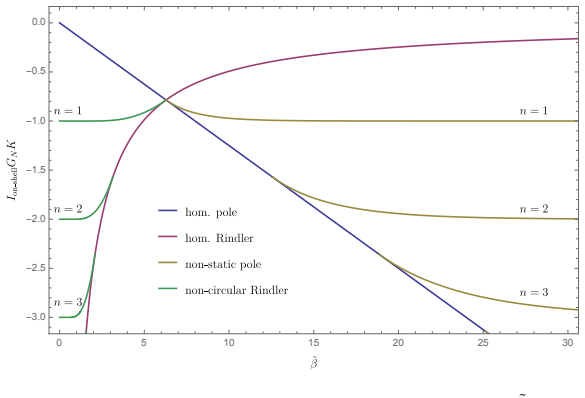
For vanishing, positive, and negative cosmological constant Lambda, boundaries enclosing different patches of locally flat, de Sitter, and Anti-de Sitter spaces are determined analytically. Solutions that depend non-trivially on either cycle of the torus are found, noting that some exhibit self-intersections. Adapting the Gibbons-Hawking prescription, inhomogeneous solutions are thermodynamically favourable in the case of Lambda less than zero and 2 less than K times absolute value of Lambda to the minus one half less than 3 over square root of 2. Moreover, for all values of Lambda, there exist patches of space with a non-contractible thermal circle and a macroscopic entropy.
What carries the argument
Analytic constructions of constant-K torus boundaries whose induced metric varies along the cycles and that bound distinct 3D gravity patches, whose on-shell actions are compared in the thermal ensemble.
If this is right
- The semi-classical thermodynamics of AdS3 includes stable phases with boundary inhomogeneities for K in the identified window.
- Patches with non-contractible thermal circles supply macroscopic entropy for any cosmological constant.
- Most other saddles remain thermally unstable or metastable relative to the uniform and favored inhomogeneous ones.
- The construction admits a reformulation as classical strings and special limits at the AdS boundary or stretched dS horizon.
Where Pith is reading between the lines
- Similar constant-mean-curvature undulations may stabilize inhomogeneous phases in four-dimensional gravity or with added matter fields.
- The self-intersecting solutions could be interpreted as multi-sheeted or branched coverings whose entropy requires separate regularization.
- The string recasting hints that integrability techniques might classify all such boundaries exactly.
Load-bearing premise
The found inhomogeneous solutions with smaller on-shell action dominate the semi-classical Euclidean path integral when it is interpreted as a thermal partition function.
What would settle it
An explicit evaluation of the difference in Euclidean on-shell action between one of the inhomogeneous solutions and the uniform boundary for a negative Lambda and a K value inside the interval 2 < K |Lambda|^{-1/2} < 3/sqrt(2), to check whether the difference is negative.
Figures



read the original abstract
We consider three-dimensional Einstein gravity in Euclidean signature with a finite boundary of torus topology endowed with an induced metric of fixed conformal class and a constant trace of extrinsic curvature $K$. For vanishing, positive, and negative cosmological constant $\Lambda$, we analytically determine boundaries enclosing different patches of locally flat, de Sitter (dS$_3$), and Anti-de Sitter (AdS$_3$) spaces. We find solutions that depend non-trivially on either cycle of the torus, noting that some of them exhibit self-intersections. Adapting the Gibbons-Hawking prescription of interpreting the Euclidean gravitational path integral as a thermal partition function, we explore the rich semi-classical thermodynamic phase space of the problem. While most saddles are found to be either thermally unstable or metastable compared to those with uniform boundaries, we find inhomogeneous solutions that are thermodynamically favourable in the case of $\Lambda < 0$ and $2<K|\Lambda|^{-1/2}<3/\sqrt{2}$. Moreover, for all values of $\Lambda$, there exist patches of space with a non-contractible thermal circle and a macroscopic entropy. We further analyse the problem in both the AdS$_3$ boundary limit and the stretched dS$_3$ horizon limit, and comment on a recasting of the problem in terms of classical strings.
Editorial analysis
A structured set of objections, weighed in public.
Referee Report
Summary. The paper considers three-dimensional Euclidean Einstein gravity with a toroidal boundary of fixed conformal class and constant trace of extrinsic curvature K. For vanishing, positive, and negative cosmological constant Λ, it analytically constructs boundaries enclosing patches of locally flat, dS3, and AdS3 geometries, including inhomogeneous solutions that depend non-trivially on the torus cycles (some exhibiting self-intersections). Adapting the Gibbons-Hawking prescription to interpret the Euclidean path integral as a thermal partition function, the work explores the semi-classical thermodynamics, finding that most saddles are unstable or metastable relative to uniform boundaries, but identifying inhomogeneous solutions that are thermodynamically favourable for Λ < 0 and 2 < K |Λ|^{-1/2} < 3/√2. It also notes the existence, for all Λ, of patches with a non-contractible thermal circle and macroscopic entropy, and analyzes limits including the AdS3 boundary and stretched dS3 horizon.
Significance. If the solutions are valid saddles and the thermodynamic comparisons are robust, the results would offer concrete analytical examples of inhomogeneous phases in 3D gravity under mixed boundary conditions, extending beyond uniform boundaries. The explicit constructions across all signs of Λ, the identification of a parameter window where inhomogeneous solutions dominate, and the observation of macroscopic entropy in non-contractible patches provide falsifiable predictions that could inform holographic models, dS thermodynamics, or string-theoretic interpretations. The analytical character of the solutions is a strength, as is the systematic comparison of on-shell actions.
major comments (2)
- [Gibbons-Hawking prescription and thermodynamic analysis] The central thermodynamic claims rest on the constructed geometries being saddles of the Euclidean action. The boundary conditions fix only the conformal class of the induced metric while holding K constant (a mixed condition). The standard Gibbons-Hawking term is derived for a fully fixed induced metric; under variations consisting of Weyl rescalings that preserve δK = 0, the first variation may yield a non-vanishing boundary integral. An explicit check that the on-shell action is stationary under these allowed variations (or a modified boundary term) is required before the on-shell action comparisons and dominance statements can be used to determine thermodynamic preference.
- [Thermodynamic phase space] The claim that inhomogeneous solutions are thermodynamically favourable for Λ < 0 and 2 < K |Λ|^{-1/2} < 3/√2 (abstract) requires a precise statement of the stability criteria and free-energy comparison. The paper should show the explicit on-shell actions, the range derivation, and checks that the solutions remain free of self-intersections and satisfy the stability window without implicit selection. This range is load-bearing for the strongest claim.
minor comments (1)
- [Abstract] The abstract mentions self-intersections for some solutions; a brief discussion or figure illustrating which solutions intersect and how this affects the thermodynamic interpretation would improve clarity.
Simulated Author's Rebuttal
We thank the referee for the careful reading of our manuscript and the constructive comments. We address each major comment below and indicate the revisions we will make to strengthen the thermodynamic analysis.
read point-by-point responses
-
Referee: [Gibbons-Hawking prescription and thermodynamic analysis] The central thermodynamic claims rest on the constructed geometries being saddles of the Euclidean action. The boundary conditions fix only the conformal class of the induced metric while holding K constant (a mixed condition). The standard Gibbons-Hawking term is derived for a fully fixed induced metric; under variations consisting of Weyl rescalings that preserve δK = 0, the first variation may yield a non-vanishing boundary integral. An explicit check that the on-shell action is stationary under these allowed variations (or a modified boundary term) is required before the on-shell action comparisons and dominance statements can be used to determine thermodynamic preference.
Authors: We agree that the boundary conditions are of mixed type and that the standard Gibbons-Hawking term assumes a fixed induced metric. While we adapted the prescription to interpret the Euclidean path integral as a thermal partition function, the manuscript does not contain an explicit first-variation calculation under Weyl rescalings that preserve δK = 0. We will add this verification in a new appendix, computing the boundary integral explicitly for our solutions and confirming that it vanishes on-shell. This will justify the use of the on-shell action for the thermodynamic comparisons. revision: yes
-
Referee: [Thermodynamic phase space] The claim that inhomogeneous solutions are thermodynamically favourable for Λ < 0 and 2 < K |Λ|^{-1/2} < 3/√2 (abstract) requires a precise statement of the stability criteria and free-energy comparison. The paper should show the explicit on-shell actions, the range derivation, and checks that the solutions remain free of self-intersections and satisfy the stability window without implicit selection. This range is load-bearing for the strongest claim.
Authors: We will revise the manuscript to present the explicit on-shell actions for the uniform and inhomogeneous solutions. The derivation of the interval 2 < K |Λ|^{-1/2} < 3/√2 will be expanded with the intermediate steps of the free-energy comparison. We will also include direct checks confirming that, inside this window, the inhomogeneous solutions remain free of self-intersections and satisfy the stated stability criteria. These additions will make the thermodynamic dominance statements fully explicit and reproducible. revision: yes
Circularity Check
No significant circularity; thermodynamic comparisons follow from explicit constructions.
full rationale
The paper constructs explicit inhomogeneous solutions satisfying fixed conformal class and constant K, then evaluates their on-shell Euclidean actions under the standard Gibbons-Hawking prescription to compare thermodynamic stability. The quoted window 2 < K|Λ|^{-1/2} < 3/√2 is the derived interval in which certain constructed solutions have lower action than uniform-boundary saddles; it is not an input parameter or self-defined fit. No self-citation chain, uniqueness theorem, or ansatz smuggling supports the central claims. The derivation remains self-contained: solutions are found by solving the Einstein equations with the stated boundary data, and thermodynamic preference is read off by direct action comparison without reducing to the inputs by construction.
Axiom & Free-Parameter Ledger
free parameters (1)
- K
axioms (2)
- standard math Einstein field equations in 3D with cosmological constant
- domain assumption Gibbons-Hawking prescription equating Euclidean path integral to thermal partition function
Lean theorems connected to this paper
-
IndisputableMonolith/Foundation/AlexanderDuality.leanalexander_duality_circle_linking echoes?
echoesECHOES: this paper passage has the same mathematical shape or conceptual pattern as the Recognition theorem, but is not a direct formal dependency.
We consider three-dimensional Einstein gravity... conformal boundary conditions :{[g_ij|Γ]_conf , K|Γ} fixed.
-
IndisputableMonolith/Cost/FunctionalEquation.leanwashburn_uniqueness_aczel unclear?
unclearRelation between the paper passage and the cited Recognition theorem.
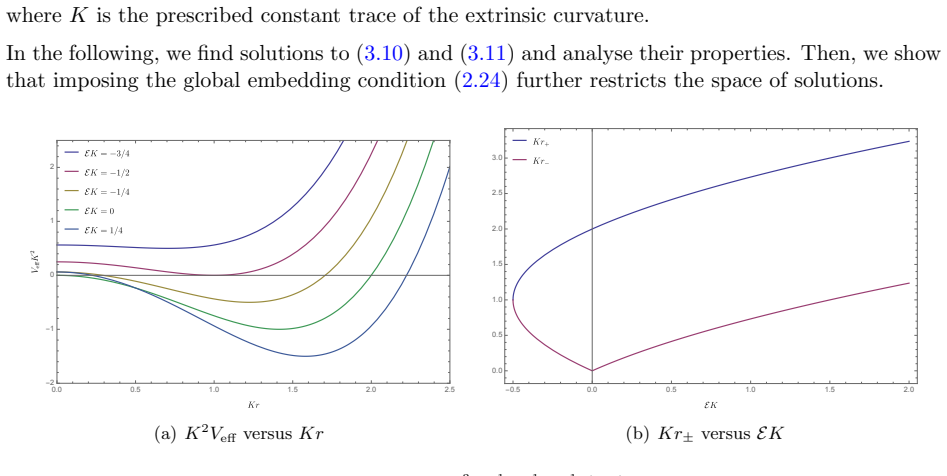
r(u)=r_+ dn(K r_+/2 u ; m) ... V_eff(r)=¼ K² r⁴ −(1+EK)r² +E²
What do these tags mean?
- matches
- The paper's claim is directly supported by a theorem in the formal canon.
- supports
- The theorem supports part of the paper's argument, but the paper may add assumptions or extra steps.
- extends
- The paper goes beyond the formal theorem; the theorem is a base layer rather than the whole result.
- uses
- The paper appears to rely on the theorem as machinery.
- contradicts
- The paper's claim conflicts with a theorem or certificate in the canon.
- unclear
- Pith found a possible connection, but the passage is too broad, indirect, or ambiguous to say the theorem truly supports the claim.
Reference graph
Works this paper leans on
- [1]
-
[2]
Witten,A note on boundary conditions in Euclidean gravity,Rev
E. Witten,A note on boundary conditions in Euclidean gravity,Rev. Math. Phys.33(2021) 2140004, [1805.11559]. 62
-
[3]
G. Fournodavlos and J. Smulevici,The Initial Boundary Value Problem for the Einstein Equations with Totally Geodesic Timelike Boundary,Commun. Math. Phys.385(2021) 1615–1653, [2006.01498]
-
[4]
Z. An and M. T. Anderson,The initial boundary value problem and quasi-local Hamiltonians in General Relativity,2103.15673
-
[5]
G. Fournodavlos and J. Smulevici,The Initial Boundary Value Problem in General Relativity: The Umbilic Case,Int. Math. Res. Not.2023(2023) 3790–3807, [2104.08851]
-
[6]
D. Anninos, D. A. Galante and C. Maneerat,Gravitational observatories,JHEP12(2023) 024, [2310.08648]
-
[7]
D. Anninos, D. A. Galante and C. Maneerat,Cosmological observatories,Class. Quant. Grav.41(2024) 165009, [2402.04305]
-
[8]
D. Anninos, R. Arias, D. A. Galante and C. Maneerat,Gravitational Observatories in AdS 4, 2412.16305
- [9]
- [10]
- [11]
-
[12]
J. W. York, Jr.,Black hole thermodynamics and the Euclidean Einstein action,Phys. Rev. D 33(1986) 2092–2099
work page 1986
-
[13]
B. B. Wang and C. G. Huang,Thermodynamics of de Sitter space-time in York’s formalism, Mod. Phys. Lett. A16(2001) 1487–1492
work page 2001
-
[14]
P. Draper and S. Farkas,Euclidean de Sitter black holes and microcanonical equilibrium, Phys. Rev. D105(2022) 126021, [2203.01871]
-
[15]
B. Banihashemi and T. Jacobson,Thermodynamic ensembles with cosmological horizons, JHEP07(2022) 042, [2204.05324]
-
[16]
B. Banihashemi, T. Jacobson, A. Svesko and M. Visser,The minus sign in the first law of de Sitter horizons,JHEP01(2023) 054, [2208.11706]
-
[17]
E. Coleman, E. A. Mazenc, V. Shyam, E. Silverstein, R. M. Soni, G. Torroba et al.,De Sitter microstates from T T+Λ 2 and the Hawking-Page transition,JHEP07(2022) 140, [2110.14670]
-
[18]
G. Batra, G. B. De Luca, E. Silverstein, G. Torroba and S. Yang,Bulk-local dS 3 holography: the Matter withT ¯T+ Λ 2,2403.01040
-
[19]
E. Silverstein and G. Torroba,Timelike-bounded dS 4 holography from a solvable sector of the T2 deformation,JHEP03(2025) 156, [2409.08709]
-
[20]
B. Banihashemi, E. Shaghoulian and S. Shashi,Flat space gravity at finite cutoff,Class. 63 Quant. Grav.42(2025) 035010, [2409.07643]
-
[21]
B. Banihashemi, E. Shaghoulian and S. Shashi,Thermal effective actions from conformal boundary conditions in gravity,2503.17471
- [22]
- [23]
-
[24]
D. Anninos, T. Hertog and J. Karlsson,Quantum Liouville Cosmology,2512.15969
work page internal anchor Pith review Pith/arXiv arXiv
-
[25]
3D near-de Sitter gravity and the soft mode of DSSYK
T. Marini, X.-L. Qi and H. Verlinde,3D near-de Sitter gravity and the soft mode of DSSYK, 2604.21014
work page internal anchor Pith review Pith/arXiv arXiv
-
[26]
K. Allameh and E. Shaghoulian,Timelike Liouville theory and AdS 3 gravity at finite cutoff, 2508.03236
-
[27]
Static Patch Solipsism: Conformal Symmetry of the de Sitter Worldline
D. Anninos, S. A. Hartnoll and D. M. Hofman,Static Patch Solipsism: Conformal Symmetry of the de Sitter Worldline,Class. Quant. Grav.29(2012) 075002, [1109.4942]
work page Pith review arXiv 2012
-
[28]
D. Anninos,De Sitter Musings,Int. J. Mod. Phys. A27(2012) 1230013, [1205.3855]
-
[29]
D. Anninos, D. A. Galante and B. M¨ uhlmann,Finite features of quantum de Sitter space, Class. Quant. Grav.40(2023) 025009, [2206.14146]
- [30]
-
[31]
D. Anninos, T. Anous, I. Bredberg and G. S. Ng,Incompressible Fluids of the de Sitter Horizon and Beyond,JHEP05(2012) 107, [1110.3792]
- [32]
-
[33]
D. Anninos, D. A. Galante, S. Georgescu, C. Maneerat and A. Svesko,The Stretched Horizon Limit,2512.16738
-
[34]
G. Odak and S. Speziale,Brown-York charges with mixed boundary conditions,JHEP11 (2021) 224, [2109.02883]
-
[35]
D. Anninos, T. Bautista and B. M¨ uhlmann,The two-sphere partition function in two-dimensional quantum gravity,JHEP09(2021) 116, [2106.01665]
-
[36]
D. Anninos, C. Baracco and B. M¨ uhlmann,Remarks on 2D quantum cosmology,JCAP10 (2024) 031, [2406.15271]
-
[37]
Rigorous results for timelike Liouville field theory
S. Chatterjee,Rigorous results for timelike Liouville field theory,Forum Math. Sigma14 (2026) e71, [2504.02348]
work page internal anchor Pith review Pith/arXiv arXiv 2026
-
[38]
F. A. Smirnov and A. B. Zamolodchikov,On space of integrable quantum field theories,Nucl. Phys. B915(2017) 363–383, [1608.05499]
work page Pith review arXiv 2017
-
[39]
$T \bar{T}$-deformed 2D Quantum Field Theories
A. Cavagli` a, S. Negro, I. M. Sz´ ecs´ enyi and R. Tateo,T¯T-deformed 2D Quantum Field Theories,JHEP10(2016) 112, [1608.05534]. 64
work page Pith review arXiv 2016
-
[40]
Moving the CFT into the bulk with $T\bar T$
L. McGough, M. Mezei and H. Verlinde,Moving the CFT into the bulk withT T,JHEP04 (2018) 010, [1611.03470]
work page Pith review arXiv 2018
- [41]
-
[42]
D. Stanford and Z. Yang,Finite-cutoff JT gravity and self-avoiding loops,2004.08005
-
[43]
J. D. Brown and J. W. York, Jr.,Quasilocal energy and conserved charges derived from the gravitational action,Phys. Rev. D47(1993) 1407–1419, [gr-qc/9209012]
work page Pith review arXiv 1993
-
[44]
J. W. York, Jr.,Role of conformal three geometry in the dynamics of gravitation,Phys. Rev. Lett.28(1972) 1082–1085
work page 1972
-
[45]
A. Lichnerowicz,L’int´ egration des ´ equations de la gravitation relativiste et le probl` eme des n corps,J. Math. Pures Appl.23(1944) 37–63
work page 1944
-
[46]
Choquet-Bruhat,General Relativity and the Einstein Equations
Y. Choquet-Bruhat,General Relativity and the Einstein Equations. Oxford Mathematical Monographs. Oxford University Press, United Kingdom, 2009
work page 2009
-
[47]
G. W. Gibbons and S. W. Hawking,Action Integrals and Partition Functions in Quantum Gravity,Phys. Rev. D15(1977) 2752–2756
work page 1977
- [48]
-
[49]
C. Delaunay,Sur la surface de r´ evolution dont la courbure moyenne est constante,Journal de Math´ ematiques Pures et Appliqu´ ees6(1841) 309–320
-
[50]
Osserman,A Survey of Minimal Surfaces
R. Osserman,A Survey of Minimal Surfaces. Dover, 1986
work page 1986
-
[51]
S. Deser and R. Jackiw,Three-dimensional cosmological gravity: Dynamics of constant curvature,Ann. Phys. (N. Y.)153(Apr., 1984) 405–416
work page 1984
-
[52]
The Black Hole in Three Dimensional Space Time
M. Banados, C. Teitelboim and J. Zanelli,The Black hole in three-dimensional space-time, Phys. Rev. Lett.69(1992) 1849–1851, [hep-th/9204099]
work page Pith review arXiv 1992
-
[53]
Geometry of the 2+1 Black Hole
M. Banados, M. Henneaux, C. Teitelboim and J. Zanelli,Geometry of the (2+1) black hole, Phys. Rev. D48(1993) 1506–1525, [gr-qc/9302012]
work page Pith review arXiv 1993
- [54]
-
[55]
Hoare,Integrable deformations of sigma models,J
B. Hoare,Integrable deformations of sigma models,J. Phys. A55(2022) 093001, [2109.14284]
-
[56]
W. P. Thurston,Three-Dimensional Geometry and Topology, vol. 1. Princeton University Press, 1997
work page 1997
-
[57]
A. Achucarro and P. K. Townsend,A Chern-Simons Action for Three-Dimensional anti-De Sitter Supergravity Theories,Phys. Lett. B180(1986) 89. 65
work page 1986
discussion (0)
Sign in with ORCID, Apple, or X to comment. Anyone can read and Pith papers without signing in.