Recognition: unknown
3D near-de Sitter gravity and the soft mode of DSSYK
Pith reviewed 2026-05-09 23:27 UTC · model grok-4.3
The pith
3D de Sitter gravity with a dS2 energy slice reproduces the soft reparametrization dynamics of double-scaled SYK.
A machine-rendered reading of the paper's core claim, the machinery that carries it, and where it could break.
Core claim
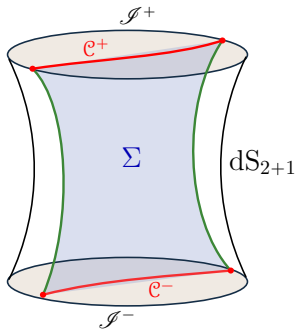
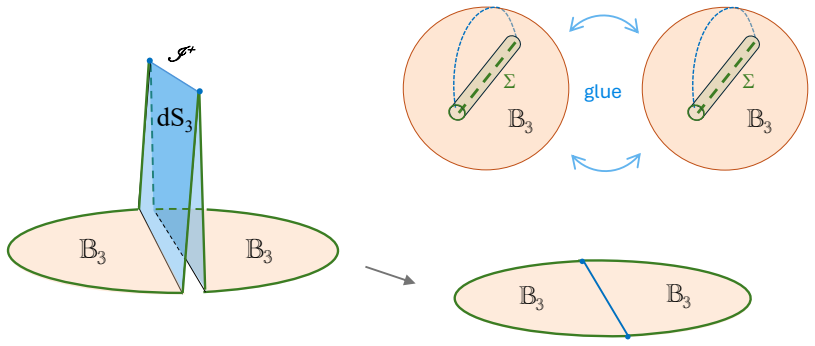
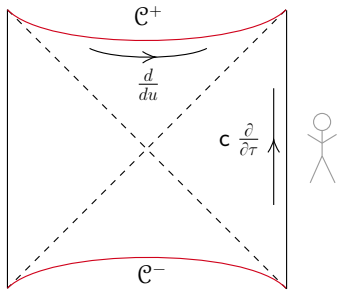
The effective SYK equations of motion take the form of the Israel junction conditions across the dS2 slice. The 1D effective action of the SYK soft mode coincides with the effective action derived from 3D Einstein-de Sitter gravity with conformal boundary conditions on I±. The boundary conditions split I± into two hyperbolic k=-1 slices, and the holographic screen is placed at the intersection. An adapted Gibbons-Hawking calculation reproduces the semiclassical DSSYK entropy, while the boundary-to-boundary Green functions in 3D de Sitter equal the square of DSSYK two-point functions.
What carries the argument
The Israel junction conditions across a dS2 energy slice embedded in dS3, which enforce matching between the SYK soft-mode equations and the gravitational constraints under the split k=-1 conformal boundary conditions.
If this is right
- The semiclassical DSSYK entropy is recovered from a Gibbons-Hawking calculation adapted to the k=-1 boundary conditions.
- Boundary-to-boundary propagators in 3D de Sitter space equal the square of the DSSYK two-point functions.
- The time-dependent Maldacena-Qi coupling in SYK is realized geometrically by the dynamics of the dS2 energy distribution.
- An alternative dual description of the same SYK soft mode exists in 3D AdS gravity with two time directions.
Where Pith is reading between the lines
- Higher-point correlation functions in DSSYK could be computed from bulk de Sitter diagrams using the same junction geometry.
- The construction offers a geometric mechanism for incorporating time-dependent boundary couplings into de Sitter holography via interior slices.
- The duality may extend to other SYK variants by varying the energy distribution on the dS2 slice.
Load-bearing premise
The dual gravity system takes the form of 2+1-dimensional Einstein-de Sitter gravity with an energy distribution localized on a dS2 slice within dS3, and that the boundary conditions on I± split into two hyperbolic k=-1 slices with the holographic screen at their intersection.
What would settle it
A direct computation showing that the gravitational effective action on the k=-1 slices fails to reproduce the 1D SYK soft-mode action for the complex reparametrization mode.
Figures








read the original abstract
We present a dual gravity interpretation of the complex reparametrization mode $\psi(u)$ that governs the soft dynamics of double-scaled SYK in the presence of a time-dependent Maldacena-Qi coupling. We find that the dual gravity system takes the form of 2+1-dimensional Einstein-de Sitter gravity with an energy distribution localized on a dS$_2$ slice within dS$_3$. The effective SYK equations of motion take the form of the Israel junction conditions across the dS$_2$ slice. We study the 1D effective action of the SYK soft mode and show that it coincides with the effective action derived from 3D Einstein-de Sitter gravity with conformal boundary conditions on $\mathscr{I}^\pm$. The boundary conditions split $\mathscr{I}^\pm$ into two hyperbolic $k=-1$ slices, and the holographic screen is placed at the intersection. We adapt the Gibbons-Hawking calculation of the Schwarzschild-de Sitter entropy to the case with $k=-1$ boundary conditions and find that it reproduces the semiclassical DSSYK entropy. The boundary-to-boundary Green functions in 3D de Sitter are equal to the square of DSSYK two-point functions. We give an alternative holographic interpretation of our results in terms of 3D AdS gravity with two time directions.
Editorial analysis
A structured set of objections, weighed in public.
Referee Report
Summary. The manuscript proposes a holographic duality between the complex reparametrization soft mode ψ(u) of double-scaled SYK (DSSYK) with time-dependent Maldacena-Qi coupling and 3D Einstein-de Sitter gravity. It identifies the effective SYK equations of motion with Israel junction conditions across an embedded dS₂ slice in dS₃, shows that the 1D SYK effective action coincides with the gravitational effective action under conformal boundary conditions on ℐ± (split into two k=-1 hyperbolic slices with the holographic screen at their intersection), adapts the Gibbons-Hawking entropy calculation to reproduce the semiclassical DSSYK entropy, and demonstrates that boundary-to-boundary Green functions in 3D de Sitter equal the square of DSSYK two-point functions. An alternative interpretation in terms of 3D AdS gravity with two time directions is also presented.
Significance. If the claimed exact coincidences hold, the work establishes a concrete dictionary linking SYK soft-mode dynamics to near-de Sitter gravitational degrees of freedom, which could advance holographic approaches to dS gravity and clarify the role of reparametrization modes. The explicit matching of equations of motion to junction conditions, effective actions, entropy, and Green functions (with the square relation) constitutes a strength, providing a falsifiable and parameter-free correspondence in the semiclassical regime. This is particularly notable given the direct derivation of gravitational features from the SYK side without post-hoc fitting.
major comments (1)
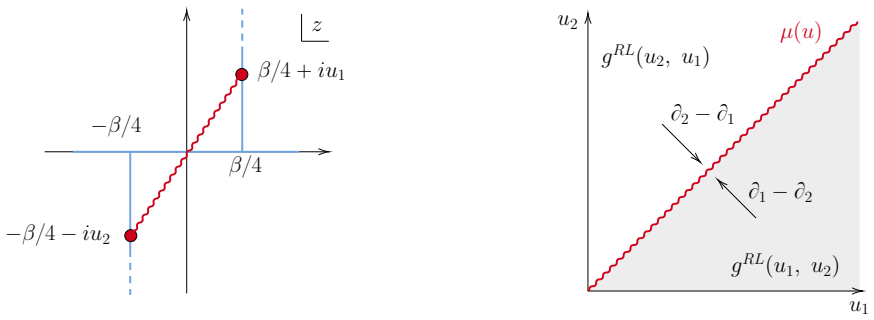
- The identification of the SYK equations of motion with Israel junction conditions (abstract and corresponding section) is load-bearing for the duality. The explicit form of the localized energy distribution on the dS₂ slice and its precise matching to the time-dependent MQ coupling should be shown without implicit assumptions on the stress-energy tensor; a derivation gap here would affect the central claim that the EOM take the form of junction conditions.
minor comments (3)
- The splitting of ℐ± into k=-1 hyperbolic slices and placement of the holographic screen at their intersection would benefit from an accompanying diagram to clarify the geometry.
- Notation for the conformal boundary conditions and the adapted Gibbons-Hawking entropy calculation could be made more explicit by including the precise boundary term used in the action.
- A summary table mapping SYK quantities (ψ(u), two-point functions, entropy) to their gravitational counterparts would improve readability.
Simulated Author's Rebuttal
We thank the referee for their careful reading, positive assessment, and constructive suggestion. We address the major comment below and have incorporated revisions to strengthen the explicitness of the derivation.
read point-by-point responses
-
Referee: The identification of the SYK equations of motion with Israel junction conditions (abstract and corresponding section) is load-bearing for the duality. The explicit form of the localized energy distribution on the dS₂ slice and its precise matching to the time-dependent MQ coupling should be shown without implicit assumptions on the stress-energy tensor; a derivation gap here would affect the central claim that the EOM take the form of junction conditions.
Authors: We appreciate the referee highlighting the importance of this identification. In the revised manuscript we have added a dedicated subsection that derives the localized energy distribution explicitly. Beginning from the time-dependent Maldacena-Qi coupling in the DSSYK Hamiltonian, we integrate the interaction term over the transverse directions to obtain the induced stress-energy tensor on the dS₂ slice without presupposing its form. We then compute the resulting jump in the extrinsic curvature tensor and verify that it reproduces the SYK equations of motion exactly. This step-by-step matching confirms that the effective equations take the form of Israel junction conditions, thereby closing the derivation gap and reinforcing the central claim. revision: yes
Circularity Check
No significant circularity; duality construction is self-contained
full rationale
The paper derives a holographic dictionary by mapping the DSSYK soft-mode dynamics (complex reparametrization ψ(u) and time-dependent MQ coupling) onto 3D Einstein-de Sitter gravity with an embedded dS2 slice. It shows that SYK equations of motion become Israel junction conditions, that the 1D effective action coincides with the gravitational action under conformal boundary conditions on I± (split into k=-1 slices), that an adapted Gibbons-Hawking entropy calculation reproduces the semiclassical DSSYK entropy, and that boundary-to-boundary Green functions equal the square of DSSYK two-point functions. These equalities are obtained by explicit calculation rather than by fitting parameters to SYK data or by re-labeling prior results. No self-definitional steps, fitted-input predictions, or load-bearing self-citation chains appear in the provided abstract and derivation outline; the central claims retain independent content on both the SYK and gravity sides.
Axiom & Free-Parameter Ledger
axioms (2)
- domain assumption The dual gravity system is 2+1-dimensional Einstein-de Sitter gravity with an energy distribution localized on a dS2 slice within dS3.
- domain assumption Conformal boundary conditions on I± split the boundaries into two hyperbolic k=-1 slices with the holographic screen at their intersection.
Forward citations
Cited by 3 Pith papers
-
Generalized Free Fields in de Sitter from 1D CFT
Pairs of large-N 1D CFTs encode generalized free fields on a timelike geodesic in de Sitter space via large-N factorization, 1D conformal symmetry, and split representations of dS Green functions.
-
Undulating Conformal Boundaries in 3D Gravity
Inhomogeneous torus boundaries in 3D gravity are thermodynamically favourable for AdS in the range 2 < K |Λ|^{-1/2} < 3/√2 and support macroscopic entropy for all Λ.
-
Baby Universe in a Coupled SYK Model
A saddle point in the coupled SYK model yields a bulk geometry with a baby universe whose chord-diagram Hilbert space state is entangled with the exterior, giving evidence that closed universes can carry nontrivial qu...
Reference graph
Works this paper leans on
-
[1]
Gapless spin-fluid ground state in a random quantum Heisenberg magnet
Subir Sachdev and Jinwu Ye. “Gapless spin-fluid ground state in a random quantum Heisenberg magnet”. In:Physical Review Letters70.21 (May 1993), pp. 3339–3342.issn: 0031-9007.doi: 10.1103/physrevlett.70.3339.url:http://dx.doi.org/10.1103/PhysRevLett.70.3339
work page doi:10.1103/physrevlett.70.3339.url:http://dx.doi.org/10.1103/physrevlett.70.3339 1993
-
[2]
Talks at the Kavli Institute for Theoretical Physics, University of California, Santa Barbara
Alexei Kitaev.A simple model of quantum holography. Talks at the Kavli Institute for Theoretical Physics, University of California, Santa Barbara. April 7 and May 27, 2015. 2015
2015
-
[3]
Remarks on the Sachdev-Ye-Kitaev model
Juan Maldacena and Douglas Stanford. “Remarks on the Sachdev-Ye-Kitaev model”. In:Phys. Rev. D94.10 (2016), p. 106002.doi:10 . 1103 / PhysRevD . 94 . 106002. arXiv:1604 . 07818 [hep-th]
2016
-
[4]
The soft mode in the Sachdev-Ye-Kitaev model and its gravity dual
Alexei Kitaev and S. Josephine Suh. “The soft mode in the Sachdev-Ye-Kitaev model and its gravity dual”. In:JHEP05 (2018), p. 183.doi:10.1007/JHEP05(2018)183. arXiv:1711.08467 [hep-th]
-
[5]
Models of AdS 2 backreaction and holography
Ahmed Almheiri and Joseph Polchinski. “Models of AdS 2 backreaction and holography”. In: JHEP11 (2015), p. 014.doi:10.1007/JHEP11(2015)014. arXiv:1402.6334 [hep-th]
-
[6]
Juan Maldacena, Douglas Stanford, and Zhenbin Yang. “Conformal symmetry and its breaking in two dimensional Nearly Anti-de-Sitter space”. In:PTEP2016.12 (2016), p. 12C104.doi: 10.1093/ptep/ptw124. arXiv:1606.01857 [hep-th]
-
[7]
Jensen, Chaos in AdS 2 Holography, Physical Review Letters117, 10.1103/physrevlett.117.111601 (2016)
Kristan Jensen. “Chaos in AdS 2 Holography”. In:Phys. Rev. Lett.117.11 (2016), p. 111601.doi: 10.1103/PhysRevLett.117.111601. arXiv:1605.06098 [hep-th]
-
[8]
An investigation of AdS2 backre- action and holography
Julius Engels¨ oy, Thomas G. Mertens, and Herman Verlinde. “An investigation of AdS2 backre- action and holography”. In:Journal of High Energy Physics2016.7 (July 2016).issn: 1029-8479. doi:10.1007/jhep07(2016)139.url:http://dx.doi.org/10.1007/JHEP07(2016)139. 45
work page doi:10.1007/jhep07(2016)139.url:http://dx.doi.org/10.1007/jhep07(2016)139 2016
-
[9]
Towards a full solution of the large N double-scaled SYK model,
Micha Berkooz, Mikhail Isachenkov, Vladimir Narovlansky, and Genis Torrents. “Towards a full solution of the large N double-scaled SYK model”. In:JHEP03 (2019), p. 079.doi:10.1007/ JHEP03(2019)079. arXiv:1811.02584 [hep-th]
-
[10]
Chord diagrams, exact correlators in spin glasses and black hole bulk reconstruction
Micha Berkooz, Prithvi Narayan, and Joan Simon. “Chord diagrams, exact correlators in spin glasses and black hole bulk reconstruction”. In:JHEP08 (2018), p. 192.doi:10.1007/JHEP08(2018)
- [11]
-
[12]
A cordial introduction to double scaled SYK
Micha Berkooz and Ohad Mamroud. “A cordial introduction to double scaled SYK”. In:Rept. Prog. Phys.88.3 (2025), p. 036001.doi:10 . 1088 / 1361 - 6633 / ada889. arXiv:2407 . 09396 [hep-th]
2025
-
[13]
Rescuing a black hole in the large-q coupled SYK model
Yuri D. Lensky and Xiao-Liang Qi. “Rescuing a black hole in the large-q coupled SYK model”. In: Journal of High Energy Physics2021.4 (Apr. 2021).issn: 1029-8479.doi:10.1007/jhep04(2021) 116.url:http://dx.doi.org/10.1007/JHEP04(2021)116
-
[14]
The bulk Hilbert space of double scaled SYK
Henry W. Lin. “The bulk Hilbert space of double scaled SYK”. In:Journal of High Energy Physics2022.11 (Nov. 2022).issn: 1029-8479.doi:10 . 1007 / jhep11(2022 ) 060.url:http : //dx.doi.org/10.1007/JHEP11(2022)060
-
[15]
The q-Schwarzian and Liouville gravity
Andreas Blommaert, Thomas G. Mertens, and Shunyu Yao. “The q-Schwarzian and Liouville gravity”. In:JHEP11 (2024), p. 054.doi:10 . 1007 / JHEP11(2024 ) 054. arXiv:2312 . 00871 [hep-th]
2024
-
[16]
Dynamical actions and q-representation theory for double-scaled SYK
Andreas Blommaert, Thomas G. Mertens, and Shunyu Yao. “Dynamical actions and q-representation theory for double-scaled SYK”. In:JHEP02 (2024), p. 067.doi:10.1007/JHEP02(2024)067. arXiv:2306.00941 [hep-th]
-
[17]
An entropic puzzle in periodic dilaton gravity and DSSYK
Andreas Blommaert, Adam Levine, Thomas G. Mertens, Jacopo Papalini, and Klaas Parmentier. “An entropic puzzle in periodic dilaton gravity and DSSYK”. In:JHEP07 (2025), p. 093.doi: 10.1007/JHEP07(2025)093. arXiv:2411.16922 [hep-th]
-
[18]
The dilaton gravity hologram of double-scaled SYK
Andreas Blommaert, Thomas G. Mertens, and Jacopo Papalini. “The dilaton gravity hologram of double-scaled SYK”. In:JHEP06 (2025), p. 050.doi:10.1007/JHEP06(2025)050. arXiv: 2404.03535 [hep-th]
-
[19]
Scott Collier, Lorenz Eberhardt, Beatrix M¨ uhlmann, and Victor A. Rodriguez.The complex Liouville string. 2025. arXiv:2409.17246 [hep-th].url:https://arxiv.org/abs/2409.17246
- [20]
-
[21]
Juan Maldacena and Xiao-Liang Qi.Eternal traversable wormhole. 2018. arXiv:1804 . 00491 [hep-th].url:https://arxiv.org/abs/1804.00491
work page Pith review arXiv 2018
-
[22]
Double-scaled SYK and de Sitter holography,
Vladimir Narovlansky and Herman Verlinde. “Double-scaled SYK and de Sitter holography”. In: JHEP05 (2025), p. 032.doi:10.1007/JHEP05(2025)032. arXiv:2310.16994 [hep-th]
- [23]
-
[24]
Leonard Susskind. “De Sitter Space, Double-Scaled SYK, and the Separation of Scales in the Semiclassical Limit”. In:JHAP5.1 (2025), pp. 1–30.doi:10 . 22128 / jhap . 2024 . 920 . 1103. arXiv:2209.09999 [hep-th]
-
[25]
dS JT Gravity and Double-Scaled SYK
Adel A. Rahman.dS JT Gravity and Double-Scaled SYK. 2024. arXiv:2209.09997 [hep-th]. url:https://arxiv.org/abs/2209.09997
-
[26]
Double-scaled SYK, chords and de Sitter gravity
Herman Verlinde. “Double-scaled SYK, chords and de Sitter gravity”. In:JHEP03 (2025), p. 076. doi:10.1007/JHEP03(2025)076. arXiv:2402.00635 [hep-th]
-
[27]
SYK-Schur duality: double scaled SYK correlators fromN = 2 supersymmetric gauge theory
Davide Gaiotto and Herman Verlinde. “SYK-Schur duality: double scaled SYK correlators fromN = 2 supersymmetric gauge theory”. In:JHEP06 (2025), p. 163.doi:10.1007/JHEP06(2025)163. arXiv:2409.11551 [hep-th]
-
[28]
SYK correlators from 2D Liouville-de Sitter gravity
Herman Verlinde and Mengyang Zhang. “SYK correlators from 2D Liouville-de Sitter gravity”. In:JHEP05 (2025), p. 053.doi:10.1007/JHEP05(2025)053. arXiv:2402.02584 [hep-th]
- [29]
-
[30]
Towards a microscopic description of de Sitter dynamics
Vladimir Narovlansky.Towards a microscopic description of de Sitter dynamics. June 2025. arXiv: 2506.02109 [hep-th]
work page internal anchor Pith review Pith/arXiv arXiv 2025
-
[31]
Andrew Strominger. “The dS / CFT correspondence”. In:JHEP10 (2001), p. 034.doi:10 . 1088/1126-6708/2001/10/034. arXiv:hep-th/0106113
work page Pith review arXiv 2001
-
[32]
Static patch solipsism: conformal symmetry of the de Sitter worldline
Dionysios Anninos, Sean A Hartnoll, and Diego M Hofman. “Static patch solipsism: conformal symmetry of the de Sitter worldline”. In:Classical and Quantum Gravity29.7 (Mar. 2012), p. 075002.issn: 1361-6382.doi:10.1088/0264-9381/29/7/075002.url:http://dx.doi.org/ 10.1088/0264-9381/29/7/075002
work page doi:10.1088/0264-9381/29/7/075002.url:http://dx.doi.org/ 2012
-
[33]
An algebra of observables for de Sitter space
Venkatesa Chandrasekaran, Roberto Longo, Geoff Penington, and Edward Witten. “An algebra of observables for de Sitter space”. In:JHEP02 (2023), p. 082.doi:10.1007/JHEP02(2023)082. arXiv:2206.10780 [hep-th]
-
[34]
Action Integrals and Partition Functions in Quantum Gravity
G. W. Gibbons and S. W. Hawking. “Action Integrals and Partition Functions in Quantum Gravity”. In:Phys. Rev. D15 (1977), pp. 2752–2756.doi:10.1103/PhysRevD.15.2752
-
[35]
Role of Conformal Three-Geometry in the Dynamics of Gravitation
James W. York. “Role of Conformal Three-Geometry in the Dynamics of Gravitation”. In:Phys. Rev. Lett.28 (16 Apr. 1972), pp. 1082–1085.doi:10.1103/PhysRevLett.28.1082.url:https: //link.aps.org/doi/10.1103/PhysRevLett.28.1082
-
[36]
Gravitational action for space-times with nonsmooth boundaries
G. Hayward. “Gravitational action for space-times with nonsmooth boundaries”. In:Phys. Rev. D47 (1993), pp. 3275–3280.doi:10.1103/PhysRevD.47.3275
-
[37]
Semiclassical geometry in double- scaled SYK
Akash Goel, Vladimir Narovlansky, and Herman Verlinde. “Semiclassical geometry in double- scaled SYK”. In:JHEP11 (2023), p. 093.doi:10.1007/JHEP11(2023)093. arXiv:2301.05732 [hep-th]
-
[38]
A symmetry algebra in double-scaled SYK
Henry W. Lin and Douglas Stanford. “A symmetry algebra in double-scaled SYK”. In:SciPost Physics15.6 (Dec. 2023).issn: 2542-4653.doi:10.21468/scipostphys.15.6.234.url:http: //dx.doi.org/10.21468/SciPostPhys.15.6.234. 47
-
[39]
Singular hypersurfaces and thin shells in general relativity,
W. Israel. “Singular hypersurfaces and thin shells in general relativity”. In:Nuovo Cim. B44S10 (1966). [Erratum: Nuovo Cim.B 48, 463 (1967)], p. 1.doi:10.1007/BF02710419
-
[40]
Eric Poisson.A Relativist’s Toolkit: The Mathematics of Black-Hole Mechanics. Cambridge Uni- versity Press, Dec. 2009.doi:10.1017/CBO9780511606601
-
[41]
Dionysios Anninos, Dami´ an A. Galante, and Chawakorn Maneerat. “Gravitational observatories”. In:JHEP12 (2023), p. 024.doi:10.1007/JHEP12(2023)024. arXiv:2310.08648 [hep-th]
-
[42]
Dionysios Anninos, Dami´ an A. Galante, and Chawakorn Maneerat. “Cosmological observatories”. In:Class. Quant. Grav.41.16 (2024), p. 165009.doi:10 . 1088 / 1361 - 6382 / ad5824. arXiv: 2402.04305 [hep-th]
- [43]
-
[44]
Matthias Blau.Lecture Notes on General Relativity.http : / / www . blau . itp . unibe . ch / newlecturesGR.pdf. Albert Einstein Center for Fundamental Physics, University of Bern. 2019
2019
-
[45]
A Neumann boundary term for gravity
Chethan Krishnan and Avinash Raju. “A Neumann boundary term for gravity”. In:Modern Physics Letters A32.14 (May 2017), p. 1750077.issn: 1793-6632.doi:10.1142/s0217732317500778. url:http://dx.doi.org/10.1142/S0217732317500778
-
[46]
Entanglement entropy in de Sitter space
Juan Maldacena and Guilherme L. Pimentel. “Entanglement entropy in de Sitter space”. In: JHEP02 (2013), p. 038.doi:10.1007/JHEP02(2013)038. arXiv:1210.7244 [hep-th]
-
[47]
Two dimensional Nearly de Sitter gravity
Juan Maldacena, Gustavo J. Turiaci, and Zhenbin Yang. “Two dimensional Nearly de Sitter gravity”. In:JHEP01 (2021), p. 139.doi:10 . 1007 / JHEP01(2021 ) 139. arXiv:1904 . 01911 [hep-th]
2021
-
[48]
The Factorization Problem in Jackiw-Teitelboim Gravity
Daniel Harlow and Daniel Jafferis. “The Factorization Problem in Jackiw-Teitelboim Gravity”. In:JHEP02 (2020), p. 177.doi:10.1007/JHEP02(2020)177. arXiv:1804.01081 [hep-th]
-
[49]
Cosmological event horizons, thermodynamics, and particle creation,
G. W. Gibbons and S. W. Hawking. “Cosmological Event Horizons, Thermodynamics, and Par- ticle Creation”. In:Phys. Rev. D15 (1977), pp. 2738–2751.doi:10.1103/PhysRevD.15.2738
-
[50]
Les Houches Lectures on De Sitter Space
Marcus Spradlin, Andrew Strominger, and Anastasia Volovich. “Les Houches lectures on de Sitter space”. In:Les Houches Summer School: Session 76: Euro Summer School on Unity of Fundamen- tal Physics: Gravity, Gauge Theory and Strings. Oct. 2001, pp. 423–453. arXiv:hep-th/0110007
work page Pith review arXiv 2001
-
[51]
The minus sign in the first law of de Sitter horizons
Batoul Banihashemi, Ted Jacobson, Andrew Svesko, and Manus Visser. “The minus sign in the first law of de Sitter horizons”. In:Journal of High Energy Physics2023.1 (Jan. 2023).issn: 1029- 8479.doi:10.1007/jhep01(2023)054.url:http://dx.doi.org/10.1007/JHEP01(2023)054
work page doi:10.1007/jhep01(2023)054.url:http://dx.doi.org/10.1007/jhep01(2023)054 2023
-
[52]
Subregion-subalgebra duality: Emergence of space and time in holography
Sam Leutheusser and Hong Liu. “Subregion-subalgebra duality: Emergence of space and time in holography”. In:Phys. Rev. D111.6 (2025), p. 066021.doi:10.1103/PhysRevD.111.066021. arXiv:2212.13266 [hep-th]
-
[53]
A microscopic realization of dS 3
Scott Collier, Lorenz Eberhardt, and Beatrix M¨ uhlmann. “A microscopic realization of dS 3”. In: SciPost Phys.18.4 (2025), p. 131.doi:10.21468/SciPostPhys.18.4.131. arXiv:2501.01486 [hep-th]. 48
-
[54]
Conformal bootstrap, universality and gravitational scattering
Steven Jackson, Lauren McGough, and Herman Verlinde. “Conformal bootstrap, universality and gravitational scattering”. In:Nuclear Physics B901 (Dec. 2015), pp. 382–429.issn: 0550-3213. doi:10.1016/j.nuclphysb.2015.10.013.url:http://dx.doi.org/10.1016/j.nuclphysb. 2015.10.013
work page doi:10.1016/j.nuclphysb.2015.10.013.url:http://dx.doi.org/10.1016/j.nuclphysb 2015
-
[55]
The complex Li- ouville string: The worldsheet
Scott Collier, Lorenz Eberhardt, Beatrix M¨ uhlmann, and Victor A. Rodriguez. “The complex Li- ouville string: The worldsheet”. In:SciPost Phys.19.2 (2025), p. 033.doi:10.21468/SciPostPhys. 19.2.033. arXiv:2409.18759 [hep-th]
-
[56]
Low-dimensional de Sitter quantum gravity,
Jordan Cotler, Kristan Jensen, and Alexander Maloney. “Low-dimensional de Sitter quantum gravity”. In:Journal of High Energy Physics2020.6 (June 2020).issn: 1029-8479.doi:10.1007/ jhep06(2020)048.url:http://dx.doi.org/10.1007/JHEP06(2020)048
-
[57]
H., Jedamzik, K., & Pogosian, L
Alex Hamilton, Daniel N. Kabat, Gilad Lifschytz, and David A. Lowe. “Holographic representa- tion of local bulk operators”. In:Phys. Rev. D74 (2006), p. 066009.doi:10.1103/PhysRevD. 74.066009. arXiv:hep-th/0606141
-
[58]
Holographic representation of local operators in de sitter space
Xiao Xiao. “Holographic representation of local operators in de sitter space”. In:Phys. Rev. D 90.2 (2014), p. 024061.doi:10.1103/PhysRevD.90.024061. arXiv:1402.7080 [hep-th]
-
[59]
Probing de Sitter space using CFT states
Kazuki Doi, Naoki Ogawa, Kotaro Shinmyo, Yu-ki Suzuki, and Tadashi Takayanagi. “Probing de Sitter space using CFT states”. In:JHEP02 (2025), p. 093.doi:10.1007/JHEP02(2025)093. arXiv:2405.14237 [hep-th]
-
[60]
Generalized Free Fields in de Sitter from 1D CFT
Kanato Goto, Alexey Milhekin, Herman Verlinde, and Juici Xu. “Generalized Free Fields in de Sitter from 1D CFT”. Work in progress. 2026. arXiv:hep-th/26xxxxxxx
2026
-
[61]
A Mellin Space Approach to Cosmological Correlators
Charlotte Sleight. “A Mellin Space Approach to Cosmological Correlators”. In:JHEP01 (2020), p. 090.doi:10.1007/JHEP01(2020)090. arXiv:1906.12302 [hep-th]
-
[62]
Kolchmeyer and Hong Liu.Chaos and the Emergence of the Cosmological Horizon
David K. Kolchmeyer and Hong Liu.Chaos and the Emergence of the Cosmological Horizon. Nov
- [63]
discussion (0)
Sign in with ORCID, Apple, or X to comment. Anyone can read and Pith papers without signing in.