Recognition: 2 theorem links
· Lean TheoremCMB Limits on the Absorption of Light Vector and Axial-Vector Dark Matter
Pith reviewed 2026-05-11 01:50 UTC · model grok-4.3
The pith
Planck CMB observations constrain vector and axial-vector dark matter couplings to electrons via energy injection into the primordial plasma.
A machine-rendered reading of the paper's core claim, the machinery that carries it, and where it could break.
Core claim
Leptophilic sub-MeV spin-1 dark matter can inject energy into the primordial plasma through inelastic scattering with free electrons or absorption by neutral hydrogen, altering CMB anisotropies; using Planck 2018 data, the authors derive upper limits on the vector and axial-vector DM-electron couplings for masses between 100 eV and 100 keV, with inelastic scattering dominating above the keV scale due to form-factor suppression and hydrogen absorption dominating at lower masses due to post-recombination efficiency.
What carries the argument
Energy deposition efficiency from DM-induced photon production, which changes the free-electron fraction and thereby shifts the CMB temperature, polarization, and lensing spectra.
If this is right
- For DM masses above a few keV, the inelastic scattering channel supplies the strongest CMB bound because the atomic form factor suppresses absorption.
- Below the keV scale, absorption by neutral hydrogen provides the leading constraint because energy injected after recombination efficiently changes the free-electron fraction.
- The derived coupling limits remain weaker than laboratory and astrophysical bounds yet furnish a fully independent cosmological consistency check.
- The same energy-injection framework can be applied to future CMB experiments to tighten the mass-dependent constraints.
Where Pith is reading between the lines
- If the form-factor modeling proves more uncertain at high energies than assumed, the crossover mass where scattering overtakes absorption would shift.
- Extending the analysis to include velocity-dependent couplings or non-standard recombination histories could reveal whether the current limits are conservative.
- The CMB probe remains valuable even if laboratory bounds improve, because it directly tests the cosmological abundance and thermal history of the same particles.
Load-bearing premise
The calculated energy deposition rates and the hydrogen atomic form factor are accurate enough that the resulting shift in ionization history maps directly onto the observed CMB power spectra without additional unaccounted systematics.
What would settle it
A precise measurement of the CMB power spectra or the reionization optical depth that deviates from the ionization history predicted by the DM energy-injection model at the claimed coupling strengths.
Figures


read the original abstract
Leptophilic sub-MeV spin-1 dark matter (DM) can be converted into a photon via inelastic scattering with a free electron or absorption by a neutral hydrogen atom in the primordial plasma. We study for the first time the impact of the energy injection resulting from such processes on cosmic microwave background (CMB) anisotropies. We obtain upper limits on the vector and axial-vector DM-electron couplings using Planck 2018 temperature, polarization, and lensing data for DM masses between 100 eV and 100 keV. We find that, due to the suppression of the hydrogen atomic form factor at high energies, inelastic scattering provides the dominant constraint for DM masses above the keV scale. At lower masses, hydrogen ionization through DM absorption is the leading channel, driven by the higher efficiency of post-recombination energy injection in modifying the free-electron fraction. Although the bounds we derive are considerably weaker than existing laboratory and astrophysical limits, they provide a robust and independent cosmological probe of leptophilic DM interactions.
Editorial analysis
A structured set of objections, weighed in public.
Referee Report
Summary. The paper calculates the energy injection into the primordial plasma from leptophilic spin-1 DM via photon conversion through inelastic electron scattering and neutral-hydrogen absorption. It modifies the ionization history accordingly and derives upper limits on the vector and axial-vector DM-electron couplings from Planck 2018 TT, EE, and lensing data for DM masses 100 eV–100 keV. The authors conclude that inelastic scattering dominates the constraints above ~1 keV because of hydrogen form-factor suppression, while absorption dominates at lower masses.
Significance. If the energy-deposition and form-factor modeling is accurate, the work supplies the first CMB-derived limits on this specific interaction channel. These limits are weaker than laboratory and astrophysical bounds but constitute an independent cosmological probe that distinguishes the two channels by mass scale.
major comments (2)
- [§3.3, Eq. (12)] §3.3 and Eq. (12): The hydrogen atomic form factor is used to suppress the absorption rate at high momentum transfer; the transition to inelastic-scattering dominance at m_DM ≳ 1 keV rests on this suppression. No comparison to an independent atomic calculation (e.g., exact hydrogen wave functions) or uncertainty band on the form factor is provided, which directly scales the quoted coupling limits in the keV range.
- [§3.4] §3.4: The fraction of deposited energy that ionizes rather than heats is taken from standard prescriptions without a dedicated validation or sensitivity test for the inelastic-scattering channel. Because this fraction sets the redshift-dependent ionization rate and therefore x_e(z), even a factor-of-two uncertainty would shift the high-mass coupling bounds by a comparable factor.
minor comments (2)
- [Abstract, §1] The abstract and §1 state that the bounds are 'considerably weaker' than existing limits; a brief quantitative comparison table would help readers assess the complementarity.
- [§2] Notation for the vector and axial-vector couplings (g_V, g_A) is introduced without an explicit definition of the interaction Lagrangian; adding the Lagrangian in §2 would remove ambiguity.
Simulated Author's Rebuttal
We thank the referee for their careful reading of our manuscript and for the constructive comments, which help improve the clarity and robustness of our analysis. We address each major comment below.
read point-by-point responses
-
Referee: [§3.3, Eq. (12)] §3.3 and Eq. (12): The hydrogen atomic form factor is used to suppress the absorption rate at high momentum transfer; the transition to inelastic-scattering dominance at m_DM ≳ 1 keV rests on this suppression. No comparison to an independent atomic calculation (e.g., exact hydrogen wave functions) or uncertainty band on the form factor is provided, which directly scales the quoted coupling limits in the keV range.
Authors: We thank the referee for this observation. The atomic form factor employed in Eq. (12) follows the standard dipole approximation widely adopted in the literature for hydrogen absorption processes. While a direct comparison against exact hydrogen wave-function calculations or an explicit uncertainty band would provide additional rigor, such a dedicated atomic-physics computation exceeds the scope of the present cosmological study. In the revised manuscript we will expand Section 3.3 with a short discussion of the approximation, referencing variations reported in the atomic-physics literature and providing a qualitative estimate of its effect on the high-mass coupling limits. revision: partial
-
Referee: [§3.4] §3.4: The fraction of deposited energy that ionizes rather than heats is taken from standard prescriptions without a dedicated validation or sensitivity test for the inelastic-scattering channel. Because this fraction sets the redshift-dependent ionization rate and therefore x_e(z), even a factor-of-two uncertainty would shift the high-mass coupling bounds by a comparable factor.
Authors: We agree that a channel-specific sensitivity test is valuable. The ionization, excitation, and heating fractions are taken from the standard results in the literature for early-universe energy deposition. In the revised Section 3.4 we will include an explicit sensitivity analysis in which the ionization efficiency is varied by a factor of two; the resulting shifts in the derived coupling limits will be shown, thereby quantifying the robustness of the constraints for the inelastic-scattering channel. revision: yes
Circularity Check
No circularity: limits derived from external Planck likelihoods via forward modeling
full rationale
The paper performs a forward calculation of energy injection from vector/axial-vector DM processes (absorption and inelastic scattering) into the primordial plasma, using standard atomic form factors and deposition efficiencies to obtain the redshift-dependent ionization rate and resulting x_e(z). This modified recombination history is then passed to an external CMB Boltzmann solver and compared against the independent Planck 2018 TT/EE/lensing likelihoods to extract upper limits on the DM-electron couplings. No parameter in the signal model is fitted to the CMB data itself, nor is any key quantity (form factor, deposition fraction, or ionization efficiency) defined in terms of the target limits. The atomic-physics inputs are taken from established literature and are falsifiable independently of the present dataset. Consequently the derivation chain contains no self-definitional step, fitted-input prediction, or load-bearing self-citation that reduces the claimed result to its own inputs.
Axiom & Free-Parameter Ledger
axioms (2)
- domain assumption Standard Lambda-CDM recombination history and linear perturbation theory remain valid when a small additional energy injection term is added.
- domain assumption The hydrogen atomic form factor and DM-electron interaction matrix elements are correctly computed from quantum mechanics.
Lean theorems connected to this paper
-
IndisputableMonolith/Foundation/RealityFromDistinctionreality_from_one_distinction unclear?
unclearRelation between the paper passage and the cited Recognition theorem.
We compute the energy deposition functions fc(z) using a modified version of DarkHistory v2.0... supply the energy deposition functions fc(z) computed with DarkHistory to the injection module of CLASS
-
IndisputableMonolith/Cost/FunctionalEquationwashburn_uniqueness_aczel unclear?
unclearRelation between the paper passage and the cited Recognition theorem.
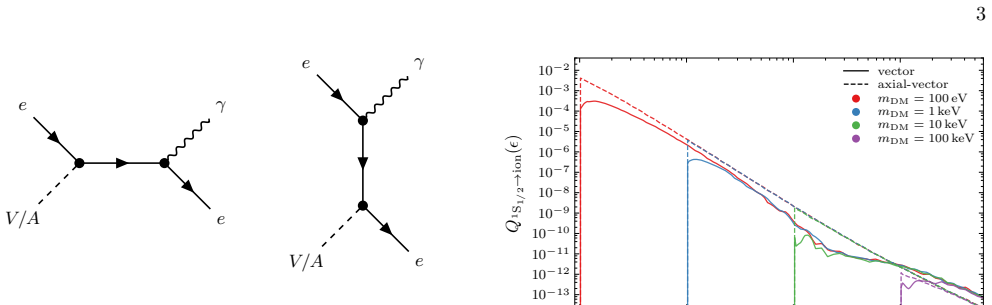
the hydrogen atomic form factor QV(ϵ) ... peaks at ϵ≈mDM and is increasingly suppressed at larger energies
What do these tags mean?
- matches
- The paper's claim is directly supported by a theorem in the formal canon.
- supports
- The theorem supports part of the paper's argument, but the paper may add assumptions or extra steps.
- extends
- The paper goes beyond the formal theorem; the theorem is a base layer rather than the whole result.
- uses
- The paper appears to rely on the theorem as machinery.
- contradicts
- The paper's claim conflicts with a theorem or certificate in the canon.
- unclear
- Pith found a possible connection, but the passage is too broad, indirect, or ambiguous to say the theorem truly supports the claim.
Reference graph
Works this paper leans on
-
[1]
Cross Section and Atomic Form Factor for DM-Induced Hydrogen Ionization 10
Axial-vector case 10 B. Cross Section and Atomic Form Factor for DM-Induced Hydrogen Ionization 10
-
[2]
Ionization cross section 11
-
[3]
Evaluation of the atomic form factor 11
-
[4]
Derivation of the DM-electron Absorption Rate 12
Contributions from individual bound states 12 C. Derivation of the DM-electron Absorption Rate 12
-
[5]
DM conversion via inelastic scattering 13 ∗ montefalcone@utexas.edu
-
[6]
CMB Limits on the Absorption of Light Vector and Axial-Vector Dark Matter
DM absorption via hydrogen ionization 13 D. DM Absorption Implementation inDarkHistory13 References 14 I. INTRODUCTION The fundamental nature of dark matter (DM) remains one of the central open questions in modern cosmology and particle physics. While terrestrial experiments and astrophysical searches have placed increasingly stringent bounds on DM intera...
work page internal anchor Pith review Pith/arXiv arXiv 2026
-
[7]
V ector case The tree-level process e−V→e−γreceives contribu- tions from the two Feynman diagrams shown in Fig. 1. Each diagram involves a (−igV¯eeγν) vertex for the DM coupling and a ( −ieγµ) vertex for the electromagnetic coupling, withe= √4παEM. The corresponding spin- and polarization-averaged squared amplitude is 10 |M|2 = 16παEMg2 V¯ee 3 (s−m2e)2 (m...
-
[8]
The spin and polarization averaging is performed with the same 1/6 factor
Axial-vector case For the axial-vector model, the calculation proceeds identically to the vector case, with the sole modifica- tion being the replacement of the DM–electron vertex gV¯eeγν→gA¯eeγ5γνin both Feynman diagrams, reflect- ing the axial-vector structure of the coupling. The spin and polarization averaging is performed with the same 1/6 factor. Fo...
-
[9]
Ionization cross section We consider the process in which a vector DM parti- cle Vµwith energy ϵis absorbed by a hydrogen atom, ionizing it. In the NR regime relevant for cold DM at late cosmological times, the massive vector field is dominated by its longitudinal (temporal) component, and the interaction Lagrangian in Eq. (1) reduces to Lint ≈ −gV¯eeV 0 ...
-
[10]
Substituting this decomposition into the matrix ele- ment in Eq
Evaluation of the atomic form factor To evaluate the form factors numerically, we decom- pose the electron wavefunctions using the two-component spherical spinors Ω κ m(θ,ϕ) as [96, 97] ψe(⃗ r) =1 r ( fκ ϵ(r) Ωκ m(θ,ϕ) igκ ϵ(r) Ω−κ m (θ,ϕ) ) ,(B5) where f and g are the radial components of the elec- tron wavefunction, and the quantum number κ≡(j + 1/2)(−1...
-
[11]
(B10) have been writ- ten as sums over all initial bound states b
Contributions from individual bound states So far, the form factors in Eq. (B10) have been writ- ten as sums over all initial bound states b. However, as discussed in the main text, in our analysis we re- tain only the contribution from the hydrogen ground state 1S1/2, since for DM masses well above the binding energies, mDM≫O(10 eV), the most tightly bou...
-
[12]
DM conversion via inelastic scattering The interaction rate per unit volume for the inelastic process (V/A)e−→γe−is obtained by integrating the cross section over the phase-space distributions of the incoming DM and electron. In the NR limit, relevant at late cosmological times, both species follow Maxwell– Boltzmann distributions, and we can write ⟨σv⟩=1...
-
[13]
DM absorption via hydrogen ionization For hydrogen ionization, the thermal averaging pro- ceeds analogously to the inelastic scattering case, with the free-electron number density ne replaced by the neu- tral hydrogen density nHI, and the electron velocity now referring to that of the bound electron within the hydro- gen atom. The cross sections, Eqs. (3)...
-
[14]
The result of Eq. (C4) then directly applies, giving ⟨σv⟩(V/A)H→p+e−≈g2 (V/A) ¯eea2 0QV/A(mDM).(C5) Appendix D: DM Absorption Implementation in DarkHistory We compute the energy deposition functions fc(z) using DarkHistory v2.0 [48, 49], which we modify to include the DM conversion processes discussed in Sec. III. In this appendix, we summarize the main m...
- [15]
-
[16]
Particle decays during the cosmic dark ages
X.-L. Chen and M. Kamionkowski, Particle decays during the cosmic dark ages, Phys. Rev. D70, 043502 (2004), arXiv:astro-ph/0310473
work page Pith review arXiv 2004
-
[17]
Detecting dark matter annihilation with CMB polarization: Signatures and experimental prospects,
N. Padmanabhan and D. P. Finkbeiner, Detecting dark matter annihilation with CMB polarization: Signatures and experimental prospects, Phys. Rev. D72, 023508 15 (2005), arXiv:astro-ph/0503486
- [18]
-
[19]
T. R. Slatyer, N. Padmanabhan, and D. P. Finkbeiner, CMB Constraints on WIMP Annihilation: Energy Ab- sorption During the Recombination Epoch, Phys. Rev. D 80, 043526 (2009), arXiv:0906.1197 [astro-ph.CO]
work page Pith review arXiv 2009
-
[20]
Effects of Dark Matter Annihilation on the Cosmic Microwave Background,
T. Kanzaki, M. Kawasaki, and K. Nakayama, Ef- fects of Dark Matter Annihilation on the Cosmic Mi- crowave Background, Prog. Theor. Phys.123, 853 (2010), arXiv:0907.3985 [astro-ph.CO]
- [21]
- [22]
- [23]
- [24]
- [25]
- [26]
-
[27]
C. Weniger, P. D. Serpico, F. Iocco, and G. Bertone, CMB bounds on dark matter annihilation: Nucleon energy- losses after recombination, Phys. Rev. D87, 123008 (2013), arXiv:1303.0942 [astro-ph.CO]
-
[28]
L. Lopez-Honorez, O. Mena, S. Palomares-Ruiz, and A. C. Vincent, Constraints on dark matter annihilation from CMB observationsbefore Planck, JCAP07, 046, arXiv:1303.5094 [astro-ph.CO]
-
[29]
R. Diamanti, L. Lopez-Honorez, O. Mena, S. Palomares- Ruiz, and A. C. Vincent, Constraining Dark Matter Late- Time Energy Injection: Decays and P-Wave Annihilations, JCAP02, 017, arXiv:1308.2578 [astro-ph.CO]
- [30]
-
[31]
S. Galli, T. R. Slatyer, M. Valdes, and F. Iocco, Systematic Uncertainties In Constraining Dark Matter Annihilation From The Cosmic Microwave Background, Phys. Rev. D 88, 063502 (2013), arXiv:1306.0563 [astro-ph.CO]
- [32]
- [33]
- [34]
- [35]
-
[36]
Cosmological constraints on exotic injection of electromagnetic energy
V. Poulin, J. Lesgourgues, and P. D. Serpico, Cosmological constraints on exotic injection of electromagnetic energy, JCAP03, 043, arXiv:1610.10051 [astro-ph.CO]
- [37]
-
[38]
M. Kawasaki, H. Nakatsuka, K. Nakayama, and T. Sekiguchi, Revisiting CMB constraints on dark mat- ter annihilation, JCAP12(12), 015, arXiv:2105.08334 [astro-ph.CO]
- [39]
-
[40]
F. Capozzi, R. Z. Ferreira, L. Lopez-Honorez, and O. Mena, CMB and Lyman- αconstraints on dark mat- ter decays to photons, JCAP06, 060, arXiv:2303.07426 [astro-ph.CO]
- [41]
-
[42]
G. Montefalcone, G. Elor, K. K. Boddy, and N. Bel- lomo, CMB constraints on loop-induced decays of lep- tophilic dark matter, Phys. Rev. D112, 023506 (2025), arXiv:2503.00110 [hep-ph]
-
[43]
Working Group Report: New Light Weakly Coupled Particles,
R. Essig et al., Working Group Report: New Light Weakly Coupled Particles, in Snowmass 2013: Snowmass on the Mississippi (2013) arXiv:1311.0029 [hep-ph]
-
[44]
Alexanderet al.(2016) arXiv:1608.08632 [hep-ph]
J. Alexander et al., Dark Sectors 2016 Workshop: Com- munity Report (2016) arXiv:1608.08632 [hep-ph]
-
[45]
M. Fabbrichesi, E. Gabrielli, and G. Lanfranchi, The Dark Photon (2020), arXiv:2005.01515 [hep-ph]
-
[46]
The Dark Photon: a 2026 Perspective,
A. Caputo and R. Essig, The Dark Photon: a 2026 Per- spective (2026) arXiv:2603.08430 [hep-ph]
- [47]
- [48]
- [49]
-
[50]
A. E. Nelson and J. Scholtz, Dark Light, Dark Matter and the Misalignment Mechanism, Phys. Rev. D84, 103501 (2011), arXiv:1105.2812 [hep-ph]
work page Pith review arXiv 2011
-
[51]
P. Agrawal, N. Kitajima, M. Reece, T. Sekiguchi, and F. Takahashi, Relic Abundance of Dark Photon Dark Mat- ter, Phys. Lett. B801, 135136 (2020), arXiv:1810.07188 [hep-ph]
-
[52]
Can annihilating Dark Matter be lighter than a few GeVs?
C. Boehm, T. A. Ensslin, and J. Silk, Can Annihilating dark matter be lighter than a few GeVs?, J. Phys. G30, 279 (2004), arXiv:astro-ph/0208458. 16
work page Pith review arXiv 2004
- [53]
- [54]
-
[55]
G. Steigman and K. M. Nollett, Light WIMPs, Equivalent Neutrinos, BBN, and the CMB, Mem. Soc. Ast. It.85, 175 (2014), arXiv:1401.5488 [astro-ph.CO]
-
[56]
K. M. Nollett and G. Steigman, BBN And The CMB Constrain Neutrino Coupled Light WIMPs, Phys. Rev. D 91, 083505 (2015), arXiv:1411.6005 [astro-ph.CO]
work page Pith review arXiv 2015
-
[57]
M. Escudero, Neutrino decoupling beyond the Standard Model: CMB constraints on the Dark Matter mass with a fast and precise Neffevaluation, JCAP02, 007, arXiv:1812.05605 [hep-ph]
- [58]
-
[59]
C. Giovanetti, M. Lisanti, H. Liu, and J. T. Ruderman, Joint Cosmic Microwave Background and Big Bang Nu- cleosynthesis Constraints on Light Dark Sectors with Dark Radiation, Phys. Rev. Lett.129, 021302 (2022), arXiv:2109.03246 [hep-ph]
- [60]
-
[61]
N. Aghanimet al.(Planck Collaboration), Planck 2018 Results. V. CMB Power Spectra and Likelihoods, As- tron. Astrophys.641, A5 (2020), arXiv:1907.12875 [astro- ph.CO]
- [62]
- [63]
-
[64]
D. Blas, J. Lesgourgues, and T. Tram, The Cosmic Linear Anisotropy Solving System (CLASS) II: Approximation Schemes, JCAP07, 034, arXiv:1104.2933 [astro-ph.CO]
work page internal anchor Pith review arXiv
- [65]
-
[66]
Changes in Dark Matter Properties After Freeze-Out
T. Cohen, D. E. Morrissey, and A. Pierce, Changes in Dark Matter Properties After Freeze-Out, Phys. Rev. D 78, 111701 (2008), arXiv:0808.3994 [hep-ph]
work page Pith review arXiv 2008
- [67]
- [68]
- [69]
-
[70]
S. Mandal and N. Sehgal, Mass-varying dark matter from a phase transition, Phys. Rev. D107, 123003 (2023), arXiv:2212.07884 [hep-ph]
-
[71]
J. Redondo and M. Postma, Massive hidden photons as lukewarm dark matter, JCAP02, 005, arXiv:0811.0326 [hep-ph]
-
[72]
Stellar cooling bounds on new light particles: plasma mixing effects,
E. Hardy and R. Lasenby, Stellar cooling bounds on new light particles: plasma mixing effects, JHEP02, 033, arXiv:1611.05852 [hep-ph]
- [73]
-
[74]
J. Redondo and G. Raffelt, Solar constraints on hidden photons re-visited, JCAP08, 034, arXiv:1305.2920 [hep- ph]
-
[75]
Light Dark Matter: Models and Constraints,
S. Knapen, T. Lin, and K. M. Zurek, Light Dark Matter: Models and Constraints, Phys. Rev. D96, 115021 (2017), arXiv:1709.07882 [hep-ph]
-
[76]
H. A. Bethe and E. E. Salpeter, Quantum mechanics of one- and two-electron atoms , 1st ed. (Springer-Verlag, 1957)
work page 1957
-
[77]
I. I. Sobelman, Atomic spectra and radiative transitions , 2nd ed. (Springer-Verlag, 1992)
work page 1992
-
[78]
P. St¨ ocker, M. Kr¨ amer, J. Lesgourgues, and V. Poulin, Exotic energy injection with ExoCLASS: Application to the Higgs portal model and evaporating black holes, JCAP 03, 018, arXiv:1801.01871 [astro-ph.CO]
-
[79]
Y. Ali-Ha ¨ ımoud, S. Seher Gandhi, and T. L. Smith, Ex- act treatment of weak dark matter-baryon scattering for linear-cosmology observables, Physical Review D109, 10.1103/physrevd.109.083523 (2024)
-
[80]
B. Audren, J. Lesgourgues, K. Benabed, and S. Prunet, Conservative Constraints on Early Cosmology: An Il- lustration of the MontePython Cosmological Parameter Inference Code, JCAP02, 001, arXiv:1210.7183 [astro- ph.CO]
discussion (0)
Sign in with ORCID, Apple, or X to comment. Anyone can read and Pith papers without signing in.