Recognition: no theorem link
Free rotation of conducting and dielectric spheres in a uniform electrostatic field
Pith reviewed 2026-05-12 01:45 UTC · model grok-4.3
The pith
Rotation equations for conducting and dielectric spheres in a uniform electric field are integrable in quadratures.
A machine-rendered reading of the paper's core claim, the machinery that carries it, and where it could break.
Core claim
The torque arising from the tilted induced dipole produces rotary equations of motion that admit exact integration in quadratures for any conducting or dielectric sphere; closed-form solutions are given for particular values of conductivity and permittivity.
What carries the argument
The velocity-dependent braking torque generated by the misalignment between the rotating particle's induced dipole and the external field.
If this is right
- The final orientation of any such particle is always aligned with the field, with the approach to alignment governed by a single integrable function of time.
- Different electrical properties produce qualitatively different braking laws, ranging from linear friction-like damping to more complex velocity-dependent torques.
- The same quadrature method applies to any spherical particle whose induced dipole response can be written as a linear function of angular velocity.
Where Pith is reading between the lines
- The integrability suggests that similar torque mechanisms may yield exact solutions in related problems such as rotation in slowly varying fields or in the presence of weak gravity.
- The explicit solutions could be used to design experiments that separate conductivity from permittivity effects by observing damping rates alone.
Load-bearing premise
The external field remains perfectly uniform, the particle stays spherical, and only the induced dipole (no higher multipoles or other forces) determines the torque.
What would settle it
Measure the time dependence of angular velocity for a levitating sphere of known conductivity or permittivity in a uniform field and check whether it follows the explicit quadrature solutions rather than a simple exponential decay.
Figures


read the original abstract
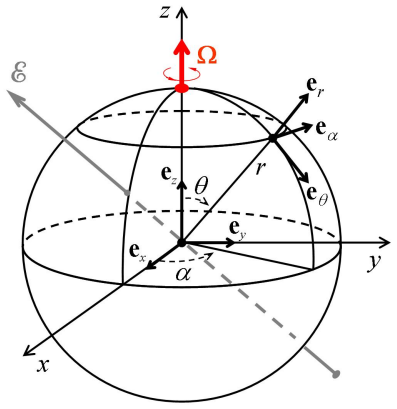
Rotation of conducting and dielectric spherical particles levitating in the uniform electrostatic field is considered. A dipole moment of the spherical particle induced by the external uniform electrostatic field is inclined to the field if the particle rotates. This causes the torque braking the rotation. Vectors of dipole moment and torque depend both on an angular velocity of the particle and its electric properties. Equations of rotary motion of the particle levitating in the external field are integrable in quadratures. Few examples of the conducting and dielectric particles are solved explicitly.
Editorial analysis
A structured set of objections, weighed in public.
Referee Report
Summary. The manuscript examines the free rotation of conducting and dielectric spherical particles levitating in a uniform electrostatic field. It shows that rotation inclines the induced dipole moment relative to the external field, producing a braking torque dependent on angular velocity and the particle's electric properties (conductivity or permittivity). The rotary equations of motion are reduced to an autonomous scalar ODE and demonstrated to be integrable in quadratures, with explicit analytic solutions provided for several conducting and dielectric cases under the quasi-static dipole approximation.
Significance. If the derivations hold, the work supplies exact integrable models for rotational braking of spheres in uniform fields, extending classical electrostatics results (exact dipolar induction, vanishing net force) to dynamics. The quadrature integrability and explicit solutions for limiting cases (e.g., perfect conductors) constitute a clear strength, enabling closed-form predictions of angular-velocity evolution without numerical integration. This framework is relevant to electrostatic levitation, particle manipulation, and related applications where analytic insight into torque-velocity coupling is useful.
major comments (1)
- [§3] §3 (equations of motion): the reduction to a single autonomous ODE for angular speed relies on fixing the rotation axis perpendicular to E and expressing torque as p(ω) × E with p derived from the quasi-static relaxation model. The manuscript should explicitly verify that this torque expression remains valid when the instantaneous angular velocity changes the effective relaxation, including a brief check that higher-order multipoles remain negligible for the sphere geometry.
minor comments (3)
- The abstract states that 'few examples' are solved explicitly; the introduction or §4 should list the specific cases (e.g., perfect conductor, dielectric with finite relaxation time) and the corresponding closed-form expressions for ω(t) to improve readability.
- [§2] Notation for the dipole moment p(ω) and torque should be introduced with a single consistent symbol set in §2; currently the dependence on material parameters (conductivity σ, permittivity ε) is introduced piecewise and could be consolidated into a table for the conducting versus dielectric limits.
- Figure captions (e.g., plots of ω(t) for the solved examples) should include units and the values of the dimensionless parameters used, to allow direct comparison with the analytic expressions in §4.
Simulated Author's Rebuttal
We thank the referee for the careful reading, positive assessment, and recommendation of minor revision. We address the single major comment below and will incorporate the requested verification into the revised manuscript.
read point-by-point responses
-
Referee: §3 (equations of motion): the reduction to a single autonomous ODE for angular speed relies on fixing the rotation axis perpendicular to E and expressing torque as p(ω) × E with p derived from the quasi-static relaxation model. The manuscript should explicitly verify that this torque expression remains valid when the instantaneous angular velocity changes the effective relaxation, including a brief check that higher-order multipoles remain negligible for the sphere geometry.
Authors: We agree that an explicit statement on the range of validity strengthens the presentation. In the revised §3 we will add a short paragraph noting the following. For any linear isotropic sphere (conducting or dielectric) placed in a uniform external field the exact solution of the electrostatic boundary-value problem yields a purely dipolar induced moment with vanishing higher multipoles; this follows directly from the uniqueness theorem for Laplace’s equation and the spherical symmetry, independent of the particle’s instantaneous angular velocity. The quasi-static relaxation model for p(ω) is obtained by solving the time-dependent charge or polarization equation in the rotating frame; it remains valid provided the electric relaxation time τ is much shorter than the instantaneous rotational period 2π/ω (i.e., ωτ ≪ 1). Under this condition the electric degrees of freedom adiabatically follow the slowly varying orientation, so that the torque p(ω) × E evaluated at the current ω can be inserted into the mechanical equation without additional transient terms. We will also state the corresponding inequality on the initial angular velocity and material parameters that guarantees the approximation holds throughout the braking process. revision: yes
Circularity Check
No significant circularity in derivation chain
full rationale
The paper's central result—that rotary equations for a levitating sphere reduce to an autonomous scalar ODE integrable by quadrature—follows directly from applying standard electrostatics to the induced dipole p(ω) of a rotating conducting or dielectric sphere in a uniform field E, yielding torque τ = p × E. This structure permits separation of variables once the rotation axis is fixed perpendicular to E, with explicit solutions for the two material cases obtained by direct integration. No load-bearing step reduces by construction to a fitted parameter, self-referential definition, or prior self-citation; the dipole and torque expressions are derived from the quasi-static Maxwell problem for a sphere, which is independent of the subsequent dynamics. The construction is self-contained against external benchmarks of electrostatics and rigid-body mechanics.
Axiom & Free-Parameter Ledger
axioms (2)
- domain assumption The external field remains uniform and the particle is spherical and levitating without translational motion or gravity effects.
- domain assumption The induced dipole moment depends on angular velocity and electric properties, producing a torque that brakes rotation.
Reference graph
Works this paper leans on
-
[1]
G. I. Melcher, J. R. Taylor, Electrohydrodynamics: A rev iew of the role of in- terfacial shear stresses, Annual Review of Fluid Mechanics 1 (1) (1969) 111–146. doi:10.1146/annurev.fl.01.010169.000551
-
[2]
T. B. Jones, Quincke rotation of spheres, IEEE Transacti ons of Inductry Applications IA- 20 (4) (1984) 845–849. doi:10.1109/tia.1984.4504495
-
[3]
T. B. Jones, Electromechanics of particles, Cambridge U niversity Press, Cambridge, 1995
work page 1995
-
[4]
R. Reimann, M. Doderer, E. Hebestrait, R. Diehl, M. Frimm er, D. Windey, F. Tebben- johanns, L. Novotny, Ghz rotation of an optically trapped na noparticle in vacuum, Phys. Rev. Lett 121 (3) (2018) 033602. doi:10.1103/PhysRevLett. 121.033602
-
[5]
J. Ahn, Z. Xu, J. Bang, P. Ju, X. Gao, T. Li, Ultrasensitive torque detection with an optically levitated nanorotor, Nat. Nanotechnol. 15 (2) (2 020) 89–95. doi:10.1038/s41565- 019-0605-9. 17
-
[6]
Y. Jin, J. Yan, S. J. Rahman, J. Li, X. Yu, J. Zhang, 6 GHz hyp erfast rotation of an optically levitated nanoparticle in vacuum, Photon. Res . 9 (7) (2021) 1344–1350. doi:10.1364/PRJ.422975
-
[7]
R. M. Corless, G. H. Gonnet, D. E. G. Hare, D. J. Jeffrey, D. E. Knuth, On the Lambert W function, Adv. Comput. Math. 5 (1) (1996) 329–359. doi:10. 1007/BF02124750
work page 1996
-
[8]
B. Frka-Petesic, B. Jean, L. Heux, First experimental ev idence of a giant permanent electric-dipole moment in cellulose nanocrystals, Europh ys. Lett. 107 (2) (2014) 28006. doi:10.1209/0295-5075/107/28006
-
[9]
H. H¨ affner, T. Beier, S. Djeki´ c, N. Hermanspahn, H.-J. Kluge, W. Quint, S. Stahl, J. Verd´ u, T. Valenzuela, G. Werth, Double Penning trap technique for p recise g factor determinations in highly charged ions, Eur. Phys. J. D 22 (2) (2003) 163–182. doi:10.1140/epjd/e2003- 00012-2
-
[10]
P. J. W. Debye, Polar Molecules, Dover science books, Do ver Publications, NY, 1929
work page 1929
-
[11]
G. G. Raju, Dielectrics in Electric Fields. Tables, Ato ms, and Molecules, 2nd Edition, CRC Press, Boca Raton, 2016. doi:10.1201/9781315373270
-
[12]
H. A. Lorentz, The Theory of Electrons: And its Applicat ions to the Phenomena of Light and Radiant Heat, 2nd Edition, Dover Publications, Inc., Ne w York, 1952
work page 1952
-
[13]
W. G. Spitzer, D. Kleinman, D. Walsh, Infrared properti es of hexagonal silicon carbide, Phys. Rev 113 (1) (1959) 127–132. doi:10.1103/PhysRev.113 .127
-
[14]
D. Mazumdar, D. Bose, M. L. Mukherjee, Transport and die lectric properties of Lisicon, Solid State Ionics 14 (2) (1984) 143–147. doi:10.1016/0167 -2738(84)90089-4
-
[15]
L. Zhang, M. Malys, J. Jamroz, F. Krok, W. Wrobel, S. Hull , H. Yan, I. Abrahams, Structure and conductivity in LISICON analogues within the Li4GeO4–Li2MoO4 system, Inorg. Chem. 62 (30) (2023) 11876–11886. doi:10.1021/acs. inorgchem.3c01222
work page doi:10.1021/acs 2023
-
[16]
L. L. Felix, J. M. Porcel, F. F. H. Arag´ on, D. G. Pacheco- Salazar, M. H. Sousa, Simple synthesis of gold-decorated silica nanoparticles by in sit u precipitation method with new plasmonic properties, SN Appl. Sci. 3 (4) (2021) 443. doi:10 .1007/s42452-021-04456-0
work page 2021
-
[17]
A sample implementation for parallelizing divide-and-conquer algorithms on the GPU,
R. Trihan, O. Bogucki, A. Kozlowska, M. Ihle, S. Ziesche , B. Fetli´ nski, B. Janaszek, M. Kieliszczyk, M. Kaczkan, F. Rossignol, A. Aimable, Hybri d gold-silica nanoparticles for plasmonic applications: A comparison study of synthesi s methods for increasing gold coverage, Heliyon 9 (2023) e15977. doi:10.1016/j.heliyon .2023.e15977
-
[18]
Vogel, Particle confinement in Penning traps
M. Vogel, Particle confinement in Penning traps. An intr oduction, Vol. 100 of Springer series on Atomic, Optical, and Plasma Physics, Springer, Ch am, 2018
work page 2018
-
[19]
Y. Yaremko, M. Przybylska, A. J. Maciejewski, Dynamics of a relativistic charge in the Penning trap, Chaos 25 (5) (2015) 053102. doi:10.1063/1.49 19243
-
[20]
M. Przybylska, A. J. Maciejewski, Yu. Yaremko, Electro magnetic trap for polar particles, New J. Phys. 22 (10) (2020) 103047. doi:10.1088/1367-2630/ abb913
-
[21]
H. Shi, M. Bhattacharya, Optomechanics based on angula r momentum exchange between light and matter, J. Physics B 49 (15) (2016) 153001. doi:10. 1088/0953-4075/49/15/153001. 18
work page 2016
discussion (0)
Sign in with ORCID, Apple, or X to comment. Anyone can read and Pith papers without signing in.