Recognition: no theorem link
Determining Viscosity of a Liquid with Smartphone Sensors: A Classroom-Friendly Approach Using Damped Oscillations
Pith reviewed 2026-05-12 00:52 UTC · model grok-4.3
The pith
Smartphone sensors measure liquid viscosity from damped oscillations of a spring-mounted ball in mustard oil.
A machine-rendered reading of the paper's core claim, the machinery that carries it, and where it could break.
Core claim
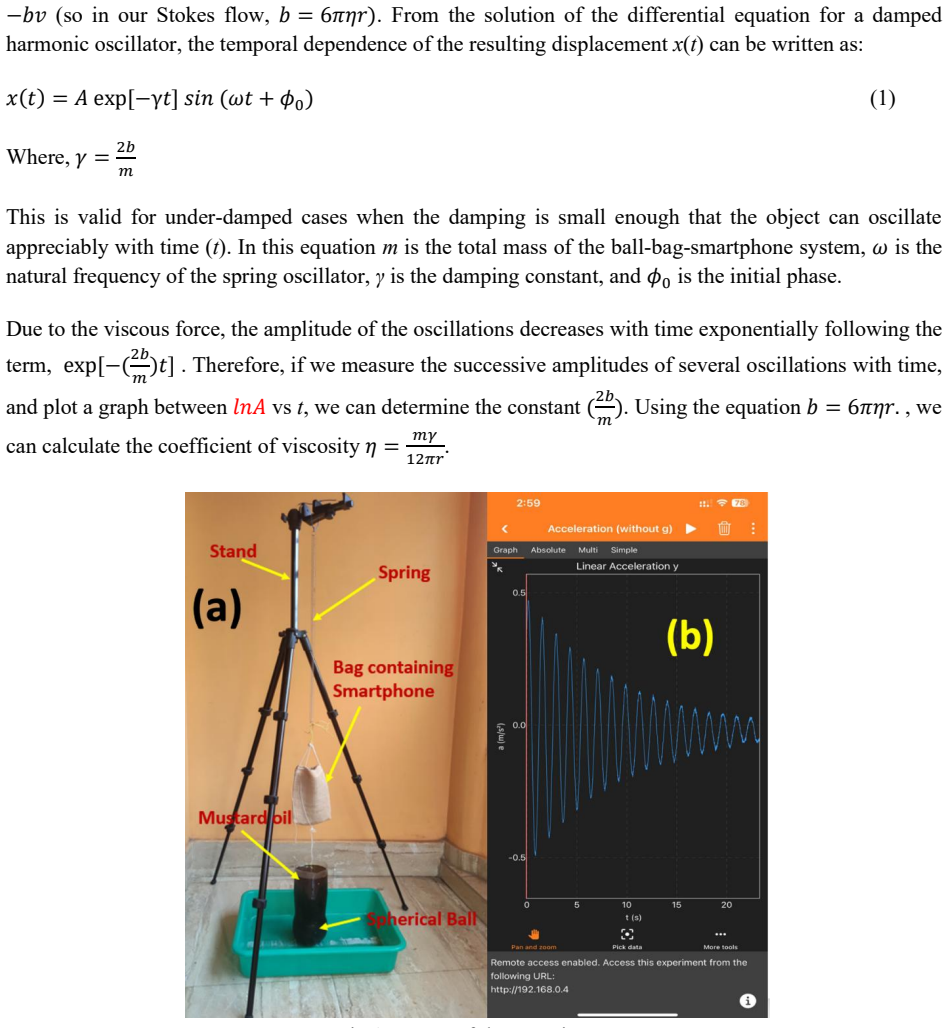
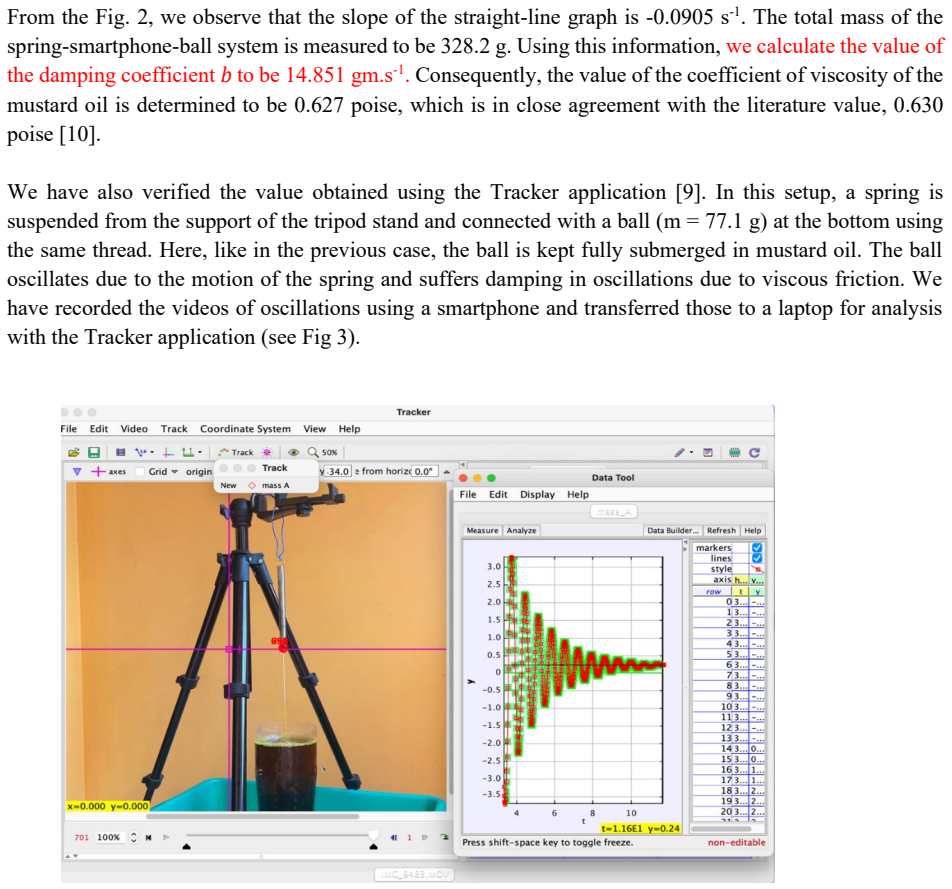
Recording the temporal variation of acceleration during damped oscillations of a metallic ball in mustard oil with a smartphone accelerometer allows calculation of the damping constant, from which the coefficient of viscosity is determined and validated to agree closely with independent Tracker app analysis and published reference values.
What carries the argument
The damping constant obtained from the exponential decay of the acceleration amplitude recorded by the smartphone sensor.
If this is right
- The experiment requires only common items plus a smartphone, enabling viscosity labs in settings without dedicated equipment.
- Students can directly extract the damping constant from real acceleration data to connect theory of damped harmonic motion to fluid properties.
- Cross-validation with video analysis provides a built-in check that improves student confidence in the measured viscosity.
- The approach can be repeated with different liquids or ball masses to explore how viscosity affects oscillation decay rates.
Where Pith is reading between the lines
- Resource-limited classrooms could use this to introduce fluid mechanics without purchasing traditional apparatus.
- The linear-drag assumption may need separate verification at higher speeds or with non-Newtonian liquids.
- Extending the method to other smartphone sensors like gyroscopes could add rotational damping measurements for more complex flows.
- Similar phone-based tracking might apply to related classroom demos such as terminal velocity or wave damping in different media.
Load-bearing premise
The observed damping is caused solely by viscous drag that is linearly proportional to velocity, without meaningful interference from buoyancy, spring nonlinearity, or sensor inaccuracies.
What would settle it
An independent measurement of the same mustard oil sample with a calibrated laboratory viscometer producing a substantially different viscosity value would indicate the smartphone method does not reliably isolate viscous effects.
Figures
read the original abstract
This study presents a classroom-friendly method for measuring the coefficient of viscosity of a liquid using a smartphone s accelerometer sensor. A metallic ball tied with a spring-mass system and submerged in mustard oil undergoes damped oscillations due to viscous forces. The Phyphox app is used to record the temporal variation of acceleration, from which the damping constant is calculated to determine the coefficient of viscosity of the oil. The experimentally obtained value is further validated using the Tracker app, and this value is shown to be in close agreement with the standard literature. This method provides an accurate, low-cost experiment ideal for educational settings, utilizing smartphone sensors for viscosity measurement.
Editorial analysis
A structured set of objections, weighed in public.
Referee Report
Summary. The paper presents a classroom experiment to measure the viscosity of mustard oil by submerging a spring-attached metallic sphere and recording its damped oscillations with a smartphone accelerometer via the Phyphox app. The damping constant is extracted from the acceleration time series and converted to viscosity using the linear Stokes drag relation b = 6π η r; the result is cross-checked with video tracking in the Tracker app and reported to agree with literature values. The work positions the approach as low-cost, accurate, and suitable for educational settings.
Significance. If the underlying model assumptions prove robust and uncertainties are quantified, the method offers a practical, sensor-based alternative to traditional viscometers for introductory physics labs. The dual-app validation (Phyphox + Tracker) is a constructive feature that could help students appreciate data consistency, though the educational impact hinges on whether the simple drag model suffices at the reported precision.
major comments (3)
- [Theory] Theory section (derivation of η from damping constant): the conversion assumes the equation of motion m_eff x'' + b x' + k x = 0 with b = 6π η r and no added-mass term. For an oscillating sphere the unsteady Stokes flow includes an added-mass contribution (½ displaced fluid mass) and Basset history integral; when the viscous penetration depth δ = √(2ν/ω) is comparable to radius r these corrections alter the inferred η. The manuscript provides no estimate of δ/r or justification that they are negligible.
- [Results] Results section: the abstract states agreement with literature values, yet no error bars, number of independent trials, fitting procedure for the exponential decay, or checks for temperature drift and sensor noise are reported. Without these the claimed agreement cannot be evaluated and the central claim that the method is 'accurate' remains unsupported.
- [Experimental Setup] Experimental setup: buoyancy shifts the equilibrium position and changes the effective restoring force; the text does not indicate whether this offset was measured or corrected before extracting the damping constant from acceleration amplitude decay.
minor comments (2)
- [Introduction] The manuscript should cite prior smartphone-based viscosity or damped-oscillator experiments to clarify novelty.
- [Theory] Notation for effective mass m_eff versus bare mass m is used inconsistently; a single consistent symbol and definition would improve clarity.
Simulated Author's Rebuttal
We thank the referee for the thorough and constructive review of our manuscript. We address each major comment in detail below, providing clarifications and indicating revisions where the manuscript will be updated to strengthen the presentation and address the concerns raised.
read point-by-point responses
-
Referee: [Theory] Theory section (derivation of η from damping constant): the conversion assumes the equation of motion m_eff x'' + b x' + k x = 0 with b = 6π η r and no added-mass term. For an oscillating sphere the unsteady Stokes flow includes an added-mass contribution (½ displaced fluid mass) and Basset history integral; when the viscous penetration depth δ = √(2ν/ω) is comparable to radius r these corrections alter the inferred η. The manuscript provides no estimate of δ/r or justification that they are negligible.
Authors: We acknowledge that the derivation in the Theory section employs the quasi-steady Stokes drag without explicit treatment of added-mass or Basset history terms. In the revised manuscript we will add a dedicated paragraph estimating the viscous penetration depth δ = √(2ν/ω) using the observed oscillation frequency from our data and the literature viscosity of mustard oil. We will report the resulting δ/r ratio and discuss its implications for the validity of the simple model under our experimental conditions. This addition will provide the missing justification and allow readers to assess the approximation directly. revision: yes
-
Referee: [Results] Results section: the abstract states agreement with literature values, yet no error bars, number of independent trials, fitting procedure for the exponential decay, or checks for temperature drift and sensor noise are reported. Without these the claimed agreement cannot be evaluated and the central claim that the method is 'accurate' remains unsupported.
Authors: We agree that the Results section would benefit from more complete reporting of uncertainties and procedures. In the revised manuscript we will specify the number of independent trials performed, include error bars derived from the standard deviation across trials on the final viscosity value, describe the fitting method used to extract the damping constant (linear regression on the logarithm of the acceleration amplitude versus time), and add a short paragraph addressing temperature stability during measurements and the contribution of sensor noise as characterized by the Phyphox app. These changes will enable readers to evaluate the reported agreement with literature values. revision: yes
-
Referee: [Experimental Setup] Experimental setup: buoyancy shifts the equilibrium position and changes the effective restoring force; the text does not indicate whether this offset was measured or corrected before extracting the damping constant from acceleration amplitude decay.
Authors: Buoyancy exerts a constant force that displaces the equilibrium position but does not modify the spring constant k or the velocity-dependent damping coefficient b. The equation of motion for small oscillations about the new equilibrium therefore retains the same form, and the damping constant extracted from the exponential decay of acceleration amplitude requires no additional buoyancy correction. We will insert a clarifying sentence in the Experimental Setup section explaining this point and confirming that the analysis procedure remains valid. revision: yes
Circularity Check
Derivation extracts damping from data then applies standard Stokes formula; no circular reduction
full rationale
The paper records acceleration time series via smartphone, fits the observed exponential envelope to extract the damping constant γ (or b), and computes η = b / (6π r) using the textbook linear-drag relation. This calculation does not fit or adjust η to match literature values; the literature comparison is performed only after the value is obtained and serves as external validation. No self-citation is invoked to justify the drag law or to close the derivation. The model assumptions (linear viscous drag, negligible added mass, etc.) are stated as premises rather than derived from the target result. Consequently the chain from raw sensor data to reported η does not reduce to its own inputs by construction.
Axiom & Free-Parameter Ledger
axioms (1)
- domain assumption Damped harmonic motion follows mẍ + bẋ + kx = 0 where b is proportional to viscosity.
Reference graph
Works this paper leans on
-
[1]
Smartphone-based measurement of magnetic force and demonstration of Newton’s third law of motion,
S. K. Pal, S. Sarkar, and P. Panchadhyayee, “Smartphone-based measurement of magnetic force and demonstration of Newton’s third law of motion,” Phys. Teach. 62, 404-405 (2024)
work page 2024
-
[2]
LiDAR based determination of spring constant using smartphones,
S. K. Pal, S. Sarkar, and P. Panchadhyayee, “LiDAR based determination of spring constant using smartphones,” The Phys. Educat. 6, 2450001 (2024)
work page 2024
-
[3]
Analyzing simple pendulum phenomena with a smartphone acceleration sensor,
P. Vogt and J. Kuhn, “Analyzing simple pendulum phenomena with a smartphone acceleration sensor,” Phys. Teach. 50,439–440 (2012)
work page 2012
-
[4]
Analyzing free fall with a smartphone acceleration sensor,
P. Vogt and J. Kuhn, “Analyzing free fall with a smartphone acceleration sensor,” Phys. Teach. 50, 182–183 (2012)
work page 2012
-
[5]
Determination of the magnetic moment of a magnet by letting it fall through a conducting pipe,
S. K. Pal, S. Sarkar, and P. Panchadhyayee, “Determination of the magnetic moment of a magnet by letting it fall through a conducting pipe,” Phys. Educ. 59, 015022 (2024)
work page 2024
-
[6]
S. K. Pal, S. Sarkar, and P. Panchadhyayee, “Determination of the Acceleration due to Gravity by Studying the Magnet’s Motion Through a Conducting Pipe,” The Phys. Educat. 6, 2450008 (2024)
work page 2024
-
[7]
Analyzing spring pendulum phenomena with a smartphone acceleration sensor,
J. Kuhn and P. Vogt, “Analyzing spring pendulum phenomena with a smartphone acceleration sensor,” Phys. Teach. 50, 504 (2012)
work page 2012
-
[8]
Motion of a damped oscillating sphere as a function of the medium viscosity,
J J Mendoza -Arenas, E L D Perico, and F Fajardo, “Motion of a damped oscillating sphere as a function of the medium viscosity,” Eur. J. Phys. 31, 129–141 (2010)
work page 2010
-
[9]
S. K. Pal, S. Sarkar, P. Panchadhyayee, and D. Syam, “Study of the effect of electromagnetic damping force on a magnet oscillating near a non -ferromagnetic conducting plate,” Eur. J. Phys. 45, 045203 (2024)
work page 2024
-
[10]
A. K. Azad, S. M. A. Uddin, and M. M. Alam, “A comprehensive study of di diesel engine performance with vegetable oil: an alternative bio fuel source of energy,” International Journal of Automotive and Mechanical Engineering. 5, 576-586 (2012)
work page 2012
discussion (0)
Sign in with ORCID, Apple, or X to comment. Anyone can read and Pith papers without signing in.