Recognition: no theorem link
Two-dimensional Clay Channels for Tunable Nanofluidic Memristor
Pith reviewed 2026-05-12 01:10 UTC · model grok-4.3
The pith
Vermiculite clay channels switch between memory states by changing electrode configurations alone
A machine-rendered reading of the paper's core claim, the machinery that carries it, and where it could break.
Core claim
Vermiculite nanofluidic devices harness dynamic charge-carrier reconfiguration under electric fields to create memory where internal resistance depends on field history. Polarity-dependent switching between crossing-1 and crossing-2 loops is realized solely by altering electrode configurations, governed by asymmetrical architecture and intrinsic surface charge, without modifying electrolyte, channel surface chemistry or device structure. This holds for re-stacked membranes at centimeter-to-micrometer lengths and extends to nanometer-scale channels made by ultramicrotomy, while also producing neuromorphic functions including synaptic potentiation-depression and programmable retention.
What carries the argument
Asymmetrical device architecture combined with vermiculite's intrinsic surface charge, which directs and reconfigures ion transport pathways under changing electrode polarity.
Load-bearing premise
The memory switching and neuromorphic behaviors arise purely from asymmetrical architecture and intrinsic surface charge, remaining controllable when channels shrink from centimeters to nanometers.
What would settle it
If repeated tests show that swapping electrode configurations produces no distinct crossing-1 versus crossing-2 loops, or if the switching disappears at nanometer channel lengths for reasons unrelated to the claimed architecture, the central claim would be falsified.
Figures

read the original abstract
Dynamic reconfiguration of charge carriers in confined ion-channels under electrical stimulation produces memory effects, where the internal resistance depends on history of the electric field. Vermiculite nanofluidic devices harness this effect to store and process information within a single component. We report switching between distinct memory loops by tuning ion transport pathways, governed by asymmetrical device architecture and intrinsic surface-charge. Polarity-dependent memory switching between crossing-1 and crossing-2 loops is achieved solely by altering electrode configurations, without modifying electrolyte, channel surface chemistry or device structure: providing mechanistic insights into ionic memristors through a straightforward, experimentally validated strategy. The memristive characteristics are demonstrated in both in-plane and out-of-plane channel configurations with channel lengths spanning from centimeters to micrometers length scales using re-stacked vermiculite membranes and further investigated for miniaturization with devices having nanometer scale channel lengths, fabricated via ultramicrotomy method. Furthermore, we demonstrate neuromorphic functionalities, including synaptic potentiation-depression and programmable memory retention, highlighting potential for bio-inspired computing systems. Cost-effective and scalable fabrication solution processed vermiculite membrane memristors pave the way for practical integration of nanofluidic memristors for neuromorphic computing applications.
Editorial analysis
A structured set of objections, weighed in public.
Referee Report
Summary. The manuscript reports on vermiculite-based two-dimensional clay nanofluidic channels as tunable memristors. It claims that polarity-dependent memory switching between distinct crossing-1 and crossing-2 hysteresis loops is achieved solely by reconfiguring electrodes in an asymmetrical device architecture, without changes to electrolyte, surface chemistry, or overall structure. Memristive behavior is demonstrated across in-plane and out-of-plane configurations with channel lengths from centimeters down to nanometers (via re-stacked membranes and ultramicrotomy), along with neuromorphic functions such as synaptic potentiation-depression and programmable memory retention. The work emphasizes cost-effective, scalable fabrication for potential neuromorphic computing applications.
Significance. If the central claims hold with adequate controls, the result would be significant for ionic memristor design: it offers a simple, architecture-based tuning mechanism grounded in intrinsic surface charge and confined ion transport, using abundant clay materials. This could enable practical, bio-inspired devices without complex chemical modifications. The scaling from macro to nano lengths and demonstration of neuromorphic primitives are potentially valuable strengths, though they require robust quantitative support to confirm reproducibility.
major comments (3)
- [Abstract] Abstract: The claim that polarity-dependent switching between crossing-1 and crossing-2 loops occurs 'solely by altering electrode configurations' (without modifying electrolyte, channel surface chemistry or device structure) is load-bearing for the central contribution. This requires explicit evidence that electrode-channel interfaces (contact resistance, local E-field gradients, ion injection profiles) remain invariant upon reconfiguration; the provided text does not reference such controls or impedance data to decouple boundary effects from the intended architectural asymmetry.
- [Abstract] The manuscript states experimental validation and neuromorphic tests across cm-to-nm length scales, yet the abstract and summary provide no quantitative metrics, error bars, device statistics, or control experiments. This leaves the reproducibility of memory retention and synaptic behaviors (especially under channel-length reduction via ultramicrotomy) unassessable and undermines the scaling claims.
- [Abstract] The weakest assumption—that memory effects arise purely from asymmetrical architecture and intrinsic surface charge and remain controllable at nanometer scales—needs direct support. Without data showing that interface properties are held constant when electrodes are swapped or when channels are miniaturized, alternative explanations involving contact-area or near-electrode ion accumulation cannot be excluded.
minor comments (1)
- [Abstract] The abstract would benefit from a brief statement on how many devices were tested and what statistical measures (e.g., standard deviation) accompany the reported behaviors.
Simulated Author's Rebuttal
We thank the referee for the constructive and detailed feedback. We address each major comment point-by-point below. Where the manuscript lacked sufficient supporting data or quantitative details, we have revised it to incorporate the requested evidence and clarifications.
read point-by-point responses
-
Referee: [Abstract] Abstract: The claim that polarity-dependent switching between crossing-1 and crossing-2 loops occurs 'solely by altering electrode configurations' (without modifying electrolyte, channel surface chemistry or device structure) is load-bearing for the central contribution. This requires explicit evidence that electrode-channel interfaces (contact resistance, local E-field gradients, ion injection profiles) remain invariant upon reconfiguration; the provided text does not reference such controls or impedance data to decouple boundary effects from the intended architectural asymmetry.
Authors: We agree that explicit controls are essential to substantiate the claim of invariance under electrode reconfiguration. In the revised manuscript, we have added electrochemical impedance spectroscopy (EIS) data for both configurations, showing that the high-frequency intercept (contact resistance) and overall impedance spectra remain consistent within experimental variation. We have also included control measurements with symmetric electrode arrangements and clarified that electrode materials, contact areas, and fabrication protocols are identical. These additions directly address the decoupling of boundary effects from architectural asymmetry. revision: yes
-
Referee: [Abstract] The manuscript states experimental validation and neuromorphic tests across cm-to-nm length scales, yet the abstract and summary provide no quantitative metrics, error bars, device statistics, or control experiments. This leaves the reproducibility of memory retention and synaptic behaviors (especially under channel-length reduction via ultramicrotomy) unassessable and undermines the scaling claims.
Authors: We acknowledge that the original abstract and summary lacked quantitative metrics and statistical details, limiting assessment of reproducibility. The revised manuscript updates the abstract with key metrics including on/off ratios (mean ± standard deviation from n=6 devices), retention times, and synaptic update precision. We have added error bars to all relevant figures, device-to-device statistics, and a dedicated supplementary section with control data and yield information for the ultramicrotomy-fabricated nanometer-scale channels. These revisions provide the requested quantitative support for the scaling claims. revision: yes
-
Referee: [Abstract] The weakest assumption—that memory effects arise purely from asymmetrical architecture and intrinsic surface charge and remain controllable at nanometer scales—needs direct support. Without data showing that interface properties are held constant when electrodes are swapped or when channels are miniaturized, alternative explanations involving contact-area or near-electrode ion accumulation cannot be excluded.
Authors: We recognize the need for direct evidence to support the assumption and exclude alternatives. The revised manuscript includes AFM and SEM characterization of electrode-channel interfaces before and after reconfiguration, confirming unchanged contact morphology and area. For nanometer-scale devices, we present comparative data across length scales alongside finite-element simulations of electric-field distributions that isolate the role of architectural asymmetry. A new discussion section addresses potential near-electrode ion accumulation and why it does not dominate in our confined geometry. These additions provide the requested direct support. revision: yes
Circularity Check
No circularity: purely experimental claims with no derivation chain
full rationale
The manuscript is an experimental study of nanofluidic memristors fabricated from vermiculite membranes. All reported behaviors (polarity-dependent memory switching between crossing-1 and crossing-2 loops, neuromorphic functionalities) are presented as direct observations from I-V measurements under varied electrode configurations. No equations, fitted parameters, or mathematical derivations appear in the abstract or described content; therefore no step can reduce by construction to its own inputs. Self-citations, if present, are not load-bearing for any claimed derivation because none exists. The central claim rests on physical reproducibility across length scales rather than any self-referential logic.
Axiom & Free-Parameter Ledger
axioms (1)
- domain assumption Dynamic reconfiguration of charge carriers in confined ion channels produces history-dependent resistance.
Reference graph
Works this paper leans on
-
[1]
*Corresponding email: radha.boya@manchester.ac.uk †Contributed equally
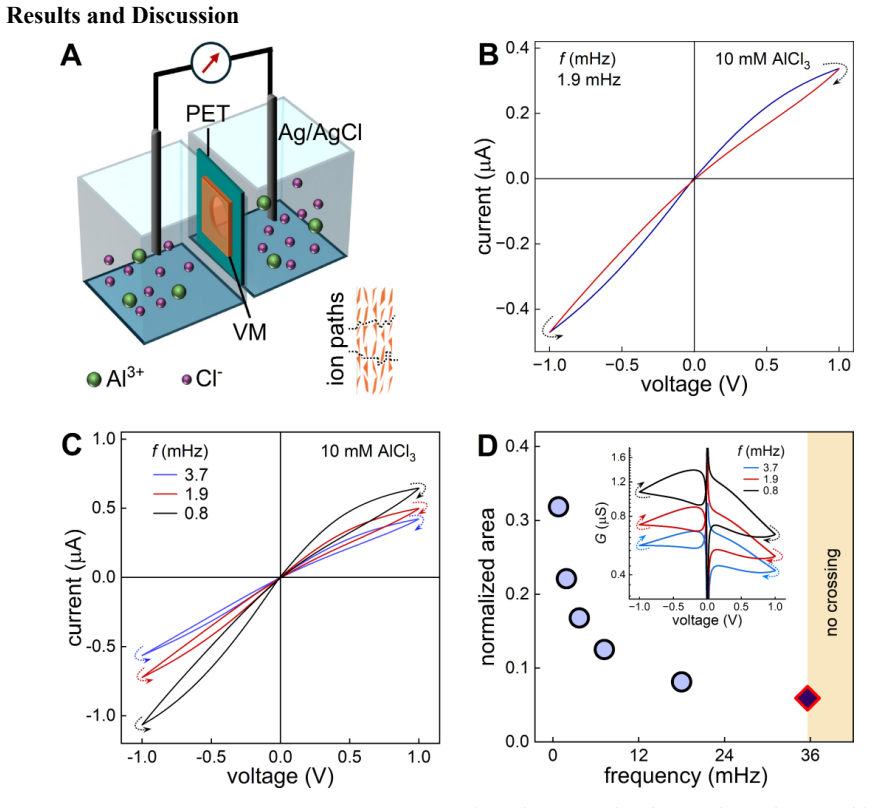
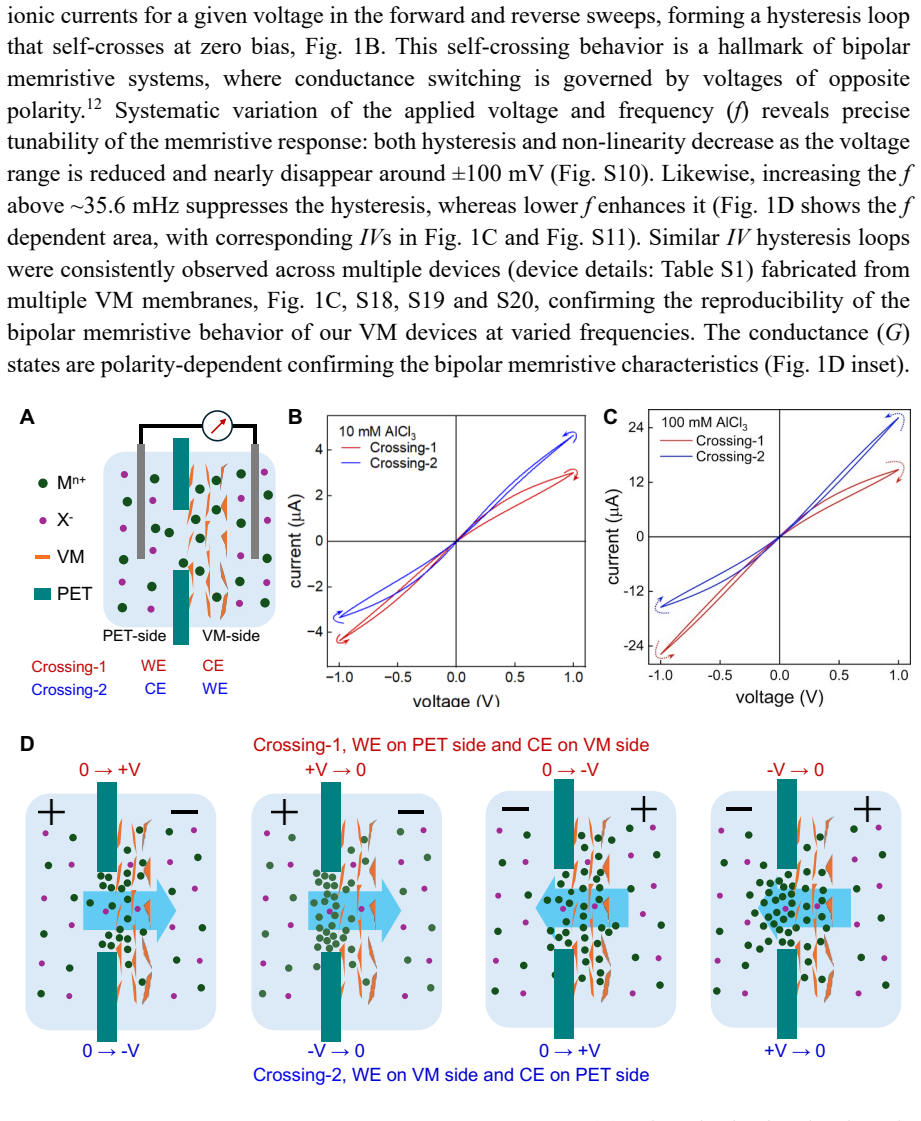
1 Two-dimensional Clay Channels for Tunable Nanofluidic Memristor Sangeeta Yadav,1,2,3,† Raj Kumar Gogoi,1,2,† Aziz Lokhandwala,1,2 Siddhi Vinayak Pandey,1,2 Ankit Bhardwaj,1,2 Sunando DasGupta,4 Boya Radha1,2,5,* 1Department of Physics and Astronomy, The University of Manchester, Manchester M13 9PL, United Kingdom 2National Graphene Institute, The Univer...
work page 1971
-
[2]
Neuromorphic mimicking of the vermiculite memristor: Evolution of the ionic current under constant polarity voltage pulses for (A) crossing-1 and (B) crossing-2. The increase (decrease) in G after applying the 8 programming pulses of (C) −0.55 V (+0.55 V) for duration of 120 s for crossing-1 and (D) +0.55 V (−0.55 V) for duration of 60 s for crossing-2. T...
discussion (0)
Sign in with ORCID, Apple, or X to comment. Anyone can read and Pith papers without signing in.