Recognition: no theorem link
Quantifying Exposure Information Uncertainty in Regional Risk Assessment
Pith reviewed 2026-05-12 01:22 UTC · model grok-4.3
The pith
A methodology quantifies bias and uncertainty from incomplete exposure data in regional risk assessments.
A machine-rendered reading of the paper's core claim, the machinery that carries it, and where it could break.
Core claim
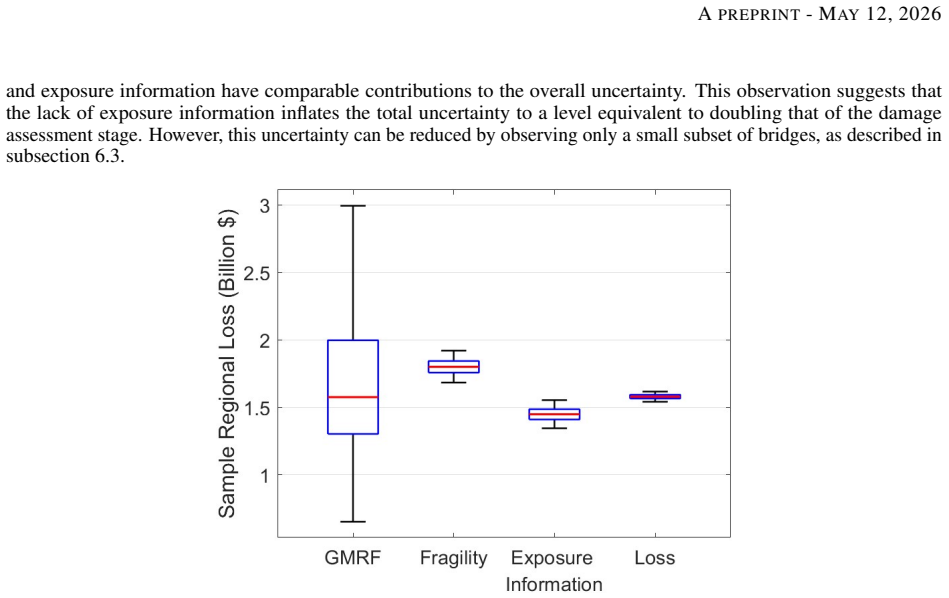
By integrating analytical and simulation-based approaches, the methodology quantifies the bias and uncertainty in regional risk assessment that arises from probabilistic exposure characterization and decomposes the total uncertainty into contributions from incomplete exposure information as well as other sources including hazard and damage characterization.
What carries the argument
Integration of analytical and simulation-based approaches to decompose uncertainty from probabilistic exposure characterization.
Load-bearing premise
That the probabilistic imputations for missing attributes can be accurately modeled and that the analytical-simulation integration correctly isolates exposure-related bias without unaccounted interactions.
What would settle it
Running the methodology on a dataset where all exposure attributes are known and comparing the decomposed exposure uncertainty component to a baseline with known missing data patterns.
Figures








read the original abstract
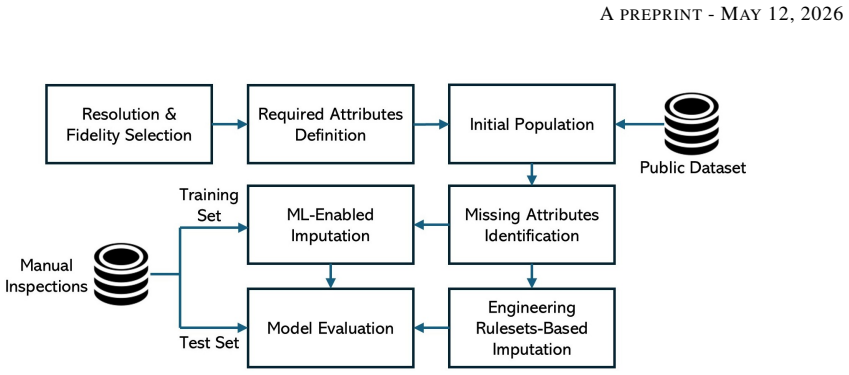
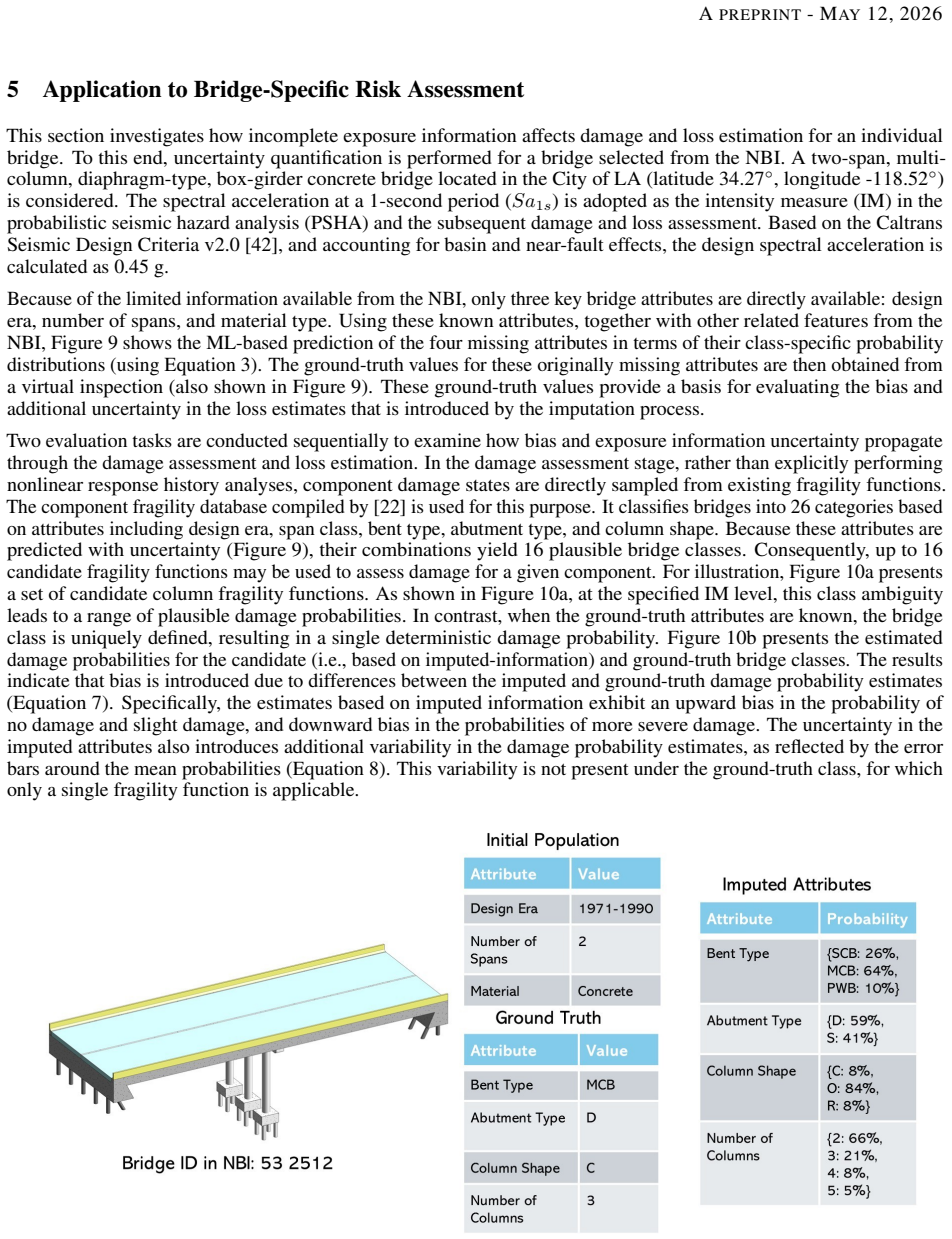
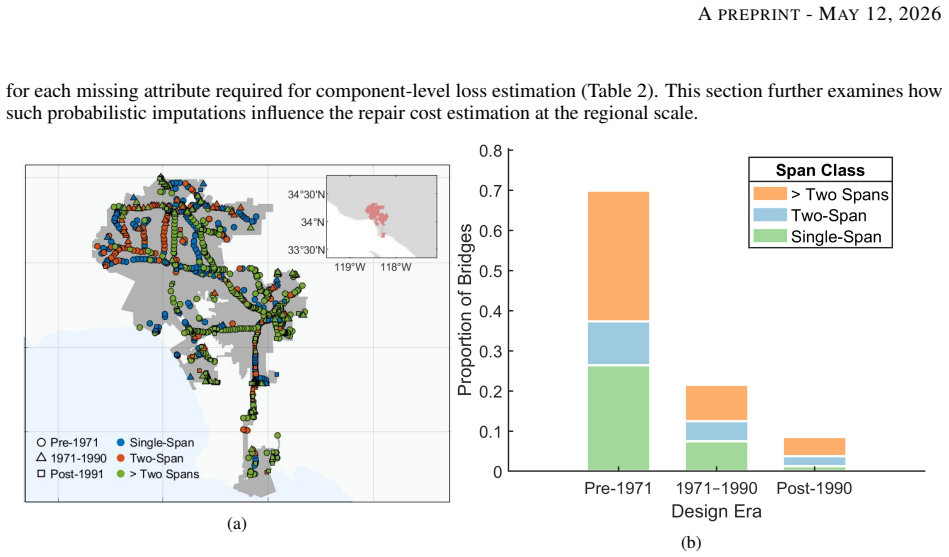
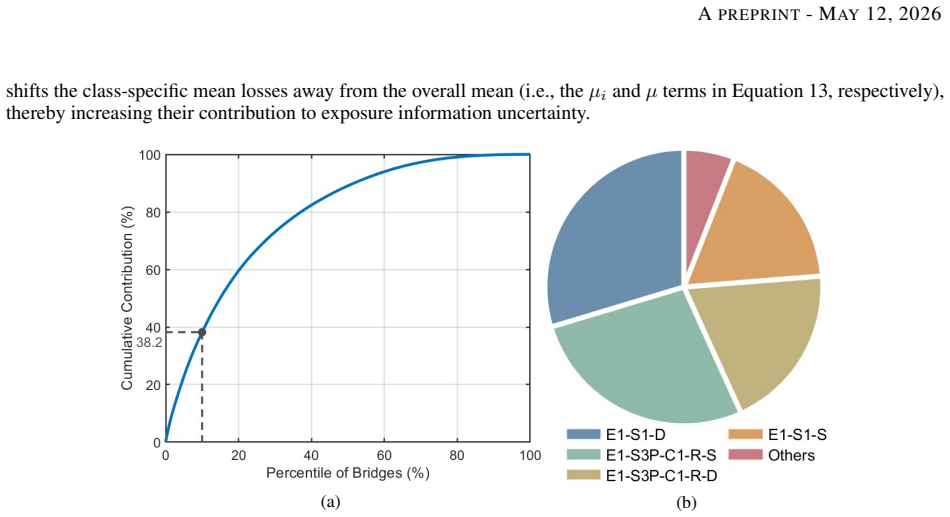
Exposure characterization in regional risk assessment aims to assign physical properties to the assets of interest so they can be associated with damage and loss functions. While this process has benefited from the growing availability of public infrastructure inventories, these datasets often lack the detailed attributes required for high-resolution risk assessment. Missing attributes are commonly inferred using predictive models or engineering-based rulesets. However, these imputations are inherently imperfect and can introduce bias and additional uncertainty in regional risk estimates. This study proposes a methodology to quantify the bias and uncertainty in regional risk assessment that arises from probabilistic exposure characterization. By integrating analytical and simulation-based approaches, the methodology decomposes the total uncertainty into contributions from incomplete exposure information as well as other sources, including hazard and damage characterization. This decomposition clarifies how bias and uncertainty associated with missing exposure information are generated and propagated through the risk assessment pipeline. The methodology is applied to both bridge-specific and regional risk assessments. A high-resolution bridge exposure inventory is developed using a data augmentation framework that combines publicly available information with machine learning and engineering-based imputation methods.
Editorial analysis
A structured set of objections, weighed in public.
Referee Report
Summary. The manuscript proposes a methodology to quantify bias and uncertainty in regional risk assessment arising from probabilistic exposure characterization. It integrates analytical and simulation-based approaches to decompose total uncertainty into contributions from incomplete exposure information (via ML and engineering imputations) as well as hazard and damage characterization. The approach is demonstrated on bridge-specific and regional assessments, including development of a high-resolution bridge inventory using public data augmented by predictive models.
Significance. If the decomposition is shown to be robust, the work would be significant for applied risk assessment by clarifying how exposure data gaps propagate through the pipeline and enabling targeted improvements in data collection. The combination of analytical and simulation methods for attribution is a conceptual strength, as is the focus on real-world bridge inventories.
major comments (2)
- [Methodology] The central decomposition requires that probabilistic imputations produce bias/variance that can be isolated without unmodeled interactions or residual correlations with hazard and damage functions. The manuscript provides no cross-validation against fully observed cases to test this separability assumption, which is load-bearing for the attribution claims.
- [Results/Application] No validation data, error analysis, or quantitative checks on the decomposition accuracy are presented, leaving the central claim that exposure-related uncertainty can be correctly isolated unverifiable from the available evidence.
minor comments (2)
- [Abstract] The abstract would benefit from a brief statement of the key decomposition equation or integration procedure to make the approach more concrete.
- [Methodology] Notation for the analytical vs. simulation components should be defined consistently when first introduced to aid readability.
Simulated Author's Rebuttal
We thank the referee for their constructive comments on our manuscript. We address each major comment below and indicate planned revisions where appropriate.
read point-by-point responses
-
Referee: [Methodology] The central decomposition requires that probabilistic imputations produce bias/variance that can be isolated without unmodeled interactions or residual correlations with hazard and damage functions. The manuscript provides no cross-validation against fully observed cases to test this separability assumption, which is load-bearing for the attribution claims.
Authors: We agree that the separability assumption is fundamental to the proposed decomposition. The analytical derivations treat exposure imputation errors as additive contributions independent of hazard and damage models, while the simulation component is intended to allow exploration of dependencies. We acknowledge that no cross-validation against fully observed cases is presented, as such complete datasets are typically unavailable for regional infrastructure inventories. In the revised manuscript, we will add an explicit limitations subsection discussing the assumption, potential interaction effects, and conditions under which the decomposition may not hold. revision: partial
-
Referee: [Results/Application] No validation data, error analysis, or quantitative checks on the decomposition accuracy are presented, leaving the central claim that exposure-related uncertainty can be correctly isolated unverifiable from the available evidence.
Authors: The manuscript demonstrates the methodology through analytical derivations and application to a real-world bridge inventory developed from public data. Quantitative outputs include decomposed uncertainty contributions and comparisons across imputation methods. We concur that direct validation against ground-truth complete data is not feasible in this setting. We will incorporate additional error propagation analysis and sensitivity checks on the decomposition results in the revised version to provide stronger quantitative support. revision: yes
- The absence of fully observed validation datasets prevents empirical cross-validation of the separability assumption underlying the decomposition.
Circularity Check
No circularity: uncertainty decomposition is independent of imputations
full rationale
The paper proposes integrating analytical and simulation methods to decompose total risk uncertainty into components from incomplete exposure data versus hazard/damage sources. No derivation step reduces by construction to its own inputs, fitted parameters renamed as predictions, or self-citation chains. The decomposition is framed as a general methodology applicable after any probabilistic imputation, without equations that presuppose the separability result or import uniqueness from prior author work. The bridge inventory application uses ML and rulesets for imputation but treats the uncertainty quantification as a downstream, independent analysis. This is self-contained against external benchmarks and receives the default non-finding.
Axiom & Free-Parameter Ledger
Reference graph
Works this paper leans on
-
[1]
Craig A. Davis, Laurie A. Johnson, Anne Kiremidjian, Alexis Kwasinski, Thomas D. O’Rourke, Ellis Stanley, Kent Yu, Farzin Zareian, Katherine J. Johnson, and Ayse Hortacsu. Initial framework to design lifeline infrastructure for post-earthquake functional recovery. Technical Report 1310, National Institute of Standards and Technology, March 2024
work page 2024
-
[2]
HAZUS technical manual, Federal Emergency Management Agency, Washington, D.C
Federal Emergency Management Agency . HAZUS technical manual, Federal Emergency Management Agency, Washington, D.C. 2003
work page 2003
-
[3]
Shanshan Chen, Yazhou Xie, Chenhao Wu, Henry V Burton, and Jamie E Padgett. High-resolution regional seismic loss assessment of reinforced concrete bridges using component-level fragility models and repair cost estimations.Earthquake Engineering & Structural Dynamics, 55(2):301–318, 2026
work page 2026
-
[4]
Modeling post-earthquake functional recovery of bridges
Chenhao Wu, Henry V Burton, Ádám Zsarnóczay, Shanshan Chen, Yazhou Xie, Vesna Terzi ´c, Selim Günay, Jamie E Padgett, Mike Mieler, and Ibrahim Almufti. Modeling post-earthquake functional recovery of bridges. Earthquake Spectra, 41(3):2089–2122, 2025. 23 APREPRINT- MAY12, 2026
work page 2089
-
[5]
Tinger Zhu, Charalampos Avraam, and Jack W Baker. Macroeconomic models for predicting indirect impacts of disasters: A review.Resilient Cities and Structures, 4(3):1–14, 2025
work page 2025
-
[6]
Laxman Dahal, Henry Burton, and Kuanshi Zhong. High-fidelity high-resolution regional seismic risk and resilience assessment of large building inventories.Earthquake Engineering & Structural Dynamics, 54(5):1376– 1396, 2025
work page 2025
-
[7]
T Anagnos, MC Comerio, C Goulet, J Steele, and JP Stewart. Development of a concrete building inventory: Los angeles case study for the analysis of collapse risk. InProceedings of 9th National & 10th Canadian Conference on Earthquake Engineering, 2010
work page 2010
-
[8]
Peihui Lin and Naiyu Wang. Stochastic post-disaster functionality recovery of community building portfolios i: Modeling.Structural Safety, 69:96–105, 2017
work page 2017
-
[9]
Meredith Lochhead, Ádám Zsarnóczay, and Gregory G Deierlein. Exposure matters: A synthesis framework for high-resolution building inventory development.International Journal of Disaster Risk Reduction, page 106148, 2026
work page 2026
-
[10]
Tracy Kijewski-Correa, Barbaros Cetiner, Kuanshi Zhong, Chaofeng Wang, Adam Zsarnoczay, Yunhui Guo, Meredith Lochhead, and Frank McKenna. Validation of an augmented parcel approach for hurricane regional loss assessments.Natural Hazards Review, 24(3):04023022, 2023
work page 2023
-
[11]
Gordana Pavi ´c, Marijana Hadzima-Nyarko, Borko Bulaji ´c, and Željka Jurkovi ´c. Development of seismic vulnerability and exposure models—a case study of croatia.Sustainability, 12(3):973, 2020
work page 2020
-
[12]
Chaofeng Wang, Qian Yu, Kincho H Law, Frank McKenna, Stella X Yu, Ertugrul Taciroglu, Adam Zsarnóczay, Wael Elhaddad, and Barbaros Cetiner. Machine learning-based regional scale intelligent modeling of building information for natural hazard risk management.Automation in Construction, 122:103474, 2021
work page 2021
-
[13]
Federica Ghione, Steffen Mæland, Abdelghani Meslem, and V olker Oye. Building stock classification using machine learning: A case study for oslo, norway.Frontiers in Earth Science, 10:886145, 2022
work page 2022
-
[14]
Daniel Gomez, Daniela Charris, Winston Percybrooks, and Carlos A Arteta. Automating building typology identification for seismic risk assessment using deep learning.Earthquake Spectra, 41(3):1833–1862, 2025
work page 2025
-
[15]
Rachel Hamburger and Tracy Kijewski-Correa. Computer vision-enabled roof subassembly damage detection from hurricanes using aerial reconnaissance imagery.Natural Hazards Review, 26(1):04024057, 2025
work page 2025
-
[16]
Zihao Song, Wenjun Jiang, Sang-ri Yi, and Jize Zhang. Reliable building inventory imputation for regional-scale risk assessment: An uncertainty-guided framework using spatially-enhanced transformers.Reliability Engineering & System Safety, 274:112436, 2026
work page 2026
-
[17]
Saeid Ghasemi, Milad Roohi, Dylan Sanderson, Omar Sediek, and John W van de Lindt. Integrated data imputation of national inventories for bridging information gaps and outcome risk uncertainty in community resilience modeling.International Journal of Disaster Risk Reduction, page 106077, 2026
work page 2026
-
[18]
Juan Camilo Gómez Zapata, Massimiliano Pittore, Fabrice Cotton, Henning Lilienkamp, Simantini Shinde, Paula Aguirre, and Hernán Santa María. Epistemic uncertainty of probabilistic building exposure compositions in scenario-based earthquake loss models.Bulletin of Earthquake Engineering, 20(5):2401–2438, 2022
work page 2022
-
[19]
Sang-ri Yi, Alexandros A Taflanidis, Parisa Toofani Movaghar, and Carmine Galasso. Impact of structural infor- mation fidelity on reduced-order model development for regional risk assessment.Structural Safety, 116:102602, 2025
work page 2025
-
[20]
David M Boore, Jonathan P Stewart, Emel Seyhan, and Gail M Atkinson. Nga-west2 equations for predicting pga, pgv, and 5% damped psa for shallow crustal earthquakes.Earthquake Spectra, 30(3):1057–1085, 2014
work page 2014
-
[21]
Correlation model for spatially distributed ground-motion intensities
Nirmal Jayaram and Jack W Baker. Correlation model for spatially distributed ground-motion intensities. Earthquake Engineering & Structural Dynamics, 38(15):1687–1708, 2009
work page 2009
-
[22]
Shanshan Chen, Yazhou Xie, Chenhao Wu, Henry V Burton, Jamie E Padgett, and Ádám Zsarnóczay. Second- generation component and system-level seismic fragility models for reinforced concrete bridges in california. Earthquake Spectra, 41(4):3234–3253, 2025
work page 2025
-
[23]
Seismic risk analysis with reliability methods, part ii: Analysis.Structural Safety, 42:63–74, 2013
M Mahsuli and T Haukaas. Seismic risk analysis with reliability methods, part ii: Analysis.Structural Safety, 42:63–74, 2013
work page 2013
-
[24]
Peihui Lin and Naiyu Wang. Stochastic post-disaster functionality recovery of community building portfolios ii: Application.Structural Safety, 69:106–117, 2017
work page 2017
-
[25]
Burton, Shanshan Chen, Yazhou Xie, Pengfei Wang, Scott J
Chenhao Wu, Henry V . Burton, Shanshan Chen, Yazhou Xie, Pengfei Wang, Scott J. Brandenberg, and Jamie E. Padgett. Risk-based model for post-earthquake functional recovery of bridge networks.Earthquake Engineering & Structural Dynamics, 2026. Accepted for publication. 24 APREPRINT- MAY12, 2026
work page 2026
-
[26]
Aleatory or epistemic? does it matter?Structural safety, 31(2):105–112, 2009
Armen Der Kiureghian and Ove Ditlevsen. Aleatory or epistemic? does it matter?Structural safety, 31(2):105–112, 2009
work page 2009
-
[27]
Abbie B Liel, Curt B Haselton, Gregory G Deierlein, and Jack W Baker. Incorporating modeling uncertainties in the assessment of seismic collapse risk of buildings.Structural safety, 31(2):197–211, 2009
work page 2009
-
[28]
Yue-Jun Yin and Yue Li. Seismic collapse risk of light-frame wood construction considering aleatoric and epistemic uncertainties.Structural Safety, 32(4):250–261, 2010
work page 2010
-
[29]
Andre T Beck, Wellison JS Gomes, and Felipe A V Bazán. On the robustness of structural risk optimization with respect to epistemic uncertainties.International Journal for Uncertainty Quantification, 2(1), 2012
work page 2012
-
[30]
Chenhao Wu and Henry V Burton. Effects of probability model misspecification on the number of ground motions required for seismic performance assessment.Earthquake Spectra, 40(4):2888–2916, 2024
work page 2024
-
[31]
Brendon A Bradley and Dominic S Lee. Accuracy of approximate methods of uncertainty propagation in seismic loss estimation.Structural Safety, 32(1):13–24, 2010
work page 2010
-
[32]
Jaehwan Jeon, Junho Song, and Oh-Sung Kwon. Ensemble-based uncertainty quantification and decomposition of probabilistic surrogate models using bayesian neural networks.Structural Safety, page 102698, 2026
work page 2026
-
[33]
Predicting good probabilities with supervised learning
Alexandru Niculescu-Mizil and Rich Caruana. Predicting good probabilities with supervised learning. In Proceedings of the 22nd international conference on Machine learning, pages 625–632, 2005
work page 2005
-
[34]
On calibration of modern neural networks
Chuan Guo, Geoff Pleiss, Yu Sun, and Kilian Q Weinberger. On calibration of modern neural networks. In International conference on machine learning, pages 1321–1330. PMLR, 2017
work page 2017
-
[35]
Pablo Heresi and Eduardo Miranda. Regional-risk-targeted seismic design: A novel approach for earthquake resistant design.Earthquake Engineering & Structural Dynamics, 52(13):3983–4008, 2023
work page 2023
-
[36]
Kevin R Mackie, John-Michael Wong, and Božidar Stojadinovi´c. Post-earthquake bridge repair cost and repair time estimation methodology.Earthquake Engineering & Structural Dynamics, 39(3):281–301, 2010
work page 2010
-
[37]
Federal Highway Administration. National Bridge Inventory. https://www.fhwa.dot.gov/bridge/nbi.cfm. Accessed: May 2025., 2025
work page 2025
-
[38]
Google Street View.https://www.google.com/streetview/
Google. Google Street View.https://www.google.com/streetview/. Accessed: May 2025., 2025
work page 2025
-
[39]
Classifier chains for multi-label classification
Jesse Read, Bernhard Pfahringer, Geoff Holmes, and Eibe Frank. Classifier chains for multi-label classification. In Joint European conference on machine learning and knowledge discovery in databases, pages 254–269. Springer, 2009
work page 2009
-
[40]
Xgboost: A scalable tree boosting system
Tianqi Chen and Carlos Guestrin. Xgboost: A scalable tree boosting system. InProceedings of the 22nd acm sigkdd international conference on knowledge discovery and data mining, pages 785–794, 2016
work page 2016
-
[41]
Jia Wu, Xiu-Yun Chen, Hao Zhang, Li-Dong Xiong, Hang Lei, and Si-Hao Deng. Hyperparameter optimization for machine learning models based on bayesian optimization.Journal of Electronic Science and Technology, 17(1):26–40, 2019
work page 2019
-
[42]
California Department of Transportation. Seismic design criteria v2.0. Sacramento, CA. 2018
work page 2018
-
[43]
Cambridge University Press, 2021
Jack Baker, Brendon Bradley, and Peter Stafford.Seismic hazard and risk analysis. Cambridge University Press, 2021
work page 2021
-
[44]
Edward H Field, Ramon J Arrowsmith, Glenn P Biasi, Peter Bird, Timothy E Dawson, Karen R Felzer, David D Jackson, Kaj M Johnson, Thomas H Jordan, Christopher Madden, et al. Uniform california earthquake rupture forecast, version 3 (ucerf3)—the time-independent model.Bulletin of the Seismological Society of America, 104(3):1122–1180, 2014
work page 2014
-
[45]
Jianye Ching, Keith A Porter, and James L Beck. Propagating uncertainties for loss estimation in performance- based earthquake engineering using moment matching.Structure and Infrastructure Engineering, 5(3):245–262, 2009. 25
work page 2009
discussion (0)
Sign in with ORCID, Apple, or X to comment. Anyone can read and Pith papers without signing in.