Recognition: 2 theorem links
· Lean TheoremLaWM: Least Action World Models for Long-Horizon Physical Consistency from Visual Observations
Pith reviewed 2026-05-12 00:45 UTC · model grok-4.3
The pith
LaWM derives future visual predictions from a learned Lagrangian action functional instead of unconstrained neural transitions.
A machine-rendered reading of the paper's core claim, the machinery that carries it, and where it could break.
Core claim
LaWM operationalizes the Principle of Least Action in learned visual latent space: observations are encoded into generalized coordinates, a latent discrete Lagrangian is learned over consecutive states, a discrete action functional is constructed, and prediction advances by solving the corresponding discrete integration condition so that physical structure defines the latent transition rule itself.
What carries the argument
The latent variational integrator that builds a discrete action functional from a learned Lagrangian and solves the resulting stationarity condition to generate each next state.
If this is right
- Long-horizon visual rollouts exhibit reduced compounding error and better preservation of physical invariants such as energy and momentum.
- The transition rule itself carries the physical bias, so no separate auxiliary losses or post-hoc guidance modules are required.
- Improved metrics on background consistency, motion smoothness, and geometric prediction follow directly from the variational construction.
- The same framework applies across both clean synthetic dynamics and real embodied robot tasks without domain-specific tuning.
Where Pith is reading between the lines
- The approach could be tested for robustness when latent coordinate encoding is imperfect, such as under heavy visual noise or partial observability in real robotics.
- It opens a path to hybrid models that combine learned Lagrangians with known physical priors for specific environments.
- If the integrator remains stable, similar variational biases might transfer to other sequence prediction domains like video forecasting or simulation.
Load-bearing premise
Observations can be encoded into latent generalized coordinates such that a discrete Lagrangian learned over consecutive states produces a variational integrator whose solutions stay physically consistent and accurate over long horizons.
What would settle it
Run identical long-horizon rollouts on the robot interaction benchmarks; if LaWM trajectories exhibit comparable energy drift, geometric violations, or background inconsistencies to standard latent world models, the structure-preserving bias claim is falsified.
Figures




read the original abstract
Learning predictive world models from visual observations is a core problem in embodied AI, with applications to model-based reinforcement learning and robotic planning. Existing latent world models typically generate future states with unconstrained neural transition functions, while modern video generation systems often prioritize perceptual plausibility or introduce physical structure through auxiliary losses, external guidance, or separate dynamics modules. As a result, long-horizon rollouts can remain weakly grounded in the physical principles that govern real dynamics, leading to compounding error, energy drift, and physically inconsistent futures. We propose Least Action World Models (LaWM), a latent world-modeling framework that operationalizes the Principle of Least Action in learned visual latent space: future rollouts are governed by a learned Lagrangian action functional rather than produced only by an unconstrained transition predictor. Our main technical realization is a latent variational integrator: LaWM encodes observations into learned generalized coordinates, learns a latent discrete Lagrangian over consecutive latent states, constructs a discrete action functional, and advances prediction by solving the corresponding discrete integration condition. Thus, physical structure is not merely used to score, regularize, or constrain a completed trajectory; it defines the latent transition rule itself. Because the transition is induced by a discrete variational principle, LaWM provides a structure-preserving bias for long-horizon visual prediction. Across physics-clean synthetic dynamics and embodied robot interaction benchmarks, LaWM improves physical invariance, background consistency, motion smoothness, and appearance and geometric prediction metrics over video-generation and world-model baselines.
Editorial analysis
A structured set of objections, weighed in public.
Referee Report
Summary. The paper proposes Least Action World Models (LaWM), a latent world-modeling framework that encodes visual observations into learned generalized coordinates, learns a discrete Lagrangian over consecutive latent states, constructs a discrete action functional, and generates future rollouts by solving the corresponding discrete Euler-Lagrange integration condition. This operationalizes the Principle of Least Action directly as the transition rule rather than as an auxiliary loss or post-hoc constraint, with the goal of enforcing physical invariance and reducing compounding errors over long horizons. Empirical results are reported on synthetic physics benchmarks and robot interaction tasks, showing gains in physical consistency, motion smoothness, and prediction metrics over standard video-generation and unconstrained world-model baselines.
Significance. If the central mechanism holds, LaWM would represent a principled advance in embedding variational structure from discrete mechanics into learned visual dynamics, providing a bias toward energy conservation and physical consistency that is absent from purely data-driven transition predictors. This could improve reliability in model-based planning and long-horizon simulation for embodied AI, particularly where unconstrained neural rollouts currently exhibit drift. The approach is a direct, non-ad-hoc application of existing discrete variational integrators to latent spaces, which is a strength if the encoding step is shown to be robust.
major comments (3)
- [§3] §3 (latent variational integrator): the manuscript must supply the explicit discrete Euler-Lagrange equation solved at each step, the numerical method used to solve for q_{k+1} given q_k and the learned L_d, and any convergence or uniqueness guarantees; without these details it is impossible to verify that the reported long-horizon invariance arises from the variational principle rather than from the encoder or optimization procedure.
- [§4.2, §5] §4.2 and §5 (training and ablations): the paper should demonstrate that the parameters of the learned discrete Lagrangian are optimized independently of the multi-step rollout loss (or provide an ablation that isolates the effect of the variational integrator); the current description leaves open the possibility that gains reduce to standard fitting choices reused as the predictor.
- [§4.1] §4.1 (latent coordinate encoding): the assumption that observations can be mapped to generalized coordinates in which a well-defined action functional exists is load-bearing; the manuscript needs quantitative diagnostics (e.g., sensitivity to latent dimension, reconstruction of known conserved quantities on synthetic data) showing that the encoder produces coordinates compatible with the discrete Lagrangian rather than arbitrary embeddings.
minor comments (2)
- Notation for the discrete Lagrangian L_d(q_k, q_{k+1}) and the action functional should be introduced with a short table or diagram to avoid ambiguity when the same symbols appear in the continuous and discrete settings.
- Figure captions and axis labels on the long-horizon rollout plots should explicitly state the number of steps and the exact physical quantities being measured (energy drift, etc.) so that readers can directly compare to the claimed invariance.
Simulated Author's Rebuttal
We thank the referee for the thoughtful and constructive review. The comments highlight important aspects of clarity, verification, and empirical validation that we will address in the revision. Below we respond to each major comment.
read point-by-point responses
-
Referee: [§3] §3 (latent variational integrator): the manuscript must supply the explicit discrete Euler-Lagrange equation solved at each step, the numerical method used to solve for q_{k+1} given q_k and the learned L_d, and any convergence or uniqueness guarantees; without these details it is impossible to verify that the reported long-horizon invariance arises from the variational principle rather than from the encoder or optimization procedure.
Authors: We agree that the explicit discrete Euler-Lagrange equation and solver details are necessary for full reproducibility and to confirm the source of the observed invariance. In the revised manuscript we will add the precise discrete Euler-Lagrange equation obtained from the learned discrete Lagrangian L_d, specify the numerical procedure (a damped Newton solver with line search) used to obtain q_{k+1} from q_k and the action, and report practical convergence behavior observed across the benchmarks. While we do not claim general theoretical uniqueness guarantees for arbitrary learned L_d, we will include a brief discussion of local convergence under the smoothness assumptions satisfied by the neural parameterization of L_d. These additions will make it possible to verify that the long-horizon properties derive from the variational integration step. revision: yes
-
Referee: [§4.2, §5] §4.2 and §5 (training and ablations): the paper should demonstrate that the parameters of the learned discrete Lagrangian are optimized independently of the multi-step rollout loss (or provide an ablation that isolates the effect of the variational integrator); the current description leaves open the possibility that gains reduce to standard fitting choices reused as the predictor.
Authors: We will clarify the training objective in §4.2 and add an ablation in §5 that isolates the contribution of the variational integrator. Specifically, we will report results for a controlled variant in which the same encoder-decoder architecture and overall training losses are retained, but the transition rule is replaced by a standard unconstrained neural predictor (identical capacity and optimization schedule). The performance gap between this baseline and the full LaWM model will quantify the benefit attributable to solving the discrete Euler-Lagrange condition rather than to other modeling or optimization choices. We will also state explicitly that the discrete Lagrangian parameters are updated through gradients of both the single-step reconstruction loss and the multi-step variational integration loss. revision: yes
-
Referee: [§4.1] §4.1 (latent coordinate encoding): the assumption that observations can be mapped to generalized coordinates in which a well-defined action functional exists is load-bearing; the manuscript needs quantitative diagnostics (e.g., sensitivity to latent dimension, reconstruction of known conserved quantities on synthetic data) showing that the encoder produces coordinates compatible with the discrete Lagrangian rather than arbitrary embeddings.
Authors: We acknowledge that direct diagnostics on the learned latent coordinates strengthen the central modeling assumption. In the revision we will augment §4.1 with two sets of quantitative results on the synthetic physics benchmarks: (i) prediction and physical-consistency metrics as a function of latent dimension, and (ii) empirical verification that known conserved quantities (total energy and linear momentum) remain approximately constant when the learned discrete dynamics are integrated forward in the latent space. These measurements will provide evidence that the encoder discovers coordinates in which a meaningful discrete action functional can be defined, beyond what would be expected from an arbitrary embedding. revision: yes
Circularity Check
No significant circularity in the derivation chain
full rationale
The paper's central mechanism encodes visual observations to latent generalized coordinates q, learns a discrete Lagrangian L_d(q_k, q_{k+1}) from consecutive states, forms the discrete action, and obtains the next state by solving the discrete Euler-Lagrange condition. This transition rule is defined by the variational principle applied to the learned functional; the structure-preserving bias therefore follows by construction from discrete mechanics rather than by re-using fitted parameters or self-citations as the prediction itself. No load-bearing step reduces the claimed long-horizon consistency to an input fit, renamed empirical pattern, or author-specific uniqueness theorem. The derivation remains self-contained against the stated synthetic and robot benchmarks.
Axiom & Free-Parameter Ledger
free parameters (1)
- parameters of the learned discrete Lagrangian
axioms (1)
- standard math Principle of Least Action
invented entities (2)
-
latent generalized coordinates
no independent evidence
-
latent discrete Lagrangian
no independent evidence
Lean theorems connected to this paper
-
IndisputableMonolith/Cost/FunctionalEquation.leanwashburn_uniqueness_aczel echoes?
echoesECHOES: this paper passage has the same mathematical shape or conceptual pattern as the Recognition theorem, but is not a direct formal dependency.
LaWM encodes observations into learned generalized coordinates, learns a latent discrete Lagrangian over consecutive latent states, constructs a discrete action functional, and advances prediction by solving the corresponding discrete Euler–Lagrange (DEL) condition... the transition is induced by a discrete variational principle
-
IndisputableMonolith/Foundation/ArithmeticFromLogic.leanembed_add echoes?
echoesECHOES: this paper passage has the same mathematical shape or conceptual pattern as the Recognition theorem, but is not a direct formal dependency.
a latent variational integrator: ... the DEL condition matches the incoming and outgoing discrete momenta at qk, giving the update its standard variational-integrator interpretation
What do these tags mean?
- matches
- The paper's claim is directly supported by a theorem in the formal canon.
- supports
- The theorem supports part of the paper's argument, but the paper may add assumptions or extra steps.
- extends
- The paper goes beyond the formal theorem; the theorem is a base layer rather than the whole result.
- uses
- The paper appears to rely on the theorem as machinery.
- contradicts
- The paper's claim conflicts with a theorem or certificate in the canon.
- unclear
- Pith found a possible connection, but the passage is too broad, indirect, or ambiguous to say the theorem truly supports the claim.
Reference graph
Works this paper leans on
-
[1]
Revisiting Feature Prediction for Learning Visual Representations from Video
Adrien Bardes, Quentin Garrido, Jean Ponce, Xinlei Chen, Michael Rabbat, Yann LeCun, Mahmoud Assran, and Nicolas Ballas. Revisiting feature prediction for learning visual repre- sentations from video.arXiv preprint arXiv:2404.08471, 2024
work page internal anchor Pith review arXiv 2024
-
[2]
Align your latents: High-resolution video synthesis with latent diffusion models
Andreas Blattmann, Robin Rombach, Huan Ling, Tim Dockhorn, Seung Wook Kim, Sanja Fidler, and Karsten Kreis. Align your latents: High-resolution video synthesis with latent diffusion models. InProceedings of the IEEE/CVF conference on computer vision and pattern recognition, pages 22563–22575, 2023
work page 2023
-
[3]
Anthony Bloch, Marta Farré Puiggalí, and David Martín de Diego. Metriplectic euler-poincar\’e equations: smooth and discrete dynamics.arXiv preprint arXiv:2401.05220, 2024
-
[4]
Symmetric discrete optimal control and deep learning.arXiv preprint arXiv:2404.06556, 2024
Anthony M Bloch, Peter E Crouch, and Tudor S Ratiu. Symmetric discrete optimal control and deep learning.arXiv preprint arXiv:2404.06556, 2024
-
[5]
Video generation models as world simulators
Tim Brooks, Bill Peebles, Connor Holmes, Will DePue, Yufei Guo, Leo Jing, David Schnurr, Joe Taylor, Troy Luhman, Eric Luhman, et al. Video generation models as world simulators. OpenAI Blog, 1(8):1, 2024
work page 2024
-
[6]
Lagrangian neural networks.arXiv:2003.04630,
Miles Cranmer, Sam Greydanus, Stephan Hoyer, Peter Battaglia, David Spergel, and Shirley Ho. Lagrangian neural networks.arXiv preprint arXiv:2003.04630, 2020
-
[7]
Hamiltonian neural networks.Advances in neural information processing systems, 32, 2019
Samuel Greydanus, Misko Dzamba, and Jason Yosinski. Hamiltonian neural networks.Advances in neural information processing systems, 32, 2019
work page 2019
-
[8]
Dream to Control: Learning Behaviors by Latent Imagination
Danijar Hafner, Timothy Lillicrap, Jimmy Ba, and Mohammad Norouzi. Dream to control: Learning behaviors by latent imagination.arXiv preprint arXiv:1912.01603, 2019
work page internal anchor Pith review arXiv 1912
-
[9]
Learning latent dynamics for planning from pixels
Danijar Hafner, Timothy Lillicrap, Ian Fischer, Ruben Villegas, David Ha, Honglak Lee, and James Davidson. Learning latent dynamics for planning from pixels. InInternational conference on machine learning, pages 2555–2565. PMLR, 2019
work page 2019
-
[10]
Mastering Diverse Domains through World Models
Danijar Hafner, Jurgis Pasukonis, Jimmy Ba, and Timothy Lillicrap. Mastering diverse domains through world models.arXiv preprint arXiv:2301.04104, 2023
work page internal anchor Pith review Pith/arXiv arXiv 2023
-
[11]
Physics-informed machine learning.Nature Reviews Physics, 3(6):422–440, 2021
George Em Karniadakis, Ioannis G Kevrekidis, Lu Lu, Paris Perdikaris, Sifan Wang, and Liu Yang. Physics-informed machine learning.Nature Reviews Physics, 3(6):422–440, 2021
work page 2021
-
[12]
Cambridge university press, 2004
Benedict Leimkuhler and Sebastian Reich.Simulating hamiltonian dynamics. Cambridge university press, 2004
work page 2004
-
[13]
Physgen: Rigid-body physics-grounded image-to-video generation
Shaowei Liu, Zhongzheng Ren, Saurabh Gupta, and Shenlong Wang. Physgen: Rigid-body physics-grounded image-to-video generation. InEuropean Conference on Computer Vision, pages 360–378. Springer, 2024
work page 2024
-
[14]
Christian Lubich and Gerhard Wanner.Geometric Numerical Integration: Structure-Preserving Algorithms for Ordinary Differential Equations. Springer, 2006
work page 2006
-
[15]
Bethany Lusch, J Nathan Kutz, and Steven L Brunton. Deep learning for universal linear embeddings of nonlinear dynamics.Nature communications, 9(1):4950, 2018
work page 2018
-
[16]
Discrete mechanics and variational integrators.Acta numerica, 10:357–514, 2001
Jerrold E Marsden and Matthew West. Discrete mechanics and variational integrators.Acta numerica, 10:357–514, 2001
work page 2001
-
[17]
Maziar Raissi, Paris Perdikaris, and George E Karniadakis. Physics-informed neural networks: A deep learning framework for solving forward and inverse problems involving nonlinear partial differential equations.Journal of Computational physics, 378:686–707, 2019
work page 2019
-
[18]
Roboscape: Physics-informed embodied world model, 2025
Yu Shang, Xin Zhang, Yinzhou Tang, Lei Jin, Chen Gao, Wei Wu, and Yong Li. Roboscape: Physics-informed embodied world model.arXiv preprint arXiv:2506.23135, 2025
-
[19]
Phyt2v: Llm-guided iterative self- refinement for physics-grounded text-to-video generation
Qiyao Xue, Xiangyu Yin, Boyuan Yang, and Wei Gao. Phyt2v: Llm-guided iterative self- refinement for physics-grounded text-to-video generation. InProceedings of the Computer Vision and Pattern Recognition Conference, pages 18826–18836, 2025. 10
work page 2025
-
[20]
CogVideoX: Text-to-Video Diffusion Models with An Expert Transformer
Zhuoyi Yang, Jiayan Teng, Wendi Zheng, Ming Ding, Shiyu Huang, Jiazheng Xu, Yuanming Yang, Wenyi Hong, Xiaohan Zhang, Guanyu Feng, et al. Cogvideox: Text-to-video diffusion models with an expert transformer.arXiv preprint arXiv:2408.06072, 2024
work page internal anchor Pith review Pith/arXiv arXiv 2024
-
[21]
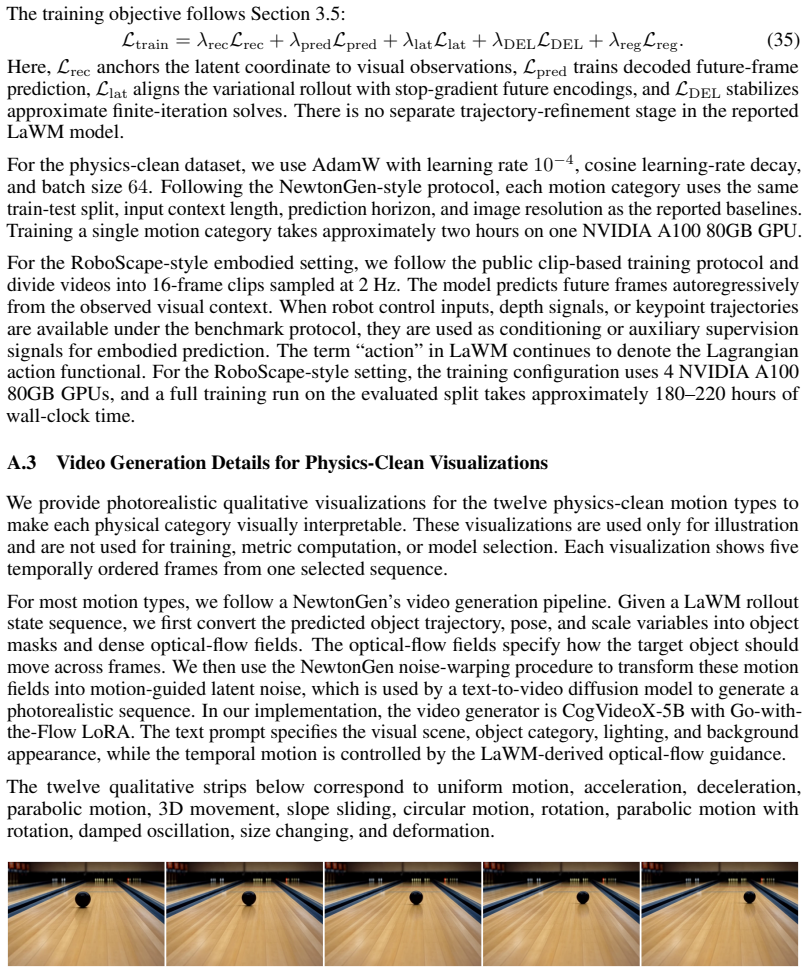
Yu Yuan, Xijun Wang, Tharindu Wickremasinghe, Zeeshan Nadir, Bole Ma, and Stanley H Chan. Newtongen: Physics-consistent and controllable text-to-video generation via neural newtonian dynamics.arXiv preprint arXiv:2509.21309, 2025. 11 A Additional Experimental Details A.1 Datasets Physics-clean dynamics.The physics-clean benchmark follows the NewtonGen-sty...
discussion (0)
Sign in with ORCID, Apple, or X to comment. Anyone can read and Pith papers without signing in.