Recognition: 2 theorem links
· Lean TheoremEmbodied Communication: Sensing-Induced Reliability Fields and Capacity Bounds
Pith reviewed 2026-05-12 03:28 UTC · model grok-4.3
The pith
Information can be sent by imprinting it on environmental states and recovering it via RF sensing without any dedicated transmitter or extra spectrum.
A machine-rendered reading of the paper's core claim, the machinery that carries it, and where it could break.
Core claim
Embodied communication imprints information onto environmental states that are recovered at the receiver by sensing rather than by receiving a transmitted waveform. Using a multi-snapshot RF model, the work derives a sensing-induced reliability field that quantifies pairwise distinguishability of physical states. This field converts codebook design into a packing problem on the state space. Achievable schemes are constructed with lattice codebooks and a closed-form hexagonal design under a main-lobe approximation; matching converses are obtained from information-theoretic and geometric arguments. The analysis further identifies an intrinsic sensing-duration tradeoff in which the number of RF
What carries the argument
The sensing-induced reliability field, a function of multi-snapshot RF measurements that quantifies how reliably any pair of physical states can be distinguished and thereby shapes the geometry of valid embodied codebooks.
If this is right
- Lattice codebooks achieve positive rates in the embodied channel for any fixed number of snapshots.
- A closed-form hexagonal codebook is optimal under the main-lobe approximation of the sensing response.
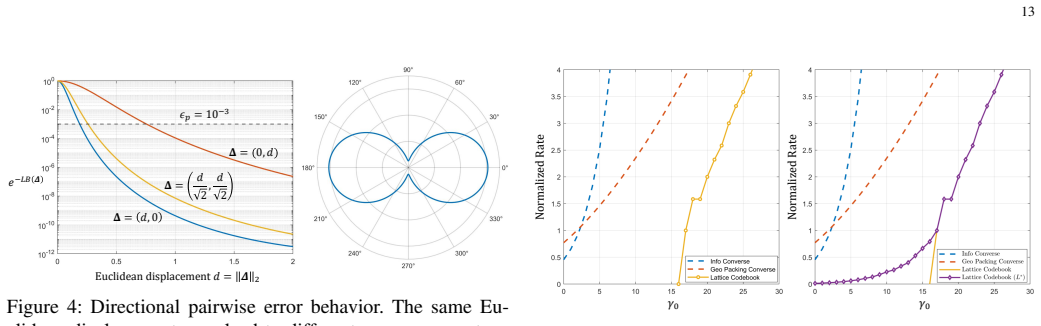
- Both information-theoretic and geometric upper bounds limit the finite-snapshot ε-capacity.
- Throughput is maximized at a finite sensing duration because additional snapshots improve reliability but increase symbol length.
Where Pith is reading between the lines
- Sensing hardware already deployed for radar or localization could support this form of communication as a secondary use without new spectrum allocation.
- Environments whose states are already controllable (e.g., smart buildings or reconfigurable surfaces) become potential low-power data links.
- Adaptive sensing-time control could be added to existing systems to track the optimal operating point as channel conditions change.
Load-bearing premise
That controllable physical states in the environment can be imprinted with information and then reliably distinguished from one another by multi-snapshot RF sensing without a dedicated transmitter being active.
What would settle it
An experiment that measures the actual pairwise error rates between a set of physically realizable states under increasing numbers of sensing snapshots and checks whether the observed rates fall inside or outside the derived hexagonal packing bound and the information-theoretic converse.
Figures


read the original abstract
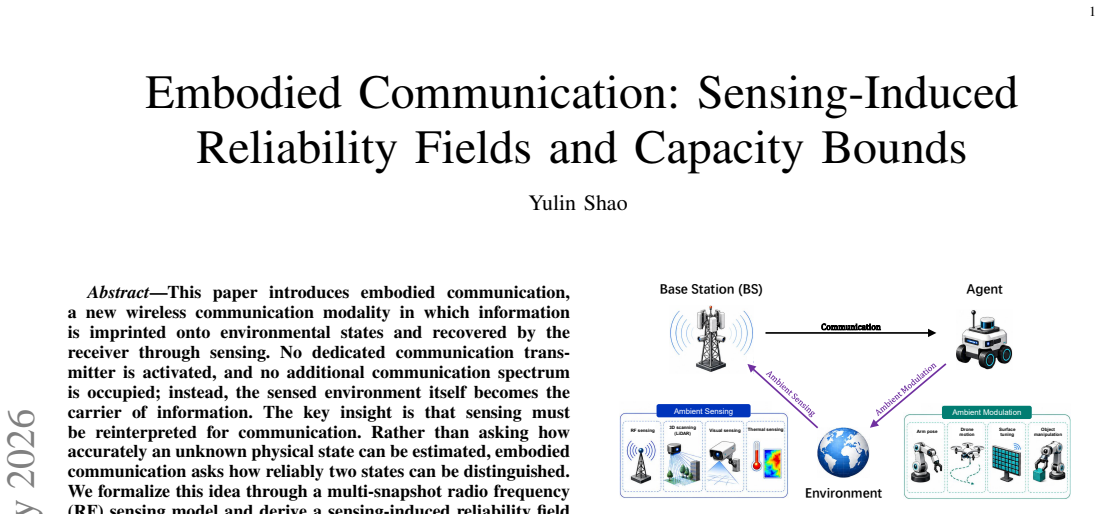
This paper introduces embodied communication, a new wireless communication modality in which information is imprinted onto environmental states and recovered by the receiver through sensing. No dedicated communication transmitter is activated, and no additional communication spectrum is occupied; instead, the sensed environment itself becomes the carrier of information. The key insight is that sensing must be reinterpreted for communication. Rather than asking how accurately an unknown physical state can be estimated, embodied communication asks how reliably two states can be distinguished. We formalize this idea through a multi-snapshot radio frequency (RF) sensing model and derive a sensing-induced reliability field that quantifies the distinguishability between physical states. This field turns embodied symbol design into a geometric packing problem shaped by the sensing resolution of the infrastructure. For this embodied channel, we characterize the finite-snapshot $\epsilon$-capacity through achievable designs and converses. We develop lattice-based codebooks, obtain a closed-form hexagonal design under a main-lobe approximation, and establish information-theoretic and geometric upper bounds. We further reveal an intrinsic sensing-duration tradeoff: more sensing snapshots improve reliability, but also lengthen each embodied symbol, leading to a finite optimal sensing time. These results expose a latent communication pathway in sensing-enabled infrastructure and show how the environment can be transformed from a passive backdrop into an active information carrier.
Editorial analysis
A structured set of objections, weighed in public.
Referee Report
Summary. The manuscript introduces embodied communication, a modality in which information is imprinted onto environmental physical states and recovered at the receiver exclusively through multi-snapshot RF sensing, without activating a dedicated transmitter or occupying additional spectrum. It derives a sensing-induced reliability field that quantifies distinguishability between states, recasting symbol design as a geometric packing problem governed by the sensing resolution. For the resulting embodied channel the finite-snapshot ε-capacity is characterized by lattice-based achievable schemes (including a closed-form hexagonal design under a main-lobe approximation) together with information-theoretic and geometric converses; an explicit sensing-duration versus reliability tradeoff is also identified, implying a finite optimal sensing interval.
Significance. If the derivations are correct, the work identifies a latent communication pathway within existing sensing infrastructure and supplies concrete geometric constructions and capacity bounds that could guide system design. The explicit tradeoff between number of snapshots and symbol duration is a practically relevant insight. The modeling is internally consistent and treats state imprinting as an exogenous physical configuration, avoiding circularity with active transmission.
major comments (2)
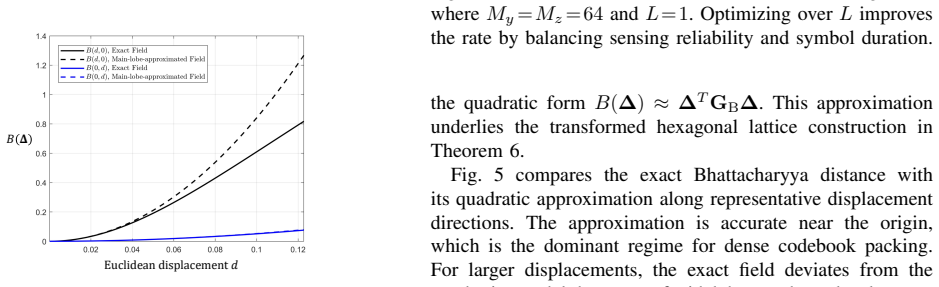
- The closed-form hexagonal lattice design is obtained under the main-lobe approximation; however, the manuscript does not supply explicit error bounds or a quantitative assessment of how the approximation error propagates into the achievable rate or the ε-capacity gap, which is load-bearing for the claimed optimality of the design.
- The information-theoretic and geometric upper bounds are stated separately; their relative tightness across regimes of snapshot count and reliability threshold is not compared analytically or numerically, leaving the strength of the converse unclear for the central capacity characterization.
minor comments (2)
- The reliability field is introduced as a distinguishability metric; a short comparison with conventional sensing metrics (e.g., CRLB or mutual information for estimation) would clarify its novelty and prevent reader confusion.
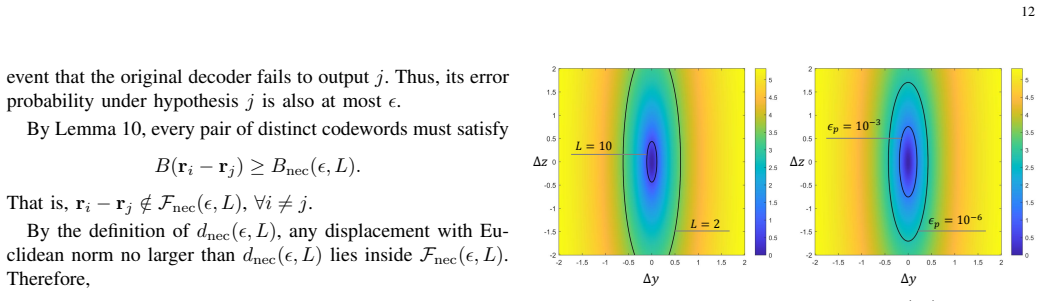
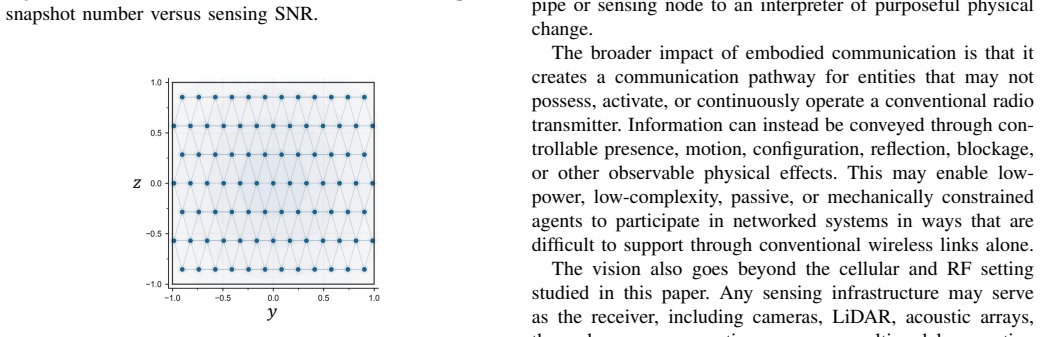
- Lattice packing illustrations would benefit from overlaying level sets of the reliability field to visually connect the geometric construction to the underlying distinguishability measure.
Simulated Author's Rebuttal
We thank the referee for the thorough review and constructive comments. We address each major comment below, indicating the revisions we will implement to strengthen the manuscript.
read point-by-point responses
-
Referee: The closed-form hexagonal lattice design is obtained under the main-lobe approximation; however, the manuscript does not supply explicit error bounds or a quantitative assessment of how the approximation error propagates into the achievable rate or the ε-capacity gap, which is load-bearing for the claimed optimality of the design.
Authors: We agree that an explicit assessment of the approximation error is necessary to substantiate the optimality claims. The main-lobe approximation is invoked to obtain a tractable closed-form hexagonal design, which is reasonable when the main lobe of the sensing kernel dominates for typical system parameters. In the revised version we will add an appendix deriving analytical bounds on the approximation error together with numerical evaluations that quantify the resulting gap in achievable rate and ε-capacity across ranges of snapshot counts and reliability thresholds, including direct comparisons to numerically optimized designs that use the exact kernel. revision: yes
-
Referee: The information-theoretic and geometric upper bounds are stated separately; their relative tightness across regimes of snapshot count and reliability threshold is not compared analytically or numerically, leaving the strength of the converse unclear for the central capacity characterization.
Authors: The information-theoretic converse follows from standard mutual-information arguments while the geometric converse exploits packing properties of the reliability field. To clarify their relative strength we will add a dedicated subsection providing both asymptotic analytical comparisons (e.g., large-snapshot regime) and numerical plots that overlay both bounds against the lattice achievable rate for varying snapshot counts and ε values. This will make the tightness of the overall converse explicit. revision: yes
Circularity Check
Derivation is self-contained with no circular steps
full rationale
The paper introduces embodied communication by reinterpreting multi-snapshot RF sensing as a distinguishability task, derives the reliability field directly from the sensing model equations, recasts symbol design as geometric packing induced by that field, and applies standard lattice constructions plus information-theoretic converses to bound the finite-snapshot ε-capacity. The sensing-duration tradeoff follows from the explicit dependence of reliability on snapshot count and symbol duration. All steps are internally generated from the proposed model without reduction to fitted inputs, self-referential definitions, or load-bearing self-citations; the framework remains self-contained against external benchmarks.
Axiom & Free-Parameter Ledger
axioms (1)
- domain assumption The multi-snapshot RF sensing model accurately represents the distinguishability of environmental states.
invented entities (2)
-
sensing-induced reliability field
no independent evidence
-
embodied channel
no independent evidence
Lean theorems connected to this paper
-
IndisputableMonolith/Foundation/AbsoluteFloorClosure.leanabsolute_floor_iff_bare_distinguishability echoessensing-induced reliability field B(Δ) ... Bhattacharyya distance ... lattice-based codebooks, closed-form hexagonal design ... sensing-duration tradeoff
-
IndisputableMonolith/Cost/FunctionalEquation.leanwashburn_uniqueness_aczel unclearpairwise embodied sensing exponent Bij = log[(1+γ0/2)^2 − (γ0²/4)ηij]/(1+γ0)
Reference graph
Works this paper leans on
-
[1]
Integrated sensing and communications: Toward dual-functional wire- less networks for 6G and beyond,
F. Liu, Y . Cui, C. Masouros, J. Xu, T. X. Han, Y . C. Eldar, and S. Buzzi, “Integrated sensing and communications: Toward dual-functional wire- less networks for 6G and beyond,”IEEE Journal on Selected Areas in Communications, vol. 40, no. 6, pp. 1728–1767, 2022
work page 2022
-
[2]
A survey on fundamental limits of integrated sensing and communication,
A. Liu, Z. Huang, M. Li, Y . Wan, W. Li, T. X. Han, C. Liu, R. Du, D. K. P. Tan, J. Luet al., “A survey on fundamental limits of integrated sensing and communication,”IEEE Communications Surveys & Tutorials, vol. 24, no. 2, pp. 994–1034, 2022
work page 2022
-
[3]
Computer vision aided mmWave beam alignment in V2X communications,
W. Xu, F. Gao, X. Tao, J. Zhang, and A. Alkhateeb, “Computer vision aided mmWave beam alignment in V2X communications,”IEEE Trans. Wireless Commun., vol. 22, no. 4, pp. 2699–2714, 2022
work page 2022
-
[4]
Optical integrated sensing and communication with light-emitting diode,
R. Zhang, Y . Shao, M. Li, L. Lu, and Y . C. Eldar, “Optical integrated sensing and communication with light-emitting diode,”IEEE Internet of Things Journal, vol. 12, no. 9, pp. 12 896–12 911, 2024
work page 2024
-
[5]
Y . Shao, C. Bian, L. Yang, Q. Yang, Z. Zhang, and D. Gunduz, “Point cloud in the air,”IEEE Communications Magazine, 2025
work page 2025
-
[6]
Over-the-air learning-based geometry point cloud transmission,
C. Bian, Y . Shao, and D. G¨und¨uz, “Over-the-air learning-based geometry point cloud transmission,”IEEE Journal on Selected Areas in Commu- nications, vol. 43, no. 12, pp. 4042–4058, 2025
work page 2025
-
[7]
Radar-assisted predictive beamforming for vehicular links: Communication served by sensing,
F. Liu, W. Yuan, C. Masouros, and J. Yuan, “Radar-assisted predictive beamforming for vehicular links: Communication served by sensing,” IEEE Trans. Wireless Commun., vol. 19, no. 11, pp. 7704–7719, 2020
work page 2020
-
[8]
Learning site-specific probing beams for fast mmWave beam alignment,
Y . Heng, J. Mo, and J. G. Andrews, “Learning site-specific probing beams for fast mmWave beam alignment,”IEEE Transactions on Wire- less Communications, vol. 21, no. 8, pp. 5785–5800, 2022
work page 2022
-
[9]
Vehicular ad hoc networks: A new challenge for localization-based systems,
A. Boukerche, H. A. Oliveira, E. F. Nakamura, and A. A. Loureiro, “Vehicular ad hoc networks: A new challenge for localization-based systems,”Computer Commun., vol. 31, no. 12, pp. 2838–2849, 2008
work page 2008
-
[10]
Spotfi: Decimeter level localization using wifi,
M. Kotaru, K. Joshi, D. Bharadia, and S. Katti, “Spotfi: Decimeter level localization using wifi,” inACM SIGCOMM, 2015, pp. 269–282
work page 2015
-
[11]
Federated edge learning with misaligned over-the-air computation,
Y . Shao, D. G ¨und¨uz, and S. C. Liew, “Federated edge learning with misaligned over-the-air computation,”IEEE Transactions on Wireless Communications, vol. 21, no. 6, pp. 3951–3964, 2021. 15
work page 2021
-
[12]
Habitat: A platform for embodied AI research,
M. Savva, A. Kadian, O. Maksymets, Y . Zhao, E. Wijmans, B. Jain, J. Straub, J. Liu, V . Koltun, J. Maliket al., “Habitat: A platform for embodied AI research,” inIEEE/CVF International Conference on Computer Vision, 2019, pp. 9339–9347
work page 2019
-
[13]
Embodied Artificial Intelligence,
R. Chrisley, “Embodied Artificial Intelligence,”Artificial intelligence, vol. 149, no. 1, pp. 131–150, 2003
work page 2003
-
[14]
A theory of semantic communication,
Y . Shao, Q. Cao, and D. G¨und¨uz, “A theory of semantic communication,” IEEE Transactions on Mobile Computing, vol. 23, no. 12, pp. 12 211– 12 228, 2024
work page 2024
- [15]
- [16]
-
[17]
High-resolution radar via compressed sensing,
M. A. Herman and T. Strohmer, “High-resolution radar via compressed sensing,”IEEE Transactions on Signal Processing, vol. 57, no. 6, pp. 2275–2284, 2009
work page 2009
-
[18]
Statistical signal processing: estimation theory,
S. M. Kay, “Statistical signal processing: estimation theory,”Prentice Hall, vol. 1, pp. Chapter–3, 1993
work page 1993
-
[19]
Statistical resolution limits and the complexified Cramer- Rao bound,
S. T. Smith, “Statistical resolution limits and the complexified Cramer- Rao bound,”IEEE Transactions on Signal Processing, vol. 53, no. 5, pp. 1597–1609, 2005
work page 2005
-
[20]
Channel coding rate in the finite blocklength regime,
Y . Polyanskiy, H. V . Poor, and S. Verd ´u, “Channel coding rate in the finite blocklength regime,”IEEE Transactions on Information Theory, vol. 56, no. 5, pp. 2307–2359, 2010
work page 2010
-
[21]
The divergence and Bhattacharyya distance measures in signal selection,
T. Kailath, “The divergence and Bhattacharyya distance measures in signal selection,”IEEE Transactions on Communication Technology, vol. 15, no. 1, pp. 52–60, 1967
work page 1967
-
[22]
R. Zamir,Lattice coding for signals and networks: A structured coding approach to quantization, modulation, and multiuser information theory. Cambridge University Press, 2014
work page 2014
-
[23]
T. M. Cover,Elements of information theory. John Wiley & Sons, 1999
work page 1999
-
[24]
Accurate Minkowski sum approxima- tion of polyhedral models,
G. Varadhan and D. Manocha, “Accurate Minkowski sum approxima- tion of polyhedral models,” inIEEE Pacific Conference on Computer Graphics and Applications, 2004, pp. 392–401
work page 2004
discussion (0)
Sign in with ORCID, Apple, or X to comment. Anyone can read and Pith papers without signing in.