Recognition: 2 theorem links
· Lean TheoremExactness Matters for Physical Rule Enforcement
Pith reviewed 2026-05-12 03:18 UTC · model grok-4.3
The pith
Exact physical constraint enforcement improves forecasts only when the repair operator exactly matches the target manifold.
A machine-rendered reading of the paper's core claim, the machinery that carries it, and where it could break.
Core claim
Autoregressive scientific forecasters enforce constraints by repairing each predicted state before feeding it back. When the repair map is the identity on the target manifold and aligned with target geometry, rollout accuracy improves, as in periodic NS-128 where Fourier projection lowers final-step MSE at horizon 100 from (9.390 ± 6.290)×10^{-5} to (5.370 ± 0.113)×10^{-7}. Without an exact projection, approximate Poisson-based cleanup can lower divergence while raising rollout error; target-distortion MSE forecasts this harm better than linear-system residual. Exact forecast reconciliation remains a stable baseline, whereas blended top-down repair is dataset-dependent. Constraint therefore,
What carries the argument
operator exactness, defined as the property that the repair map is the identity on the target manifold and aligned with the target geometry
If this is right
- In periodic NS-128, post-hoc and in-loop Fourier projection reduce final-step rollout MSE by roughly two orders of magnitude at horizon 100.
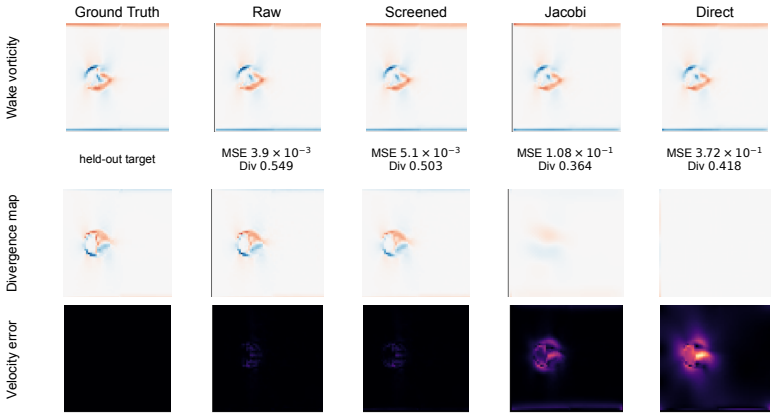
- Across cavity, tube, dam, and cylinder flows, stronger Poisson cleanup reduces divergence yet can increase rollout error.
- Target-distortion MSE predicts harm from approximate repairs better than linear-system residual.
- Controlled mismatch, screened cleanup, and adaptive gating experiments identify raw or near-identity forecasts as optimal in approximate regimes.
- Hierarchical forecasting reproduces the pattern: exact reconciliation is stable while blended top-down repair varies with the dataset.
Where Pith is reading between the lines
- The results imply that any new physical simulator should first test whether an exact projection operator exists before adding repair steps.
- Adaptive gating keyed to alignment diagnostics could be extended to other time-varying physical domains.
- Similar exactness checks may matter for constraint methods outside forecasting, such as physics-informed networks or optimization layers.
Load-bearing premise
The chosen benchmarks of periodic Navier-Stokes, CFDBench cavity/tube/dam/cylinder flows, and the hierarchical task are representative enough for the exact-versus-approximate distinction to generalize.
What would settle it
A new physical forecasting task in which increasing the strength of an approximate boundary-preserving repair consistently lowers rollout error without added distortion would falsify the alignment-over-strength conclusion.
Figures




read the original abstract
Autoregressive scientific forecasters often enforce physical or structural constraints by repairing each predicted state before feeding it back into the model. However, it remains unclear when stronger physical rule enforcement becomes reliable and when it becomes a source of distribution shift. We study this question through operator exactness, meaning whether the repair map is the identity on the target manifold and is aligned with the target geometry. We compare raw forecasting, post hoc repair, and in-loop repair across periodic incompressible Navier--Stokes, non-periodic CFDBench flows, and a hierarchical-forecasting support task. In the exact periodic regime, Fourier projection substantially improves rollout accuracy. On the NS-128 benchmark, a strong Raw-FNO has a final-step rollout MSE at horizon 100 of $(9.390 \pm 6.290)\times 10^{-5}$, and post hoc and in-loop projection reduce it to $(1.130 \pm 0.165)\times 10^{-6}$ and $(5.370 \pm 0.113)\times 10^{-7}$. However, once an exact projection is unavailable and only approximate boundary-preserving cleanup is available, the ordering changes. Across cavity, tube, dam, and cylinder flow, stronger Poisson-based cleanup can reduce divergence while worsening rollout error; target-distortion MSE predicts this harm far better than a linear-system residual. Controlled mismatch, screened cleanup, adaptive gating, and external-backbone checks show that the best approximate-regime operating point can be raw or near-identity. Hierarchical forecasting gives the same broader pattern. Exact forecast reconciliation is a stable baseline, whereas blended top-down repair, a validation-tuned interpolation toward historical-proportion top-down reconciliation, is dataset-dependent. Thus, constraint enforcement should be benchmarked by operator--data alignment before enforcement strength.
Editorial analysis
A structured set of objections, weighed in public.
Referee Report
Summary. The manuscript examines when physical or structural constraint enforcement via state repair in autoregressive scientific forecasters improves versus harms rollout accuracy. It focuses on operator exactness (whether the repair is the identity on the target manifold and geometrically aligned with the data) and compares raw forecasting, post-hoc repair, and in-loop repair on periodic incompressible Navier-Stokes (NS-128), non-periodic CFDBench flows (cavity/tube/dam/cylinder), and a hierarchical forecasting task. Key findings: exact Fourier projection reduces final-step MSE on NS-128 from (9.390 ± 6.290)×10^{-5} to (5.370 ± 0.113)×10^{-7}; approximate Poisson cleanup can lower divergence yet increase error, with target-distortion MSE predicting harm better than residual; exact reconciliation is stable while blended top-down repair is dataset-dependent. The conclusion is that alignment must be benchmarked before enforcement strength.
Significance. If the empirical patterns hold, the work offers timely guidance for physics-informed ML forecasting by identifying risks of distribution shift from inexact repairs and advocating controlled benchmarking of operators. Strengths include concrete quantitative results with error bars on NS-128, controlled mismatch/gating experiments, and consistent patterns across exact and approximate regimes that support the alignment hypothesis over raw enforcement strength.
major comments (3)
- [Abstract and §4] Abstract and §4 (CFDBench results): the central claim that approximate Poisson cleanup worsens rollout error (despite lowering divergence) on cavity/tube/dam/cylinder flows is load-bearing, yet only qualitative reversals are described; unlike the NS-128 quantitative table with ± values, no MSE numbers, error bars, or per-flow breakdowns are provided, preventing assessment of effect size and statistical reliability.
- [§5 and Discussion] §5 (hierarchical task) and Discussion: the assertion that 'exact forecast reconciliation is a stable baseline, whereas blended top-down repair is dataset-dependent' underpins the final recommendation, but the manuscript does not report the precise form of the validation-tuned interpolation, the historical-proportion baseline, or cross-validation splits, leaving the dataset-dependence claim difficult to reproduce or falsify.
- [Conclusion] Conclusion: the prescriptive claim that 'constraint enforcement should be benchmarked by operator-data alignment before enforcement strength' is the paper's main takeaway, but all evidence is restricted to divergence-free enforcement in incompressible flows and hierarchical proportion reconciliation; no results appear for other constraint families (positivity, energy, graph structure) or geometries, so the exact/approximate distinction may not generalize beyond the tested periodic vs. non-periodic boundary cases.
minor comments (2)
- [Abstract] Abstract: define 'target-distortion MSE' explicitly (how it is computed from the target manifold) since it is invoked as the superior predictor of harm but is not formalized in the summary.
- [Methods] Methods: supply full details on FNO architecture, training hyperparameters, data splits, and Poisson solver implementation (including boundary handling) to support the reported NS-128 numbers and CFDBench qualitative claims.
Simulated Author's Rebuttal
We thank the referee for the constructive feedback, which highlights opportunities to strengthen the quantitative support and clarify the scope of our claims. We address each major comment below.
read point-by-point responses
-
Referee: [Abstract and §4] Abstract and §4 (CFDBench results): the central claim that approximate Poisson cleanup worsens rollout error (despite lowering divergence) on cavity/tube/dam/cylinder flows is load-bearing, yet only qualitative reversals are described; unlike the NS-128 quantitative table with ± values, no MSE numbers, error bars, or per-flow breakdowns are provided, preventing assessment of effect size and statistical reliability.
Authors: We agree that quantitative details with error bars are necessary to evaluate effect sizes reliably. In the revised manuscript we will add a table in §4 (and reference it in the abstract) that reports final-step MSE with standard deviations for raw forecasting, post-hoc Poisson cleanup, and in-loop Poisson cleanup, broken down individually for the cavity, tube, dam, and cylinder flows. This will mirror the NS-128 presentation and allow direct assessment of the reported error increases. revision: yes
-
Referee: [§5 and Discussion] §5 (hierarchical task) and Discussion: the assertion that 'exact forecast reconciliation is a stable baseline, whereas blended top-down repair is dataset-dependent' underpins the final recommendation, but the manuscript does not report the precise form of the validation-tuned interpolation, the historical-proportion baseline, or cross-validation splits, leaving the dataset-dependence claim difficult to reproduce or falsify.
Authors: We will supply the missing implementation details in the revised §5 and appendix. The validation-tuned interpolation is defined as the convex combination λ·exact_reconciliation + (1-λ)·top-down_reconciliation, with λ chosen by grid search on a held-out validation set to minimize rollout MSE. The historical-proportion baseline computes top-down reconciliation using the mean category proportions observed across the entire training set. Cross-validation uses 5-fold temporal splits that preserve sequence order and prevent leakage. These additions will make the dataset-dependence results fully reproducible. revision: yes
-
Referee: [Conclusion] Conclusion: the prescriptive claim that 'constraint enforcement should be benchmarked by operator-data alignment before enforcement strength' is the paper's main takeaway, but all evidence is restricted to divergence-free enforcement in incompressible flows and hierarchical proportion reconciliation; no results appear for other constraint families (positivity, energy, graph structure) or geometries, so the exact/approximate distinction may not generalize beyond the tested periodic vs. non-periodic boundary cases.
Authors: We acknowledge that the empirical support is confined to divergence-free constraints on fluid flows and hierarchical reconciliation. The core hypothesis concerns operator exactness (identity on the target manifold plus geometric alignment), which we demonstrate produces consistent patterns in the tested regimes. In the revision we will qualify the conclusion to state the current scope explicitly and note that the same alignment principle should be tested on other families (e.g., positivity or graph constraints) before broad prescriptive use. We will add a short discussion paragraph outlining how the exact/approximate distinction could be examined in those settings without claiming universality from the present results. revision: partial
Circularity Check
No circularity; empirical benchmark comparisons are self-contained
full rationale
The paper reports direct experimental comparisons of forecasting methods (raw, post-hoc repair, in-loop repair) on fixed benchmarks including periodic Navier-Stokes, CFDBench flows, and hierarchical reconciliation. Results are quantified via rollout MSE values and divergence metrics without any derivation steps that reduce to self-defined quantities, fitted parameters renamed as predictions, or load-bearing self-citations. The conclusion that operator-data alignment should be benchmarked before enforcement strength follows from observed patterns across the tested cases rather than tautological definitions or imported uniqueness claims. No equations or ansatzes are presented that collapse by construction to the inputs.
Axiom & Free-Parameter Ledger
axioms (1)
- domain assumption The selected flow benchmarks are representative of broader physical forecasting scenarios
Lean theorems connected to this paper
-
IndisputableMonolith/Cost/FunctionalEquation.leanwashburn_uniqueness_aczel unclearWe study this question through operator exactness, meaning whether the repair map is the identity on the target manifold and is aligned with the target geometry.
-
IndisputableMonolith/Foundation/ArithmeticFromLogic.leanLogicNat recovery unclearExact forecast reconciliation is a stable baseline, whereas blended top-down repair... is dataset-dependent.
Reference graph
Works this paper leans on
-
[1]
Rong An. Error Analysis of a New Fractional-Step Method for the Incompressible Navier-Stokes Equations with Variable Density.J. Sci. Comput., 84(1):3, 2020
work page 2020
-
[2]
George Athanasopoulos, Roman A Ahmed, and Rob J Hyndman. Hierarchical forecasts for Australian domestic tourism.International Journal of Forecasting, 25(1):146–166, 2009
work page 2009
-
[3]
Forecast reconciliation: A review.International Journal of Forecasting, 40(2):430–456, 2024
George Athanasopoulos, Rob J Hyndman, Nikolaos Kourentzes, and Anastasios Panagiotelis. Forecast reconciliation: A review.International Journal of Forecasting, 40(2):430–456, 2024
work page 2024
-
[4]
John B Bell, Phillip Colella, and Harland M Glaz. A second-order projection method for the incompressible Navier-Stokes equations.Journal of computational physics, 85(2):257–283, 1989
work page 1989
-
[5]
The Helmholtz- Hodge Decomposition - A Survey.IEEE Trans
Harsh Bhatia, Gregory Norgard, Valerio Pascucci, and Peer-Timo Bremer. The Helmholtz- Hodge Decomposition - A Survey.IEEE Trans. Vis. Comput. Graph., 19(8):1386–1404, 2013
work page 2013
-
[6]
Johannes Brandstetter, Daniel E. Worrall, and Max Welling. Message Passing Neural PDE Solvers. InICLR, 2022
work page 2022
-
[7]
David L Brown, Ricardo Cortez, and Michael L Minion. Accurate projection methods for the incompressible Navier–Stokes equations.Journal of computational physics, 168(2):464–499, 2001
work page 2001
-
[8]
Learning Phrase Representations using RNN Encoder- Decoder for Statistical Machine Translation
Kyunghyun Cho, Bart van Merrienboer, Çaglar Gülçehre, Dzmitry Bahdanau, Fethi Bougares, Holger Schwenk, and Yoshua Bengio. Learning Phrase Representations using RNN Encoder- Decoder for Statistical Machine Translation. InEMNLP, pages 1724–1734, 2014
work page 2014
-
[9]
Numerical solution of the Navier-Stokes equations.Mathematics of computation, 22(104):745–762, 1968
Alexandre Joel Chorin. Numerical solution of the Navier-Stokes equations.Mathematics of computation, 22(104):745–762, 1968
work page 1968
-
[10]
Filipe de Avila Belbute-Peres, Thomas D. Economon, and J. Zico Kolter. Combining Differ- entiable PDE Solvers and Graph Neural Networks for Fluid Flow Prediction. InICML, pages 2402–2411, 2020
work page 2020
-
[11]
Selective Classification for Deep Neural Networks
Yonatan Geifman and Ran El-Yaniv. Selective Classification for Deep Neural Networks. In NIPS, pages 4878–4887, 2017
work page 2017
-
[12]
Modeling the dynamics of PDE systems with physics- constrained deep auto-regressive networks.J
Nicholas Geneva and Nicholas Zabaras. Modeling the dynamics of PDE systems with physics- constrained deep auto-regressive networks.J. Comput. Phys., 403, 2020
work page 2020
-
[13]
Charles W Gross and Jeffrey E Sohl. Disaggregation methods to expedite product line forecast- ing.Journal of forecasting, 9(3):233–254, 1990
work page 1990
-
[14]
Jean-Luc Guermond, Peter Minev, and Jie Shen. An overview of projection methods for incompressible flows.Computer methods in applied mechanics and engineering, 195(44-47): 6011–6045, 2006
work page 2006
-
[15]
Simultaneously Reconciled Quantile Forecasting of Hierarchically Related Time Series
Xing Han, Sambarta Dasgupta, and Joydeep Ghosh. Simultaneously Reconciled Quantile Forecasting of Hierarchically Related Time Series. InAISTATS, pages 190–198, 2021
work page 2021
-
[16]
Rob J. Hyndman, Roman A. Ahmed, George Athanasopoulos, and Han Lin Shang. Optimal combination forecasts for hierarchical time series.Comput. Stat. Data Anal., 55(9):2579–2589, 2011
work page 2011
-
[17]
Xiaowei Jin, Shengze Cai, Hui Li, and George Em Karniadakis. NSFnets (Navier-Stokes flow nets): Physics-informed neural networks for the incompressible Navier-Stokes equations.J. Comput. Phys., 426:109951, 2021
work page 2021
-
[18]
Harshavardhan Kamarthi, Lingkai Kong, Alexander Rodríguez, Chao Zhang, and B. Aditya Prakash. When Rigidity Hurts: Soft Consistency Regularization for Probabilistic Hierarchical Time Series Forecasting. InKDD, pages 1057–1072, 2023. 10
work page 2023
-
[19]
Azevedo, Nils Thuerey, Theodore Kim, Markus H
Byungsoo Kim, Vinicius C. Azevedo, Nils Thuerey, Theodore Kim, Markus H. Gross, and Barbara Solenthaler. Deep Fluids: A Generative Network for Parameterized Fluid Simulations. Comput. Graph. Forum, 38(2):59–70, 2019
work page 2019
-
[20]
John Kim and Parviz Moin. Application of a fractional-step method to incompressible Navier- Stokes equations.Journal of computational physics, 59(2):308–323, 1985
work page 1985
-
[21]
Dmitrii Kochkov, Jamie A Smith, Ayya Alieva, Qing Wang, Michael P Brenner, and Stephan Hoyer. Machine learning–accelerated computational fluid dynamics.Proceedings of the National Academy of Sciences, 118(21):e2101784118, 2021
work page 2021
-
[22]
APEBench: A Benchmark for Autoregressive Neural Emulators of PDEs
Felix Koehler, Simon Niedermayr, Rüdiger Westermann, and Nils Thuerey. APEBench: A Benchmark for Autoregressive Neural Emulators of PDEs. InNeurIPS, 2024
work page 2024
-
[23]
Zongyi Li, Nikola Borislavov Kovachki, Kamyar Azizzadenesheli, Burigede Liu, Kaushik Bhattacharya, Andrew M. Stuart, and Anima Anandkumar. Fourier Neural Operator for Parametric Partial Differential Equations. InICLR, 2021
work page 2021
-
[24]
arXiv preprint arXiv:2111.03794 , year =
Zongyi Li, Hongkai Zheng, Nikola B. Kovachki, David Jin, Haoxuan Chen, Burigede Liu, Kamyar Azizzadenesheli, and Anima Anandkumar. Physics-Informed Neural Operator for Learning Partial Differential Equations.CoRR, abs/2111.03794, 2021
-
[25]
Turner, and Johannes Brandstetter
Phillip Lippe, Bas Veeling, Paris Perdikaris, Richard E. Turner, and Johannes Brandstetter. PDE-Refiner: Achieving Accurate Long Rollouts with Neural PDE Solvers. InNeurIPS, 2023
work page 2023
-
[26]
Learning nonlinear operators via DeepONet based on the universal approximation theorem of operators
Lu Lu, Pengzhan Jin, Guofei Pang, Zhongqiang Zhang, and George Em Karniadakis. Learning nonlinear operators via DeepONet based on the universal approximation theorem of operators. Nat. Mach. Intell., 3(3):218–229, 2021
work page 2021
-
[27]
Yining Luo, Yingfa Chen, and Zhen Zhang. CFDBench: A large-scale benchmark for machine learning methods in fluid dynamics.arXiv preprint arXiv:2310.05963, 2023
-
[28]
Olivares, Federico Garza, David Luo, Cristian Challu, Max Mergenthaler, and Artur Dubrawski
Kin G. Olivares, Federico Garza, David Luo, Cristian Challu, Max Mergenthaler, and Artur Dubrawski. HierarchicalForecast: A Reference Framework for Hierarchical Forecasting in Python.CoRR, abs/2207.03517, 2022
-
[29]
Anastasios Panagiotelis, George Athanasopoulos, Puwasala Gamakumara, and Rob J Hyndman. Forecast reconciliation: A geometric view with new insights on bias correction.International Journal of Forecasting, 37(1):343–359, 2021
work page 2021
- [30]
-
[31]
Maziar Raissi, Paris Perdikaris, and George E. Karniadakis. Physics-informed neural networks: A deep learning framework for solving forward and inverse problems involving nonlinear partial differential equations.J. Comput. Phys., 378:686–707, 2019
work page 2019
-
[32]
Werner, Konstantinos Benidis, Pedro Mercado, Jan Gasthaus, and Tim Januschowski
Syama Sundar Rangapuram, Lucien D. Werner, Konstantinos Benidis, Pedro Mercado, Jan Gasthaus, and Tim Januschowski. End-to-End Learning of Coherent Probabilistic Forecasts for Hierarchical Time Series. InICML, pages 8832–8843, 2021
work page 2021
-
[33]
Coherent Probabilistic Forecast- ing of Temporal Hierarchies
Syama Sundar Rangapuram, Shubham Kapoor, Rajbir-Singh Nirwan, Pedro Mercado, Tim Januschowski, Yuyang Wang, and Michael Bohlke-Schneider. Coherent Probabilistic Forecast- ing of Temporal Hierarchies. InAISTATS, pages 9362–9376, 2023
work page 2023
-
[34]
U-Net: Convolutional Networks for Biomedical Image Segmentation
Olaf Ronneberger, Philipp Fischer, and Thomas Brox. U-Net: Convolutional Networks for Biomedical Image Segmentation. InMICCAI (3), pages 234–241, 2015
work page 2015
- [35]
- [36]
-
[37]
SPNets: Differentiable Fluid Dynamics for Deep Neural Networks
Connor Schenck and Dieter Fox. SPNets: Differentiable Fluid Dynamics for Deep Neural Networks. InCoRL, pages 317–335, 2018
work page 2018
-
[38]
Stachenfeld, Drummond Buschman Fielding, Dmitrii Kochkov, Miles D
Kimberly L. Stachenfeld, Drummond Buschman Fielding, Dmitrii Kochkov, Miles D. Cranmer, Tobias Pfaff, Jonathan Godwin, Can Cui, Shirley Ho, Peter W. Battaglia, and Alvaro Sanchez- Gonzalez. Learned Simulators for Turbulence. InICLR, 2022
work page 2022
-
[39]
Souhaib Ben Taieb, James W. Taylor, and Rob J. Hyndman. Coherent Probabilistic Forecasts for Hierarchical Time Series. InICML, pages 3348–3357, 2017
work page 2017
-
[40]
Roger Temam. Sur l’approximation de la solution des équations de Navier-Stokes par la méthode des pas fractionnaires (I).Archive for Rational Mechanics and Analysis, 32(2):135–153, 1969
work page 1969
-
[41]
Accelerating Eulerian Fluid Simulation With Convolutional Networks
Jonathan Tompson, Kristofer Schlachter, Pablo Sprechmann, and Ken Perlin. Accelerating Eulerian Fluid Simulation With Convolutional Networks. InICML, pages 3424–3433, 2017
work page 2017
-
[42]
Learning Optimal Projection for Forecast Reconciliation of Hierarchical Time Series
Asterios Tsiourvas, Wei Sun, Georgia Perakis, Pin-Yu Chen, and Yada Zhu. Learning Optimal Projection for Forecast Reconciliation of Hierarchical Time Series. InICML, pages 48713– 48727, 2024
work page 2024
-
[43]
""Project periodic 2D velocity fields onto the divergence-free subspace
Shanika L Wickramasuriya, George Athanasopoulos, and Rob J Hyndman. Optimal forecast reconciliation for hierarchical and grouped time series through trace minimization.Journal of the American Statistical Association, 114(526):804–819, 2019. Appendix Table of Contents A Theoretical Analysis 13 B Exact Periodic Projection Code 17 C Forecasting Variant Detai...
work page 2019
discussion (0)
Sign in with ORCID, Apple, or X to comment. Anyone can read and Pith papers without signing in.