Recognition: 2 theorem links
· Lean TheoremDiagnosing Spectral Ceilings in Equivariant Neural Force Fields
Pith reviewed 2026-05-12 03:05 UTC · model grok-4.3
The pith
Equivariant neural force fields preserve angular frequencies only up to a multiple of their layer degree.
A machine-rendered reading of the paper's core claim, the machinery that carries it, and where it could break.
Core claim
On aspirin, a quadratic SPN attached to an L = 2 NequIP backbone recovers the boundary signal at l = 4 but collapses at l = 5: a 11.7x cliff at the predicted drL boundary, with p dropping from 0.913 to 0.078. The same boundary-vs-above contrast persists across n = 4 independently trained backbones and is corroborated by a denominator-free injected-residual metric. A finite-degree span theorem calibrates the diagnostic by showing that degree-d polynomials of degree-L spherical-harmonic features span exactly H ≤ dL with multiplicity-one saturation at the boundary, scoped to single-direction probes.
What carries the argument
The spectral-injection diagnostic that attaches a lightweight quadratic Spectral Prediction Network to the frozen equivariant backbone to measure recoverable angular frequencies, calibrated by the finite-degree span theorem.
If this is right
- The equivariant backbone cannot represent or preserve angular force components with frequencies above the dL boundary.
- The spectral ceiling scales directly with the product of polynomial degree d and layer degree L.
- This limit is consistent across independently trained models and different architectures.
- The ceiling is not an artifact of insufficient model capacity but a structural property.
Where Pith is reading between the lines
- Models aiming for higher accuracy in capturing fine molecular interactions may require increasing L or incorporating higher-degree polynomial expansions.
- The diagnostic could be used to benchmark and improve future equivariant architectures for better frequency coverage.
- In molecular simulations, this may lead to systematic errors in predicting high-frequency dynamics or rare events.
- Generalizing the single-direction span theorem to full multi-atom interactions could provide tighter bounds on model expressivity.
Load-bearing premise
That the lightweight quadratic SPN attached to the frozen backbone isolates and accurately measures only the frequencies preserved by the backbone without the SPN's own training dynamics or capacity introducing bias, and that the single-direction finite-degree span theorem extends meaningfully to the full multi-atom molecular setting.
What would settle it
Applying the diagnostic to an L=3 backbone and finding recovery up to l=6 but not l=7 would support the scaling of the spectral ceiling with dL.
Figures


read the original abstract
We introduce a spectral-injection diagnostic for measuring which angular frequencies a trained equivariant force-field backbone preserves: inject a controlled angular-frequency perturbation into a molecular force field, attach a lightweight Spectral Prediction Network (SPN) to the frozen backbone, and read off which frequencies are recoverable. On aspirin, a quadratic SPN attached to an L = 2 NequIP backbone recovers the boundary signal at l = 4 but collapses at l = 5: a 11.7x cliff at the predicted drL boundary, with p dropping from 0.913 to 0.078. The same boundary-vs-above contrast persists across n = 4 independently trained backbones (raw-gain delta contrast, hierarchical cluster bootstrap) and is corroborated by a denominator-free injected-residual metric (R2_inj(4) = 0.374 versus R2_inj(5) = 0.006). A finite-degree span theorem calibrates the diagnostic: for a single marked direction, degree-d polynomials of degree-L spherical-harmonic features span exactly H less than or equal to dL with multiplicity-one saturation at the boundary (scoped to single-direction degree-bounded probes, not a function-class upper bound on multi-atom MPNNs). A synthetic C5 calibration plus capacity, activation, and cross-architecture controls rule out parameter count alone as the explanation.
Editorial analysis
A structured set of objections, weighed in public.
Referee Report
Summary. The paper introduces a spectral-injection diagnostic for equivariant neural force fields: a controlled angular-frequency perturbation is injected into a molecular system, a lightweight quadratic Spectral Prediction Network (SPN) is attached to the frozen backbone, and recoverability of specific frequencies is measured via signal strength and an injected-residual R² metric. On aspirin with an L=2 NequIP backbone, the method recovers the boundary signal at l=4 but shows collapse at l=5 (11.7x drop, p from 0.913 to 0.078), replicated across four backbones with bootstrap statistics; this is calibrated by a finite-degree span theorem (degree-d polynomials of degree-L spherical harmonics span H ≤ dL with saturation at the boundary) and supported by synthetic C5 controls plus capacity/activation/architecture ablations.
Significance. If the diagnostic holds, it supplies a practical, quantitative tool for identifying spectral ceilings in equivariant architectures used for force fields, which could guide improvements in expressivity without increasing L. Strengths include the denominator-free R²_inj metric, replication across independent backbones, and explicit scoping of the theorem; the synthetic calibration helps rule out trivial capacity explanations.
major comments (2)
- [Finite-degree span theorem and aspirin experiments] The finite-degree span theorem is explicitly scoped to single marked directions and degree-bounded probes (as stated in the abstract). The aspirin results involve multi-atom graphs, varying interatomic directions, and message-passing aggregation inside the frozen backbone; no derivation or control is shown demonstrating that the exact H ≤ dL span property (with multiplicity-one saturation) survives this aggregation, which is load-bearing for interpreting the l=4/5 cliff and R²_inj(4)=0.374 vs R²_inj(5)=0.006 contrast as direct evidence of the backbone's preserved frequencies.
- [Methods (SPN attachment and training)] The SPN is trained on backbone outputs, introducing potential dependence. While the paper employs a denominator-free injected-residual metric and cites a calibration theorem, the methods must explicitly demonstrate that the injection remains isolated and that SPN training dynamics do not introduce post-hoc selection bias affecting the reported p-value drop and cross-backbone consistency; this is central to the soundness of the quantitative contrasts.
minor comments (2)
- [Results (R²_inj reporting)] The exact definition and formula for the injected-residual R²_inj metric should appear in the main text (rather than solely in the appendix) to allow readers to verify the denominator-free property without cross-referencing.
- [Figures] Figure captions for the aspirin and synthetic C5 plots should state the precise number of independent backbone trainings and bootstrap iterations used for the p-values and cluster statistics.
Simulated Author's Rebuttal
We thank the referee for the careful reading and constructive feedback on our manuscript. We appreciate the positive assessment of the diagnostic's potential and the noted strengths. We address each major comment below with clarifications and proposed revisions.
read point-by-point responses
-
Referee: [Finite-degree span theorem and aspirin experiments] The finite-degree span theorem is explicitly scoped to single marked directions and degree-bounded probes (as stated in the abstract). The aspirin results involve multi-atom graphs, varying interatomic directions, and message-passing aggregation inside the frozen backbone; no derivation or control is shown demonstrating that the exact H ≤ dL span property (with multiplicity-one saturation) survives this aggregation, which is load-bearing for interpreting the l=4/5 cliff and R²_inj(4)=0.374 vs R²_inj(5)=0.006 contrast as direct evidence of the backbone's preserved frequencies.
Authors: We agree that the finite-degree span theorem is derived and scoped strictly to single marked directions with degree-bounded probes, and we do not claim it provides a function-class bound for aggregated multi-atom MPNNs. The manuscript already states this scoping explicitly. The aspirin results are presented as empirical measurements of frequency recoverability from the frozen backbone outputs, with the observed l=4/5 cliff aligning with the dL boundary predicted by the theorem (d=2 for the quadratic SPN). The synthetic C5 calibration, capacity ablations, and cross-backbone bootstrap consistency are intended to support that the contrast is not explained by trivial factors. We acknowledge the absence of a full derivation showing propagation through message-passing aggregation. We will revise the discussion to emphasize the empirical nature of the aspirin contrast and to explicitly note this as a limitation of the current theoretical grounding, rather than interpreting it as direct evidence of the exact span property in the aggregated setting. revision: partial
-
Referee: [Methods (SPN attachment and training)] The SPN is trained on backbone outputs, introducing potential dependence. While the paper employs a denominator-free injected-residual metric and cites a calibration theorem, the methods must explicitly demonstrate that the injection remains isolated and that SPN training dynamics do not introduce post-hoc selection bias affecting the reported p-value drop and cross-backbone consistency; this is central to the soundness of the quantitative contrasts.
Authors: We will revise the Methods section to include explicit isolation controls: (i) verification that SPN predictions are near-zero in the absence of any injected signal, (ii) reporting of R²_inj stability across independent SPN training seeds, and (iii) confirmation that the bootstrap procedure for p-values and cross-backbone consistency uses the full distribution without selective thresholding. These additions will demonstrate that the injection remains isolated from the backbone and that training dynamics do not introduce bias into the reported contrasts or the 11.7x drop and R²_inj values. revision: yes
Circularity Check
No significant circularity; empirical diagnostic and scoped theorem are independent
full rationale
The paper's derivation chain consists of an empirical spectral-injection procedure (inject perturbation, freeze backbone, train lightweight quadratic SPN, measure recovery via p and R2_inj) whose outputs are direct performance metrics on aspirin data, plus a finite-degree span theorem that is mathematically derived for single-direction probes and explicitly scoped as not applying to multi-atom MPNNs. No step reduces a reported result to its inputs by construction, renames a fit as a prediction, or relies on load-bearing self-citation. The observed 11.7x cliff and R2_inj contrast are measured quantities, not forced by the equations or theorem; controls (synthetic C5, capacity, cross-architecture) further separate the measurement from any definitional dependence. The central claim therefore retains independent empirical content.
Axiom & Free-Parameter Ledger
free parameters (2)
- L =
2
- SPN polynomial degree =
quadratic
axioms (1)
- ad hoc to paper Finite-degree span theorem: for a single marked direction, degree-d polynomials of degree-L spherical-harmonic features span exactly H ≤ dL with multiplicity-one saturation at the boundary
invented entities (1)
-
Spectral Prediction Network (SPN)
no independent evidence
Lean theorems connected to this paper
-
Foundation/AlexanderDuality.leanalexander_duality_circle_linking unclear?
unclearRelation between the paper passage and the cited Recognition theorem.
Proposition 2 (Polynomial–Spectral Correspondence): PL,d = H≤dL ... multiplicity of HdL ... exactly one, stretched-state product.
-
Cost/FunctionalEquation.leanwashburn_uniqueness_aczel unclear?
unclearRelation between the paper passage and the cited Recognition theorem.
Lemma 2 (Output-side CG irrep-grade ceiling): output irreps only up to ℓ≤dr LB ... independent of backbone depth T
What do these tags mean?
- matches
- The paper's claim is directly supported by a theorem in the formal canon.
- supports
- The theorem supports part of the paper's argument, but the paper may add assumptions or extra steps.
- extends
- The paper goes beyond the formal theorem; the theorem is a base layer rather than the whole result.
- uses
- The paper appears to rely on the theorem as machinery.
- contradicts
- The paper's claim conflicts with a theorem or certificate in the canon.
- unclear
- Pith found a possible connection, but the passage is too broad, indirect, or ambiguous to say the theorem truly supports the claim.
Reference graph
Works this paper leans on
-
[1]
J. Abramson et al. Accurate structure prediction of biomolecular interactions with AlphaFold 3. Nature, 630:493–500, 2024
work page 2024
-
[2]
B. Anderson, T.-S. Hy, and R. Kondor. Cormorant: Covariant molecular neural networks. In NeurIPS, 2019
work page 2019
-
[3]
I. Batatia, D. P. Kovacs, G. N. C. Simm, C. Ortner, and G. Csányi. MACE: Higher order equivariant message passing neural networks for fast and accurate force fields. InNeurIPS, 2022. 9
work page 2022
-
[4]
S. Batzner et al. E(3)-equivariant graph neural networks for data-efficient and accurate inter- atomic potentials.Nature Communications, 13:2453, 2022
work page 2022
-
[5]
S. Chmiela, V . Vassilev-Galindo, O. T. Unke, A. Kabylda, H. E. Sauceda, A. Tkatchenko, and K.-R. Müller. Accurate global machine learning force fields for molecules with hundreds of atoms.Science Advances, 9(2):eadf0873, 2023
work page 2023
-
[6]
T. S. Cohen, M. Geiger, J. Köhler, and M. Welling. Spherical CNNs. InICLR, 2018
work page 2018
-
[7]
S. Boucheron, G. Lugosi, and P. Massart.Concentration Inequalities: A Nonasymptotic Theory of Independence. Oxford University Press, 2013
work page 2013
-
[8]
G. Cybenko. Approximation by superpositions of a sigmoidal function.Mathematics of Control, Signals and Systems, 2(4):303–314, 1989
work page 1989
-
[9]
K. Hornik. Approximation capabilities of multilayer feedforward networks.Neural Networks, 4(2):251–257, 1991
work page 1991
-
[10]
R. Drautz. Atomic cluster expansion for accurate and transferable interatomic potentials. Physical Review B, 99(1):014104, 2019
work page 2019
-
[11]
R. Drautz. Atomic cluster expansion of scalar, vectorial, and tensorial properties including magnetism and charge transfer.Physical Review B, 102:024104, 2020
work page 2020
-
[12]
M. Bachmayr, R. Drautz, G. Dusson, S. Etter, C. van der Oord, and C. Ortner. Atomic cluster expansion: Completeness, efficiency and stability.Journal of Computational Physics, 454:110946, 2022
work page 2022
- [13]
- [14]
-
[15]
F. Bigi, S. N. Pozdnyakov, and M. Ceriotti. Wigner kernels: body-ordered equivariant machine learning without a basis.Journal of Chemical Physics, 161(4):044101, 2024
work page 2024
-
[16]
S. N. Pozdnyakov, M. J. Willatt, A. P. Bartók, C. Ortner, G. Csányi, and M. Ceriotti. Incom- pleteness of atomic structure representations.Physical Review Letters, 125:166001, 2020
work page 2020
- [17]
-
[18]
A. Musaelian et al. Learning local equivariant representations for large-scale atomistic dynamics. Nature Communications, 14:579, 2023
work page 2023
-
[19]
K. T. Schütt, O. T. Unke, and M. Gastegger. Equivariant message passing for the prediction of tensorial properties and molecular spectra. InICML, 2021
work page 2021
-
[20]
K. T. Schütt et al. SchNet: A continuous-filter convolutional neural network for modeling quantum interactions. InNeurIPS, 2017
work page 2017
-
[21]
A. Duval et al. FAENet: Frame averaging equivariant GNN for materials modeling. InICML, 2023
work page 2023
- [22]
-
[23]
M. Geiger and T. Smidt. e3nn: Euclidean neural networks.arXiv:2207.09453, 2022
-
[24]
C. K. Joshi et al. On the expressive power of geometric graph neural networks. InICML, 2023
work page 2023
-
[25]
J. Jumper et al. Highly accurate protein structure prediction with AlphaFold.Nature, 596:583– 589, 2021. 10
work page 2021
-
[26]
Y .-L. Liao and T. Smidt. Equiformer: Equivariant graph attention transformer for 3D atomistic graphs. InICLR, 2023
work page 2023
-
[27]
Y .-L. Liao, B. Wood, A. Das, and T. Smidt. EquiformerV2: Improved equivariant transformer for scaling to higher-degree representations. InICLR, 2024
work page 2024
-
[28]
S. Passaro and C. L. Zitnick. Reducing SO(3) convolutions to SO(2) for efficient equivariant GNNs. InICML, 2023
work page 2023
-
[29]
M. Rupp, A. Tkatchenko, K.-R. Müller, and O. A. von Lilienfeld. Fast and accurate modeling of molecular atomization energies with machine learning.Physical Review Letters, 108:058301, 2012
work page 2012
-
[30]
O. Puny, M. Atzmon, H. Ben-Hamu, M. Galun, and Y . Lipman. Frame averaging for invariant and equivariant network design. InICLR, 2022
work page 2022
-
[31]
N. Rahaman et al. On the spectral bias of neural networks. InICML, 2019
work page 2019
-
[32]
Tensor field networks: Rotation- and translation-equivariant neural networks for 3D point clouds
N. Thomas et al. Tensor field networks: Rotation- and translation-equivariant neural networks for 3D point clouds.arXiv:1802.08219, 2018
work page Pith review arXiv 2018
-
[33]
I. Batatia, S. Batzner, D. P. Kovács, A. Musaelian, G. N. C. Simm, R. Drautz, C. Ortner, B. Kozinsky, and G. Csányi. The design space of E(3)-equivariant atom-centred interatomic potentials.Nature Machine Intelligence, 2024
work page 2024
-
[34]
D. A. Varshalovich, A. N. Moskalev, and V . K. Khersonskii.Quantum Theory of Angular Momentum. World Scientific, 1988
work page 1988
-
[35]
Y . Xie, A. Daigavane, M. Kotak, and T. Smidt. The price of freedom: Exploring expressivity and runtime tradeoffs in equivariant tensor products. InICML, 2025
work page 2025
-
[36]
G. Simeon and G. De Fabritiis. TensorNet: Cartesian tensor representations for efficient learning of molecular potentials. InNeurIPS, 2023
work page 2023
- [37]
-
[38]
Z. Xu, H. Yu, M. Bohde, and S. Ji. PACE: Poincaré-Asymptotic complete equivariance for interatomic potentials.Transactions on Machine Learning Research, 2024
work page 2024
-
[39]
M. Pacini and R. Santin. On the universality of equivariant tensor-network architectures. arXiv:2506.02293, 2025
- [40]
-
[41]
J. Wohlwend, G. Corso, S. Passaro, M. Reveiz, K. Leidal, W. Swiderski, T. Portnoi, I. Chinn, J. Silterra, T. Jaakkola, and R. Barzilay. Boltz-1: Democratizing biomolecular interaction modeling.bioRxiv, 2024. doi:10.1101/2024.11.19.624167
-
[42]
J. D. Jackson.Classical Electrodynamics. John Wiley & Sons, 3rd edition, 1999. A Cross-Molecule Detailed Analysis We apply the diagnostic to four chemically diverse molecules from the sGDML CCSD/CCSD(T) dataset: aspirin (21 atoms, aromatic + multi-functional), ethanol (9 atoms, aliphatic flexibility), mal- onaldehyde (9 atoms, intramolecular proton transf...
-
[43]
Diagnose before scaling.Raising L is expensive (O(L3) CG coupling cost). The spectral stethoscope measures whether the target property actuallyrequireshigher angular resolution, avoiding blind architectural scaling. The per-atom analysis (Appendix T) further localizes spectral deficits to specific atoms, guiding targeted interventions
-
[44]
Depth empirically improves the recovery fraction; the cliff location is depth-invariant. At fixed (LB, dr), deeper backbones yield higher within-ceiling ρ (Table 7); the cubic- readout clifflocationis at ℓ⋆ =d rLB independently of depth (Appendix N), as Lemma 2 predicts. We interpret the depth effect on ρ as a within-ceiling fidelity gain (and partial tru...
-
[45]
Width cannot substitute for reach.The nf33 null result is unequivocal: adding parameters within a fixed polynomial structure provides zero spectral extension. Before attributing a performance gap to “underfitting,” practitioners should check that the gap is not a spectral ceiling—i.e., that the target content lies within the backbone’sd·Lrange. Angular co...
-
[46]
Take a protein ensemble (CASP/mdCATH/ATLAS MD frames, or a single PDB with rotamer perturbations)
-
[47]
Compute a reference geometric field: atomic forces from a classical force field (Am- ber/CHARMM), or differential quantities from an AlphaFold-quality predictor
-
[48]
Project the field onto Yℓm(ˆr)in each atom’s local frame, yielding per-atom coefficients {cℓm(i)}
-
[49]
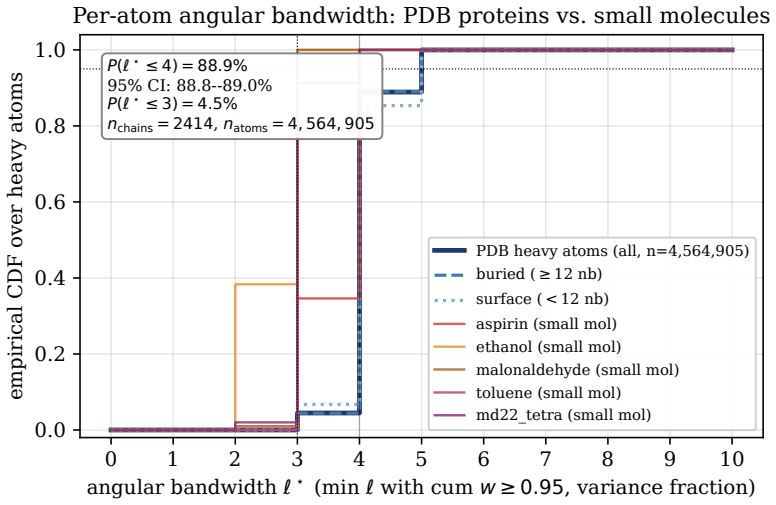
Compute the per- ℓ variance fraction w(ℓ) =∥c ℓ∥2/∥c∥2 (distinct from the main-text recovery fractionρ; this is an input-side basis-occupancy quantity). 40 The smallest ℓ⋆ withP ℓ≤ℓ⋆ w(ℓ)≥0.95 (theeffective protein bandwidth) is an architecture-free measurement of the one-hop input-density bandwidth. An ideal degree-bounded input readout would avoid the c...
discussion (0)
Sign in with ORCID, Apple, or X to comment. Anyone can read and Pith papers without signing in.